
Cosmos Transfer 2.5

Search documents
掘金CES 2026:AI全域渗透加速,应用端投资机会将至?
智通财经网· 2026-01-09 00:55
Group 1: CES 2026 Overview - CES 2026, known as the "Spring Festival Gala" of the tech industry, commenced on January 6 in Las Vegas, focusing on "defining the physical boundaries of AI" [1] - The event featured 207 Chinese companies across various cutting-edge fields, including AI, smart wearables, and smart home technologies, showcasing over 120 small and medium-sized tech firms [1] - The technologies presented by leading Chinese companies reflect the country's technological strengths and outline key directions for global industry evolution [1] Group 2: Robotics and AI Technologies - AI and robotics technologies were a major highlight at CES 2026, with global leaders showcasing various robots and core components [2] - NVIDIA's CEO announced that the robotics sector has entered its "ChatGPT moment," introducing world models to enhance robots' understanding of physical properties and spatial relationships [2] - Chinese companies, including Yushu Technology and Fourier, presented a wide range of innovative products, covering industrial applications, daily life, medical assistance, and emergency rescue [2][3] Group 3: Key Exhibitors and Innovations - Notable exhibitors included Ninebot, Ecovacs, and SUTENG, showcasing advanced robotic solutions such as AI path-planning lawn mowers and delivery robots capable of complex tasks [4][5] - Companies like Lingyi Zhi Zao and Zhaowei Electric displayed high-freedom dexterous hands and collaborative systems, indicating significant advancements in robotics [5] - The emergence of a cohesive display of robotics indicates a breakthrough in China's robotics industry, transitioning from fragmented to integrated solutions [5] Group 4: Automotive Innovations - The automotive sector at CES 2026 emphasized the transformation of vehicles into "smart partners" with emotional resonance and autonomous capabilities [6] - NVIDIA introduced the world's first open-source autonomous driving model, aiming to address challenges in extreme weather and construction detours [6] - Chinese automakers, including Great Wall Motors and Geely, showcased innovative models and technologies, highlighting the integration of smart features and collaboration with supply chain partners [6][7] Group 5: Wearable Devices and AI Glasses - Wearable devices, particularly AI glasses, gained significant attention at CES 2026, with over 60% of the showcased products coming from Chinese brands [10][11] - Innovations included independent communication-capable AR glasses and various health monitoring devices, indicating a shift towards mass production and consumer adoption [10][11] - The advancements in display and optical technologies for AI glasses reflect a robust ecosystem supporting the transition from concept to widespread use [12][13] Group 6: Industry Trends and Future Outlook - The CES 2026 event signaled a clear shift in AI's role from mere technology demonstration to deep integration within industry value chains [14] - The trend of AI becoming a physical entity is accelerating, with applications in robotics, smart driving, and wearable devices becoming observable realities [14] - Investors are encouraged to focus on the transition from technology validation to commercial scale, marking a critical window for capturing scene-based opportunities in 2026 [14]





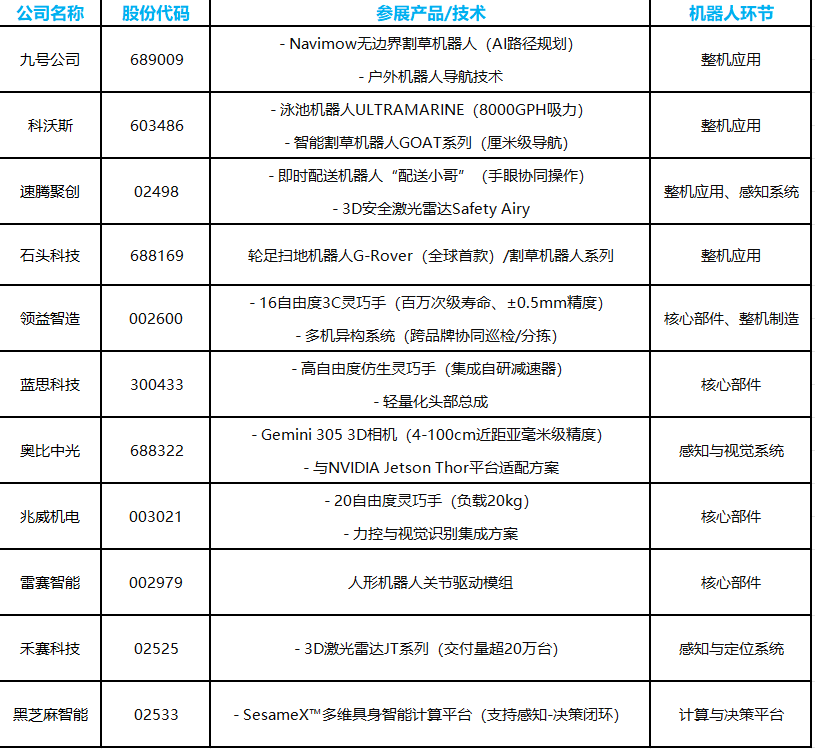
海内外多家厂商亮相CES 2026 人形机器人板块投资机遇凸显
Zhong Guo Zheng Quan Bao· 2026-01-06 21:53
Core Insights - The humanoid robot industry is approaching a pivotal moment, with significant advancements showcased at CES 2026, highlighting its central role in global technological competition and industrial transformation [1][2] - The humanoid robot concept index has increased by 12.92% since December 17, 2025, indicating a positive market trend [1] Industry Developments - CES 2026, held from January 6 to January 9 in Las Vegas, has seen a surge in the humanoid robot sector, with the concept index rising by 0.54% on January 6, 2026 [2] - Notable companies like NVIDIA are emphasizing the shift towards "general-specialized robots," which combine broad knowledge with specialized skills, marking a significant evolution in robot capabilities [2] Product Innovations - LG showcased the CLOiD household robot capable of performing various domestic tasks, while Boston Dynamics announced the mass production of its Atlas robot, set to be deployed in Hyundai's factories starting in 2026 [3] - Several leading domestic humanoid robot manufacturers, including Yushu Technology and Zhiyuan Robotics, presented their latest products at CES 2026, indicating a strong domestic presence in the market [3] Supply Chain and Collaboration - A-share listed companies are actively positioning themselves across different segments of the humanoid robot supply chain, with firms like Haozhi Electromechanical and Tongda Power focusing on key components such as precision reducers and servo systems [4] - Companies like Orbbec are providing comprehensive 3D vision sensor solutions, essential for the autonomous movement and interaction capabilities of humanoid robots [4] Market Potential - The Chinese embodied intelligent robot market is experiencing rapid growth, driven by policy, capital, and industry chain advancements, transitioning from "technological breakthroughs" to "value realization" [5] - Analysts suggest that the humanoid robot sector is poised for significant expansion, with potential applications in manufacturing and logistics, particularly in high-demand industries like automotive and 3C [6][7] Future Outlook - The year 2025 is anticipated to be a milestone for mass production of humanoid robots, with 2026 expected to showcase their practical capabilities in real-world applications [6] - The market for humanoid robots could reach a demand of 840,000 units by 2028 in key sectors, highlighting the substantial potential for automation in labor-intensive industries [7]

人形机器人板块投资机遇凸显
Zhong Guo Zheng Quan Bao· 2026-01-06 20:42
Core Insights - The humanoid robot industry is approaching a pivotal moment, with significant advancements showcased at CES 2026, highlighting its central role in global technological competition and industrial transformation [1] - The humanoid robot concept index has risen by 12.92% since December 17, 2025, indicating a positive market trend [1] - Analysts predict a broad market potential for embodied robots, with continuous technological breakthroughs and successful commercialization efforts [1] Industry Developments - CES 2026, held in Las Vegas from January 6 to 9, 2026, featured humanoid robots as a key focus, with significant participation from leading global companies [1] - NVIDIA's CEO announced that the robotics field has entered its "ChatGPT moment," emphasizing the shift towards "general-specialized" robots that combine broad knowledge with specialized skills [1] - NVIDIA introduced new models aimed at enhancing robots' understanding of physical properties and spatial relationships [1] Application Scenarios - LG showcased the CLOiD household robot capable of performing various domestic tasks, while Boston Dynamics announced the mass production of its Atlas humanoid robot, set to be deployed in Hyundai's factories starting in 2026 [2] - Numerous domestic humanoid robot manufacturers, including Yushu Technology and Zhiyuan Robotics, presented their latest products at CES 2026, indicating a strong domestic presence in the market [2] Industry Chain Collaboration - A-share listed companies are actively positioning themselves across different segments of the humanoid robot industry, leveraging their technological expertise for diversified development [3] - Key components such as precision reducers and servo systems are being tested and developed by companies like Haozhi Electromechanical and Tongda Power, indicating a focus on enhancing core robotic technologies [3] Market Analysis - The Chinese embodied intelligent robot market is experiencing rapid growth, driven by policy, capital, and industry chain support, transitioning from "technological breakthroughs" to "value realization" [4] - Analysts suggest that the humanoid robot sector will see significant investment and development, with Chinese companies leading in hardware and operational control, while AI technology remains a competitive focal point [4] Future Projections - 2025 is anticipated to be the year of mass production for humanoid robots, with 2026 expected to mark a significant advancement in their practical application [5] - The commercial progress of humanoid robots is accelerating, with potential applications in inspection and navigation expected to expand significantly [5] - The manufacturing and logistics sectors are projected to be the first to adopt humanoid robots at scale, with substantial demand anticipated in automotive and 3C manufacturing by 2028 [6]
英伟达想做“物理AI”的“安卓”
Hua Er Jie Jian Wen· 2026-01-06 04:01
Core Insights - Nvidia is establishing a default platform in the robotics sector, aiming to replicate Android's dominance in smartphone operating systems [1] - The company has released multiple open-source foundational models to enable robots to reason, plan, and adapt across various tasks and environments, all available on the Hugging Face platform [1] - Nvidia's new Jetson T4000 graphics card and the open-source command center OSMO are designed to support the entire robotics development workflow [1][4] - The trend of AI migrating from the cloud to the physical world is evident, driven by decreasing sensor costs, advancements in simulation technology, and improved generalization capabilities of AI models [1][6] Model Matrix Construction - The foundational models released by Nvidia form the core capabilities layer of physical AI [2] Data Generation and Evaluation - Cosmos Transfer 2.5 and Cosmos Predict 2.5 are responsible for data synthesis and robot strategy evaluation, allowing validation of robot behavior in simulated environments [3] - Cosmos Reason 2 is a reasoning-based visual language model that enables AI systems to observe, understand, and act in the physical world [3] - Isaac GR00T N1.6 is a visual language action model specifically developed for humanoid robots, utilizing Cosmos Reason for full-body control [3] - The Isaac Lab-Arena, launched at CES, is an open-source simulation framework hosted on GitHub, addressing industry pain points in robot capability validation [3] Hardware Accessibility - The Jetson T4000 graphics card, part of the Thor series, offers a cost-effective upgrade with 1.2 trillion floating-point AI operations and 64GB of memory, while maintaining power consumption between 40 to 70 watts [4] Strategic Partnerships - Nvidia has deepened its collaboration with Hugging Face, integrating Isaac and GR00T technologies into the LeRobot framework, connecting 2 million robot developers with 13 million AI builders [5] - The open-source humanoid robot Reachy 2 now supports Nvidia's Jetson Thor chips, allowing developers to test various AI models without being locked into proprietary systems [5] - Early signs indicate that Nvidia's strategy is effective, with robotics becoming the fastest-growing category on the Hugging Face platform and Nvidia's models leading in download numbers [5]
NVIDIA Accelerates Robotics Research and Development With New Open Models and Simulation Libraries
Globenewswire· 2025-09-29 15:00
Core Viewpoint - NVIDIA has launched the open-source Newton Physics Engine and the open NVIDIA Isaac GR00T N1.6 reasoning vision language action model, enhancing robotics development by providing an accelerated platform for simulation and real-world application [2][4][8] Group 1: Technology Advancements - The Newton Physics Engine is GPU-accelerated and co-developed with Google DeepMind and Disney Research, enabling complex robot simulations [4][5] - The Isaac GR00T N1.6 model integrates NVIDIA Cosmos Reason, allowing robots to interpret vague instructions and perform tasks using prior knowledge and common sense [7][8] - The new dexterous grasping workflow in Isaac Lab 2.3 trains robots in a virtual environment, gradually increasing task complexity [13][14] Group 2: Adoption and Impact - Over a quarter-million robotics developers globally require accurate physics for safe real-world execution of robot skills [3] - Leading research institutions and companies, including ETH Zurich and Boston Dynamics, are adopting NVIDIA's technologies for robotics research and development [5][10][19] - The Cosmos Reason model has been downloaded over 1 million times and is leading in the Physical Reasoning Leaderboard on Hugging Face [8][9] Group 3: Infrastructure and Evaluation - NVIDIA is developing AI infrastructure to support demanding robotics workloads, including the upcoming Cosmos Predict 2.5 and Cosmos Transfer 2.5 models [18] - The Isaac Lab - Arena framework, co-developed with Lightwheel, will allow for scalable experimentation and standardized testing of robot skills [17][19] - The open-source NVIDIA Physical AI Dataset has been downloaded over 4.8 million times, providing extensive data for post-training of Isaac GR00T N models [9]