DRAM与NAND芯片

Search documents
营收暴增近三倍、利润狂涨近八倍!美光狂赚950亿,AI引爆存储芯片狂潮
是说芯语· 2026-03-20 14:42
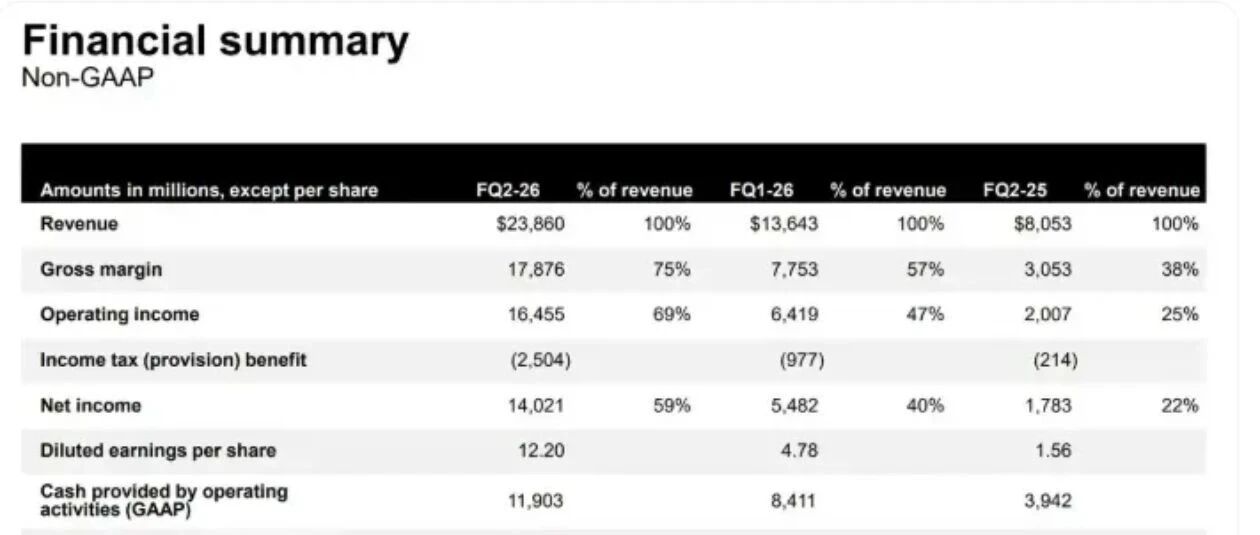
Core Viewpoint - The global storage chip market is experiencing unprecedented growth, with Micron Technology reporting a record-breaking second-quarter financial performance driven by massive memory demand from artificial intelligence (AI) applications [1][2]. Financial Performance - Micron's second-quarter revenue reached $23.86 billion, a nearly 300% increase from $8.05 billion in the same period last year, significantly exceeding market expectations of $20 billion [1][2]. - Net income surged from $1.58 billion to $14.02 billion year-over-year, representing an approximate 800% increase, with diluted earnings per share rising from $1.41 to $12.20 [1][2]. Business Segments - Micron's core segments saw substantial growth, particularly in cloud memory, which grew over 160% year-over-year to $7.75 billion, and mobile devices and personal computing, which doubled from $2.24 billion to $7.71 billion [3]. - The company forecasts revenue for the upcoming quarter to reach approximately $33.5 billion, more than double the $9.3 billion from the same quarter last year, indicating sustained high demand for storage chips [3]. Market Dynamics - The explosive growth in Micron's performance is primarily attributed to the rapid expansion of the AI industry, which has led to increased demand for DRAM and NAND chips, causing supply constraints and rising prices [2][3]. - Micron is benefiting from long-term supply contracts with semiconductor companies to ensure stable production capacity, which has improved its product mix and profitability, with gross margins increasing from 36.8% to 74.4% over the past year [4]. Strategic Positioning - Micron is actively pursuing opportunities in the high-bandwidth memory (HBM) market, having begun mass production of HBM4 products and planning to expand shipments of HBM4e products by 2027, aligning with NVIDIA's future GPU releases [4]. - The storage chip market is currently dominated by Micron, Samsung, and SK Hynix, with expectations of strong demand persisting for several years due to structural supply constraints [6]. Challenges Ahead - Micron plans to significantly increase capital expenditures from $20 billion to $25 billion for fiscal year 2026, raising concerns about short-term cash flow and profit margins not keeping pace with revenue growth [5]. - The company's performance is heavily reliant on NVIDIA's procurement decisions, which could pose risks if NVIDIA shifts its storage needs to competitors like Samsung or SK Hynix [5][7].


芯片巨头,奔赴印度
半导体行业观察· 2025-06-02 02:28
Core Viewpoint - India's semiconductor industry is rapidly emerging as a strategic hub for global chip giants amidst geopolitical tensions and a trend of de-globalization in the semiconductor sector [1][2]. Group 1: Major Developments in India's Semiconductor Industry - Renesas Electronics has launched two 3nm chip design centers in India, marking the country's first foray into advanced chip design, with plans for mass production by mid-2027 [2][3]. - Foxconn and HCL Group are jointly establishing a semiconductor packaging plant in Uttar Pradesh, with an investment of ₹37.06 billion (approximately $435 million), expected to start production in 2027 [4][5]. - Powerchip Semiconductor Manufacturing Corporation (PSMC) is collaborating with Tata Electronics to build India's first 12-inch wafer fab in Gujarat, with a total investment of $11 billion and a monthly capacity of 50,000 wafers, projected to begin production in 2026 [7][8]. Group 2: Government Support and Policy Framework - The Indian government is providing substantial financial incentives, including up to 50% subsidies for semiconductor projects, to attract international investment and foster local talent development [3][12]. - The revised semiconductor policy aims to enhance support for manufacturing and packaging sectors, which has led to increased interest from major players like Micron and Renesas [19][23]. Group 3: Challenges Facing the Semiconductor Sector - Despite the rapid developments, India's semiconductor industry faces significant challenges, including a lack of advanced manufacturing capabilities, reliance on imported materials, and insufficient local talent with experience in cutting-edge technologies [3][8][30]. - Infrastructure issues, such as unstable power supply and inadequate water resources, pose additional hurdles for semiconductor manufacturing in India [26][30]. - The local workforce's efficiency is lower compared to other countries, and there is a projected shortage of skilled labor in the semiconductor sector, which could hinder growth [30][28]. Group 4: Market Potential and Future Outlook - The Indian semiconductor market is expected to grow significantly, with projections indicating a market size of $110 billion by 2030, driven by demand in automotive electronics and 5G technology [22][28]. - The establishment of a complete semiconductor ecosystem, from design to manufacturing and packaging, is crucial for India to become a competitive player in the global semiconductor supply chain [30][32].