
E40H

Search documents
“eVTOL五小龙”齐聚 上海争夺低空经济“制空权”
Zhong Guo Jing Ying Bao· 2026-01-20 17:37
Core Viewpoint - Shanghai is actively developing the low-altitude economy and commercial aerospace sectors, aiming to establish itself as a global hub for electric vertical takeoff and landing (eVTOL) aircraft by implementing supportive policies and infrastructure development [1][3][2]. Group 1: Policy Initiatives - Shanghai has introduced multiple policies to support the low-altitude economy, including a target to reach a core industry scale of approximately 80 billion yuan by 2028 [3]. - The city aims to build a complete industrial chain for new low-altitude aircraft and establish a national advanced manufacturing cluster for the low-altitude economy [3]. - Financial incentives are provided, with up to 10 million yuan in support for eVTOL manufacturing projects, encouraging investment in low-altitude and commercial aerospace sectors [3][6]. Group 2: Industry Development - As of December 2025, Shanghai is home to at least 251 startups in the low-altitude economy, with 66 companies focused on eVTOL and drones, representing over 50% of the leading eVTOL firms in China [5]. - Companies like Volant, Peak Aviation, and Shide Technology are recognized as key players in the eVTOL sector, achieving significant milestones in flight testing and certification [6][9]. - The city has also attracted several commercial aerospace companies, contributing to a robust ecosystem for low-altitude economic activities [6]. Group 3: Infrastructure and Ecosystem - Infrastructure development is identified as a critical challenge, with calls for improved facilities for flight testing and operational deployment of eVTOLs [7][8]. - Experts suggest enhancing the layout of takeoff and landing points, particularly in transportation hubs and business districts, to facilitate low-altitude operations [7]. - The establishment of a comprehensive regulatory framework and streamlined approval processes is essential for the successful implementation of low-altitude economic initiatives [7][8]. Group 4: Talent and Experience - Shanghai's aviation industry benefits from a wealth of talent and experience, with a strong background in civil aviation and aircraft certification processes [4][5]. - The city has produced a skilled workforce through successful projects like the domestically developed C919 aircraft, which supports the growth of the low-altitude economy [5]. - The presence of experienced regulatory bodies enhances the industry's ability to develop and implement eVTOL technologies effectively [4].
低空经济寻路:商业化加速与资本分化并行
2 1 Shi Ji Jing Ji Bao Dao· 2026-01-05 12:40
Group 1: Core Insights - The E40H unmanned aerial vehicle system developed by Yufeng Future's subsidiary, Fukun, has successfully obtained a Type Certificate (TC) from the Civil Aviation Administration of China (CAAC) [1][2] - E40H is the first medium composite wing and hybrid power unmanned aerial product to receive TC certification in China, marking a significant milestone in the country's low-altitude economy [1][2] - The certification indicates that E40H meets the stringent airworthiness standards set by the CAAC, enabling it for large-scale commercial operations [1][2] Group 2: Industry Developments - The low-altitude economy sector is accelerating its airworthiness certification process, with several models expected to complete TC certification by 2026, including Yufeng Future's M1B and others [1][3] - The low-altitude economy market in China is projected to reach 1.5 trillion yuan by 2025 and is expected to exceed 2 trillion yuan by 2030, indicating strong growth potential [3][4] Group 3: Investment Trends - In 2025, the low-altitude economy is experiencing a "capital explosion year," with 244 financing events totaling 220.89 billion yuan reported by November 24, 2025 [4][5] - Major investments are concentrated in leading companies within the industry, with significant single financing amounts reported for companies like Xiaopeng Huitian and Yufeng Future [5] Group 4: Market Dynamics - Despite the robust activity in the primary market, the secondary market for low-altitude economy stocks has cooled, with leading companies experiencing stock price declines of over 20% [5][7] - Industry experts highlight ongoing challenges such as insufficient infrastructure, complex airspace management, and the need for improved safety guarantees as critical issues facing the low-altitude economy [7]


全球首个混动eVTOL获发TC 国内近20款eVTOL“蓄势待飞”
Zhong Guo Jing Ying Bao· 2026-01-04 11:19
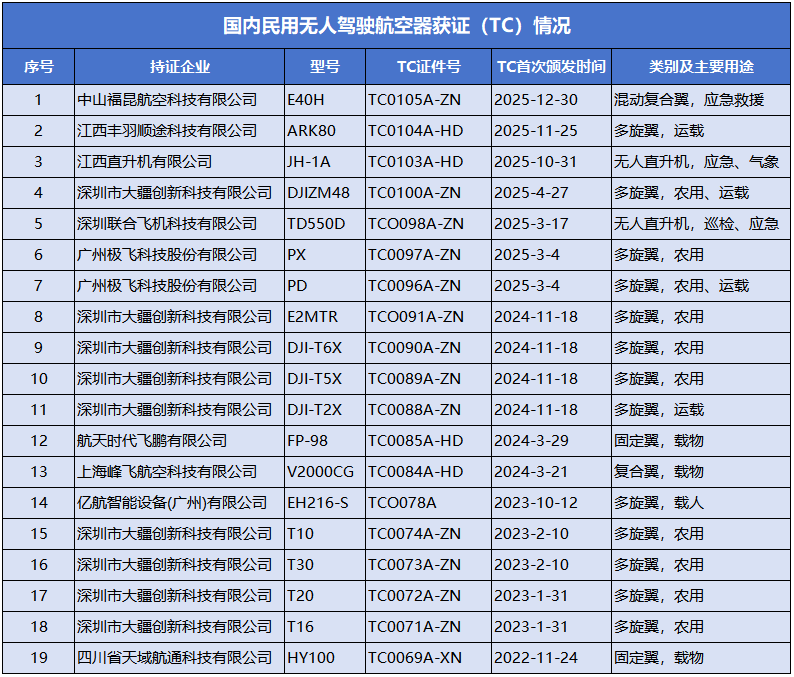
Core Viewpoint - The domestic civil unmanned aerial vehicles (UAVs) have received type certification (TC), with the E40H model from Fukun Aviation being the first to obtain TC under the new Civil Aviation Law, marking a significant milestone in the industry [2][4]. Group 1: Certification and Regulatory Framework - The E40H model is the first medium eVTOL to meet airworthiness requirements globally and is the first unmanned aerial product to receive TC after the new Civil Aviation Law was enacted [2]. - As of now, a total of 19 models of civil unmanned aerial vehicles have been issued TC in China, with DJI holding 9 of these certifications, covering various applications such as emergency response, agriculture, and transportation [4]. Group 2: Technical Achievements and Testing - The E40H underwent rigorous testing, completing 41 compliance verification tests, 42 engineering reports, and over 2000 hours of ground and laboratory tests, along with 167 flights totaling over 480 flight hours and 43,000 kilometers [2]. - The E40H has been actively involved in real-world emergency rescue operations, including flood rescue missions and typhoon response, demonstrating its operational capabilities [3]. Group 3: Future Developments - The company is progressing with the airworthiness certification for its 2-ton eVTOL model M1B, with the TC application accepted in January 2024 and expected to be completed by 2026 for commercial use in emergency firefighting and logistics [4]. - Plans are in place to submit a TC application for a manned version of the M1 model to gradually advance the commercialization of manned operations [4].
混动+复合翼,御风未来E40H获首张中型复合翼无人机型号合格证
Guan Cha Zhe Wang· 2026-01-04 09:00
Core Viewpoint - The E40H unmanned aerial vehicle (UAV) developed by Yufeng Future has successfully obtained the Type Certificate (TC) from the Civil Aviation Administration of China, marking it as the first hybrid and composite wing UAV to meet airworthiness requirements globally, and the first to receive a TC under the new Civil Aviation Law in China [1][4]. Technical Specifications - The E40H has a fuselage length of 3.78 meters, a height of 0.99 meters, a maximum flight speed of 115 km/h, a maximum altitude of 1000 meters, a maximum takeoff weight of 150 kilograms, an empty weight of 100 kilograms, a maximum payload of 50 kilograms, a maximum flight time of 10 hours, and a maximum range of 800 kilometers [2][4]. Development Timeline - The application for the TC was submitted on July 29, 2024, and the approval was granted on December 30, 2025, taking a total of 1 year and 5 months [4]. Industry Impact - The E40H's TC acquisition is seen as a significant milestone in the industry, with expectations for a series of similar eVTOLs to follow in obtaining airworthiness certification [4]. The primary application scenarios for such products are currently focused on emergency cargo transport [4]. Operational Limitations - The operational scenarios for the E40H are limited to cargo transport and surveillance tasks, with restrictions on flying over densely populated areas and in mixed airspace, and it is prohibited from carrying passengers [4]. Practical Applications - The E40H has participated in various real-world rescue operations, including flood relief and typhoon rescue missions, and has successfully completed logistics flights over a distance of 150 kilometers [6]. Future Developments - Yufeng Future is advancing its large eVTOL model M1B, which has already submitted its TC application and is expected to complete certification and commercial launch within the year, focusing on emergency firefighting and logistics [6][9]. The company plans to submit a TC application for a manned version of the M1 at an appropriate time [8]. Financing and Growth Strategy - Yufeng Future has completed nine rounds of financing and is currently in the B round, with a recent funding round aimed at accelerating the testing and certification of the M1 model [9]. The company follows a development path outlined by the National Development and Reform Commission, prioritizing cargo operations before moving to passenger services [9]. Certification Landscape - As of December 30, 2025, a total of 12 aircraft have received TC certificates this year, with Yufeng Future's E40H being the first UAV certified under the revised Civil Aviation Law [10][11].
