GLB

Search documents
奔驰卖不动了
投资界· 2026-03-03 07:35
Core Viewpoint - Mercedes-Benz is experiencing unprecedented challenges, with significant declines in revenue, profit, and sales, particularly in the Chinese market, which is crucial for its future growth and transformation [4][7][12]. Financial Performance - In the fiscal year 2025, Mercedes-Benz reported revenue of €132.14 billion, a year-on-year decline of 9.2%, and a net profit of €5.33 billion, down 48.8% [4]. - Adjusted EBIT was €8 billion, reflecting a decrease of approximately 40% [4]. - Free cash flow from industrial operations was €5.4 billion, significantly lower than the previous year's nearly €9.2 billion [4]. Sales and Market Challenges - In 2025, Mercedes-Benz sold 575,000 vehicles in China, a decline of about 19%, marking the lowest sales since 2016 [7]. - Global sales fell by 10% to 2.16 million vehicles, the lowest level since 2014 [11]. - The passenger car segment, a key revenue driver, saw a revenue drop of 10.5% to €96.41 billion, with EBIT down 57.9% [11]. Cost Pressures and Strategic Adjustments - The company faced approximately €1 billion in tariff expenses and incurred €1.6 billion in restructuring costs due to a voluntary departure program [8]. - R&D expenditures remained high at €9.68 billion, with a slight year-on-year decrease of 0.4%, while capital investments surged by 35.7% to €5.48 billion [9]. - The management acknowledged the need for cost reduction and efficiency improvements, with plans to launch over 40 new models in the next three years [7][9]. Electric Vehicle Strategy - Mercedes-Benz's electric vehicle sales in 2025 were only 168,800 units, down 9%, significantly trailing competitors like BMW and Audi [10]. - The CEO revised the goal for full electrification from 2030 to a dual-track approach of both fuel and electric vehicles due to underperformance in the electric segment [10]. Focus on the Chinese Market - The Chinese market is critical for Mercedes-Benz, with plans to introduce 7 models specifically tailored for this market between 2025 and 2027 [16]. - The company aims to enhance local partnerships and supply chain localization to reduce costs by 10% for materials and 20% for variable and fixed production costs by 2027 [17]. - Recent price adjustments on key models indicate a response to competitive pressures in the Chinese market [13]. Management Changes - The appointment of Oliver Thöne as the head of Greater China operations reflects a strategic shift towards local market focus and value chain optimization [16][18]. - The new management is expected to drive the product offensive and address the challenges posed by local competitors and changing consumer preferences [18].


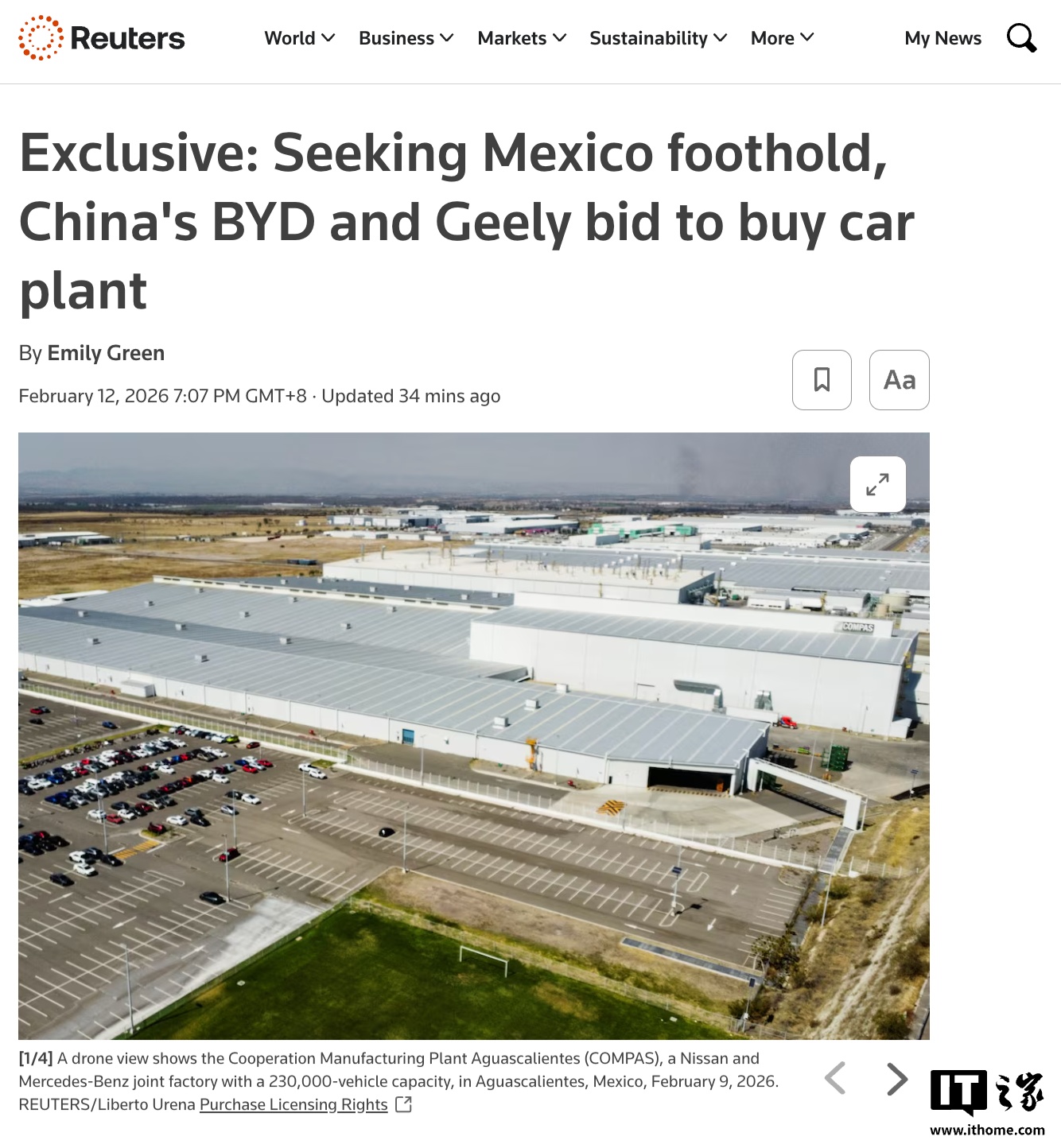
日产-奔驰墨西哥工厂获多家中国车企青睐,消息称比亚迪、吉利等有意竞标
Xin Lang Cai Jing· 2026-02-12 12:17
Core Viewpoint - Chinese automakers, including BYD and Geely, are in the final competition to acquire the Nissan-Benz factory in Aguascalientes, Mexico, as they seek to establish a manufacturing foothold in the region amid increasing factory closures and layoffs due to U.S. tariffs [1][7]. Group 1: Market Dynamics - Mexico has become a significant export market for Chinese automakers, with market share rising from zero in 2020 to approximately 10% last year, according to AutoForecast Solutions [4][10]. - The annual vehicle sales in Mexico are around 1.5 million units [4][10]. Group 2: Industry Challenges - The Mexican automotive industry is heavily reliant on the U.S. market, with projections indicating that out of 4 million vehicles produced in 2024, 2.8 million will be exported to the U.S. [6][11]. - The imposition of a 25% tariff by the U.S. on Mexican-made vehicles since March of last year has put continuous pressure on the industry [6][11]. Group 3: Factory Closure and Acquisition - The Nissan-Benz factory, which began operations in 2017, is set to close due to multiple factors, with U.S. tariffs being a significant contributor [6][11]. - The factory has an annual production capacity of 230,000 vehicles and is equipped with skilled labor and robust transportation infrastructure [7][11]. - Nine companies, including Chinese firms Chery and Great Wall, as well as Vietnam's VinFast, have expressed interest in acquiring the factory, which primarily produces hybrid and electric vehicles for the Mexican and Latin American markets [10][11].

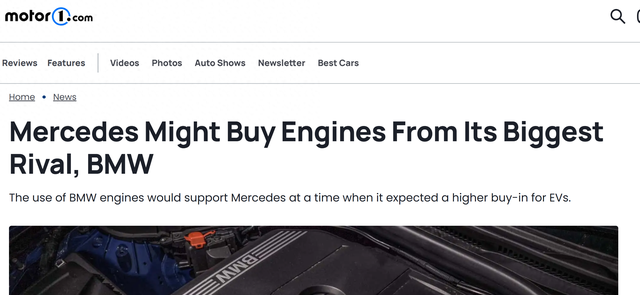
大和解?奔驰拟采用宝马四缸发动机
Huan Qiu Wang· 2025-08-22 05:57
Group 1 - The core point of the article is that Mercedes-Benz and BMW are in high-level negotiations to collaborate on engine technology, specifically for BMW to supply its four-cylinder gasoline engines for multiple Mercedes models, marking a historic cross-brand technology sharing initiative [1][3]. - The collaboration aims to reduce R&D costs and adapt to industry changes, with the potential to enhance the market sustainability of fuel vehicles and accelerate the deployment of plug-in hybrid models for Mercedes [1][3]. - The specific models that may utilize BMW's engines include CLA, GLA, GLB, C-Class, E-Class, GLC, and a planned small SUV, which indicates a broad application of the partnership [3]. Group 2 - The BMW B48 series 2.0-liter turbocharged four-cylinder engine is expected to be produced in Austria and offers layout flexibility for both compact and mid-size vehicles, which could benefit Mercedes' vehicle lineup [3][4]. - The partnership may extend beyond engine sharing to include technology collaboration in areas such as transmissions, although no official confirmation of the details has been made yet [4]. - The outcome of the negotiations is anticipated to be announced by the end of the year, indicating a timeline for potential developments in this collaboration [4].