
C级

Search documents
奔驰卖不动了
投资界· 2026-03-03 07:35
Core Viewpoint - Mercedes-Benz is experiencing unprecedented challenges, with significant declines in revenue, profit, and sales, particularly in the Chinese market, which is crucial for its future growth and transformation [4][7][12]. Financial Performance - In the fiscal year 2025, Mercedes-Benz reported revenue of €132.14 billion, a year-on-year decline of 9.2%, and a net profit of €5.33 billion, down 48.8% [4]. - Adjusted EBIT was €8 billion, reflecting a decrease of approximately 40% [4]. - Free cash flow from industrial operations was €5.4 billion, significantly lower than the previous year's nearly €9.2 billion [4]. Sales and Market Challenges - In 2025, Mercedes-Benz sold 575,000 vehicles in China, a decline of about 19%, marking the lowest sales since 2016 [7]. - Global sales fell by 10% to 2.16 million vehicles, the lowest level since 2014 [11]. - The passenger car segment, a key revenue driver, saw a revenue drop of 10.5% to €96.41 billion, with EBIT down 57.9% [11]. Cost Pressures and Strategic Adjustments - The company faced approximately €1 billion in tariff expenses and incurred €1.6 billion in restructuring costs due to a voluntary departure program [8]. - R&D expenditures remained high at €9.68 billion, with a slight year-on-year decrease of 0.4%, while capital investments surged by 35.7% to €5.48 billion [9]. - The management acknowledged the need for cost reduction and efficiency improvements, with plans to launch over 40 new models in the next three years [7][9]. Electric Vehicle Strategy - Mercedes-Benz's electric vehicle sales in 2025 were only 168,800 units, down 9%, significantly trailing competitors like BMW and Audi [10]. - The CEO revised the goal for full electrification from 2030 to a dual-track approach of both fuel and electric vehicles due to underperformance in the electric segment [10]. Focus on the Chinese Market - The Chinese market is critical for Mercedes-Benz, with plans to introduce 7 models specifically tailored for this market between 2025 and 2027 [16]. - The company aims to enhance local partnerships and supply chain localization to reduce costs by 10% for materials and 20% for variable and fixed production costs by 2027 [17]. - Recent price adjustments on key models indicate a response to competitive pressures in the Chinese market [13]. Management Changes - The appointment of Oliver Thöne as the head of Greater China operations reflects a strategic shift towards local market focus and value chain optimization [16][18]. - The new management is expected to drive the product offensive and address the challenges posed by local competitors and changing consumer preferences [18].


奔驰“天价”裁员,中国市场失守
Hua Er Jie Jian Wen· 2025-10-24 03:47
Core Insights - Mercedes-Benz has initiated a significant voluntary layoff plan, aiming to encourage approximately 30,000 employees to leave the company with generous severance packages, reflecting a strategic shift amid declining sales and market challenges [2][5] - The company's global sales have dropped, with a 12% year-on-year decline in Q3 and a 27% drop in sales in China, indicating a critical need for transformation [2][3] - The automotive industry is undergoing a structural shift, with traditional manufacturing roles declining while demand for software and battery expertise is increasing, necessitating a realignment of workforce skills [6][7] Group 1: Layoff and Compensation - Mercedes-Benz's voluntary layoff plan offers substantial severance packages, with senior management receiving over €500,000 (approximately ¥4.13 million) and factory workers receiving compensation equivalent to two years' salary [2] - Approximately 4,000 employees have already accepted the severance offer, highlighting the urgency of the company's transformation efforts [2] Group 2: Sales Performance - In Q3, Mercedes-Benz's global sales totaled 525,300 units, a 12% decrease year-on-year, with total sales for the first three quarters at 1.602 million units, down 9% [2] - The Chinese market, a crucial segment for Mercedes, saw a staggering 27% decline in sales in Q3, worsening from a 19% drop in Q2 [2] Group 3: Industry Context - Other German automakers, such as BMW and Volkswagen, are also facing significant challenges, with BMW's revenue down 8% and Volkswagen's profit down over 38% year-on-year [3] - The automotive industry is experiencing a "double squeeze" on labor structure, with a 5%-8% annual decline in internal combustion engine-related jobs and a growing demand for software engineers and battery experts [6] Group 4: Strategic Shift - Mercedes-Benz is attempting to pivot towards electric and smart vehicle production, with new model launches and significant investments in R&D, particularly in China [3][5] - The company aims to save €5 billion by 2027 through workforce reductions and cost-cutting measures, reallocating resources towards electric and intelligent vehicle development [5][7] Group 5: Future Outlook - The transition in the automotive industry is marked by a shift in value chain dynamics, with software development costs rising from 10% to 40% of total costs, necessitating a reconfiguration of talent [7] - The ongoing transformation may indicate a strategic contraction phase for the entire European automotive industry as major players like Volkswagen and BMW adopt similar restructuring plans [7][8]
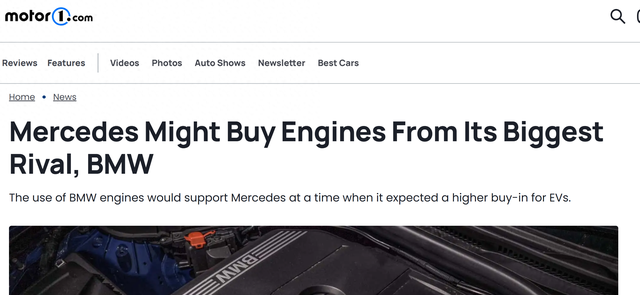
大和解?奔驰拟采用宝马四缸发动机
Huan Qiu Wang· 2025-08-22 05:57
Group 1 - The core point of the article is that Mercedes-Benz and BMW are in high-level negotiations to collaborate on engine technology, specifically for BMW to supply its four-cylinder gasoline engines for multiple Mercedes models, marking a historic cross-brand technology sharing initiative [1][3]. - The collaboration aims to reduce R&D costs and adapt to industry changes, with the potential to enhance the market sustainability of fuel vehicles and accelerate the deployment of plug-in hybrid models for Mercedes [1][3]. - The specific models that may utilize BMW's engines include CLA, GLA, GLB, C-Class, E-Class, GLC, and a planned small SUV, which indicates a broad application of the partnership [3]. Group 2 - The BMW B48 series 2.0-liter turbocharged four-cylinder engine is expected to be produced in Austria and offers layout flexibility for both compact and mid-size vehicles, which could benefit Mercedes' vehicle lineup [3][4]. - The partnership may extend beyond engine sharing to include technology collaboration in areas such as transmissions, although no official confirmation of the details has been made yet [4]. - The outcome of the negotiations is anticipated to be announced by the end of the year, indicating a timeline for potential developments in this collaboration [4].

老豪华如何进化为新豪华
Zhong Guo Qi Che Bao Wang· 2025-08-12 06:33
Core Insights - Traditional luxury brands like BBA (Benz, BMW, Audi) are facing strong competition from new luxury brands represented by companies like Wenjie and Li Auto in the Chinese market [2][3] - Significant price reductions have been observed for multiple Benz models, with discounts reaching up to 50%, leading to the closure of several dealerships in cities like Tangshan, Dongying, and Luoyang [2] - Mercedes-Benz's net profit after tax dropped by 55.8% year-on-year in the first half of the year, with total sales in China declining by 14% to 293,200 units [2] - Audi and BMW also reported declines in sales, with Audi's sales down 10.2% and BMW's net profit decreasing by over 29% [2] Market Dynamics - The definition of luxury is evolving as the automotive industry accelerates towards electrification and intelligence, with younger consumers prioritizing technology and practicality over brand prestige [2][3] - Mercedes-Benz is adjusting its electrification strategy to allow for a coexistence of fuel and electric vehicles, catering to different market conditions, particularly in China [3][10] - The acceptance of intelligent technology varies globally, with Chinese consumers showing the highest willingness to adopt smart features, while North American and European consumers express concerns about privacy and data security [3][9] Technological Focus - Mercedes-Benz identifies five key future technology anchors: electronic and electrical architecture, powertrains, autonomous driving, smart cockpits, and data security [8][9] - The company emphasizes the importance of self-research in electronic architecture and powertrains to maintain competitive advantage, while opting for collaboration in areas like data security and chip development [10][12] - The strategy includes a focus on user-centered technology that enhances safety, comfort, and convenience, avoiding mere technological accumulation [6][7] Localization and Global Strategy - The unique dynamics of the Chinese market are seen as a testing ground for innovation, with Mercedes-Benz aiming to adapt its product development processes to align with local market demands [13][14] - The company plans to leverage its experiences in China to enhance its global operations, potentially developing next-generation platforms locally [13] - The shift from traditional luxury to new luxury is characterized by a blend of brand heritage with modern consumer needs, with China acting as a catalyst for this transformation [14]

新能源汽车行业周刊:行业发展日新月异,充电基础设施建设加快
Chan Ye Xin Xi Wang· 2025-07-17 03:50
Key Companies - BYD has committed to fully cover safety and losses in intelligent parking scenarios, becoming the first globally to achieve L4-level intelligent parking, with over 1 million vehicles equipped with the "Tian Shen Zhi Yan" system [51] - NIO has completed its plan for 1,000 highway battery swap stations, connecting 550 cities across China, with a total investment exceeding 18 billion yuan [53] - Zeekr has launched its luxury hybrid architecture, "Haohan-S," featuring a 900V high-voltage system and a 70-degree 6C hybrid battery, with a pure electric range of 380 kilometers [54] - Volkswagen Group reported global deliveries of 2.272 million vehicles in Q2 2025, a year-on-year increase of 1.2%, with a notable decline in North America [55] - FAW-Volkswagen has signed a strategic cooperation agreement to introduce four new energy models based on a new platform in Changchun, with plans to launch over 20 new models by 2030 [56][58][61] Policy Developments - The U.S. government is expediting the approval process for autonomous vehicles, which may benefit Tesla's plans for deploying fully autonomous taxis [5][6] - The UK government is set to introduce new incentives to lower the cost of purchasing electric vehicles, with a potential subsidy of up to 700 million pounds [10][11] - The Canadian government remains committed to its zero-emission vehicle sales targets despite industry warnings about potential supply shortages [13][15] Market Data - In June, the retail sales of passenger vehicles in China reached 2.11 million units, a year-on-year increase of 18.6%, with new energy vehicle sales growing by 29.7% [48] - The total number of electric vehicles delivered by VinFast in Vietnam for the first half of 2025 was 67,569 units [17] Industry Trends - The average price of electric vehicles in the UK is more than double that of gasoline vehicles, prompting government efforts to boost sales [11] - The luxury car market in India is growing, with Mercedes-Benz achieving a record sales figure of 4,238 units in Q1 2025, driven by strong demand for high-end models [23][24]



