GMLRS制导火箭弹

Search documents
晨枫:年末的正义,想来就来!
Guan Cha Zhe Wang· 2025-12-31 01:20
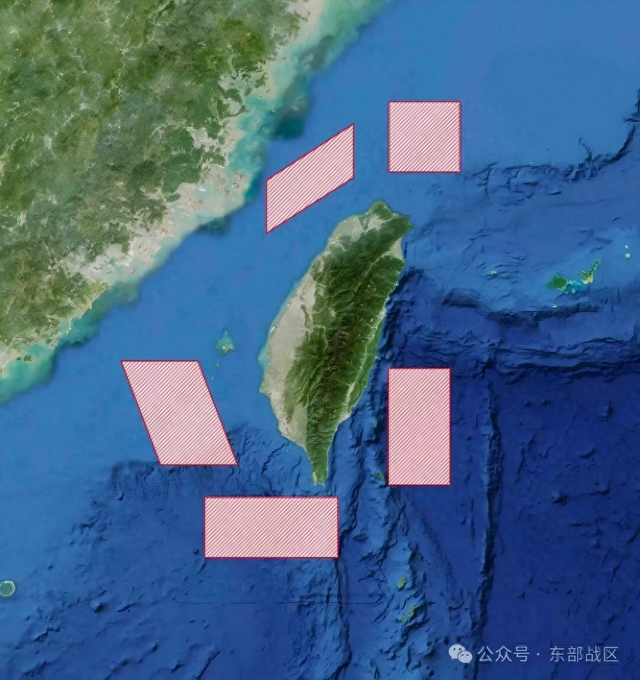
Core Viewpoint - The article discusses the large-scale military exercise "Justice Mission-2025" conducted by the Eastern Theater Command of the People's Liberation Army (PLA), emphasizing its significance as a warning against "Taiwan independence" and external interference, while showcasing the PLA's readiness for potential military action in the Taiwan Strait. Group 1: Exercise Characteristics - "Justice Mission-2025" exhibits three main characteristics: full-time readiness, full-time capability to engage, and immediate initiation of combat operations [3] - The exercise demonstrates a heightened level of cold-start offensive capability, allowing for rapid and surprise full-scale attacks without prior warning [4] Group 2: Military Actions and Responses - The PLA's recent military actions in the Taiwan Strait have been characterized by a decrease in intensity since July, but the sudden launch of "Justice Mission-2025" indicates a readiness to act at any moment [6] - The exercise includes live-fire drills in the waters surrounding Taiwan, enhancing the PLA's ability to transition from training to combat [7] Group 3: Strategic Implications - The exercise highlights the importance of the "blockade" option in military strategy, as the balance of power increasingly favors the mainland [11] - Taiwan's limited strategic resources and reliance on imports for energy make it vulnerable to sustained military action, particularly if supply lines are disrupted [12] Group 4: External Factors and International Relations - The exercise serves as a direct response to recent provocations from external actors, including the U.S. arms sales to Taiwan, which are viewed as serious challenges to China's sovereignty [6][22] - The PLA's actions are framed as a demonstration of strength and a message to both Taiwan and external powers, indicating that the PLA is prepared to take decisive action if necessary [22]

央视披露:美对台超110亿美元军售包括“海马斯”火箭炮、自杀无人机、反坦克导弹、自行榴弹炮;专家:美国“出兵协防”可能性越来越小
Mei Ri Jing Ji Xin Wen· 2025-12-25 00:51
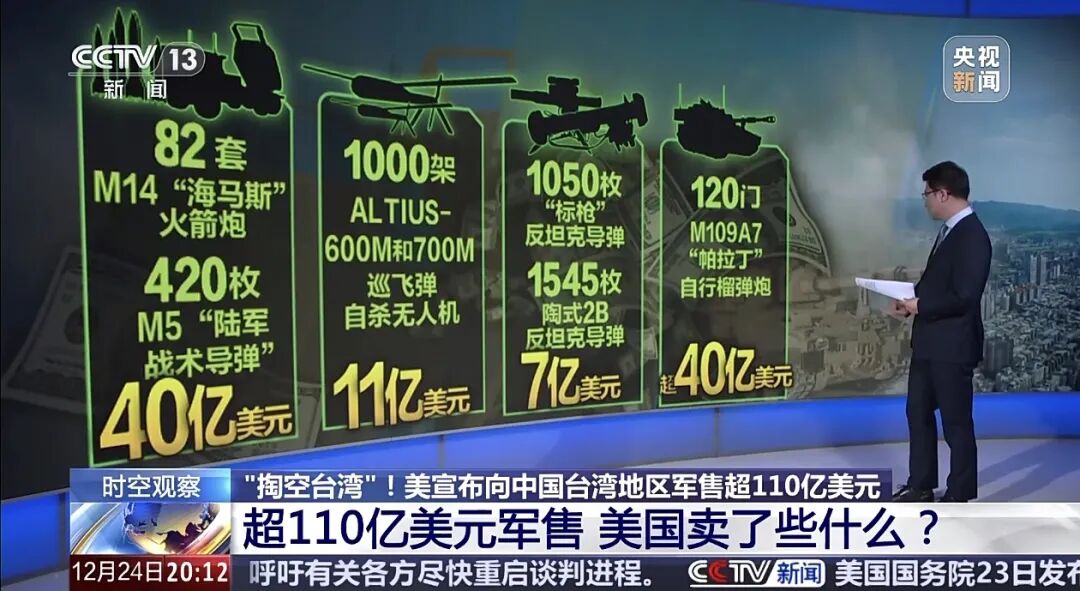
Group 1 - The core point of the article is the announcement of a record-breaking arms sale from the United States to Taiwan, totaling over $11 billion, which is the largest in history for such transactions [1][10]. - The arms sale includes four main components: 82 sets of M142 "HIMARS" rocket systems and 420 M57 "Army Tactical Missiles" valued at $4 billion, 1,000 ALTIUS-600M and 700M suicide drones worth $1.1 billion, 1,050 "Javelin" anti-tank missiles and 1,545 TOW 2B anti-tank missiles totaling $700 million, and 120 M109A7 "Paladin" self-propelled howitzers valued at over $4 billion [3][5][4]. Group 2 - The military analyst Shao Yongling noted that the choice of these specific weapons aims to enhance Taiwan's defense capabilities, particularly against potential land invasions [3][7]. - The article highlights concerns within Taiwan regarding the financial implications of such a large military expenditure, with fears that it may deplete Taiwan's economic resources and impact social welfare and education budgets [10][12]. - There is a prevailing sentiment among Taiwanese scholars that the arms sale may ultimately be detrimental to Taiwan, as it positions the island as a pawn in U.S. strategic interests without direct military support from the U.S. [12][14]. Group 3 - The article discusses the broader implications of U.S. actions on Taiwan's economy, including increased military spending that could lead to a significant portion of Taiwan's budget being allocated to defense, thereby affecting other sectors [16][18]. - The ongoing U.S. strategy is perceived as a method to extract economic value from Taiwan, particularly in the semiconductor industry, which is crucial for Taiwan's competitive edge [13][14]. - The potential for increased economic disparity in Taiwan, referred to as "Taiwan disease," is highlighted, suggesting that the arms sale and related economic policies could exacerbate existing inequalities [18].
超111亿美元,对台军售美国究竟意欲何为?军事专家犀利点评
Yang Shi Wang· 2025-12-24 07:06
Group 1 - The core viewpoint of the article emphasizes that no amount of advanced weapon sales to Taiwan can prevent China's eventual reunification, and China will take necessary measures to safeguard its sovereignty and territorial integrity [1] - The recent arms sale from the U.S. to Taiwan amounts to over $11.1 billion, marking the largest arms sale in history to Taiwan, with a focus on anti-landing combat equipment [3] - The arms package includes 82 sets of M142 "HIMARS" rocket launchers and 420 M57 "Army Tactical Missiles," valued at $4 billion, which will increase Taiwan's total HIMARS to 111 sets [5] Group 2 - The arms sale also features 1,000 ALTIUS-600M and 700M suicide drones, valued at $1.1 billion, capable of targeting armored land vehicles and surface ships [5] - Additionally, the package includes 1,050 "Javelin" anti-tank missiles and 1,545 TOW-2B anti-tank missiles, totaling $700 million, aimed at post-landing heavy armored targets [5] - The sale further comprises 120 M109A7 "Paladin" self-propelled howitzers, valued at over $4 billion, which will complement the HIMARS systems [5] Group 3 - The U.S. strategy appears to focus on enhancing Taiwan's anti-landing capabilities while reducing the likelihood of direct military intervention, indicating a shift towards accelerating Taiwan's armament [7] - This approach aims to maximize the costs for China in pursuing reunification, while also suggesting that the U.S. is preparing for a potential abandonment of Taiwan by profiting from arms sales [7]