GNoME

Search documents
当人工智能走向实体空间
Xin Lang Cai Jing· 2026-02-01 20:19
Core Insights - Modern artificial intelligence (AI) is a product of advanced computing and is transforming various industries, evolving from early symbolic approaches to deep learning and large-scale model training [1][4]. Group 1: Historical Development of AI - The pursuit of intelligence has deep historical roots, beginning with the creation of symbolic systems for communication, which allowed for the storage and transmission of complex information [2]. - The evolution of computing technology, starting from Turing's model to the first electronic computer ENIAC, laid the foundation for AI development [3]. - The emergence of industrial robots and expert systems in the 1960s to 1980s marked the transition of AI from information processing to practical applications [3]. Group 2: Current Trends in AI - The rise of large models, such as OpenAI's GPT-3 with 175 billion parameters, demonstrates the potential of scale in AI capabilities [4]. - AI is transitioning from narrow AI, represented by expert systems and deep learning, to general AI, with advancements in generative AI and autonomous machine evolution [4]. Group 3: AI in Manufacturing - AI is becoming integral to the manufacturing sector, with a significant increase in the application of large models and intelligent agents in industrial enterprises, projected to rise from 9.6% in 2024 to 47.5% in 2025 [7]. - The establishment of smart factories in China, with over 421 national-level demonstration factories, showcases the successful integration of AI and digital twin technologies [7]. Group 4: Challenges and Solutions - The development of practical AI faces challenges such as high technical barriers and unclear implementation paths [10]. - A proposed framework for advancing practical AI includes a "perception-cognition-decision-execution" system, emphasizing the need for accurate representation of physical entities and collaborative decision-making between large and small models [11]. Group 5: Policy and Standardization - The Chinese government is promoting AI integration across all industrial processes, emphasizing a comprehensive upgrade of traditional industries through AI [8]. - Establishing a unified standard system for practical AI is crucial for supporting large-scale development and ensuring effective integration across various sectors [12].
AI产业速递:谷歌正在进行哪些布局?
Changjiang Securities· 2026-01-14 15:16
Investment Rating - The investment rating for the industry is "Positive" and maintained [7] Core Insights - Google has established a comprehensive AI ecosystem, including TPU computing infrastructure, the Gemini multimodal model family, AI Studio, and the Vertex AI developer platform, which continuously empowers its AI layout and strengthens its data moat [2][10] - The acceleration of AI applications is moving towards realization, with a positive outlook on the performance of large model companies like Zhiyu and Minimax post-IPO. Key marginal factors include (1) model capability enhancement and release event catalysts; (2) advancement of business models (C-end traffic entry logic & B-end labor replacement logic). A paradigm shift in models by 2026 is expected to bring excess opportunities, with a long-term positive view on AI industry upgrade opportunities [2][10] Summary by Relevant Sections AI Applications - Google is actively expanding its AI strategy across various segments, focusing on providing infrastructure and open-source models in healthcare. Notable developments include the Vertex AI Search for Healthcare tool optimized for medical scenarios and partnerships like the one with Color Health for breast cancer screening assistance [10] AI for Science - Google has a significant advantage in AI for Science (AI4S) due to its extensive experience and capabilities in the field. The company has developed world-class scientific intelligence models and tools, applying AI across multiple scientific domains such as biology, meteorology, and physics [10] Edge Deployment - Google has a well-established edge deployment strategy, focusing on embodied intelligence, AI glasses, AI phones, Google TV, and Robotaxi services. The latest data shows significant growth in Robotaxi services, with a 80% increase in service volume compared to earlier months [10]

AI for Science,走到哪一步了?
3 6 Ke· 2025-12-03 09:15
Core Insights - Google DeepMind's AlphaFold has significantly impacted protein structure prediction, driving advancements in scientific research over the past five years [1][4] - AI is reshaping scientific research, particularly in life sciences and biomedicine, due to rich data availability and urgent societal needs [1][3] Group 1: AI in Scientific Research - AI models and tools have achieved breakthroughs in basic research, including protein structure prediction and the discovery of new biological pathways [1][3] - The paradigm of "foundation models + research agents + autonomous laboratories" is emerging in AI-driven scientific research [3][13] Group 2: Advancements in Biology - DeepMind's AlphaFold has solved the protein structure prediction problem, earning the 2024 Nobel Prize in Chemistry and establishing itself as a digital infrastructure for modern biology [4] - The C2S-Scale model, developed by Google and Yale University, has generated new hypotheses about cancer cell behavior, showcasing AI's potential in formulating original scientific hypotheses [8] Group 3: AI in Drug Development - AI-assisted pathology detection has expanded to new disease scenarios, with the DeepGEM model achieving a prediction accuracy of 78% to 99% for lung cancer gene mutations [10] - The AI-optimized drug MTS-004 has completed Phase III clinical trials, marking a significant milestone in AI-driven drug discovery [10] Group 4: AI in Other Scientific Fields - AI applications in materials science are gaining momentum, with startups like Periodic Labs and CuspAI focusing on discovering new materials [11] - DeepMind's WeatherNext 2 model has surpassed traditional physical models in accuracy and efficiency for weather predictions [5] Group 5: Future of AI in Science - The evolution of scientific intelligence technologies is expected to accelerate, with AI foundational models and robotics enhancing research efficiency [19] - The integration of AI into scientific discovery is anticipated to lead to significant breakthroughs, with predictions of achieving near-relativistic level discoveries by 2028 [19]


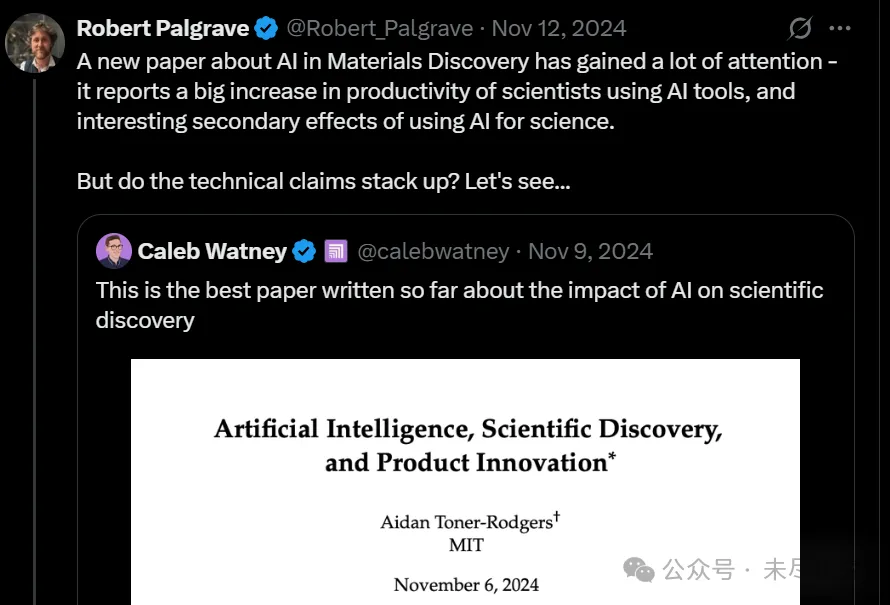
关于MIT博士论文造假:相信并加大质疑AI声称的最美好的东西
Hu Xiu· 2025-05-18 23:51
Core Viewpoint - The case of MIT PhD student Aidan Toner-Rodgers' paper fraud has sparked significant reactions across AI, economics, research, policy, and media circles, similar to the initial uproar it caused six months ago [1] Group 1: Paper Withdrawal and Reactions - MIT concluded after an internal review that the paper must be retracted, which was set to be published in one of the top economics journals, The Quarterly Journal of Economics [2] - The paper's advisors, Nobel laureate Daron Acemoglu and Professor David Autor, publicly requested its retraction [2] Group 2: Research Topic and Implications - The preprint paper titled "Artificial Intelligence, Scientific Discovery, and Product Innovation" addresses the critical question of AI's contribution to economic growth, particularly in corporate R&D and innovation [3] - A breakthrough paper proving AI's significant efficiency enhancement in fields like new materials discovery would be akin to achieving a small research holy grail [4] Group 3: Expert Criticism and Concerns - Concerns were raised by experts like UCL Professor Robert Palgrave, who has been skeptical about AI's role in discovering new materials [6][8] - Critics argue that many of the materials proposed by Google's DeepMind, which claimed to predict 2.2 million new crystals, lack novelty and utility, questioning the validity of AI-generated findings [12][14] Group 4: Broader Implications for AI in Research - The incident highlights the potential for AI to disrupt scientific research, raising concerns about the integrity of academic work in the era of large language models (LLMs) [24][29] - Experts emphasize the need for interdisciplinary collaboration in AI research, particularly when it involves fields outside the researcher's primary expertise [25][26] Group 5: Future Considerations - The case raises fundamental questions about the distinction between synthetic, simulated, and fraudulent data in research, especially in non-physical domains [27][28] - The proliferation of preprint papers, particularly during the COVID-19 pandemic and the rise of generative AI, has led to concerns about the reliability of unreviewed research [29][30]