Gaudi系列芯片

Search documents
特朗普“敲诈”黄仁勋,为华为昇腾910C献上“助攻”
Guan Cha Zhe Wang· 2025-04-21 08:39
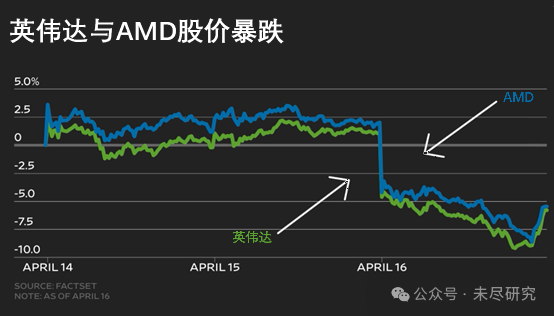
Core Viewpoint - The U.S. government has imposed new export controls on AI chips, specifically targeting Nvidia's H20 chip, marking a significant escalation in restrictions on technology exports to China [1][2][8]. Group 1: Export Controls and Market Impact - Nvidia announced that its H20 chip requires a license for export to China, a first for a special version of AI chips [1]. - Intel has informed Chinese customers that starting April 2025, chips meeting certain performance criteria will also require U.S. government approval for export [1]. - The restrictions primarily affect Nvidia's H20 and AMD's MI308 chips, with Nvidia's H20 being particularly critical due to its market presence in China [1][8]. - Following the announcement, Nvidia's stock price dropped nearly 7%, resulting in a market value loss of over $148 billion, while AMD warned of an $800 million loss due to the new restrictions [11]. Group 2: Competitive Landscape - The H20 chip's performance exceeds that of other AI chips, making it highly sought after by Chinese cloud computing providers [8][9]. - Huawei's Ascend 910C AI accelerator is expected to fill the market gap left by Nvidia, with performance metrics approaching Nvidia's latest offerings [13][15]. - The competitive dynamics are shifting, with domestic Chinese manufacturers poised to accelerate their development in response to U.S. export controls [11][13]. Group 3: Strategic Implications - The U.S. export controls reflect a broader strategy to maintain technological dominance while balancing commercial interests [16]. - Nvidia's decision to maintain high performance in its products, even under export restrictions, indicates a strategic intent to retain market share in China [10]. - The ongoing policy fluctuations highlight the challenges faced by the U.S. in navigating the intersection of technology control and economic interests [16].


英伟达领跌,黄仁勋来中国救场
Hu Xiu· 2025-04-17 23:54
Group 1 - Major semiconductor companies, including Nvidia and AMD, experienced significant stock declines of approximately 7%, while Applied Materials, Lam Research, and KLA fell around 5% [1] - The semiconductor industry is facing numerous challenges, including fluctuating tariff policies, export restrictions on advanced AI chips to China, and a slow recovery in consumer electronics [3] - Nvidia's CEO Jensen Huang recently met with Chinese officials to discuss designing next-generation chips that comply with both customer needs and regulatory requirements [4] Group 2 - Nvidia's warning about the need for U.S. government approval for H20 chip exports to China has raised concerns, leading to a $5.5 billion provision for potential losses [5] - AMD has also indicated uncertainty regarding the licensing of its MI308 series chips for China, leading to an $800 million inventory provision [5] - The Biden administration's legacy includes a framework for AI export controls, which may complicate the future of U.S.-China semiconductor relations [6] Group 3 - The U.S. House of Representatives is investigating how Nvidia sold restricted chips to DeepSeek, citing national security concerns [7] - The ongoing supply chain investigations and potential tariffs on semiconductor components could further increase the U.S. trade deficit with affected economies [8] - Trump's recent directives to investigate the semiconductor supply chain under national security claims could lead to new tariffs, impacting both domestic and international semiconductor production [10] Group 4 - The uncertainty surrounding tariffs is already affecting the semiconductor industry, with companies like TSMC and ASML expressing concerns about the potential impact on their profit margins [13] - The loss of the Chinese market poses a long-term risk for U.S. semiconductor firms, as Chinese companies are increasingly filling market gaps left by U.S. firms [14] - Huawei's advancements in system solutions are positioning it as a significant competitor to Nvidia and AMD, with notable improvements in performance metrics [14][15] Group 5 - The competitive landscape for mature chips is intensifying, with China imposing tariffs on U.S. products, which could disadvantage American manufacturers with local production [15] - The production of mature chips remains critical for the evolution of semiconductor technology and the growth of the domestic supply chain [16] - Jensen Huang's recent visit to China underscores the importance of the Chinese market for Nvidia, highlighting the need for collaboration despite regulatory challenges [17]