GeForce RTX 50系列GPU

Search documents
AI内容供需旺盛,英伟达发力本地AI创作
2 1 Shi Ji Jing Ji Bao Dao· 2026-03-13 04:32
Core Insights - NVIDIA is focusing on promoting AI content creation tools at GDC, aiming to lower development barriers for users [1] - The company introduced simplified features for its AI drawing tool ComfyUI and enhanced local AI video generation processes [1][2] - NVIDIA's RTX Video Super Resolution technology significantly improves the efficiency of 4K video production, making it 30 times faster than other mainstream tools [2] Group 1: AI Content Creation Tools - NVIDIA launched a new "application view" for ComfyUI, targeting designers unfamiliar with node workflows, allowing them to generate AI content easily by inputting prompts and adjusting parameters [1] - Since September 2022, performance on RTX GPUs for ComfyUI has improved by 40%, with the GeForce RTX 50 series offering up to 2.5 times performance improvement using NVFP4 format and 1.7 times using FP8 format, while also reducing memory usage by 60% and 40% respectively [1] Group 2: Market Trends and Growth - The demand for AI-generated content is surging, with AI-generated videos gaining acceptance in the market, driven by OpenAI's Sora and subsequent offerings from ByteDance and Kuaishou [2] - The AI comic drama market in China is projected to exceed 24 billion yuan by 2026, with user numbers surpassing 300 million, as traditional production cycles are reduced from months to weeks, cutting costs by over 60% [3] - NVIDIA is aligning its software, models, and toolchains to lower the barriers for local AI creation tools, integrating its GPUs with AI production processes to capitalize on the growing AI content production trend [3]

端侧AI需求爆发改写联想估值逻辑
Zhi Tong Cai Jing· 2025-10-21 12:10
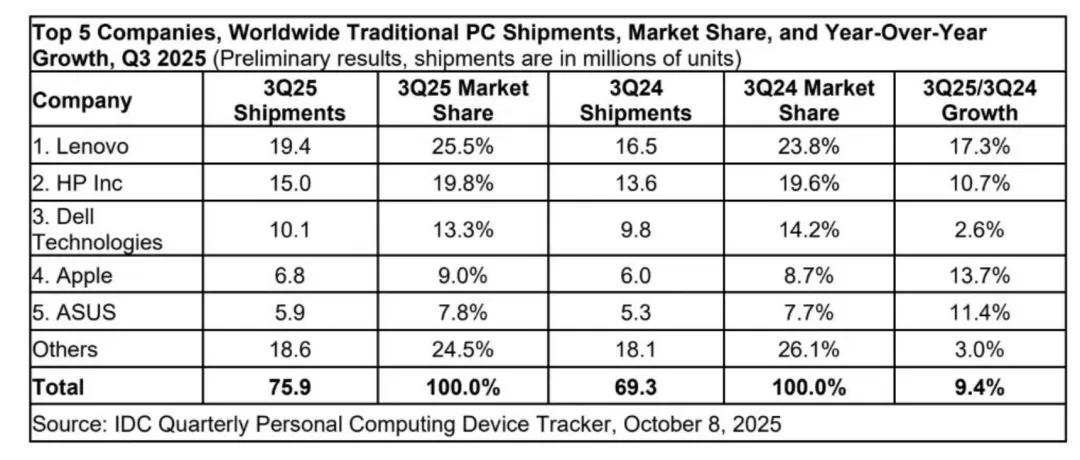
Core Insights - The global PC market is experiencing a resurgence driven by artificial intelligence (AI), with shipments expected to reach 75.9 million units in Q3 2025, marking a 9.4% year-over-year increase [1][2] - Lenovo has significantly increased its market share to 25.5%, outperforming competitors like HP and Dell, which indicates a shift towards AI-driven demand in the PC sector [1][2][7] - The competition among leading PC manufacturers is increasingly focused on capturing the AI edge, with Lenovo's strategy aligning well with the industry's shift towards edge AI [3][6] Market Performance - Lenovo's PC shipments reached 19.4 million units in Q3 2025, reflecting a 17.3% growth compared to the previous year, while HP and Dell saw lower growth rates of 10.7% and 2.6%, respectively [2][7] - The overall market share distribution shows Lenovo leading with 25.5%, followed by HP at 19.8%, and Dell at 13.3% [2] AI PC Market Dynamics - The AI PC segment is projected to grow at a compound annual growth rate (CAGR) of 44% from 2024 to 2028, with expectations that AI PCs will account for 70% of total PC shipments by 2028 [6] - Lenovo's AI PC shipments have surpassed 30%, positioning the company as a leader in the global Windows AI PC market [7] Strategic Positioning - Major tech companies like NVIDIA, OpenAI, and Microsoft are recognizing the potential of edge AI, with NVIDIA investing $5 billion in Intel to enhance AI PC capabilities [3][4] - Lenovo's "hybrid AI" strategy aligns with the industry's focus on local computing power, data privacy, and low latency, positioning it as a key player in the AI ecosystem [5][9] Financial Implications - The shift towards AI PCs is expected to enhance Lenovo's overall gross margin, as AI PCs are viewed as high-value products [9] - Lenovo's service business (SSG) is projected to maintain high growth and profitability, further supporting the company's transition from hardware sales to integrated AI service offerings [9][10]


端侧AI需求爆发改写联想(00992)估值逻辑
智通财经网· 2025-10-21 11:42
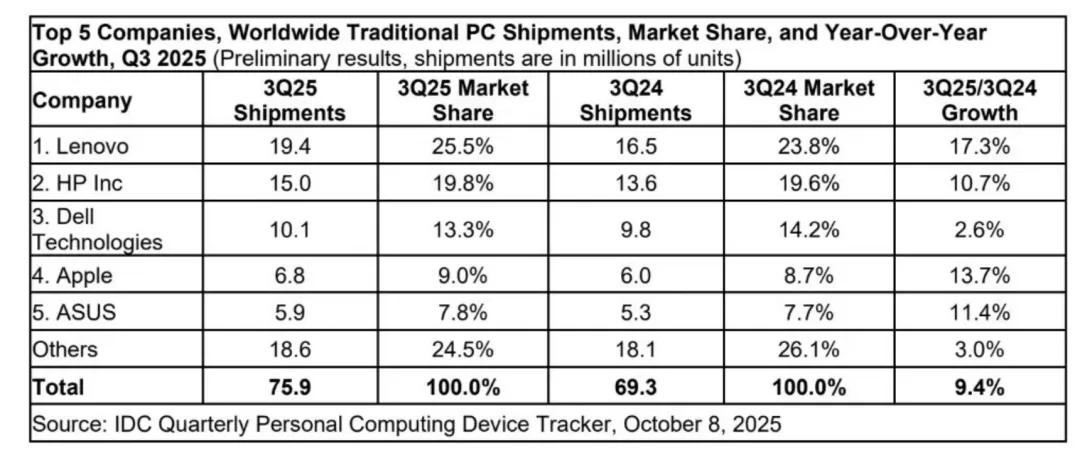
Core Insights - The global PC market is experiencing a resurgence driven by artificial intelligence (AI), with shipments expected to reach 75.9 million units in Q3 2025, representing a year-over-year growth of 9.4% [1][2] - Lenovo has significantly increased its market share to 25.5%, widening the gap with HP, which holds 19.8% [1][2] - The competition among top manufacturers is increasingly focused on capturing the edge AI market, with Lenovo's strategy aligning well with industry giants like NVIDIA and Microsoft [3][5] Market Performance - Lenovo's PC shipments reached 19.4 million units in Q3 2025, a 17.3% increase from 16.5 million units in Q3 2024 [2][8] - HP's shipments grew by 10.7% to 15.0 million units, while Dell's growth was only 2.6%, resulting in a decline in its market share from 14.2% to 13.3% [2][8] - The overall market is seeing a shift towards AI PCs, with a projected compound annual growth rate (CAGR) of 44% from 2024 to 2028 [7] Strategic Positioning - The shift towards edge AI is redefining the role of PCs, positioning them as critical hardware for executing AI applications locally [4][6] - Major companies like NVIDIA and OpenAI are investing heavily in AI PC technologies, indicating a strategic pivot towards local processing capabilities [3][6] - Lenovo's "cloud-edge-end" collaborative architecture is well-aligned with the needs of AI giants, enhancing its position in the AI ecosystem [6][10] Financial Implications - The rise of AI PCs is expected to enhance Lenovo's overall gross margin, as these products are viewed as high-value offerings [10] - Lenovo's service business (SSG) has a high operating profit margin of 22%, which is significantly higher than its hardware business, indicating a potential for increased profitability through AI service integration [10][11] - The company's ability to maintain a resilient supply chain and efficient cost control is crucial for sustaining its market leadership amid increasing competition [11]
PC市场再现加速增长,背后绝非简单的周期轮回
Ge Long Hui· 2025-10-21 11:38
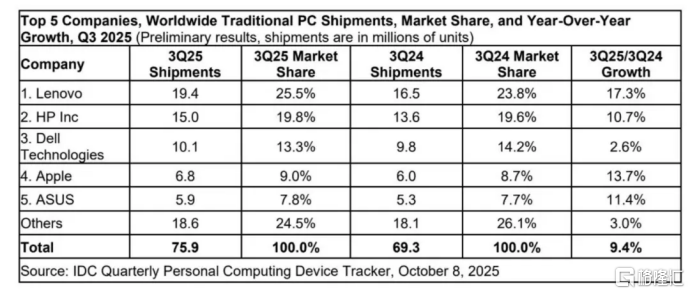
Core Insights - The global PC market is experiencing a resurgence driven by artificial intelligence (AI), with a projected shipment of 75.9 million units in Q3 2025, representing a year-over-year growth of 9.4% [1][2] - Lenovo leads the market with a 25.5% share, significantly ahead of HP at 19.8%, and has shown a remarkable growth rate of 17.3%, far exceeding the industry average [1][2][8] - The competition among top manufacturers is increasingly focused on capturing the edge AI market, with companies like NVIDIA and OpenAI recognizing the potential of AI PCs as critical hardware for AI applications [3][4][5] Market Dynamics - The AI PC segment is expected to grow at a compound annual growth rate (CAGR) of 44% from 2024 to 2028, potentially capturing 70% of the total PC market by 2028 [7] - Lenovo's AI PC shipments accounted for over 30% of its total PC shipments in Q3 2025, solidifying its position as a leader in the AI PC market [8][9] - The shift towards AI PCs is reshaping the valuation logic for companies, with AI PCs being viewed as high-margin products compared to traditional PCs [9] Strategic Positioning - Lenovo's "hybrid AI" strategy aligns with the broader industry trend towards localized AI models and edge computing, positioning the company as a key player in the AI ecosystem [6] - The integration of AI capabilities into Lenovo's service offerings is expected to enhance overall profitability, with the services segment showing a 22% operating margin, significantly higher than hardware [9][10] - Lenovo's robust supply chain and operational resilience are critical competitive advantages, enabling the company to meet large-scale enterprise demands effectively [10]


业绩依然坚挺!段永平:英伟达很难看懂的并不是短期的增长,而是长期的护城河
聪明投资者· 2025-02-27 06:50
Core Viewpoint - NVIDIA's financial performance shows significant growth, with Q4 2025 revenue reaching $39.331 billion, a 78% increase year-over-year, and a net profit of $22.066 billion, up 72% [1]. Financial Performance - In Q4 2025, NVIDIA reported revenue of $39.331 billion, a 78% increase compared to the same quarter last year, and a net profit of $22.066 billion, reflecting a 72% year-over-year growth [1]. - For the entire fiscal year 2025, NVIDIA achieved total revenue of $130.497 billion, a 114% increase year-over-year, with a net profit of $72.880 billion, up 145% [1]. Business Segments - The data center business generated $35.58 billion in revenue, marking a 93.32% increase year-over-year [1]. Market Reaction - Following the earnings report, NVIDIA's stock closed at $131.28 per share, up 3.67%, but experienced slight fluctuations in after-hours trading [2]. CEO Insights - CEO Jensen Huang highlighted the extraordinary demand for the AI chip Blackwell, leading to a significant increase in production [2]. Long-term Perspectives - Investor Duan Yongping expressed skepticism about NVIDIA's long-term competitive advantage, questioning whether the company will maintain its current market position in ten years [3][5]. - Duan emphasized the importance of understanding a company's long-term moat rather than just short-term growth [3][12]. Investment Philosophy - Duan Yongping advocates for a long-term investment perspective, suggesting that evaluating companies over a decade or more can provide valuable insights for investment decisions [4][34]. - He noted that understanding a business is crucial for making informed investment choices, and if a company is not comprehensible, it may not be worth investing in [25][33]. Competitive Landscape - Huang acknowledged that NVIDIA faces intense competition from various tech giants and startups, but he remains confident in the company's technological advantages and market position [44][48]. Future Outlook - Huang envisions a future where AI technology will proliferate across industries, with NVIDIA playing a central role in driving innovation [47][48].