Harmony

Search documents
Consensus Cloud Solutions (CCSI) Reports Q4 2025 Revenue of $87.07M and 13.7% Growth in Adjusted EPS
Yahoo Finance· 2026-02-24 11:51
Core Insights - Consensus Cloud Solutions Inc. (NASDAQ:CCSI) is recognized as a promising stock for beginners in 2026, reporting Q4 and full year 2025 earnings with a revenue of $87.07 million, reflecting a year-over-year increase of 0.10% and a slight beat against market expectations [1] Financial Performance - The company achieved a 7.3% year-over-year growth in corporate revenue during Q4, marking the highest growth rate since 2022, with this segment now representing two-thirds of total revenue and maintaining a retention rate of 101.3% [2] - The Small Office/Home Office segment experienced an 11.1% decline in revenue as the company shifts focus away from lower-margin accounts, with expectations that corporate revenue could grow to 75% of total business in the next three years [2] Future Outlook - For 2026, Consensus Cloud Solutions has provided revenue guidance between $350 million and $364 million, with adjusted EPS projected to be between $5.55 and $5.95 [4] - The company is focusing on AI-driven solutions, such as Clarity and Harmony, aimed at automating administrative tasks for hospitals, including referral management and prior authorizations [4] Business Model - Consensus Cloud Solutions, along with its subsidiaries, offers information delivery services through a SaaS platform across the US, Canada, Ireland, and internationally [5]

Check Point Software Technologies Q4 Earnings Call Highlights
Yahoo Finance· 2026-02-12 16:42
Core Insights - Check Point aims to secure customers' AI transformation through a "prevention-first" approach and AI-powered unified management across its portfolio [1] - The company has expanded its platform to include AI security and exposure management, responding to an AI-driven shift in the threat landscape [2] - Check Point's strategy focuses on consistent execution and strengthening its foundation for long-term growth, with changes in organizational structure and go-to-market strategies [3] Financial Performance - For Q4 2025, Check Point reported revenue of $745 million, a 6% year-over-year increase, with subscription revenue growing by 11% [6][10] - Non-GAAP EPS for Q4 was $3.40, exceeding guidance, which included a one-time tax benefit of approximately $0.52 [11] - Full-year 2025 revenue reached $2.725 billion, also a 6% year-over-year increase, with non-GAAP EPS of $11.89, boosted by a tax benefit [14] Growth Projections - For 2026, Check Point guided revenue between $2.83 billion and $2.95 billion, representing 4% to 8% growth, with subscription revenue growth projected at 10% to 14% [5][17] - The company anticipates Q1 2026 revenue of $655 million to $685 million, with subscription revenue between $318 million and $328 million [17] Strategic Initiatives - Check Point is repositioning to secure AI transformation with a four-pillar platform that includes AI security and exposure management [7] - The company has made targeted acquisitions, including Cyclops for asset discovery and Cyada for governing autonomous AI agents [8] - Check Point is focusing on managed service providers (MSPs) to enhance its offerings for smaller customers through partnerships [9] Market Dynamics - The company highlighted that attackers are adopting AI faster than defenders, creating new attack surfaces due to rapid enterprise AI adoption [2] - Check Point's revenue growth in Q4 was driven primarily by subscription revenue, which is expected to continue benefiting from a product price increase effective January 1, 2026 [16] Operational Metrics - Deferred revenue grew 9% year-over-year to $2.18 billion, with calculated billings up 8% to $1.039 billion [12] - Gross margin for Q4 was 89%, with operating expenses rising 13% due to workforce increases and investments in sales and marketing [13]

Consensus(CCSI) - 2025 Q4 - Earnings Call Transcript
2026-02-10 14:32
Financial Data and Key Metrics Changes - Consensus reported a record revenue of $87.1 million for Q4 2025, marking a slight increase of 0.1% year-over-year, and a full year revenue of $349.7 million, which is essentially flat compared to the previous year [27][28] - Adjusted EBITDA for Q4 2025 was $45.2 million, up from $44.4 million in Q4 2024, resulting in a solid EBITDA margin of 51.9% [27] - Free cash flow reached a record $106 million for the year, an increase of 20% from 2024, with a capital expenditure of $30 million, down 10% year-over-year [30] Business Line Data and Key Metrics Changes - Corporate channel revenue for Q4 2025 was $56.8 million, a 7.3% increase year-over-year, and for the full year, it reached $222.7 million, up 6.5% [13][24] - SOHO channel revenue for Q4 2025 was $30.3 million, a decrease of 11.1% year-over-year, with a full year revenue of $127 million, down 10% compared to 2024 [19][26] Market Data and Key Metrics Changes - The corporate revenue retention rate stood at 101.3%, an improvement from 100.5% in the previous year, with the corporate customer base increasing by 11.3% year-over-year to approximately 65,000 [17][24] - The average revenue per account (ARPA) for the corporate channel was approximately $290, a decrease of $13 year-over-year, while the SOHO ARPA was $15.55, remaining flat year-over-year [24][26] Company Strategy and Development Direction - The company is focused on transitioning its business model towards a recurring revenue platform, with a significant shift towards corporate revenue, which is projected to reach 68% of total revenue by 2026 [12] - The strategy includes enhancing healthcare solutions and expanding into the public sector, particularly with the eFax product tailored for government use [16][17] Management's Comments on Operating Environment and Future Outlook - Management expressed optimism about the demand environment, noting that hospitals are adapting to budget constraints and showing increased engagement with the company's services [40] - The company anticipates continued growth in corporate revenue, projecting a 9% growth rate at the midpoint of guidance for 2026, while SOHO revenue is expected to decline by approximately 10% [9][10] Other Important Information - The CFO, Jim Malone, will retire, with Adam Varon set to succeed him, indicating a smooth transition in leadership [34][35] - The company plans to be more aggressive in its share repurchase program, given the favorable free cash flow yield compared to debt costs [10] Q&A Session Summary Question: Can you talk about the demand environment and the success of the VA? - Management noted that hospitals are adjusting to budget changes and are increasingly interested in operational services, with the VA projected to contribute over $9 million in revenue for 2026, exceeding previous expectations [40][41] Question: What are the underlying demand dynamics for Clarity and competition? - The company highlighted that demand for Clarity is driven by the need to reduce administrative burdens and accelerate processing times, with a focus on specific use cases like referral management [62] Question: Can you discuss expectations for ARPA this year? - Management indicated that ARPA may experience downward pressure due to the growth of eFax Protect, but the non-eFax Protect cohort is expected to see growth [78] Question: Can you provide details on gross margin expectations? - The company expects stable gross margins around 80%, with most cost increases occurring in operating expenses rather than cost of goods sold [85]
Market Mavericks: 3 Financial Stocks Up 50% in 2025 & Still Gaining
ZACKS· 2025-12-18 15:35
Core Insights - The finance sector is experiencing strong customer retention and exposure growth despite declining global commercial insurance rates, which decreased by 4% in Q3 2025, marking the fifth consecutive quarter of decline [3][10] - Falling interest rates are positively impacting real estate, M&A activities, and consumer spending, although investment yields may decline for finance companies [2][6][10] - Continued investments in technology are enhancing operational efficiency and margins across the finance industry [9] Industry Overview - The finance sector includes a diverse range of players such as banks, investment companies, insurance firms, and real estate companies, providing various financial services [1] - Catastrophes pose significant risks for insurers, leading to higher policy renewal rates and rate hikes, yet exposure growth and customer retention are driving premium income [3][4] - Interest rate cuts initiated in September 2025 are expected to benefit the real estate market and increase demand for loans and credit cards, aiding the banking sector [5][10] Company Highlights - **Customers Bancorp (CUBI)**: This company utilizes a high-tech, high-touch model for personalized banking and has a diversified loan portfolio with a low non-performing loan ratio of 0.17%. The Zacks Consensus Estimate for 2026 earnings is $8.01 per share, indicating a 5.8% rise from 2025 [13][14] - **HCI Group (HCI)**: HCI leverages internally developed platforms to enhance claims processing and underwriting, leading to improved financial performance. The Zacks Consensus Estimate for 2026 earnings is $16.00 per share, with a year-to-date stock gain of 59.5% [17][18] - **Enova International (ENVA)**: Enova is a leading online financial services provider that has extended around $5.5 billion in credit in 2025. The Zacks Consensus Estimate for 2026 earnings is $14.12 per share, reflecting a 10.6% increase from 2025 [19][20]





复锐医疗20251114
2025-11-16 15:36
Summary of the Conference Call for Furuya Medical Company Overview - **Company**: Furuya Medical - **Industry**: Medical aesthetics and energy devices Key Points Financial Performance and Projections - Furuya Medical expects significant growth in 2025, fully compensating for a 1.9% decline in the first half of the year, with double-digit growth anticipated in 2026 driven by the launch of Daxify [2][24] - The company aims for Daxify to achieve sales of 100 million RMB in its first year, with a cumulative target of 1 to 2 billion RMB over the next 3-5 years, capturing approximately one-third of the botulinum toxin market [2][7] - Profile's market performance exceeded expectations, achieving over 10 million USD in sales within the first nine months post-launch in Thailand, with a projected annual sales of 30 million USD [2][14] Product Development and Market Strategy - Daxify's commercialization is progressing steadily, with expectations to complete inspections by the end of the year and begin full market rollout [2][6] - The company plans to adjust its business structure, shifting the revenue mix from 80% energy devices and 10% injectables to 60% and 40% respectively, to optimize business structure and enhance valuation multiples [2][26] - Furuya Medical's energy source business continues to grow, with new orders showing double-digit growth in Q3 2025, and plans for domestic production of energy devices expected to materialize in the first half of next year [2][20][21] Market Expansion and Sales Strategy - The U.S. market showed signs of recovery in Q3 2025, with expectations to reach a sales peak of 150 million USD as new sales teams are integrated [2][5][23] - The company plans to prioritize high-end clinics in tier-one and tier-two cities for Daxify promotion, initially targeting around 300 clinics [2][10][37] - Furuya Medical's team is expanding from approximately 30 to 40 members, with a focus on experienced professionals from major companies [2][9] Competitive Positioning and Pricing Strategy - Daxify is expected to be priced higher than existing botulinum products due to its long-lasting effects, with a market entry planned for December 2025 [2][8][38] - The company aims to maintain product pricing integrity to protect market value, with a clear strategy to avoid price erosion [2][35][36] Future Outlook - Furuya Medical anticipates a significant recovery in gross margins in the second half of 2025, driven by new product launches and improved sales efficiency [2][29] - The company is targeting 1 billion USD in sales within a few years, with projections of 400 million USD in 2026, aiming for a 60% contribution from energy devices and 40% from injectables [2][31] Additional Insights - The company is actively pursuing domestic production capabilities to enhance service delivery in the Asia-Pacific market, leveraging local supply chains for cost efficiency [2][28] - Furuya Medical is committed to continuous innovation, with plans to introduce new energy devices and injectable products in the coming years [2][30][32] This summary encapsulates the key insights from the conference call, highlighting Furuya Medical's strategic direction, market performance, and future growth prospects.
复锐医疗科技(01696.HK):北美承压亚太增长 新品与渠道潜力待释放
Ge Long Hui· 2025-08-21 19:28
Overall Performance - The company reported a revenue of 165 million USD for H1 2025, a year-on-year decrease of 2.5% [1] - The net profit attributable to the parent company was 6 million USD, down 41.3% year-on-year [1] - Gross margin stood at 60.0%, a decline of 2.4 percentage points year-on-year, while net margin was 5.4%, also down 2.4 percentage points [1] Regional Market Performance - Revenue from medical beauty products was 137.7 million USD, a decrease of 7.8% year-on-year, primarily affected by weak demand in the North American market [2] - Injection filling products generated 14.4 million USD, a significant increase of 218.1% year-on-year, driven by global direct sales and distribution networks [2] - North American revenue was 56.6 million USD, down 15.6% year-on-year, impacted by high interest rates and weak consumer spending [2] - Asia-Pacific revenue reached 65.8 million USD, up 17.6% year-on-year, benefiting from the effectiveness of the direct sales strategy [2] - European revenue was 23.8 million USD, a slight decline of 0.8% year-on-year [2] Product Development and Strategy - The company continues to optimize its product matrix, with core energy source devices like Soprano and Harmony maintaining competitiveness in hair removal and skin tightening [3] - The global first long-acting peptide-based neuromodulator Daxxify has received NMPA approval, and a sales team is being formed for its launch in China [3] - The company is advancing its pipeline with lipolytic injections completing Phase II clinical trials and other products like silk protein composite gel progressing [3] - The launch of AI-driven personalized skincare system Universkin and smart skin analysis platform Alma IQ is expected to enhance service value [3] - The company aims to leverage its direct sales network to strengthen its position in the Asia-Pacific region and open a second growth curve through injection filling business [3] - The company maintains profit forecasts, expecting net profits of 3.8 million USD, 4.6 million USD, and 5.4 million USD for 2025-2027, representing year-on-year growth of 52%, 21%, and 16% respectively [3]
复锐医疗科技(01696):北美承压亚太增长,新品与渠道潜力待释放
Shenwan Hongyuan Securities· 2025-08-21 13:53
Investment Rating - The report maintains a "Buy" rating for the company [2][27] Core Insights - The company reported its 2025 mid-year results, which met expectations, with a revenue of $165 million, a year-on-year decline of 2.5%, and a net profit of $6 million, down 41.3% year-on-year [9] - The financial forecast for the company shows expected revenue growth from $359 million in 2023 to $543 million in 2027, with a projected net profit increase from $31 million to $54 million over the same period [8][19] - The company is focusing on optimizing its product matrix and has several new products in the pipeline, including the long-acting peptide formulation Daxxify, which has received approval for the Chinese market [9] Financial Data and Profit Forecast - Revenue projections: $359 million in 2023, $349 million in 2024, $416 million in 2025E, $490 million in 2026E, and $543 million in 2027E, with growth rates of 1%, -3%, 19%, 18%, and 11% respectively [8][19] - Net profit projections: $31 million in 2023, $25 million in 2024, $38 million in 2025E, $46 million in 2026E, and $54 million in 2027E, with growth rates of -22%, -20%, 52%, 21%, and 16% respectively [8][19] - The company’s gross margin for the first half of 2025 was 60.0%, with a net margin of 5.4% [9][16]
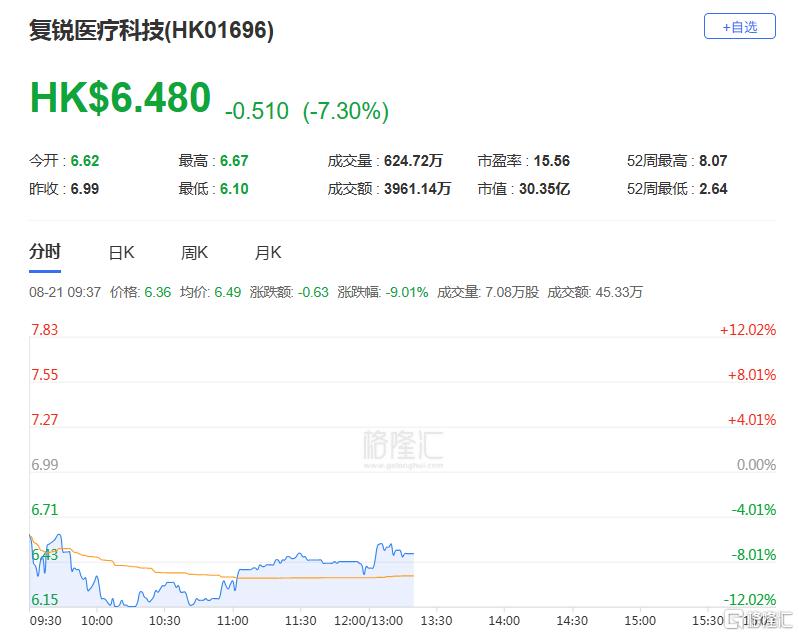
营收利润双降!复锐医疗科技中期业绩“爆雷”,股价一度下挫13%
Ge Long Hui· 2025-08-21 07:09
Core Viewpoint - The financial report of Alma Medical Technology revealed a surprising decline in both revenue and profit, leading to a significant drop in stock price, marking the third consecutive day of decline [1][4]. Financial Performance - Revenue for the first half of 2025 was $165.5 million, a slight decrease of 1.9% year-on-year, primarily due to high interest rates in North America affecting consumer spending and geopolitical issues causing shipment delays in June [4][6]. - Net profit was $8.99 million, a substantial decline of 31.9% year-on-year, with adjusted net profit down 28.1% to $11.97 million, resulting in a net profit margin of 7.2% [4][5]. - Gross margin decreased from 62.5% in the same period last year to 60%, a drop of 2.4 percentage points [5]. Cash Flow and Liquidity - Operating cash flow showed a net outflow of $489,000, compared to a net inflow of $396,000 in the previous year, mainly due to increased working capital requirements (accounts receivable and inventory increased by approximately $30 million) [5]. - As of the end of the reporting period, cash and cash equivalents stood at $60.1 million, sufficient to cover short-term debts of $50.7 million, although liquidity is becoming tighter [5]. Business Segment Performance - The injection filling segment was a highlight, with revenue surging 218% due to the successful launch of Profhilo in Thailand and Revanesse in direct sales markets in the UK, Germany, and Australia [4][6]. - Revenue from energy source devices declined, with flagship products Harmony and Soprano series experiencing weak demand in North America, although the Asia-Pacific market continued to grow, partially offsetting the decline in Europe and the US [7]. Outlook - Despite the poor performance in the first half, the company is optimistic about the second half of 2025, expecting stronger revenue and profit driven by new orders [10][11]. - The company plans to focus on consolidating its leadership position in strategic growth regions, particularly in Asia-Pacific and North America, through direct sales expansion and targeted product launches [11].
Docebo(DCBO) - 2025 Q2 - Earnings Call Transcript
2025-08-08 13:00
Financial Data and Key Metrics Changes - Docebo reported a strong performance in Q2 2025, with a notable increase in customer count above $100,000, ramping up to 23% from 16% in the previous quarter, attributed to new customer acquisitions and expansions [74][75]. - The company experienced a favorable foreign exchange impact, contributing 1% to total revenues and 2% to subscription revenues [21]. Business Line Data and Key Metrics Changes - The mid-market segment showed significant strength, with technology, healthcare, and financial services sectors contributing to this growth [6][8]. - The percentage of new customers using two or more use cases decreased to 65%, down from 70-80% in the previous year, indicating a shift in customer purchasing behavior [9][10]. Market Data and Key Metrics Changes - The government sector, particularly after achieving FedRAMP certification, is expected to unlock a total addressable market of $2.7 billion across federal, state, and local agencies [27][28]. - The company is currently penetrating about 10 states in the government sector, with a 10% penetration rate, indicating substantial growth potential [31]. Company Strategy and Development Direction - Docebo is transitioning to an AI-first learning platform, with the launch of Harmony, which enhances user experience through advanced AI capabilities [41][42]. - The company is focusing on integrating sales and customer success functions to improve execution efficiency and customer value [55][56]. Management's Comments on Operating Environment and Future Outlook - Management noted that while there are elongated sales cycles in the enterprise space, the mid-market sector continues to perform strongly, and they expect this trend to persist [21][70]. - The company anticipates meaningful contributions from the federal sector in 2026, driven by recent certifications and a growing pipeline [28][90]. Other Important Information - Docebo is actively investing in headcount and R&D to accelerate its AI roadmap, while also engaging in share buybacks when shares are deemed attractively valued [85][86]. - The company is leveraging its existing customer base to introduce new products like Harmony without immediate monetization, focusing on building usage and value first [66][67]. Q&A Session Summary Question: Strength in the mid-market segment - Management confirmed strong performance in the mid-market, particularly in technology, healthcare, and financial services, and expressed optimism about continued strength in future quarters [6][8]. Question: Decrease in multi-use case adoption - Management explained that the decrease in customers using multiple use cases is due to a strategic approach to penetrate organizations with fewer use cases initially, allowing for trust-building and future expansion [10][11]. Question: FedRAMP certification impact - The achievement of FedRAMP certification is expected to significantly enhance the government pipeline, with management expressing excitement about potential deals in 2026 [27][28]. Question: New CRO's impact on sales - Management indicated that the new CRO is already making an impact by focusing on short-term wins and improving execution efficiency, with a long-term view of blending sales and customer success functions [32][35]. Question: AI innovation and monetization - Management highlighted the transition to an AI-first platform with the launch of Harmony, emphasizing the importance of delivering value before monetization strategies are implemented [41][66]. Question: Capital allocation priorities - Management outlined three areas for cash deployment: investing in business growth, share buybacks, and potential M&A opportunities, emphasizing a strategic approach to capital allocation [85][86].

从 Co-pilot 到 Agentic AI,Sierra 如何改变客服的游戏规则
海外独角兽· 2025-07-01 07:26
Core Insights - The core value of AI Agents lies in their ability to solve complex business problems that previously required human intervention, with customer service being a primary focus area [3][4] - Sierra AI, founded by former Salesforce co-CEO Bret Taylor, aims to integrate deeply into enterprise processes, functioning as a new workforce rather than just a productivity tool [4][5] - Sierra's AI assistants have demonstrated significant success, achieving over 65% case resolution rates and 95% customer satisfaction during peak seasons, leading to substantial market interest and a valuation of $4.5 billion [5] Group 1: Deployment and Customization - Sierra employs specialized deployment teams that understand client needs, creating tailored solutions that serve as a competitive barrier [8] - The company focuses on delivering successful outcomes rather than just AI tools, emphasizing improved customer satisfaction and revenue growth [8] - Sierra's AI Agents come in three forms: Personal Agents for consumers, Role-Based Agents for employees, and Company Agents for overall business operations [9] Group 2: Customization and Technology - Sierra's competitive edge lies in its ability to provide highly customized solutions, adjusting parameters and workflows to meet specific industry needs [11] - The AI Agents utilize advanced data analysis and machine learning to create customer profiles and tailor interactions accordingly [11] - Sierra has developed a proprietary Voice Activity Detection (VAD) system to enhance voice recognition and interaction quality, significantly outperforming traditional models [15][16] Group 3: Business Model and Market Strategy - Sierra adopts a results-based pricing model, charging clients only when AI Agents successfully complete tasks, aligning the company's success with client outcomes [30][31] - The shift from traditional software sales to a results-oriented model allows Sierra to foster closer relationships with clients and ensure accountability [30][31] - The AI market is evolving towards a focus on specific business solutions rather than generic technology, with Sierra positioning itself to meet these demands [43][44] Group 4: Case Studies and Applications - Sierra's collaboration with SiriusXM led to the development of a customized AI assistant, Harmony, which effectively automates customer interactions and improves service efficiency [36][37] - Minted, a platform for personalized products, achieved over 65% case resolution and 95% customer satisfaction by deploying Sierra's AI assistant during peak seasons [39][40] - These case studies illustrate Sierra's ability to enhance customer experience and operational efficiency across various industries [35][41] Group 5: Future Trends and Leadership - The future of AI Agents will focus on providing specific business solutions rather than just technological advancements, requiring a deep understanding of customer needs [43][44] - Bret Taylor's career trajectory from programmer to strategic CEO reflects the importance of adapting to market demands and leveraging technology for business innovation [52][53] - The rise of AI Agents signifies a shift in the labor market, where AI can take on roles traditionally held by humans, enhancing productivity and creating new business opportunities [34][35]