Imfinzi(度伐利尤单抗)

Search documents
阿斯利康2026高调登场
Xin Lang Cai Jing· 2026-02-10 10:11
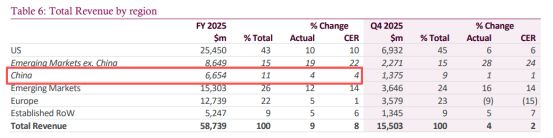
Core Insights - AstraZeneca reported a total revenue of $58.739 billion for FY 2025, reflecting an 8% increase year-over-year, with China contributing $6.654 billion, a 4% increase, representing 11% of AstraZeneca's global market share [2][5]. Financial Performance - The five major business segments contributed as follows: Oncology ($25.619 billion, +14%), CVRM ($12.861 billion, +2%), Rare Diseases ($9.126 billion, +4%), Respiratory & Immunology ($8.866 billion, +12%), and Vaccines & Immune Therapies ($1.268 billion, -14%) [5][6]. - Notable products in the oncology segment included Tagrisso ($7.254 billion, +10%), Imfinzi ($6.063 billion, +28%), Calquence ($3.518 billion, +12%), and Lynparza ($3.279 billion, +6%) [6][7]. Strategic Developments in China - AstraZeneca announced plans to invest over 100 billion RMB in China by 2030, marking its largest investment in the country, aimed at enhancing drug R&D, manufacturing, and commercial innovation [12]. - The company has been actively expanding its investment in China, including a recent agreement to invest in respiratory drug production in Qingdao, bringing total investments in the area to $886 million [13]. - AstraZeneca's R&D pipeline in China has achieved a 100% synchronization rate with global efforts, with the Chinese team leading nearly 20 global clinical trials [13][14]. Collaborations and Partnerships - AstraZeneca has entered into significant collaborations, including a $12 billion strategic R&D partnership with CSPC Pharmaceutical Group, setting a record for upfront payments in China [13]. - Additional agreements include a global licensing deal for the KRAS inhibitor JAB-23E73 worth over $2 billion and a partnership with Hengrui Medicine to develop innovative therapies [14]. Market Positioning - AstraZeneca's strategic shift reflects a broader trend in the pharmaceutical industry, where China is increasingly viewed as a hub for innovation rather than just a market for sales and manufacturing [14].


抗癌“创新药舰队”高歌猛进 助阿斯利康(AZN.US)业绩超预期
Zhi Tong Cai Jing· 2025-07-29 08:13
Core Viewpoint - AstraZeneca has reported strong second-quarter earnings, driven by its innovative cancer drugs, exceeding Wall Street expectations and indicating a positive outlook for the global innovative drug sector [1][2]. Financial Performance - AstraZeneca's total revenue for Q2 increased by 12% year-on-year to $14.5 billion, surpassing Wall Street forecasts [1]. - Adjusted earnings per share for Q2 rose by 10% to $2.17, also exceeding analyst expectations [1]. - For the first half of the year, total revenue grew by 9% to $28 billion, with adjusted earnings per share increasing by 16% to $4.66, both above market expectations [1]. Product Performance - The strong demand for cancer drugs Tagrisso and Imfinzi significantly contributed to AstraZeneca's revenue, with the oncology portfolio generating $6.3 billion in Q2, far exceeding analyst predictions [2][3]. - Tagrisso generated $1.8 billion in revenue for Q2, a 13% year-on-year increase, while Imfinzi brought in $1.5 billion, with a 30% growth [3][5]. Market Strategy - Under CEO Pascal Soriot, AstraZeneca is focusing on oncology and expanding its presence in the U.S. market, committing to invest $50 billion in production and R&D by 2030 [3]. - The company is also developing treatments for cardiovascular diseases and obesity, aiming to create next-generation weight loss drugs [3]. Future Prospects - The upcoming late-stage clinical trial results for the potential blockbuster drug Datroway are expected to be a key catalyst for AstraZeneca's stock performance, although results have been delayed until next year [2][6]. - Datroway is positioned as a new frontline treatment for patients with EGFR-resistant and immune-resistant lung cancer, with a clear commercialization path in non-small cell lung cancer [6].
异动盘点0602|蜜雪冰城创新高,目标价飙至608港元!香港稳定币条例正式生效;PLTR涨超7%
贝塔投资智库· 2025-06-02 03:34
Group 1: Hong Kong Stock Market Highlights - Mixue Group (02097) rose over 7%, reaching a new high, with Daiwa raising its target price to HKD 608, optimistic about same-store sales growth and store opening speed [1] - Lianlian Digital (02598) increased nearly 10% following the official enactment of the "Stablecoin Regulation" in Hong Kong [1] - Automotive stocks collectively declined, with Li Auto-W, Great Wall Motors, and GAC Group all dropping over 2%, as the Ministry of Industry and Information Technology and the China Association of Automobile Manufacturers opposed "involution-style" price wars [1] - CSPC Pharmaceutical Group (02005) fell over 7% after reporting a 36.9% year-on-year decline in revenue and a 59.5% drop in net profit attributable to shareholders for Q1, with expectations of a 45%-60% decline in profit for the first half of the year due to demand drop and intensified competition [1] - Solar energy stocks dropped across the board, with New Special Energy, Xinyi Energy, Fuyao Glass, and Xinyi Solar all declining over 4%, as the anticipated "531" rush in May did not materialize following the April rush [1] - Chinese property stocks fell collectively in early trading, with R&F Properties, Sunac China, New City Development, and Agile Group all dropping over 4%, as data showed a 10.8% year-on-year decline in sales for the top 100 real estate companies from January to May, with a 17.3% drop in May alone [1] Group 2: Other Notable Stocks - Chongqing Rural Commercial Bank (03618) rose nearly 5% after being included in the CSI 300 Index, becoming the first local financial institution from Chongqing to be included, with a 6.25% year-on-year increase in net profit attributable to shareholders for Q1 [2] - Baker Hughes (02149) increased over 8%, reaching a new high after completing a placement of 3 million new H-shares, raising approximately HKD 117 million [2] - Giant Bio (02367) fell over 4% amid ongoing controversies regarding its product components, with the company stating it received an apology from the relevant testing agency and will pursue accountability for the rumors [2] - Chip stocks declined across the board, with Hua Hong Semiconductor, Jingmen Semiconductor, SMIC, and Shanghai Fudan all dropping over 2%, influenced by fluctuating U.S. policies and a decline in the Philadelphia Semiconductor Index [2] - Beike-W (02423) dropped nearly 6% as Huaxi Securities reported a significant slowdown in second-hand housing transaction growth, with a mere 8% year-on-year increase in 15 cities for the first 29 days of May, the lowest since October of the previous year [2] Group 3: U.S. Stock Market Highlights - AstraZeneca (AZN.US) rose over 2% after its cancer drug Imfinzi received EU approval for specific muscle-invasive bladder cancer treatments [3] - Trump Media & Technology Group (DJT.US) increased over 2.4% after announcing the completion of approximately USD 2.44 billion in financing, planning to use about USD 2.32 billion for Bitcoin reserves, potentially becoming one of the largest Bitcoin holders among U.S. public companies [3] - Nvidia (NVDA.US) fell over 2.92% after the CEO announced plans to sell up to 6 million shares by the end of 2025 [3] - Palantir (PLTR.US) rose over 7.73% as reports indicated the Trump administration relies on its technology for inter-agency data sharing, with over USD 113 million in government contracts since Trump took office [3] - Costco (COST.US) increased over 3.12% after reporting Q3 earnings that exceeded expectations, with revenue of USD 63.2 billion, an 8% year-on-year increase, and EPS of USD 4.28, demonstrating its scale advantage and member loyalty [3]