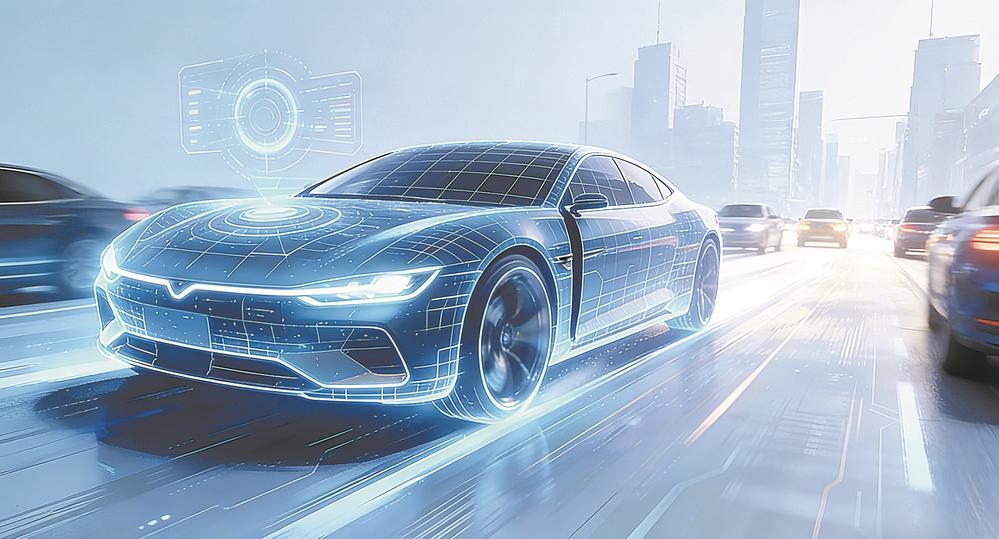
L3级智能驾驶技术

Search documents
万和财富早班车-20260205
Vanho Securities· 2026-02-05 01:56
Core Insights - The report highlights the strong performance of the domestic financial market, with the Shanghai Composite Index closing at 4102.2, up by 0.85% [4] - It emphasizes the ongoing sector rotation, with funds shifting from high-tech stocks to consumer and new energy sectors due to increasing uncertainties as the Spring Festival approaches [10] Macroeconomic News Summary - The Central Committee and State Council issued opinions on advancing rural revitalization [6] - The central bank aims to support key areas such as expanding domestic demand and technological innovation in the 2026 credit market [6] - The Ministry of Industry and Information Technology is focused on advancing key technologies in AI and manufacturing [6] Industry Updates - NAND flash memory prices are expected to rise over 40% quarter-on-quarter in Q1 2026, with related stocks including Zhaoyi Innovation and Northern Huachuang [7] - The first "Traditional Chinese Medicine Brain-Computer Interface" has been established, with related stocks including Sanbo Brain Science and Innovative Medical [7] - In January, 36 Chinese companies made it to the global top 100 mobile game publishers by revenue, with related stocks including Century Huatong and Kaiying Network [7] Company Focus - Rongda Photoelectric plans to complete its first high-end photoresist production line by the second half of 2026 [8] - Huagong Technology is focused on manufacturing engines and precision components, with ongoing customer certifications for its communication modules [8] - Xingye Silver Tin's Vice President increased his shareholding, reflecting confidence in the company's long-term value [8] - Qianli Technology's subsidiary has achieved L3-level intelligent driving capabilities and has applied for testing licenses [8] Market Review and Outlook - The market showed strong performance with the Shanghai index recovering above 4100 points, while trading volume decreased by 633 billion compared to the previous day [9] - Sectors such as coal, transportation services, real estate, and construction materials saw significant gains, while technology sectors faced declines [9] - The report suggests maintaining a moderate position in investments, focusing on cyclical stocks as the market enters an earnings-driven phase [10]
千里科技子公司千里智驾提交L3级智能驾驶测试牌照申请
Xin Lang Cai Jing· 2026-02-04 08:13
Core Viewpoint - Qianli Technology's subsidiary, Qianli Zhijia, has achieved L3-level intelligent driving technology capabilities and has submitted an application for L3-level intelligent driving testing license to the Ministry of Industry and Information Technology (MIIT) [1] Group 1 - Qianli Zhijia is fully cooperating with MIIT's relevant admission requirements [1] - The company is conducting experimental field verification and external road testing to lay the foundation for future large-scale commercialization [1]

千里科技(601777.SH):子公司千里智驾已具备L3级智能驾驶技术能力
Ge Long Hui· 2026-02-04 07:40
Core Viewpoint - Qianli Technology (601777.SH) has announced that its subsidiary, Qianli Zhijia, has achieved Level 3 (L3) autonomous driving technology capabilities and is actively cooperating with the Ministry of Industry and Information Technology to conduct experimental field validation and external road testing [1] Group 1 - The company has officially submitted an application for L3 autonomous driving testing licenses [1]
L3上路 智驾边界迎来新拓展
Xin Lang Cai Jing· 2026-01-03 20:20
Core Viewpoint - The introduction of L3-level intelligent driving technology marks a significant shift in driving responsibility and societal perceptions of transportation, transitioning from human-driven to system-driven control under specific conditions [5][12][14]. Group 1: L3-Level Intelligent Driving Implementation - The first batch of L3-level conditional autonomous driving vehicle permits has been officially issued in China, allowing two models to operate in designated areas of Beijing and Chongqing [5][18]. - L3 technology is expected to be operational by the end of 2024, with significant anticipation from various sectors regarding its potential impact on driving and transportation [5][18]. - The L3-level vehicles will operate under specific conditions, such as on highways and in urban congestion, with a speed limit of 50 km/h, emphasizing safety as a priority [19]. Group 2: Technological and Regulatory Challenges - Transitioning from L2 to L3 involves not only technological advancements but also a need for legal frameworks and societal acceptance to redefine driving responsibilities [8][10]. - The L3 classification allows the system to take over driving tasks under certain conditions, fundamentally changing the role of the driver from a controller to a supervisor [12][13]. - The shift in responsibility from the driver to the vehicle manufacturer during L3 operation introduces a "mixed responsibility" model, challenging existing traffic safety regulations [13][14]. Group 3: Market and Consumer Implications - The current L3 vehicles are not available for direct consumer purchase, as the focus remains on pilot testing to ensure safety and reliability before broader commercialization [18][19]. - The integration of L3 technology is expected to reshape the automotive industry's value chain, with manufacturers becoming responsible for software safety and algorithm performance [14][15]. - The insurance industry faces significant challenges in developing products that adequately cover the risks associated with L3 autonomous driving, necessitating innovative insurance models [16][17]. Group 4: Future Outlook - The successful implementation of L3 technology is seen as a critical step towards a safer and more efficient transportation system, with the potential to enhance overall travel experiences [19]. - The path to widespread adoption of L3 autonomous driving will require careful balancing of innovation and safety, with a focus on gradual and cautious progress [19].