Luna币

Search documents
TerraUSD史诗级骗局 创办人权渡衡被判刑15年
Ge Long Hui· 2025-12-12 06:58
Group 1 - Terraform Labs and its co-founder Do Kwon were sentenced to 15 years in prison for fraud related to the collapse of TerraUSD and Luna, which resulted in a loss of $40 billion [1] - The judge described the case as "epic, generational fraud," noting that few cases in federal prosecution history have caused such severe financial damage [1] - Kwon admitted to conspiracy to commit fraud and wire fraud in court [1] Group 2 - The prosecution highlighted that Kwon exaggerated the automatic recovery capabilities of UST and falsely claimed integration with the Korean payment platform Chai, which was not the case [2] - The Anchor Protocol, which promised returns as high as 20%, was deemed to rely on subsidies and was classified by the court as a Ponzi scheme [2] - Kwon had previously fled to Singapore and was arrested in Montenegro while using a fake passport, later being extradited to the United States [2]
算法稳定币TerraUSD创始人权道亨因400亿美元加密货币崩盘案将被判刑
Xin Lang Cai Jing· 2025-12-11 11:39
Core Viewpoint - The sentencing of Kwon Do-hyung, co-founder of Terraform Labs, is set to take place in New York federal court due to fraud and conspiracy charges related to the collapse of two cryptocurrencies, resulting in a loss of approximately $40 billion in market value [1][4]. Group 1: Legal Proceedings - Kwon Do-hyung has pleaded guilty to charges of conspiracy to commit fraud and telecommunications fraud, admitting to making misleading statements about the stability of the TerraUSD stablecoin during market volatility [3][6]. - The prosecution has requested a minimum sentence of 12 years in prison, citing that the collapse of the Terra ecosystem led to billions of dollars in losses and triggered a crisis in the cryptocurrency market [5]. - Kwon's defense attorney has requested a sentence of no more than 5 years to allow him to return to South Korea to face local criminal charges [2][5]. Group 2: Financial Impact - The TerraUSD stablecoin was designed to maintain a peg to the US dollar through an algorithm, but it decoupled in May 2021, leading to a price drop below $1 [2][5]. - Following the decoupling, Kwon falsely claimed that a computer algorithm named "Terra Protocol" would restore the token's value, while secretly arranging for a high-frequency trading firm to purchase millions of dollars worth of TerraUSD to artificially inflate its price [2][5]. Group 3: Settlements and Future Implications - In 2024, Kwon and Terraform Labs reached a settlement with the U.S. Securities and Exchange Commission for $4.55 billion, with Kwon agreeing to pay an $80 million civil fine and being banned from participating in cryptocurrency trading [3][6]. - Kwon faces multiple charges in South Korea, and according to his plea agreement, the prosecution will not oppose his request for extradition after serving half of his sentence in the U.S. [6].
互联网大厂密集布局,为什么稳定币突然火了?
3 6 Ke· 2025-06-16 11:44
Core Insights - The recent surge in interest around stablecoins is attributed to their potential to bridge traditional finance and the digital economy, with a market size exceeding $250 billion and annual transaction volume reaching $35 trillion, double that of Visa [7][10] - Regulatory frameworks are rapidly evolving, with significant legislation passed in both the US and Hong Kong, enhancing the legitimacy and operational framework for stablecoins [8][10] - The integration of stablecoins into traditional financial systems is accelerating, with major companies like Visa and PayPal adopting stablecoins for transactions, showcasing their practical utility [10][11] Group 1: Market Dynamics - Stablecoins are gaining traction as a critical component in the financial ecosystem, with their market size projected to grow significantly due to increasing demand from both retail and institutional investors [7][8] - The market experienced explosive growth post-2019, particularly during the DeFi boom, which highlighted the utility of stablecoins as both a valuation and payment tool [5][6] - The collapse of TerraUSD (UST) in 2022 raised concerns about the stability of stablecoins, prompting regulatory scrutiny and the introduction of new legislation aimed at enhancing market stability [6][12] Group 2: Regulatory Developments - The passage of the Stablecoin Regulation in Hong Kong and the introduction of the GENIUS Act in the US are pivotal in establishing a clear regulatory framework for stablecoins, which is expected to attract institutional investment [8][10] - These regulations require stablecoin issuers to maintain strict reserve requirements and undergo regular audits, thereby increasing transparency and trust in the market [7][8] - The establishment of a licensing system in Hong Kong sets a precedent for other jurisdictions, potentially leading to a more standardized global approach to stablecoin regulation [7][10] Group 3: Technological Advancements - Advances in blockchain technology, particularly the adoption of Layer 2 solutions, have significantly reduced transaction costs and improved processing speeds, making stablecoins more competitive against traditional payment systems [8][10] - The efficiency of stablecoin transactions is evidenced by the substantial increase in on-chain transaction volumes, surpassing traditional payment networks like Visa [8][10] - The technological evolution of stablecoins is expected to facilitate their integration into various financial applications, enhancing their role as a foundational component of the digital economy [13] Group 4: Market Sentiment and Investment Trends - The interest from institutional investors in stablecoins is rising, with numerous brokerages hosting discussions focused on stablecoin investments, indicating a shift towards mainstream acceptance [10][11] - Companies involved in stablecoin initiatives have seen significant stock price increases, reflecting market optimism and investor interest in the sector [11] - The potential for stablecoins to serve as a strategic asset in global monetary policy and economic strategy is becoming increasingly recognized, positioning them as a key player in the future of finance [13]


一文读懂“稳定币”,是新的货币战争?还是普通人的风口?
Sou Hu Cai Jing· 2025-06-16 02:59
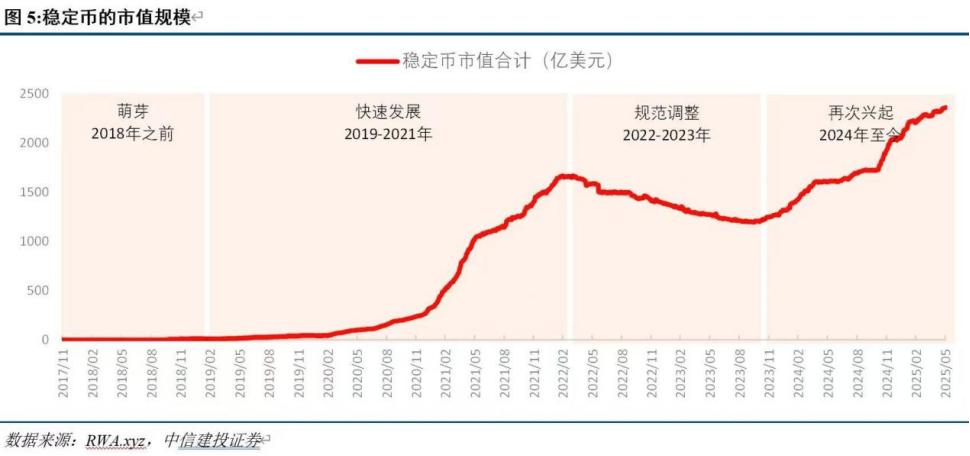
Core Viewpoint - The discussion around stablecoins is gaining momentum globally, with optimistic views suggesting they could significantly enhance the cryptocurrency market, despite their current market cap being only around $300 billion to $3000 billion. The U.S. Treasury Secretary has indicated that stablecoins could increase the demand for U.S. Treasury bonds by $2 trillion in the short term, compared to the current figure of approximately $300 billion [2]. Group 1: Definition and Stages of Stablecoins - Stablecoins are a type of blockchain digital currency that is pegged to specific assets, primarily the U.S. dollar, which distinguishes them from volatile cryptocurrencies like Bitcoin [3]. - The development of stablecoins can be categorized into four stages: 1. Emergence (before 2018): Limited price fluctuations with the first stablecoin, Tether (USDT), launched in 2014 [6]. 2. Rapid Growth (2019-2021): The DeFi ecosystem's rise led to increased demand for stablecoins, particularly during the "DeFi Summer" of 2020 [6]. 3. Regulatory Adjustment (2022-2023): The collapse of TerraUSD (UST) raised concerns about stability and prompted regulatory scrutiny [8]. 4. Resurgence (2024-present): Following the approval of Bitcoin spot ETFs, stablecoins are experiencing renewed demand as intermediaries in cryptocurrency transactions [8]. Group 2: Risks and Challenges - The primary risks associated with stablecoins stem from the compliance and operational management of issuing entities, with insufficient transparency regarding reserve assets being a significant concern [12]. - The collapse of UST highlighted the potential for a "death spiral" effect, where panic selling leads to further declines in associated assets, exacerbating instability [13]. - The concentration of wealth within the stablecoin ecosystem is problematic, with 99% of wallets holding less than $10,000, while a small number of wallets control a significant portion of the total supply [16]. Group 3: Regulatory Developments - Recent legislative efforts in the U.S. and Hong Kong aim to establish regulatory frameworks for stablecoins, with the U.S. Senate passing the GENIUS Act and Hong Kong enacting the Stablecoin Ordinance [17][22]. - The U.S. framework emphasizes the need for stablecoins to be backed by high-quality liquid assets, while Hong Kong's regulations focus on ensuring that issuers maintain sufficient reserves and comply with transparency requirements [18]. Group 4: Market Implications - The potential for stablecoins to act as a reservoir for U.S. Treasury bonds is debated, with concerns that they cannot be printed indefinitely without undermining trust [21]. - The current demand for short-term U.S. Treasury bonds from stablecoin issuers may not address the broader issues facing U.S. debt, as the focus is primarily on high-yield investments [21]. - The development of stablecoins is seen as a strategic move to solidify the dominance of the U.S. dollar in international payments, with regulatory support aimed at integrating stablecoins into the financial system [21].
香港为何颁布《稳定币条例》?稳定币会不会不稳定?
3 6 Ke· 2025-06-12 07:19
Core Viewpoint - The global trend towards the legalization of stablecoins is gaining momentum, with potential implications for the traditional currency payment system and the demand for U.S. Treasury securities [1][16]. Group 1: Definition and Characteristics of Stablecoins - Stablecoins are blockchain-based digital currencies that are pegged to specific assets, primarily the U.S. dollar, which distinguishes them from volatile cryptocurrencies like Bitcoin [2]. - The stability of stablecoins is intended to provide a reliable medium of exchange, contrasting with the inherent volatility of cryptocurrencies [2]. Group 2: Development Stages of Stablecoins - The development of stablecoins can be categorized into four stages: 1. **Emergence Stage (Pre-2018)**: Initial creation of stablecoins like Tether (USDT) with limited price fluctuations [4]. 2. **Rapid Growth Stage (2019-2021)**: Expansion driven by the DeFi ecosystem, leading to increased demand for stablecoins as payment and valuation tools [4]. 3. **Regulatory Adjustment Stage (2022-2023)**: Market corrections following significant failures like TerraUSD (UST), prompting regulatory scrutiny [4][7]. 4. **Resurgence Stage (2024-Present)**: Renewed growth in stablecoins as they become integral to the evolving cryptocurrency ecosystem, supported by new legislation in the U.S. and Hong Kong [7][16]. Group 3: Risks and Challenges - Stablecoins face risks related to the compliance and operational management of issuing entities, including insufficient transparency of reserve assets and liquidity management failures [11][15]. - The concentration of wealth within the stablecoin ecosystem raises concerns about market stability, with a significant portion of transactions driven by automated trading rather than human participation [15]. Group 4: Regulatory Developments - Recent legislative actions in the U.S. and Hong Kong aim to establish regulatory frameworks for stablecoins, emphasizing reserve management and compliance [16][22]. - The U.S. Senate's passage of the GENIUS Act and Hong Kong's Stablecoin Ordinance mark significant steps towards formalizing the stablecoin market [16][22]. Group 5: Market Implications - The potential for stablecoins to act as a reservoir for U.S. Treasury securities is debated, with concerns that they cannot be issued without corresponding fiat currency backing [17][18]. - The current focus on short-term U.S. Treasury securities by stablecoin issuers may not address the broader challenges facing U.S. debt markets [20]. Group 6: Future Outlook - While stablecoins exhibit advantages such as reduced transaction costs and improved liquidity, their growth may face hurdles in replacing traditional payment systems [24][26]. - The profitability of stablecoin issuers relies on interest rate differentials, which could pose risks if regulatory pressures increase or if users shift to alternative digital currencies [26].
香港为何颁布《稳定币条例》?稳定币会不会不稳定?
首席商业评论· 2025-06-12 03:53
Core Viewpoint - The article discusses the gradual legalization of stablecoins globally and their potential impact on traditional financial systems, particularly in relation to U.S. Treasury bonds and the evolving regulatory landscape [2][21]. Group 1: Understanding Stablecoins - Stablecoins are blockchain-based digital currencies that are pegged to specific assets, primarily the U.S. dollar, which distinguishes them from volatile cryptocurrencies like Bitcoin [4]. - The development of stablecoins can be categorized into four stages: emergence (pre-2018), rapid growth (2019-2021), regulatory adjustments (2022-2023), and resurgence (2024-present) [6][8]. Group 2: Regulatory Developments - Recent legislative actions in the U.S. and Hong Kong have established regulatory frameworks for stablecoins, including the U.S. "GENIUS Act" and Hong Kong's "Stablecoin Ordinance," which emphasize compliance, transparency, and reserve management [9][21]. - The U.S. Treasury Secretary indicated that stablecoins could increase demand for U.S. Treasury bonds by $2 trillion, highlighting their potential role in the financial system [2]. Group 3: Risks and Challenges - Stablecoins face risks related to issuer compliance and operational management, with concerns about the transparency of reserve assets and liquidity management [13][19]. - The collapse of TerraUSD (UST) in 2022 raised significant concerns about the stability of stablecoins, leading to increased regulatory scrutiny [8][10]. Group 4: Market Dynamics - Major stablecoin issuers like Tether and Circle hold substantial amounts of short-term U.S. Treasury bonds, approximately $1.705 trillion, which constitutes about 80% of their reserve assets [17]. - The trading volume of stablecoins is misleadingly inflated, with a significant portion attributed to automated trading activities rather than actual human transactions [19]. Group 5: Future Outlook - The article suggests that while stablecoins have advantages, such as efficiency and potential for cross-border payments, they still face significant hurdles in replacing traditional payment systems [31][33]. - The profitability of stablecoin issuers relies on interest rate differentials, which may expose them to risks if regulatory environments change or if users shift to other digital currencies [33].