MI400系列加速器

Search documents
AMD近一步缩小了与NVIDIA的差距
Xin Lang Cai Jing· 2025-11-10 11:32
Core Insights - AMD's Q3 performance exceeded expectations with revenue reaching $9.25 billion, a 36% year-over-year increase, and adjusted EPS of $1.20, surpassing the market expectation of $1.17 [1][2] Revenue Breakdown - Data center remains the core business segment, contributing nearly 47% of total revenue, with significant growth driven by CPU and GPU sales, particularly in server and AI GPU categories [2][3] - Client and gaming segments also showed remarkable revenue growth, reaching $4 billion, a 72% increase year-over-year, with the gaming segment alone generating $1.29 billion, up 181% [2][3] Future Outlook - Analysts expect strong revenue growth in the gaming segment due to seasonal sales peaks and new game releases, projecting Q4 2025 revenue to reach $9.6 billion, exceeding analyst expectations [3] - AMD's partnerships with OpenAI and Oracle are expected to bolster its growth trajectory, particularly in the data center market [3][8] Embedded Segment Performance - The embedded segment reported revenue of $857 million, showing an 8% year-over-year decline but a 4% quarter-over-quarter increase, indicating signs of stabilization and potential recovery [4] AI Market Position - AMD's ROCm 7 has made significant improvements, enhancing performance and framework support, although it still lags behind NVIDIA's CUDA in the AI market [5][6] - The company is transitioning from being viewed solely as a chip manufacturer to an AI ecosystem provider, which could enhance customer loyalty and profitability [7][8] Competitive Landscape - Despite AMD's advancements, NVIDIA dominates the data center AI GPU market with a 94% share compared to AMD's 6% [5][8] - Analysts believe that AMD's collaboration with OpenAI will help improve ROCm's maturity and competitiveness in the AI ecosystem [8] Future Product Launches - The upcoming launch of the Helios rack system and next-generation MI450 GPU is expected to drive further revenue growth starting in the second half of 2026 [10] - AMD aims to provide a complete rack solution, including GPU, CPU, networking, and cooling systems, to compete with NVIDIA's comprehensive AI solutions [10] Valuation Considerations - AMD appears overvalued compared to industry peers based on various valuation metrics, although analysts anticipate impressive revenue growth in the coming years [9][12] - The successful rollout of ROCm 7 and Helios will be crucial for AMD to capture market share and enhance its competitive position against NVIDIA [12]



AMD 数据不错
Xin Jing Bao· 2025-11-06 08:26
Core Viewpoint - AMD's Q3 performance shows significant revenue growth, but the market remains focused on its gross margin, which has not exceeded expectations. Group 1: Financial Performance - Q3 revenue reached a record $9.2 billion, representing a 36% year-over-year increase [1][2] - Net income rose to $1.24 billion, up from $771 million in the same quarter last year, translating to earnings per share of $0.75 compared to $0.47 [1][2] - Gross margin remained stable at 54%, unchanged from the previous year [2] Group 2: Future Guidance - The company provided revenue guidance for the next quarter with a median estimate of $9.6 billion, reflecting a 25% year-over-year growth [2] - Expected revenue range for the next quarter is between $9.3 billion and $9.9 billion, with a gross margin forecast of approximately 54.5% [2] Group 3: Product Development and Partnerships - AMD plans to launch the next-generation 2nm Venice processors by 2026 [3] - Anticipated strong customer momentum before the release of the next-generation MI400 series accelerators and Helios rack-level solutions [3] - Collaboration with OpenAI is expected to yield initial results in the second half of next year [3] - Deployment of thousands of MI450 GPUs in Oracle Cloud Infrastructure is planned to start in 2026, with expansion into 2027 and beyond [3] - Strategic planning from a rack perspective is expected to drive gross margin increases [3]
AMD 数据不错
小熊跑的快· 2025-11-06 08:20
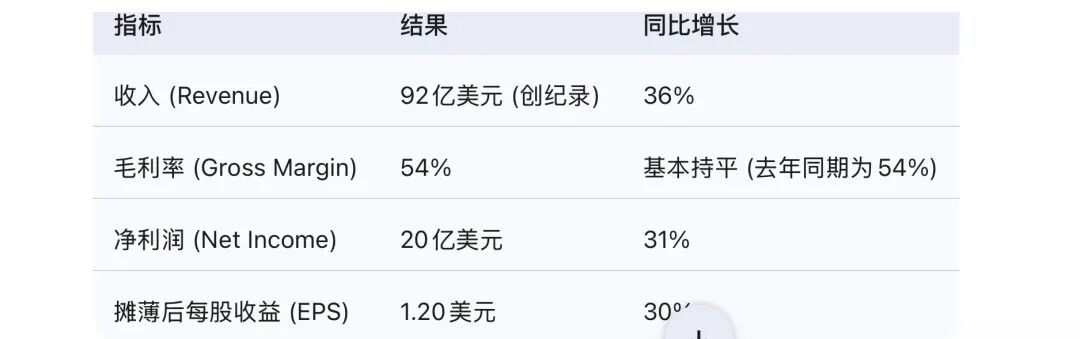
Core Viewpoint - AMD's performance in Q3 shows significant revenue growth, but the market remains focused on its gross margin, which has not exceeded expectations. Financial Performance - The company's revenue for Q3 reached $9.2 billion, marking a 36% year-over-year increase [2][3] - Net profit rose from $771 million (or $0.47 per share) in the same quarter last year to $1.24 billion (or $0.75 per share) [2] - Gross margin remained stable at 54%, unchanged from the previous year [3][5] - Net income for the quarter was $2 billion, reflecting a 31% increase [3] - Diluted earnings per share (EPS) increased by 30% to $1.20 [3] Future Guidance - The company has provided guidance for the next quarter, projecting a median revenue of $9.6 billion, which represents a 25% year-over-year growth [3] - The adjusted gross margin for the upcoming quarter is expected to be 54.5%, aligning with previous market expectations [5] Product Development and Partnerships - AMD is set to launch the next-generation 2nm Venice processors in 2026 [6] - Anticipated rapid customer momentum before the release of the next-generation MI400 series accelerators and Helios rack-level solutions [6] - Collaboration with OpenAI is expected to yield initial results in the second half of next year [6] - Plans to deploy thousands of MI450 GPUs in Oracle Cloud Infrastructure starting in 2026, with expansion into 2027 and beyond [6] - Strategic planning from a rack perspective is expected to drive gross margin increases starting in 2026 [6]

AMD终于从英伟达“平替”变成了“平起平坐”!
美股研究社· 2025-06-26 09:27
Core Viewpoint - AMD is poised to enhance its competitive position in the AI infrastructure market with the upcoming release of its next-generation MI350 and MI400 series accelerators, which are expected to significantly improve performance and deployment capabilities, potentially narrowing the gap with Nvidia [1][10][17]. Group 1: Product Developments - The MI350 series accelerators, including MI350X and MI355X, are set to begin mass production in the second half of 2025, promising up to 4 times improvement in AI computing performance and 35 times efficiency in inference workloads compared to previous generations [2][5]. - The MI400 series accelerators and the Helios system, expected to launch in 2026, will integrate advanced technologies to support complex AI workloads, with a focus on enhancing bandwidth and deployment flexibility [3][8]. - The ROCm 7 software stack has been updated to improve inference performance by 3.5 times and training performance by 3 times, further supporting AMD's hardware advancements [5][9]. Group 2: Market Position and Strategy - AMD's strategy emphasizes optimization and flexibility in deployment, allowing for significant scalability in existing infrastructure, which is crucial for large-scale customers [6][7]. - The integration of the Helios system with MI400 GPUs and Zen 6 EPYC CPUs aims to provide a comprehensive solution for AI workloads, directly competing with Nvidia's offerings [3][8]. - Early adoption by major players like Meta and OpenAI indicates growing confidence in AMD's capabilities within the AI ecosystem, enhancing its market position [10][17]. Group 3: Financial Outlook - Analysts maintain a price target of $200 for AMD, reflecting expectations of growth driven by the upcoming product launches, despite potential economic headwinds affecting AI infrastructure spending [13][14]. - The projected revenue growth for AMD's data center segment is expected to reach $32.6 billion by 2025, with a compound annual growth rate (CAGR) of 10.5% [15]. - The company's ability to provide cost-effective solutions is highlighted, with potential reductions in capital and operational expenditures for clients [5][6].