NEO机器人

Search documents
500万次围观,1X把「世界模型」真正用在了机器人NEO身上
具身智能之心· 2026-01-15 00:32
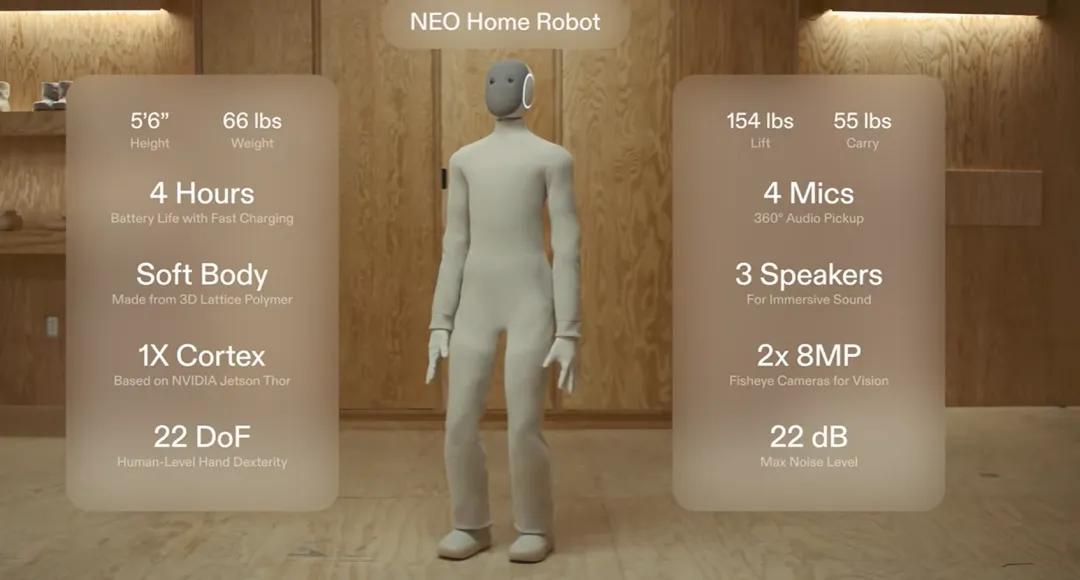
Core Viewpoint - The article discusses the advancements in the NEO home robot by 1X, particularly the introduction of the new "brain" called 1X World Model, which enables the robot to learn and perform tasks more autonomously by understanding the physical world through video pre-training [4][10]. Group 1: Technological Advancements - NEO has evolved from merely executing pre-programmed actions to being able to "imagine" tasks by generating a video in its mind before executing them [6][8]. - The 1X World Model (1XWM) integrates video pre-training to allow the robot to generalize across new objects, movements, and tasks without extensive prior data [13][24]. - The model utilizes a two-stage alignment process to convert video knowledge into actionable tasks, enhancing the robot's ability to perform in real-world scenarios [16][18]. Group 2: Training and Performance - 1XWM is built on a generative video model with 14 billion parameters, trained using a combination of detailed visual text annotations and human first-person perspective data [18][20]. - The training process includes a significant amount of human first-person video data, which improves the model's ability to understand and execute complex tasks [41]. - Experimental results indicate that NEO can perform tasks it has never encountered before, with high consistency between generated videos and actual task execution [26][30]. Group 3: Challenges and Improvements - Despite advancements, there are still challenges in executing tasks that require fine motor skills, such as pouring liquids or drawing [32]. - The quality of generated videos is linked to task success rates, prompting the team to explore methods for improving video generation quality to enhance task performance [34][41]. - The introduction of first-person data significantly boosts the model's performance in new and out-of-distribution tasks, although it may have limited effects on tasks already well-covered by existing data [42].


500万次围观,1X把「世界模型」真正用在了机器人NEO身上
3 6 Ke· 2026-01-14 02:17
Group 1 - The core concept of the article revolves around the introduction of 1X's new "brain," the 1X World Model, which enables the NEO robot to learn and understand the physical world through video observation, allowing it to perform tasks more autonomously [2][6][9] - The NEO robot now utilizes a video pre-training approach that allows it to generate a mental video of task completion before executing physical actions, marking a significant advancement in robotic intelligence [2][9][12] - The 1X World Model (1XWM) integrates a two-stage alignment process to convert video knowledge into actionable control strategies, enhancing the robot's ability to generalize across new tasks and environments without extensive pre-training data [10][12][24] Group 2 - The training process for 1XWM involves a 140 billion parameter generative video model, which is fine-tuned using human first-person perspective data and specific robot data to ensure compatibility with NEO's physical characteristics [12][15] - The model has demonstrated strong performance in task generalization, successfully executing tasks it has never encountered before, such as grasping unfamiliar objects and performing new action patterns [16][17] - The research highlights the importance of high-quality first-person data and detailed subtitles in improving video generation quality, which correlates with task success rates [21][24]

500万次围观,1X把「世界模型」真正用在了机器人NEO身上
机器之心· 2026-01-14 01:39
Core Viewpoint - The article discusses the advancements in the home humanoid robot NEO, particularly the introduction of its new brain, the 1X World Model, which enables NEO to learn and perform tasks more autonomously by understanding the physical world through video training [3][4][11]. Group 1: Technological Advancements - NEO has evolved from merely executing pre-programmed actions to being able to "imagine" tasks by generating a video of successful task completion in its mind before executing it [4][6]. - The 1X World Model (1XWM) integrates video pre-training to allow NEO to generalize across new objects, movements, and tasks without extensive prior training data [11][21]. - The model is built on a 14 billion parameter generative video model, which has undergone a multi-stage training process to adapt to NEO's physical characteristics [16][18]. Group 2: Training and Evaluation - The training process includes using 900 hours of first-person human video data to align the model with human-like operational behaviors, followed by fine-tuning with 70 hours of robot data [18][19]. - The evaluation of 1XWM's capabilities shows that it can perform tasks it has never encountered before, with generated videos closely matching real-world execution [24][30]. - The importance of high-quality subtitles and first-person data in improving video generation quality and task success rates is emphasized, indicating that detailed descriptions enhance the model's performance [39][40]. Group 3: Practical Applications - NEO has been tested on various tasks, including those requiring complex interactions and coordination, demonstrating its ability to adapt and learn from video pre-training [28][30]. - The model's performance in both in-distribution and out-of-distribution tasks shows a stable success rate, although some fine manipulation tasks remain challenging [30][32]. - The article suggests that the quality of generated videos can be linked to task success rates, allowing for potential improvements in video generation through iterative testing and selection processes [32][39].

小鹏当场剪开皮肤证明里面没藏真人,但机器人长出胸部后到底能替打工人做点啥?
3 6 Ke· 2025-11-10 09:38
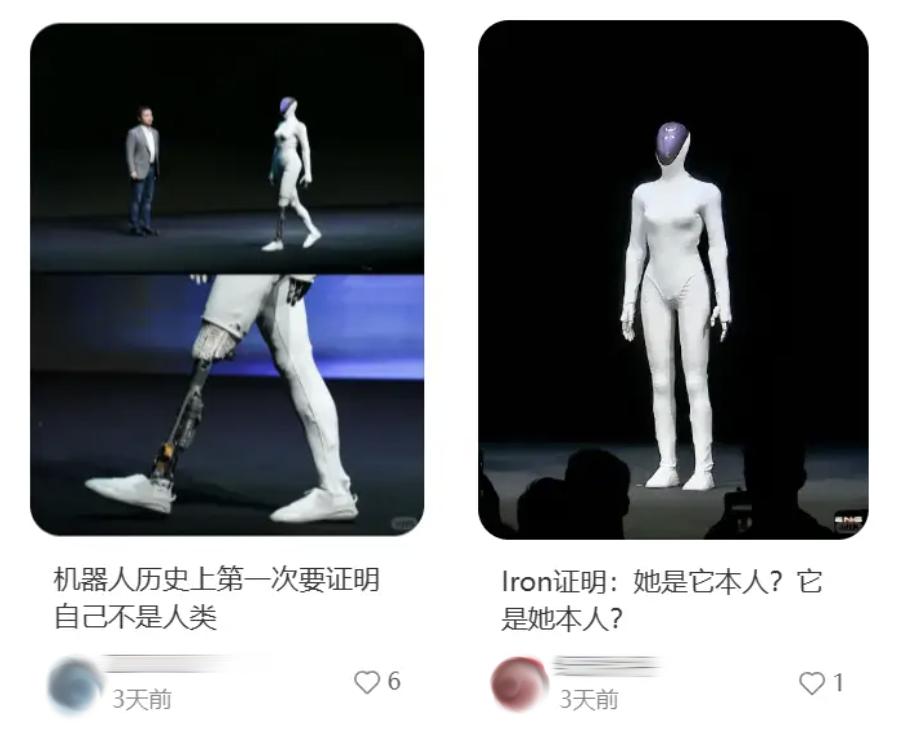
Core Viewpoint - The rapid development of humanoid robots, exemplified by Xiaopeng's IRON, raises questions about their capabilities and societal implications, particularly regarding their human-like appearance and functionality [1][3][20]. Group 1: Product Features and Development - Xiaopeng's humanoid robot IRON features a height of 178 cm and a weight of 70 kg, designed with a flexible fiber covering and a structure mimicking human anatomy [3][5]. - The robot's walking ability, which resembles a human's "catwalk," is a significant advancement, although the underlying technology is not considered groundbreaking within the industry [5][7]. - IRON's design includes movable joints in the shoulders and waist, enhancing its human-like movement, which is a departure from traditional robots that lack such features [7][20]. Group 2: Market Position and Applications - The initial application for IRON is as a sales assistant in car dealerships, highlighting its role in marketing rather than performing complex tasks [9][20]. - The rental market for humanoid robots has seen a drastic price drop, indicating a potential oversupply and raising questions about their practical applications beyond entertainment [10][12]. - Current uses for humanoid robots include performing at events and serving as customer service representatives, but their functionality in household tasks remains limited [12][13]. Group 3: Industry Challenges and Future Prospects - The humanoid robot industry faces challenges in achieving practical applications, with many robots still seen as novelty items rather than functional tools [10][18]. - The development of humanoid robots is driven by the need for market differentiation and the potential for high-value applications, despite current limitations in their capabilities [20][30]. - The expectation is that humanoid robots could eventually perform 40%-50% of tasks currently done by humans, but significant technological advancements are still required [30][31].

“机器人元年”的狂欢:为什么要把它们塑造成表演型人才?
Feng Huang Wang· 2025-11-04 11:39
Group 1 - The article discusses the current state of humanoid robots in China, highlighting their limitations and the gap between public expectations and actual capabilities [4][5][6] - Despite the hype surrounding humanoid robots, many of them are often non-functional or require remote control, leading to a perception of them as mere entertainment rather than practical tools [4][5][6] - The industry has seen significant investment, with humanoid robot companies in China securing over 60% of global funding, indicating strong interest from investors despite the challenges [7][8] Group 2 - The article notes that many humanoid robots are primarily used for demonstrations and performances rather than practical applications, with sales to individual consumers being limited due to high costs and safety concerns [14][16] - The rental market for robots has emerged, with companies renting out robots for events, which has become a more viable business model compared to direct sales [18][21] - The narrative around robots has been shaped by media and public perception, with significant events like the Spring Festival Gala boosting visibility and investment in the sector [22][28] Group 3 - The article emphasizes that while there is a growing interest in humanoid robots, the technology is still not ready for widespread household use, with many robots struggling to perform basic tasks [26][27] - The future of robotics may not necessarily be humanoid, as other forms of robots have proven to be more effective in specific applications, suggesting a need for a shift in focus within the industry [26][27] - The article concludes that while the "iPhone moment" for robots may eventually arrive, significant technological and practical hurdles remain before robots can integrate into everyday life [28]