
NVIDIA Alpamayo

Search documents
Geely Expands Strategic Partnership with NVIDIA Across Physical, Enterprise, and Industrial AI
Globenewswire· 2026-03-18 13:19
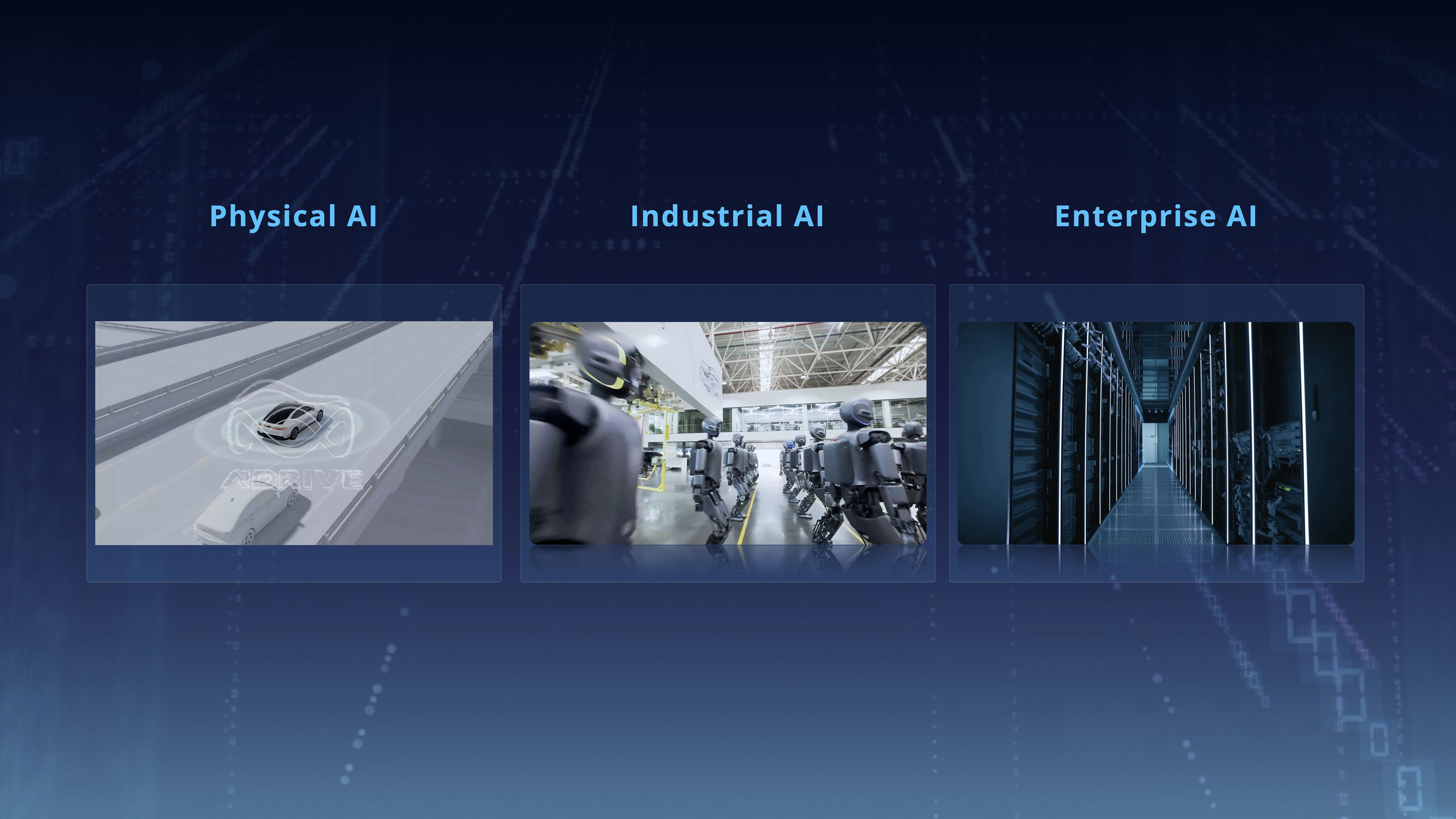
Core Insights - Geely Auto Group is expanding its strategic partnership with NVIDIA to enhance smart vehicle capabilities, cloud computing, and manufacturing digital transformation [1][5] Group 1: Partnership Expansion - The collaboration focuses on three core dimensions: Physical AI, Enterprise AI, and Industrial AI [1][5] - Geely's G-ASD system will integrate NVIDIA technologies such as Alpamayo, Cosmos, and NuRec to improve development and validation efficiency [2][5] Group 2: Autonomous Driving and Robotaxis - Geely and its ecosystem partners will develop Robotaxis using the NVIDIA DRIVE AGX Hyperion platform to improve safety and generalization in complex driving scenarios [4][5] Group 3: AI Infrastructure and Cloud Computing - Geely will utilize NVIDIA's AI supercomputing platform, Nemotron models, NeMo software, and the NVIDIA AI Enterprise suite to enhance its AI capabilities and transition into an "AI organization" [5][8] Group 4: In-Vehicle Experiences - Geely will be the first to deploy the Dimensity Auto Cockpit C-X1, optimized for LLM and VLM inference performance, featuring NVIDIA's Blackwell GPU [7][5] - The partnership will also leverage NVIDIA's edge computing and AI models for advanced in-vehicle experiences [5][7] Group 5: Industrial AI and Automation - The collaboration includes applications of Vision AI agents and factory automation using NVIDIA Omniverse libraries to shorten R&D cycles and enhance manufacturing flexibility [8][5] Group 6: New Model Launches - Geely is accelerating the application of AI capabilities in real-world scenarios with the launch of new car models like the Zeekr 8X [9]



吉利宣布与英伟达在AI领域深化合作
Mei Ri Jing Ji Xin Wen· 2026-03-18 12:12
Core Insights - Geely Auto Group's CTO announced a deepening collaboration with NVIDIA in three key areas: physical AI, enterprise AI, and industrial AI [1] - The partnership will focus on intelligent driving, smart cockpit, intelligent manufacturing and R&D, as well as cloud and AI infrastructure [1] Group 1: Intelligent Driving - Geely's G-ASD will integrate NVIDIA's Alpamayo, Cosmos, and NuRec to enhance the development, simulation, and validation efficiency of intelligent driving [1] - The collaboration aims to define the next generation of smart mobility technology [1] Group 2: Robotaxi Development - Geely will work with ecosystem partners to utilize NVIDIA's DRIVE AGX Hyperion architecture for the development and commercialization of robotaxis [1] - This initiative is expected to improve generalization capabilities and safety redundancy in complex driving scenarios [1]
NVIDIA Expands Open Model Families to Power the Next Wave of Agentic, Physical and Healthcare AI
Globenewswire· 2026-03-16 20:15
Core Insights - NVIDIA is expanding its open model families to enhance agentic, physical, and healthcare AI, enabling developers to create intelligent systems that can operate in both digital and real-world environments [2][3] Group 1: Open Model Expansion - NVIDIA's portfolio now includes models such as Nemotron™ for agentic systems, Cosmos™ for physical AI, Alpamayo for autonomous vehicles, Isaac™ GR00T for robotics, and BioNeMo™ for biomedical research, aimed at unlocking new capabilities across various industries [3][4] - The Nemotron family is introducing omni-understanding models that enhance multimodal intelligence, allowing for natural conversations, complex reasoning, and advanced visual capabilities [5][17] Group 2: Industry Adoption - Companies like Automation Anywhere, CodeRabbit, and ServiceNow are deploying NVIDIA Nemotron models for advanced agentic applications, while Edison Scientific utilizes it in Kosmos, an autonomous AI scientist used by over 50,000 researchers [6][7] - AI developers globally are leveraging Nemotron models to create sovereign models that cater to billions of users in their native languages, aligning with local cultures [8] Group 3: Healthcare and Life Sciences - NVIDIA is advancing AI-driven discovery in healthcare with open, multimodal foundation models that accelerate biomedical research, drug discovery, and medical imaging [12][19] - The Proteina-Complexa model, part of the BioNeMo platform, is designed to accelerate protein drug discovery, with collaborations expanding the AlphaFold Protein Structure Database by calculating approximately 30 million protein complex predictions [19][20] Group 4: Performance and Efficiency - The Nemotron 3 Ultra model achieves 5x throughput efficiency on the NVIDIA Blackwell platform, supporting AI-native applications like coding assistants and complex workflow automation [17] - The nvQSP simulation engine allows pharmaceutical researchers to explore numerous treatment scenarios, delivering up to 77x faster performance compared to traditional simulations [21]

老黄All in物理AI!最新GPU性能5倍提升,还砸掉了智驾门槛
量子位· 2026-01-06 01:01
Core Viewpoint - NVIDIA is shifting its focus entirely towards AI, as evidenced by its absence of gaming graphics cards at CES 2026 and the introduction of new AI products and architectures [2][10]. Group 1: AI Product Launches - NVIDIA unveiled the next-generation Rubin architecture GPU, which boasts inference and training performance that are 5 times and 3.5 times better than the Blackwell GB200, respectively [4][17]. - The company introduced five new product families targeting various AI applications, including the NVIDIA Nemotron for Agentic AI, NVIDIA Cosmos for physical AI, and NVIDIA Alpamayo for autonomous driving [6][8][39]. - The Vera Rubin NVL72 architecture was officially launched, featuring six core components designed to enhance AI data center capabilities [14][15]. Group 2: Performance Metrics - The Rubin GPU achieves an inference performance of 50 PFLOPS and a training performance of 35 PFLOPS under the NVFP4 data type, significantly surpassing its predecessor [17]. - Each Rubin GPU is equipped with 288GB of HBM4 memory and offers a bandwidth of 22 TB/s, supporting the high computational demands of modern AI models [18]. - The overall architecture of the Vera Rubin NVL72 can deliver 3.6 exaFLOPS of NVFP4 inference performance and 2.5 exaFLOPS of training performance [37]. Group 3: Networking and Connectivity - The introduction of NVLink 6 enhances interconnect bandwidth to 3.6 TB/s per GPU, with a total bandwidth of 260 TB/s across the entire NVL72 rack [20][21]. - The Vera CPU integrates 88 custom Arm cores and features a bandwidth of 1.8 TB/s for NVLink C2C interconnect, facilitating efficient communication between CPU and GPU [22]. Group 4: AI Model Developments - The Alpamayo model, a large-scale open-source visual-language-action model for autonomous driving, was launched with 10 billion parameters [41]. - The Nemotron series expanded to include specialized models for speech recognition, visual-language processing, and safety, enhancing AI applications across various sectors [49][51]. - The Cosmos model for robotics was upgraded to generate synthetic data that adheres to real-world physical laws, aiding in the development of AI agents [54][58]. Group 5: Industry Impact and Future Outlook - NVIDIA's comprehensive approach to AI, integrating models, data, and tools, is expected to strengthen its competitive edge and ecosystem lock-in [10]. - The company plans to begin mass production of the Vera Rubin NVL72 in the second half of 2026, indicating a strong commitment to advancing AI infrastructure [38].

NVIDIA Announces Alpamayo Family of Open-Source AI Models and Tools to Accelerate Safe, Reasoning-Based Autonomous Vehicle Development
Globenewswire· 2026-01-05 21:49
Core Insights - NVIDIA has introduced the Alpamayo family of open AI models, simulation tools, and datasets aimed at enhancing the development of safe, reasoning-based autonomous vehicles (AVs) [1][12] - The Alpamayo models are designed to address the challenges of operating AVs in complex and rare driving scenarios, known as the "long tail" [2][12] - The integration of reasoning capabilities into AV decision-making is expected to improve safety, explainability, and scalability in autonomous driving [3][4] Group 1: Product Features - The Alpamayo family includes chain-of-thought, reasoning-based vision language action (VLA) models that enable AVs to process and respond to novel scenarios step by step [3][12] - Alpamayo 1, a key model in the family, features a 10-billion-parameter architecture that utilizes video input to generate driving trajectories and reasoning traces [13] - AlpaSim is an open-source simulation framework that supports high-fidelity AV development, providing realistic sensor modeling and scalable testing environments [13] Group 2: Industry Support and Collaboration - Major mobility leaders such as Lucid, JLR, and Uber are expressing interest in the Alpamayo models to develop reasoning-based AV stacks that facilitate level 4 autonomy [8][12] - The open-source nature of Alpamayo is seen as a catalyst for innovation within the autonomous driving ecosystem, allowing developers to adapt the technology for specific needs [9][12] - The release of Alpamayo is viewed as a significant advancement for the AV research community, enabling unprecedented scale in training and development [12][13] Group 3: Market Implications - The introduction of reasoning capabilities in AVs is anticipated to enhance their ability to navigate complex environments and make safe decisions in unpredictable scenarios [4][12] - The shift towards physical AI emphasizes the necessity for AI systems that can reason about real-world behavior, moving beyond mere data processing [9][12] - The comprehensive ecosystem provided by Alpamayo, including models, datasets, and simulation tools, is expected to accelerate the deployment of safe, reasoning-based autonomous vehicles [4][12]
NVIDIA (NasdaqGS:NVDA) 2026 Earnings Call Presentation
2026-01-05 21:00
Open Model Ecosystem - NVIDIA leads the open model ecosystem [14, 100] - 80% of startups are building on open models [10] - 1-in-4 OpenRouter tokens are generated by open models [10] AI Performance and Benchmarks - NVIDIA's Llama Nemotron Nano VL 8B achieves 70.2% in Text 4 Recognition, 69.1% in Text 4 Referring, 61.8% in Text 4 Spotting, 81.4% in Relation 4 Extraction, 39.2% in Element A Parsing, 31.9% in Mathematical 4 Calculation, and 73.1% in Visual Unders A [20] - nvidia/canary-gwen-2.5b achieves an average WER of 5.63 [26] New NVIDIA Technologies - NVIDIA announces Alpamayo, an open reasoning VLA for autonomous vehicles [61, 65] - NVIDIA ships full-stack AV on 2025 Mercedes Benz CLA [68] - NVIDIA Vera CPU features 88 custom Olympus cores, 176 threads, 1.8 TB/s NVLink-C2C, 1.5 TB system memory, 1.2 TB/s LPDDR5X, and 227 billion transistors [120] - NVIDIA Rubin GPU offers 50 PFLOPS NVFP4 Inference (5X Blackwell), 35 PFLOPS NVFP4 Training (3.5X), 22 TB/s HBM4 Bandwidth (2.8X), 3.6 TB/s NVLink Bandwidth per GPU (2X), and 336 billion transistors (1.6X) [122] - NVIDIA ConnectX-9 Spectrum-X SuperNIC provides 800 Gb/s Ethernet, programmable RDMA, line-speed encryption, and 23 billion transistors [125] - NVIDIA BlueField-4 offers 800G Gb/s DPU, 64 Core Grace CPU, 6X Compute, 2X Networking, 3X Memory BW, and 126 Billion Transistors [127] - NVIDIA NVLink 6 Switch scales up fabric with 3.6 TB/s per-GPU bandwidth and 108 billion transistors [131] - NVIDIA Vera Rubin NVL72 achieves 3.6 EFLOPS NVFP4 Inference (5X Blackwell), 2.5 EFLOPS NVFP4 Training (3.5X), 54 TB LPDDR5X Capacity (3X), 20.7 TB HBM Capacity (1.5X), 1.6 PB/s HBM4 Bandwidth (2.8X), 260 TB/s Scale-Up Bandwidth (2X), and 220 Trillion Transistors (1.7X) [134] - NVIDIA Spectrum-X Ethernet Co-Packaged Optics scales to 102.4 Tb/s with 200G silicon photonics and 352 billion transistors [136]