AlpaSim

Search documents
英伟达的汽车“生意经”
3 6 Ke· 2026-01-22 02:42
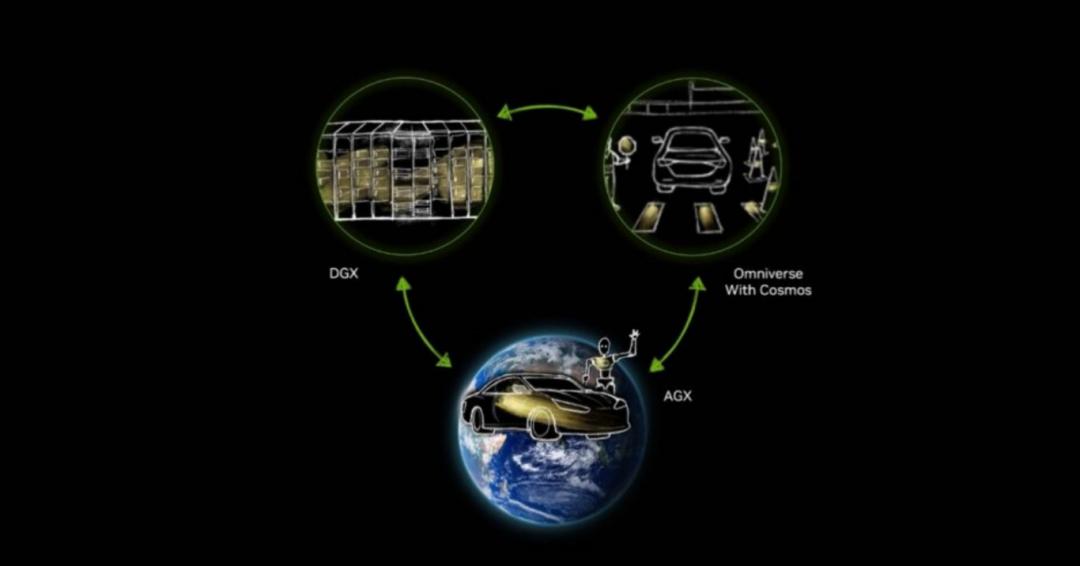
Core Insights - NVIDIA is redefining the next decade of smart automotive technology through a comprehensive approach that integrates cloud simulation and in-vehicle inference [1][2] Group 1: NVIDIA's Transformation - NVIDIA has evolved from a chip supplier to a comprehensive provider of autonomous driving solutions, offering not just vehicle chips (AGX) but also cloud training (DGX) and simulation (OVX) capabilities [2][3] - The company has opened its core AI models and datasets to lower industry barriers and expand its ecosystem, driving demand for computational power and reshaping industry standards [2][3] Group 2: Three Pillars of NVIDIA's Strategy - NVIDIA's automotive strategy is built on three key components: DGX for AI model training, OVX for simulation, and AGX for in-vehicle inference [3][8] - DGX serves as a training factory, utilizing a supercomputing cluster of thousands of GPUs to process vast amounts of driving data, including real-world videos and virtual simulations [4][9] - OVX creates a digital twin of the real world, allowing for extensive testing of autonomous driving algorithms in a risk-free environment [5][6][7] - AGX represents NVIDIA's well-known in-vehicle computing chips, with performance increasing from tens of TOPS to over a thousand TOPS, becoming standard in flagship models from various automakers [8][11] Group 3: Business Model Evolution - NVIDIA's revenue model has shifted from solely selling hardware to providing engineering services, where they assist automakers in optimizing algorithms on NVIDIA's platform [12][13] - This service model fosters a mutually beneficial relationship, allowing automakers to enhance their development capabilities while providing NVIDIA with valuable feedback for product improvement [13] Group 4: Open Source Strategy - In early 2025, NVIDIA announced the open-sourcing of its Alpamayo series, which includes a 100 billion parameter model and a comprehensive simulation framework, aimed at accelerating the development of autonomous driving technologies [16][17] - This strategic move lowers industry barriers, addresses the scarcity of high-quality data, and positions NVIDIA as a leader in defining the next generation of technology frameworks [18] Group 5: Market Dynamics and Competitive Edge - The demand from the Chinese market significantly drives NVIDIA's accelerated pace in the automotive sector, with local automakers pushing for rapid development and deployment of advanced features [21] - NVIDIA's confidence in its competitive position stems from its comprehensive engineering capabilities and the extensive ecosystem it has built over years, which is difficult for competitors to replicate [24] - The company's strategy is to become an architect and enabler of the AI-driven mobility era, moving beyond being just a supplier to defining new rules in the automotive industry [24]


英伟达还是放不下自动驾驶
远川研究所· 2026-01-12 13:12
Core Viewpoint - Nvidia is launching a comprehensive offensive in the autonomous driving sector with its open-source VLA model, Alpamayo, which aims to provide car manufacturers with a robust foundation for developing their own autonomous driving technologies [6][10][21]. Group 1: Nvidia's Innovations - At CES 2026, Nvidia announced the Alpamayo model, which utilizes a Vision-Language-Action (VLA) approach to enhance decision-making in autonomous driving by making the reasoning process interpretable and traceable [7][10]. - Alpamayo is the first open-source VLA model, allowing car manufacturers to customize it based on their data and needs, thus reducing development complexity while ensuring algorithmic differentiation [10][11]. - Alongside Alpamayo, Nvidia also introduced AlpaSim for closed-loop testing and the Physical AI dataset, which contains over 1,727 hours of driving data, providing a comprehensive toolkit for developers [11][13]. Group 2: Competitive Landscape - Other companies, such as Xiaopeng and Li Auto, are also developing VLA models, indicating a competitive shift towards this technology in the autonomous driving space [8][10]. - Tesla's FSD appears to be adopting a similar VLA-like architecture, although it remains less transparent compared to Nvidia's approach [10][14]. Group 3: Nvidia's Business Strategy - Nvidia's automotive business, while dominant in high-level driving assistance, has not met revenue expectations compared to its data center operations, prompting a strategic shift to provide more comprehensive support to car manufacturers [15][20]. - The company aims to create a closed-loop toolchain for intelligent driving, integrating cloud training and vehicle-side inference, thus facilitating easier adoption of its hardware and software solutions by automakers [21][22]. - Nvidia's strategy reflects a balance between standardization and customization, as it seeks to provide a rich software toolbox while avoiding direct involvement in specific autonomous driving projects [22][24].

东方证券:英伟达(NVDA.US)发布自动驾驶开源模型 预计Robo-X规模化进展有望加速
Zhi Tong Cai Jing· 2026-01-08 07:08
Core Insights - Nvidia has launched an open-source AI model platform, Alpamayo, aimed at enhancing autonomous driving capabilities, which is expected to accelerate the penetration of high-level autonomous driving and Robo-X services [2][3] Group 1: Nvidia's Innovations - Nvidia's CEO Jensen Huang introduced the open-source VLA (Vision-Language-Action) model platform, Alpamayo, at CES 2026, along with simulation tools and an open dataset containing over 1,700 hours of driving data, creating a comprehensive autonomous driving ecosystem [2] - Alpamayo, as a reasoning VLA model, can progressively solve complex problems and generate reasoning traces similar to human thought processes, enabling safe driving in complex environments and explaining safety decisions [2][3] Group 2: Market Trends and Projections - The current stage of Robotaxi services is approaching a break-even point per vehicle, with leading companies like Loongbo and Pony.ai achieving or nearing this milestone, indicating a potential increase in revenue and profitability for Robotaxi businesses [3] - The deployment costs for unmanned logistics vehicles have dropped below 100,000 yuan, making them a cost-effective alternative to manual labor, with predictions of nearly 40,000 units shipped in China by 2025 and 100,000 units by 2026 [3] Group 3: Opportunities for Suppliers - Nvidia's development of a global L4-level autonomous driving and Robotaxi ecosystem includes partnerships with various operators and suppliers, suggesting a growing demand for high-level autonomous driving components such as smart driving chips, LiDAR, domain controllers, and electronic control systems [3] - The expansion of Nvidia's autonomous driving ecosystem is expected to create ongoing opportunities for suppliers of both hardware and software in the autonomous driving sector [3] Group 4: Investment Recommendations - The launch of the open-source autonomous driving model Alpamayo is anticipated to benefit automotive companies, component suppliers, and mobility service providers, with specific investment targets identified in the report [4]

东方证券:英伟达发布自动驾驶开源模型 预计Robo-X规模化进展有望加速
Zhi Tong Cai Jing· 2026-01-08 07:05
Core Insights - Nvidia has launched the open-source AI model platform Alpamayo for autonomous driving at CES 2026, which is expected to enhance the penetration of advanced autonomous driving and Robo-X services [1][2] - The platform includes simulation tools and an open dataset with over 1,700 hours of driving data, aiming to create a comprehensive autonomous driving ecosystem [1] - Nvidia's CEO Jensen Huang announced that the NVIDIA DRIVE AV system will first be integrated into the Mercedes CLA, with plans for a self-driving taxi service testing in 2027 [1] Group 1: Technology and Innovation - Alpamayo, as a reasoning VLA model, can solve complex problems and generate reasoning traces similar to human thought processes, enabling safe driving in complex environments [2] - The introduction of Alpamayo is expected to accelerate the iteration of autonomous driving technology and promote the deployment of advanced autonomous driving and Robotaxi/Robovan services [2] Group 2: Market Trends and Projections - The Robotaxi sector is approaching a break-even point for individual vehicles, with leading companies like Luobo Kuaipao and Pony.ai achieving or nearing this milestone [3] - The deployment costs for unmanned logistics vehicles have dropped below 100,000 yuan, making them a cost-effective alternative to human labor [3] - Predictions indicate that the shipment volume of unmanned delivery vehicles in China will reach nearly 40,000 units in 2025 and is expected to double to 100,000 units in 2026 [3] Group 3: Ecosystem Development - Nvidia is building a global L4-level autonomous driving and Robotaxi ecosystem, collaborating with various operators and suppliers in the industry [4] - The demand for advanced autonomous driving components such as intelligent driving chips, LiDAR, domain controllers, and electronic control systems is anticipated to grow rapidly as the ecosystem expands [4] Group 4: Investment Opportunities - The launch of the Alpamayo platform is expected to benefit automotive companies, component suppliers, and mobility service providers [5] - Key investment targets include component suppliers like Jingwei Hirain (688326.SH), Desay SV (002920.SZ), and vehicle manufacturers such as XPeng Motors (09868) and Pony.ai (02026) [5]
开源证券晨会纪要-20260107
KAIYUAN SECURITIES· 2026-01-07 15:19
Group 1: Automotive Industry - Nvidia launched the Alpamayo inference driving model at CES 2026, featuring a 100 billion parameter end-to-end VLA (Vision-Language-Action) model, which enhances the reasoning capabilities for novel scenarios and provides interpretability for driving decisions [5][10] - The introduction of simulation tools like AlpaSim and a 1700-hour physical AI open dataset supports autonomous driving training and testing, aiming to create a comprehensive autonomous driving solution [10][11] - The demand for autonomous driving features is increasing, becoming essential for consumers when choosing vehicles, with expectations for L2++ and L4 Robotaxi technologies to proliferate globally [12][11] Group 2: Electronics Industry - The consumer electronics and components sector showed significant performance improvement in 2025, with the PCB industry leading in growth due to rapid iterations and shipments of AI products [6][15] - Traditional categories like smartphones and PCs maintained stable growth, while AI glasses and AI servers exhibited rapid growth trends [16][19] - Investment strategies for 2026 focus on key players in the Apple, Huawei HarmonyOS, AI glasses, and OpenAI hardware sectors, indicating a new cycle of innovation in consumer electronics [17][20] Group 3: Chemical Industry - Salt Lake Co. reported an expected net profit of 82.9-88.9 billion yuan for 2025, a year-on-year increase of 77.78%-90.65%, driven by the recovery in potassium and lithium prices [22][24] - The company plans to acquire a 51% stake in Minmetals Salt Lake to expand its potassium and lithium resources, with projected net profits for 2025-2027 revised upwards [23][24] - The production of potassium chloride is expected to be approximately 4.9 million tons in 2025, while lithium carbonate production is projected at 46,500 tons, reflecting a strategic focus on resource control and high-quality development [24][22] Group 4: Investment Recommendations - The automotive sector is advised to focus on companies like Desay SV, Huayang Group, and XPeng Motors, which are expected to benefit from advancements in autonomous driving technology [13] - In the electronics sector, companies such as Industrial Fulian, Luxshare Precision, and GoerTek are highlighted as beneficiaries of the AI computing and terminal resonance [20][19] - Salt Lake Co. is recommended for investment due to its strong market position in potassium and lithium resources and the anticipated growth from the acquisition of Minmetals Salt Lake [23][22]


英伟达发布自动驾驶开源模型,将促进相关软硬件及Robo-X渗透率提升
Orient Securities· 2026-01-07 11:11
Investment Rating - The industry investment rating is Neutral (maintained) [5] Core Insights - NVIDIA has launched an open-source autonomous driving model, Alpamayo, which is expected to enhance the penetration rates of high-level autonomous driving and Robo-X. This development is anticipated to benefit related vehicle manufacturers, component suppliers, and mobility service providers [3][9] - The Robo-X scale is expected to accelerate, with leading companies like LoBot and Pony.ai achieving or nearing single-vehicle breakeven points for their Robotaxi services. The deployment of Robovans is also increasing, with significant cost reductions in unmanned logistics vehicles [8] - NVIDIA is building a comprehensive autonomous driving ecosystem, which is likely to create growth opportunities for suppliers of autonomous driving hardware and software as demand for advanced components rises [8] Summary by Sections Investment Recommendations and Targets - Recommended stocks in the component sector include: - Jingwei Hirain (688326, Buy) - Bertel (603596, Buy) - Desay SV (002920, Buy) - Huayang Group (002906, Buy) - Coboda (603786, Buy) - Horizon Robotics (09660, Not Rated) - Hesai (02525, Not Rated) - Nexperia (01316, Not Rated) - Recommended stocks in the vehicle and mobility service sector include: - Xpeng Motors (09868, Not Rated) - Seres (601127, Not Rated) - Pony.ai (02026, Not Rated) [3][9]
“Alpamayo”推理平台出炉!英伟达为何急于布局自动驾驶?
Zhong Guo Qi Che Bao Wang· 2026-01-07 01:54
Core Viewpoint - Nvidia has launched the Alpamayo series of open-source AI autonomous driving models, simulation tools, and datasets aimed at enhancing decision-making capabilities in complex driving scenarios, marking a significant innovation in the autonomous driving sector [2][3][5]. Group 1: Technology and Innovation - The Alpamayo platform represents a shift from traditional "perception-execution" models to a more human-like reasoning approach, integrating a 10 billion parameter model and over 1700 hours of real-world driving data [5]. - The platform enhances decision transparency and can generate driving trajectories based on video inputs, facilitating research and model development [3][4]. - The introduction of Alpamayo allows for a 40% improvement in the resolution of long-tail problems, significantly enhancing the safety and reliability of autonomous driving systems [5]. Group 2: Open Source Strategy - Nvidia's open-source strategy lowers the barriers to entry for automakers, allowing them to bypass 5-8 years of algorithm development and rapidly build Level 4 autonomous driving systems [6]. - Companies using the Alpamayo platform can reduce R&D costs by 65% and shorten development cycles to 18 months, reshaping the industry's technical entry barriers [6]. Group 3: Market Position and Competition - Nvidia's Drive Thor chip offers dynamic computing power distribution, supporting a range from Level 2+ to Level 4 autonomous driving needs, showcasing its robust hardware capabilities [7]. - The company has established a strong presence in the automotive sector, covering 70% of mainstream automakers globally, although its automotive business revenue share is not the highest yet [8]. - Competitors like Tesla and Mobileye are ramping up their market presence, prompting Nvidia to solidify its technological position in the face of increasing competition [8]. Group 4: Regulatory Challenges - Nvidia faces challenges in global expansion due to varying autonomous driving regulations across different regions, necessitating adjustments to its technology and products [9]. - The company must navigate safety, ethical, and regulatory requirements while advancing autonomous driving technology [9]. Group 5: Future Outlook - Nvidia's CEO predicts that most cars will achieve autonomous or highly autonomous driving within the next decade, indicating a transformative phase for the automotive industry [10]. - The launch of Alpamayo is seen as a redefinition of the automotive industry, aligning with the new market demand for "computing power as productivity" [10].
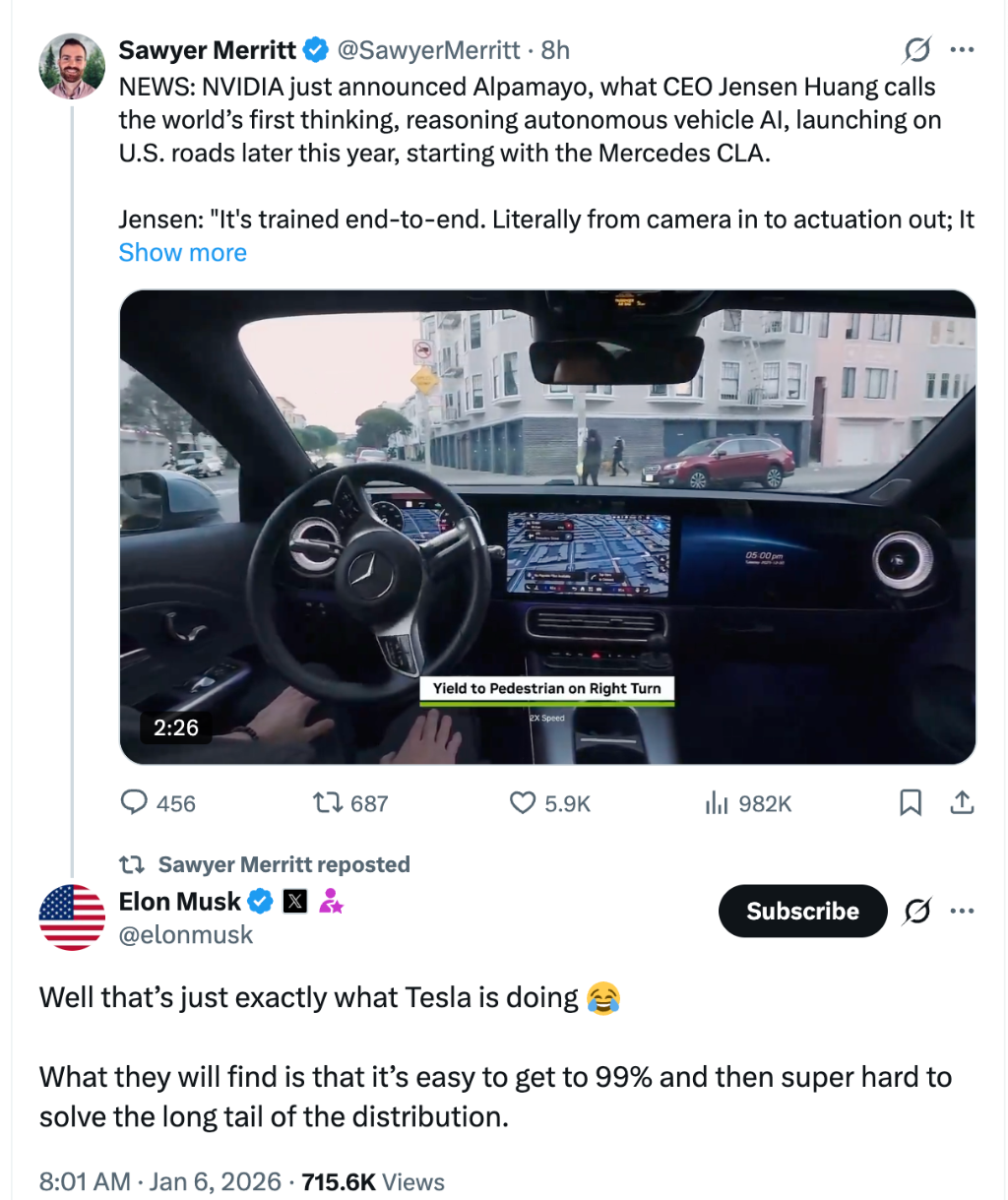
英伟达做了个FSD?马斯克淡定回应:我不会为此失眠
Hua Er Jie Jian Wen· 2026-01-06 07:53
Core Insights - Nvidia has launched an open-source autonomous driving AI model named Alpamayo at CES 2026, which CEO Jensen Huang claims to be the world's first AI capable of thinking and reasoning, directly challenging Tesla's FSD system [1][5] - Tesla's CEO Elon Musk responded to concerns about Alpamayo being a true competitor to FSD, emphasizing the difficulty of solving the long-tail problem in autonomous driving [3][8] Group 1: Product Features and Technology - Alpamayo is described as a "physical AI's ChatGPT moment," designed to address the long-tail problem in autonomous driving, which involves rare edge cases that can cause system failures [5] - The flagship model, Alpamayo 1, features 10 billion parameters and utilizes a visual-language-action (VLA) model that not only detects objects and plans paths but also explains its decision-making process in natural language [5][6] - Nvidia's open-source strategy includes making the Alpamayo 1 model weights available on the Hugging Face platform, along with an end-to-end simulation framework called AlpaSim and a dataset covering 1,700 hours of complex driving scenarios [6] Group 2: Competitive Landscape - Nvidia positions Alpamayo as the "Android of autonomous driving," aiming to create an open ecosystem in contrast to Tesla's closed FSD system [6] - The technology is set to be integrated into the Mercedes-Benz CLA models starting in Q1 of this year, marking a significant step towards commercialization [6] - Musk highlighted the structural advantages Tesla has due to its extensive real-world data collected from millions of vehicles, which aids in addressing the long-tail problem and enhances iteration efficiency [8]

NVIDIA推出Alpamayo系列开源AI模型与工具,加速安全可靠的推理型辅助驾驶汽车开发
Xin Lang Cai Jing· 2026-01-06 04:37
Core Insights - NVIDIA has launched the Alpamayo series of open-source AI models, simulation tools, and datasets aimed at advancing the development of safe and reliable inference-based autonomous driving vehicles [1][3] Group 1: Technology and Features - The Alpamayo series introduces a VLA reasoning model based on chain-of-thought, enhancing decision-making capabilities in autonomous driving systems to handle rare and complex scenarios [1][3] - Alpamayo 1 is the first reasoning model designed for the autonomous driving research community, featuring a 10 billion parameter architecture that generates driving trajectories from video input while providing reasoning insights [3][4] - AlpaSim is a fully open-source end-to-end simulation framework that offers realistic sensor modeling and configurable traffic dynamics, supporting rapid validation and strategy optimization [4] Group 2: Data and Ecosystem - NVIDIA provides a diverse large-scale open dataset for autonomous driving, containing over 1,700 hours of driving data across various geographic areas and environmental conditions, essential for developing reasoning architectures [4] - The Alpamayo ecosystem integrates open models, simulation frameworks, and datasets into a unified system, allowing developers and research teams to build upon it for their projects [3][4] Group 3: Industry Support and Impact - Leading companies in the mobility sector, including Lucid, Jaguar Land Rover, and Uber, have shown significant interest in Alpamayo, aiming to develop reasoning-based autonomous driving stacks for achieving Level 4 autonomy [5] - Industry experts emphasize the growing need for AI systems that not only process data but also possess reasoning capabilities to handle real-world behaviors, highlighting the importance of advanced simulation environments and rich datasets [5] - The open-source nature of Alpamayo is expected to accelerate innovation across the industry, enabling partners to adjust and optimize models according to their unique needs [5]
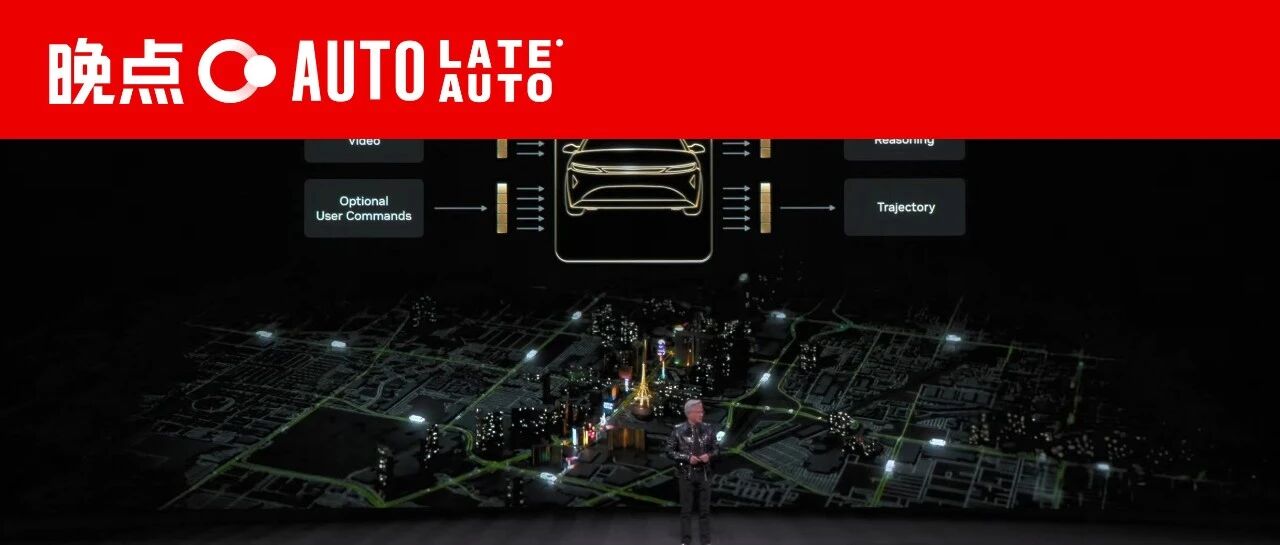
英伟达开源智驾模型,想定义 “物理 AI 的 ChatGPT 时刻”
晚点Auto· 2026-01-06 02:59
Core Viewpoint - The article discusses NVIDIA's advancements in the autonomous driving sector, particularly the launch of the open-source VLA model Alpamayo, which aims to enhance the capabilities of self-driving vehicles and compete in the market against local Chinese manufacturers [3][4][9]. Group 1: NVIDIA's Innovations - NVIDIA's CEO Jensen Huang announced at CES 2026 that the future will see 1 billion vehicles achieving high or full automation, with autonomous taxis being one of the first beneficiaries [3]. - The Alpamayo model, featuring a 10 billion parameter architecture, is designed to support Level 4 autonomous driving and is the first open-source AI system capable of reasoning and decision-making for self-driving vehicles [4][5]. - The Alpamayo series includes simulation tools and an open dataset with over 1,700 hours of driving data, providing a comprehensive foundation for developers [4]. Group 2: Competitive Landscape - Despite NVIDIA's advancements, local Chinese companies like Li Auto, Xpeng, NIO, and Huawei have already developed similar models, indicating a competitive landscape where NVIDIA is not the frontrunner [4][5]. - NVIDIA faces immediate challenges in the Level 2 assisted driving market, where it has announced a partnership with Mercedes-Benz to deploy its full-stack assisted driving solution in the 2025 model of the CLA [5][7]. - The collaboration with Mercedes-Benz involves a dual-system approach, combining an end-to-end AI system with a traditional safety-certified system to ensure reliability in complex driving scenarios [7]. Group 3: Market Opportunities and Challenges - NVIDIA's strategy includes targeting overseas markets, where the penetration of assisted driving solutions is still low compared to China, presenting significant opportunities for growth [9]. - The company is working to improve its autonomous driving solutions, with plans for quarterly software updates to enhance user experience following previous setbacks in the Chinese market [8][9]. - Despite being behind local competitors in China, NVIDIA aims to regain its influence in the autonomous driving sector through strategic partnerships and technological advancements [9].