NVIDIA Arc

Search documents
见证历史!英伟达成为首家市值突破5万亿美元的上市公司
Nan Fang Du Shi Bao· 2025-10-29 15:47
Core Viewpoint - NVIDIA's stock price surged, making it the first publicly traded company to surpass a market capitalization of $5 trillion, driven by significant announcements at the GTC conference and strong financial performance [2]. Financial Performance - For the second quarter of fiscal year 2026, NVIDIA reported revenue of $46.743 billion, a year-over-year increase of 56% [2]. - The net profit for the same period was $26.422 billion, reflecting a 59% year-over-year growth [2]. Key Announcements - NVIDIA introduced the AI-native wireless 6G technology stack, NVIDIA Arc, based on the NVIDIA Aerial platform and driven by accelerated computing [2]. - The company launched NVIDIA NVQLink, a quantum GPU interconnect technology that allows real-time CUDA-Q calls from QPU with a latency of approximately 4 microseconds [2]. - NVIDIA is collaborating with national laboratories to build a new supercomputer [2]. - CEO Jensen Huang disclosed that the visible revenue from Blackwell and Rubin has exceeded $500 billion for the next five quarters, with an order volume of approximately 20 million GPUs [2]. - NVIDIA announced a $1 billion investment in Nokia [2].



黄仁勋台上最强GPU炸场,台下感叹“中国芯片爆发”,瞄准6G投资诺基亚
3 6 Ke· 2025-10-29 08:55
Core Insights - Nvidia's new GPU launch has generated significant attention, particularly regarding its implications for the Chinese chip market, with CEO Jensen Huang highlighting the revolutionary nature of Chinese models like Qwen and DeepSeek [1][3]. Group 1: Nvidia's New Products - The newly announced Vera Rubin chip boasts a computing power of 100 PFLOPs, which is 100 times more powerful than Nvidia's first dedicated AI computer, DGX-1 [3]. - Vera Rubin is the third generation of NVLink 72 architecture, featuring a new design across chips, systems, software, and model architecture [5]. - The Vera Rubin platform will achieve 3.6 Exaflops of FP4 inference power and 1.2 Exaflops of FP8 training power by late 2026, representing a 3.3 times improvement over the previous GB300 NVL72 [10]. Group 2: Strategic Collaborations and Investments - Nvidia plans to collaborate with the U.S. Department of Energy to build seven supercomputing clusters, with two new supercomputers based on the Vera Rubin platform expected to be operational by 2027 [12]. - Nvidia has invested $1 billion in Nokia to develop a new AI-native 6G communication platform, which has led to a significant increase in Nokia's stock price [23]. Group 3: Competitive Landscape - Competitors such as AMD and Qualcomm are also making strides in the AI and data center markets, with AMD recently securing two supercomputer contracts worth $1 billion [26]. - The competition in quantum computing is intensifying, with IBM successfully implementing quantum computing without GPUs, posing a challenge to Nvidia's approach [30]. - The 6G communication sector is also seeing fierce competition, with significant advancements made by teams in China [32]. Group 4: Market Reaction - Following the announcements, Nvidia's stock price rose by 4.98% to $201.03 per share, reaching a post-market price of $204.43, which resulted in a market value increase of $315.4 billion [34].
黄仁勋台上最强GPU炸场,台下感叹“中国芯片爆发”,瞄准6G投资诺基亚
量子位· 2025-10-29 05:11
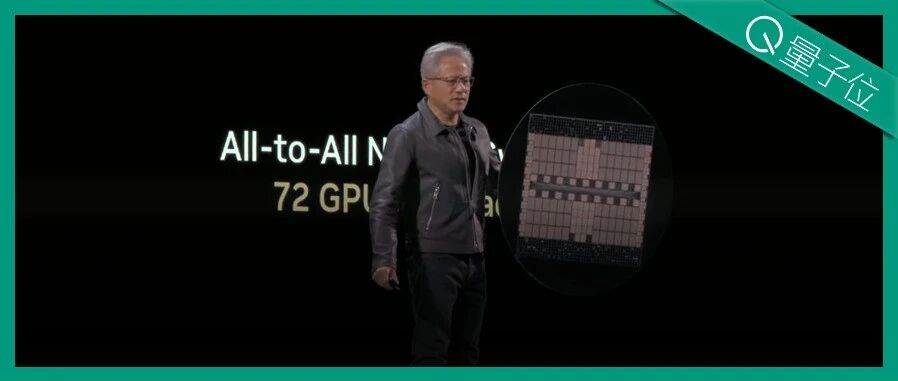
Core Viewpoint - The article highlights the significant advancements and strategic initiatives by NVIDIA in the fields of AI computing, quantum computing, and 6G communication, emphasizing the competitive landscape and potential challenges from rivals like AMD and Qualcomm [1][49]. Group 1: NVIDIA's New Chip Developments - NVIDIA introduced the Vera Rubin superchip, which boasts a computing power of 100 PFLOPs, marking a 100-fold increase over its previous AI computing model, DGX-1 [5][6]. - The Vera Rubin platform is designed with a new architecture, integrating a Vera CPU and two Rubin GPUs, with the first samples produced by TSMC [10][12]. - The upcoming Vera Rubin NVL144 platform is expected to deliver 3.6 Exaflops of FP4 inference power and 1.2 Exaflops of FP8 training power, representing a 3.3-fold improvement over the previous GB300 model [19]. Group 2: Strategic Collaborations and Investments - NVIDIA plans to collaborate with the U.S. Department of Energy to build seven new supercomputing clusters, including two new supercomputers based on the Vera Rubin platform [22]. - The company has invested $1 billion in Nokia to develop AI-native 6G communication platforms, which has positively impacted Nokia's stock price [45]. Group 3: Quantum Computing Initiatives - NVIDIA announced NVQLink, a new interconnect architecture that enables seamless integration between quantum processors (QPUs) and NVIDIA GPUs, facilitating high-speed data transfer essential for quantum error correction [29][31]. - The CUDA-Q platform was introduced to extend CUDA capabilities to support quantum GPU computing, allowing for collaboration between classical and quantum computing [33][43]. Group 4: Competitive Landscape - AMD has secured two supercomputer contracts worth $1 billion, with its Lux supercomputer expected to outperform existing systems in AI performance [50]. - Qualcomm is entering the data center market with new AI chips, AI200 and AI250, focusing on cost efficiency and enhanced memory processing capabilities [52]. - The article notes that despite NVIDIA's advancements, it faces competition from various players in the quantum computing and 6G sectors, including significant developments from Chinese companies [54][60]. Group 5: Market Reaction - Following the announcements, NVIDIA's stock price rose by 4.98%, reaching $201.03 per share, with a post-market price of $204.43, resulting in a market value increase of $315.4 billion [65][66].
黄仁勋凌晨炸场:6G、量子计算、物理AI、机器人、自动驾驶全来了!AI芯片营收已达3.5万亿|2025GTC超全指南
AI前线· 2025-10-29 00:40
Core Insights - The article discusses the significant announcements made by NVIDIA during the GPU Technology Conference (GTC), highlighting the company's ambitious plans in AI and telecommunications, particularly its collaboration with Nokia to build a 6G AI platform [2][3][10]. Group 1: NVIDIA's AI and Telecommunications Strategy - NVIDIA announced a partnership with Nokia to enhance wireless communication speeds using AI, aiming to create an AI-native mobile network and a 6G AI platform, with a $1 billion investment from NVIDIA [3][10]. - The collaboration focuses on integrating NVIDIA's Aerial RAN Computer Pro into Nokia's AirScale wireless communication system, facilitating the transition to AI-native 5G and 6G networks [10][14]. - NVIDIA's AI chip orders have reached $500 billion, showcasing the strong demand for its technology [8]. Group 2: Broader Technological Innovations - NVIDIA's CEO Huang emphasized that AI is evolving from being a user of networks to becoming the "intelligent hub" of networks [5]. - The company is also venturing into quantum computing with the development of NVQLink, which connects traditional GPUs with quantum processors, indicating a significant step in quantum technology [20]. - NVIDIA is investing in AI-driven robotics and physical AI, establishing a "three-computer" system for model training, simulation, and execution [23][24]. Group 3: AI's Expanding Role - AI is being applied beyond chatbots, with significant uses in fields like healthcare, genomics, and enterprise computing, transforming into a "digital employee" [29]. - Huang clarified that AI represents a new computing paradigm, where machines learn from data rather than following pre-written rules, marking a shift in how computing is approached [32][33]. - The concept of an "AI factory" is introduced, where AI systems are designed to produce tokens, representing a new infrastructure for modern economies [40][56]. Group 4: Future of AI and Computing - Huang discussed the exponential growth of AI's intelligence and its energy consumption, highlighting the need for extreme co-design across various technological layers to sustain this growth [46][50]. - The future of computing is envisioned as a shift from traditional command execution to enabling machines to learn and think independently, fundamentally changing productivity dynamics [58].