
NVIDIA Clara

Search documents
NVIDIA BioNeMo Platform Adopted by Life Sciences Leaders to Accelerate AI-Driven Drug Discovery
Globenewswire· 2026-01-12 15:00
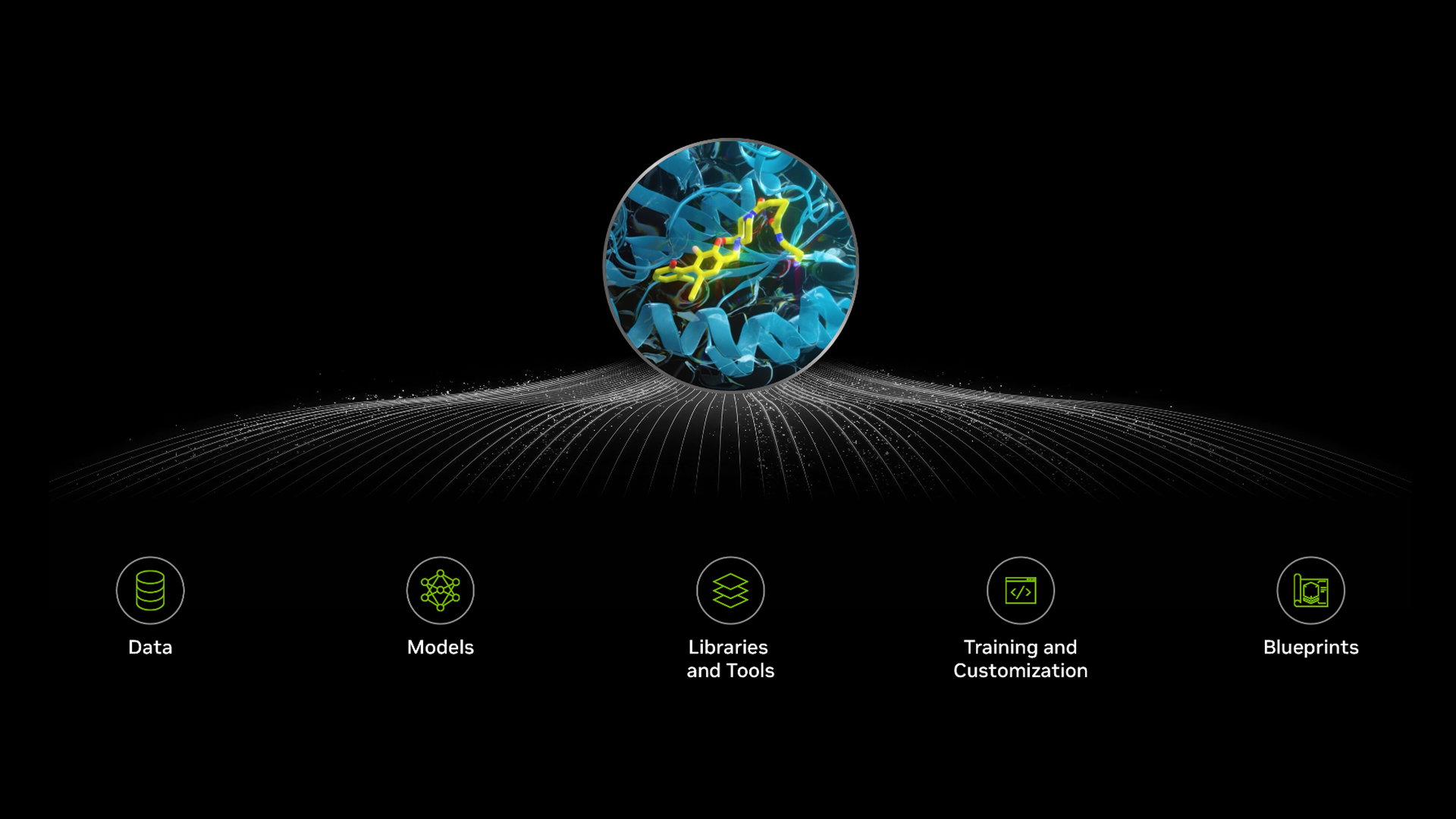
Core Insights - NVIDIA announced a significant expansion of its BioNeMo platform, aimed at enhancing AI-driven biology and drug discovery workflows [1][2] - The life sciences industry, facing $300 billion in annual R&D costs, can leverage BioNeMo to optimize data processing and model deployment, thereby increasing the probability of successful discoveries [2] - Collaborations with major companies like Lilly and Thermo Fisher are set to transform drug discovery and laboratory automation through AI integration [3][4][7] Group 1: NVIDIA BioNeMo Expansion - BioNeMo serves as an open development platform that facilitates lab-in-the-loop workflows, enabling breakthroughs in AI-driven biology and drug discovery [1][10] - The platform allows for the generation and processing of vast scientific data, training, optimizing, and deploying models to maximize discovery success while minimizing costs [2] - NVIDIA's collaboration with leading life sciences organizations aims to integrate BioNeMo with laboratory experiments, creating a continuous learning cycle that accelerates discovery [2] Group 2: Collaborations and Innovations - Lilly and NVIDIA have launched a co-innovation lab to address challenges in drug discovery, combining NVIDIA's AI and computing expertise with Lilly's drug development capabilities [3][4] - The collaboration is expected to harness investments of up to $1 billion over five years in talent, infrastructure, and computing resources [5] - Thermo Fisher's partnership with NVIDIA aims to create autonomous lab infrastructure, enhancing the efficiency and scalability of scientific research [7] Group 3: AI-Driven Drug Discovery Ecosystem - The BioNeMo platform is being utilized by various innovators globally to adopt an industrial-scale, AI-driven approach to drug discovery [8] - Companies like Chai Discovery, Basecamp Research, and Boltz are leveraging BioNeMo for model training and development in drug design [12][14] - The integration of AI with laboratory automation is expected to significantly improve the speed and accuracy of scientific experiments, ultimately accelerating discoveries with substantial human impact [7]


老黄All in物理AI!最新GPU性能5倍提升,还砸掉了智驾门槛
具身智能之心· 2026-01-07 03:33
Core Insights - NVIDIA is fully committed to AI, marking its first appearance at CES in five years without showcasing gaming graphics cards [2] - The next-generation Rubin architecture GPU demonstrates significant performance improvements, with inference and training capabilities being 5 times and 3.5 times that of the Blackwell GB200, respectively [4][17] Group 1: New Product Launches - NVIDIA introduced five new product lines, emphasizing the importance of open-source training frameworks and multimodal datasets, including 100 trillion language training tokens and 100TB of vehicle sensor data [5][6] - The Vera Rubin NVL72 architecture was officially launched, featuring six core components designed to enhance AI data center capabilities [14][15] - The Rubin GPU achieves 50 PFLOPS in inference performance and 35 PFLOPS in training performance under NVFP4 data types, significantly surpassing previous models [17] Group 2: Technological Advancements - The NVLink 6 technology enhances inter-GPU bandwidth to 3.6 TB/s, with a total bandwidth of 260 TB/s across the entire architecture [21][20] - The Vera CPU integrates 88 custom Arm cores, allowing for high thread concurrency and improved memory bandwidth [22] - NVIDIA's new BlueField-4 DPU introduces a memory layer aimed at optimizing key-value cache operations, addressing performance bottlenecks in AI infrastructure [32][34] Group 3: AI Model Developments - The Alpamayo model series was launched for autonomous driving, featuring a 10 billion parameter open-source model capable of interpreting environmental data for decision-making [39][41] - The Nemotron model family expands into voice, retrieval-augmented generation (RAG), and safety applications, enhancing AI capabilities in various domains [49][51] - The Cosmos platform for robotics has been upgraded, providing new models for generating synthetic data that adheres to physical laws [54][58] Group 4: Healthcare and Life Sciences - NVIDIA Clara targets the healthcare sector, aiming to reduce costs and accelerate the implementation of treatment solutions [62] - The company offers a dataset of 455,000 synthetic protein structures to support research in drug discovery and personalized medicine [66][69]

老黄All in物理AI!最新GPU性能5倍提升,还砸掉了智驾门槛
量子位· 2026-01-06 01:01
Core Viewpoint - NVIDIA is shifting its focus entirely towards AI, as evidenced by its absence of gaming graphics cards at CES 2026 and the introduction of new AI products and architectures [2][10]. Group 1: AI Product Launches - NVIDIA unveiled the next-generation Rubin architecture GPU, which boasts inference and training performance that are 5 times and 3.5 times better than the Blackwell GB200, respectively [4][17]. - The company introduced five new product families targeting various AI applications, including the NVIDIA Nemotron for Agentic AI, NVIDIA Cosmos for physical AI, and NVIDIA Alpamayo for autonomous driving [6][8][39]. - The Vera Rubin NVL72 architecture was officially launched, featuring six core components designed to enhance AI data center capabilities [14][15]. Group 2: Performance Metrics - The Rubin GPU achieves an inference performance of 50 PFLOPS and a training performance of 35 PFLOPS under the NVFP4 data type, significantly surpassing its predecessor [17]. - Each Rubin GPU is equipped with 288GB of HBM4 memory and offers a bandwidth of 22 TB/s, supporting the high computational demands of modern AI models [18]. - The overall architecture of the Vera Rubin NVL72 can deliver 3.6 exaFLOPS of NVFP4 inference performance and 2.5 exaFLOPS of training performance [37]. Group 3: Networking and Connectivity - The introduction of NVLink 6 enhances interconnect bandwidth to 3.6 TB/s per GPU, with a total bandwidth of 260 TB/s across the entire NVL72 rack [20][21]. - The Vera CPU integrates 88 custom Arm cores and features a bandwidth of 1.8 TB/s for NVLink C2C interconnect, facilitating efficient communication between CPU and GPU [22]. Group 4: AI Model Developments - The Alpamayo model, a large-scale open-source visual-language-action model for autonomous driving, was launched with 10 billion parameters [41]. - The Nemotron series expanded to include specialized models for speech recognition, visual-language processing, and safety, enhancing AI applications across various sectors [49][51]. - The Cosmos model for robotics was upgraded to generate synthetic data that adheres to real-world physical laws, aiding in the development of AI agents [54][58]. Group 5: Industry Impact and Future Outlook - NVIDIA's comprehensive approach to AI, integrating models, data, and tools, is expected to strengthen its competitive edge and ecosystem lock-in [10]. - The company plans to begin mass production of the Vera Rubin NVL72 in the second half of 2026, indicating a strong commitment to advancing AI infrastructure [38].

Lilly partners with NVIDIA to build the industry's most powerful AI supercomputer, supercharging medicine discovery and delivery for patients
Prnewswire· 2025-10-28 18:30
Core Insights - Eli Lilly and Company is developing the most powerful supercomputer in the pharmaceutical industry in collaboration with NVIDIA, aimed at enhancing drug discovery and development processes [1][2][3] Group 1: Supercomputer and AI Factory - The supercomputer will serve as an "AI factory," managing the entire AI lifecycle from data ingestion to high-volume inference, utilizing over 1,000 B300 GPUs on a unified networking fabric [1][2] - This initiative is expected to enable rapid learning and iteration, allowing scientists to train AI models on millions of experiments, significantly expanding drug discovery capabilities [3][4] Group 2: Applications and Benefits - Beyond drug discovery, the supercomputer will help shorten development cycles, improve medical imaging, and enhance manufacturing processes through digital twins and robotic technologies [4][5] - The AI models developed will be accessible via Lilly TuneLab, a collaborative platform aimed at expanding access to advanced discovery tools across the biopharma ecosystem [3][4] Group 3: Strategic Vision - Lilly aims to shift from using AI as a tool to embracing it as a scientific collaborator, embedding intelligence into workflows to deepen understanding of diseases and improve patient outcomes [5] - The company is committed to sustainability, ensuring the supercomputer operates on 100% renewable electricity and utilizes existing infrastructure for cooling [5]

