Nurtec ODT/Vydura

Search documents
辉瑞2025年第四季度营收175.6亿美元,非新冠业务增长9%,26全年营收指引595-625亿美元|财报见闻
Hua Er Jie Jian Wen· 2026-02-03 20:11
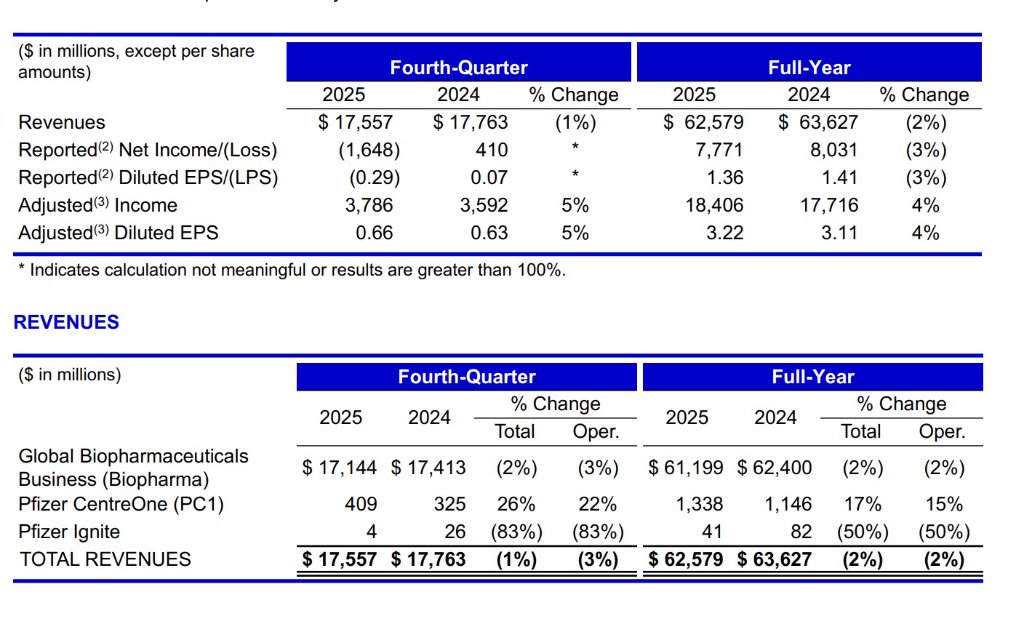
Core Insights - Pfizer demonstrated robust operational resilience during its strategic transformation phase, with total revenue reaching $62.6 billion in 2025, reflecting a 6% growth in core business excluding COVID-related products [1][4] - The company maintained its 2026 performance guidance while revealing an active product pipeline, expecting to initiate approximately 20 key clinical trials in 2026, laying the foundation for long-term growth [1][4] Financial Performance - Total revenue for Q4 2025 was $17.6 billion, a 1% decrease from Q4 2024, while full-year revenue decreased by 2% to $62.6 billion [2] - Adjusted diluted EPS for Q4 was $0.66, a 5% increase year-over-year, and for the full year, it reached $3.22, up 4% [2][3] - The adjusted sales cost ratio improved to 24.2%, down from 25.8% in 2024, indicating enhanced cost management [8] Business Segments - Non-COVID product lines showed strong structural growth, with cardiovascular and vaccine segments leading the way; Eliquis generated $8 billion in revenue, a growth of 8% [4][5] - The oncology business achieved $16.8 billion in revenue, an 8% increase, with key products like Ibrance and Xtandi maintaining strong market positions despite competition [6] - COVID-related product revenues significantly declined, with Comirnaty and Paxlovid generating $4.4 billion and $2.4 billion respectively, down 18% and 59% year-over-year [7] Strategic Initiatives - Pfizer completed the acquisition of Metsera for approximately $7 billion, marking its entry into the obesity and metabolic disease treatment market [9] - The company is advancing its obesity pipeline, with promising results from the clinical trials of its long-acting GLP-1 receptor agonist [10] - Multiple oncology products received regulatory breakthroughs, enhancing the competitive edge of Pfizer's oncology portfolio [11][12] 2026 Outlook - Pfizer projects 2026 revenue between $59.5 billion and $62.5 billion, including approximately $5 billion from COVID-related products [13] - The company plans to maintain a focus on reducing debt levels and balancing its capital structure, with no share buybacks planned for 2026 [13]


Pfizer Stock Slides Despite Q4 Earnings Beat and New Obesity Drug Data
ZACKS· 2026-02-03 17:35
Core Insights - Pfizer reported fourth-quarter 2025 adjusted earnings per share of 66 cents, exceeding the Zacks Consensus Estimate of 57 cents, with a year-over-year earnings increase of 5% [1] - Total revenues for the quarter were $17.6 billion, a decline of 1% year-over-year on a reported basis and 3% on an operational basis, primarily due to decreased revenues from COVID-19 products [2] Revenue Breakdown - International revenues decreased by 4% on an operational basis to $8.44 billion, while U.S. revenues fell by 1% to $9.1 billion [2] - The Primary Care segment saw a 13% operational decline in sales to $7.94 billion, while Specialty Care recorded a 6% increase to $4.77 billion, and Oncology sales rose by 8% to $4.44 billion [3] Product Performance - Eliquis sales in Primary Care rose by 8% to $2.02 billion, although alliance revenues fell short of the Zacks Consensus Estimate of $2.14 billion [4] - Global revenues from the Prevnar family increased by 8% to $1.71 billion, surpassing the Zacks Consensus Estimate of $1.65 billion [5] - Comirnaty sales were $2.27 billion, down 35% year-over-year, but still beat the Zacks Consensus Estimate of $2.0 billion [6] - Paxlovid revenues dropped by 70% year-over-year to $218 million, missing the Zacks Consensus Estimate of $289 million [7] Full-Year Results - For the full year 2025, Pfizer's sales declined by 2% to $62.6 billion, exceeding the Zacks Consensus Estimate of $61.94 billion [14] - Adjusted earnings for 2025 were $3.22 per share, a 4% increase year-over-year, beating the Zacks Consensus Estimate of $3.13 [14] 2026 Guidance - Pfizer expects total revenues for 2026 to be between $59.5 billion and $62.5 billion, reflecting a decline from 2025 due to lower COVID product revenues and an impending patent cliff [16] - COVID sales are projected to be around $5 billion in 2026, down from approximately $6.7 billion in 2025 [17] - Adjusted earnings per share for 2026 are expected to be in the range of $2.80-$3.00, a decrease from 2025's EPS of $3.22 [17] Research and Development - Pfizer plans to initiate 20 pivotal studies in 2026, including 10 for ultra-long-acting obesity candidates from the Metsera acquisition [26] - Positive top-line data from a phase IIb study on PF-08653944 showed significant weight reduction, positioning Pfizer competitively against other weight loss therapies [20][21]

海外MNC动态跟踪系列(十七):辉瑞发布2025Q3财报:Nectin-4ADC表现亮眼
Ping An Securities· 2025-11-20 11:11
Investment Rating - The industry investment rating is "Outperform" [31] Core Insights - Pfizer's Q3 2025 revenue decreased from $17.7 billion to $16.65 billion, a decline of 7% year-over-year, primarily due to reduced demand for COVID-19 products [3][10] - Despite the revenue drop, Pfizer raised its full-year profit forecast, driven by growth in non-COVID business segments [3] - Total revenue for the first three quarters of 2025 was $45.02 billion, down 2% year-over-year [3][10] Summary by Sections Part 1: Q3 2025 Financial Overview and Key Events - Pfizer's Q3 2025 reported net income was $3.54 billion, a 21% decrease from the previous year, while adjusted income was $4.95 billion, down 18% [7][10] - Key events included reaching an agreement with the U.S. government to alleviate tariff threats and a partnership with Metsera to enhance its presence in the obesity market [13][11] Part 2: Core Product Sales Analysis - The oncology segment is the fastest-growing among Pfizer's three business units, with Ibrance sales at $3.083 billion, down 6% year-over-year [20] - Nectin-4 ADC drug Padcev generated $464 million in Q3 2025, a 13% increase, and is established as a standard treatment for certain cancers [20][29] - Rare disease drug Vyndaqel series sales reached $1.591 billion, up 7%, benefiting from ongoing promotion in developed markets [20] Part 3: Future Pipeline Milestones - Pfizer anticipates one regulatory decision and two Phase III data readouts potentially delayed to 2026 [23][25] - The regulatory decision involves BRAFTOVI for treating BRAF V600E mutation metastatic colorectal cancer [25]
辉瑞Q3营收同比下降6%超预期,非新冠业务成亮点,公司上调全年盈利预期
美股IPO· 2025-11-04 12:42
Core Viewpoint - Pfizer's Q3 revenue decreased by 6% year-over-year to $16.65 billion, primarily due to a decline in demand for COVID-19 products, but the company raised its full-year earnings guidance due to growth in non-COVID business segments [1][3][5]. Financial Performance - Q3 revenue was $16.65 billion, down from $17.7 billion in the same quarter last year, with an operational decline of 7% [5][6]. - Net income for Q3 was $3.54 billion, a 21% decrease year-over-year, while adjusted net income was $4.95 billion, down 18% [5][6]. - Adjusted diluted EPS was $0.87, an 18% increase compared to the previous year, exceeding market expectations [5][6]. Business Segmentation - Global Biopharmaceuticals (Biopharma) revenue for Q3 was $16.31 billion, a 6% decline year-over-year [7]. - Pfizer CentreOne (PC1) revenue grew by 21% to $344 million [7]. - Pfizer Ignite revenue nearly vanished, dropping 99% year-over-year [7]. Guidance and Cost Management - The company maintained its full-year revenue guidance at $61 billion to $64 billion, while raising the adjusted diluted EPS forecast to $3.00-$3.15 from $2.90-$3.10 [8]. - Pfizer aims to achieve approximately $7.2 billion in net cost savings by the end of 2027 through previously announced cost improvement plans [9]. Market Dynamics - The decline in performance was mainly attributed to a significant drop in sales of COVID-related products, with Paxlovid's revenue down 55% and Comirnaty's down 20% [11]. - Non-COVID product revenue showed resilience, with a 4% operational growth driven by key products [12]. Strategic Developments - Pfizer announced a historic agreement with the Trump administration to ensure U.S. patients receive drug prices comparable to other developed countries, in exchange for tariff exemptions [12]. - The company faces challenges in the lucrative weight-loss drug market, having filed lawsuits against competitors regarding a key acquisition [12]. Product Performance - Sales of the anticoagulant drug Eliquis grew by 22% due to increased global demand and net pricing advantages in the U.S. [13]. - Rare disease drug Vyndaqel series saw a 7% operational growth, benefiting from ongoing promotion in the U.S. and other developed markets [13]. - Migraine medication Nurtec ODT/Vydura experienced a 22% operational growth, driven by strong demand in the U.S. and recent international market entries [13].
Pfizer's Q3 Non-Oncology Performance: Here's What to Expect
ZACKS· 2025-10-20 15:15
Core Insights - Pfizer is set to report its third-quarter 2025 results on November 4, with a focus on oncology drug sales, which represent over 25% of total revenues [1] - The company has a strong presence in other therapeutic areas, including internal medicine, vaccines, inflammation & immunology, and rare diseases [2] Oncology Segment - Key oncology drugs include Ibrance, Xtandi, Lorbrena, Braftovi/Mektovi, and ADCs from the Seagen acquisition, such as Padcev [1] Primary Care Segment - Alliance revenues and direct sales from Eliquis are expected to rise due to increased global demand, though partially offset by lower pricing from the Inflation Reduction Act [3] - Sales of the Prevnar vaccine family are anticipated to increase, driven by strong adult uptake, despite lower pediatric sales [3] COVID-19 Related Products - Revenues from the COVID-19 vaccine Comirnaty and antiviral pill Paxlovid are likely to have increased, with most Paxlovid sales coming from commercial channels [4] Newer Products - Sales of the RSV vaccine Abrysvo are expected to be limited due to restricted recommendations for RSV vaccinations [5] - Strong demand for Nurtec ODT/Vydura is anticipated, although impacted by the IRA Medical Part D redesign and the 340B program [5] Specialty Care Segment - Sales of Vyndaqel are expected to remain strong due to continued demand growth, while sales of Xeljanz and Enbrel are likely to decline [6][7]
Here's What to Expect From Pfizer's Non-Oncology Drugs in Q2 Earnings
ZACKS· 2025-07-23 15:16
Group 1: Core Business Performance - Pfizer is set to report second-quarter results on August 5, with a focus on oncology drug sales, which contribute approximately 25% to total revenues [1] - Key oncology drugs include Ibrance, Xtandi, Lorbrena, Braftovi/Mektovi, and ADCs from the Seagen acquisition, such as Padcev [1] - In Primary Care, revenues from Eliquis are expected to decline due to pricing pressures from the Inflation Reduction Act, offsetting higher demand [3] - Sales of the Prevnar vaccine are anticipated to decrease due to lower international market performance [3] - The COVID-19 vaccine Comirnaty saw revenue increases in Q1, but the continuation of this trend in Q2 remains uncertain [4] - Sales of Paxlovid are likely to decline due to reduced COVID-19 infection rates [5] - In Specialty Care, Vyndaqel sales are expected to remain strong, while Xeljanz and Enbrel may see declines [6] Group 2: Financial Outlook and Valuation - Pfizer's stock has decreased by 1.8% this year, compared to a 1.3% decline in the industry [7] - The non-oncology Q2 outlook indicates growth in Vyndaqel and Nurtec, but mixed trends in vaccine sales [8] - Pfizer's shares are trading at a price/earnings ratio of 8.20, lower than the industry average of 14.60 and below its 5-year mean of 10.85 [10] - The Zacks Consensus Estimate for 2025 earnings has slightly decreased from $3.06 to $3.05 per share, and for 2026 from $3.09 to $3.08 per share over the past 60 days [12]