OVS指标

Search documents
如何减少枢轴点信号噪音
猛兽派选股· 2026-02-10 07:25
Group 1 - The article emphasizes that pivot points are the best trend-following timing signals for beginners, but few can effectively utilize them [1] - Most traders experience extreme insecurity and often lose faith in any trading signals due to encountering counterexamples, leading to a desire for a precise timing method that guarantees significant returns [1] - It is stated that any trend-following timing system without an element of luck and guided by a correct strategy and subjective experience generally has a win rate below 45%, which is an unchangeable fact [1] Group 2 - The article suggests that objective high win rate timing systems are typically short-term contrarian, referencing Elder's triple filter thinking, and encourages those seeking high win rates to study the filtering system in "Trading for a Living" [1] - The pursuit of objective high win rates will inevitably sacrifice risk-reward ratios, which is also an unchangeable fact [1] - The article discusses the potential of combining conditions such as VAD>0 and RSL1 and SSV1 being above average to reduce noise signals and slightly improve win rates [2]


怎样看动量背离
猛兽派选股· 2026-02-09 13:01
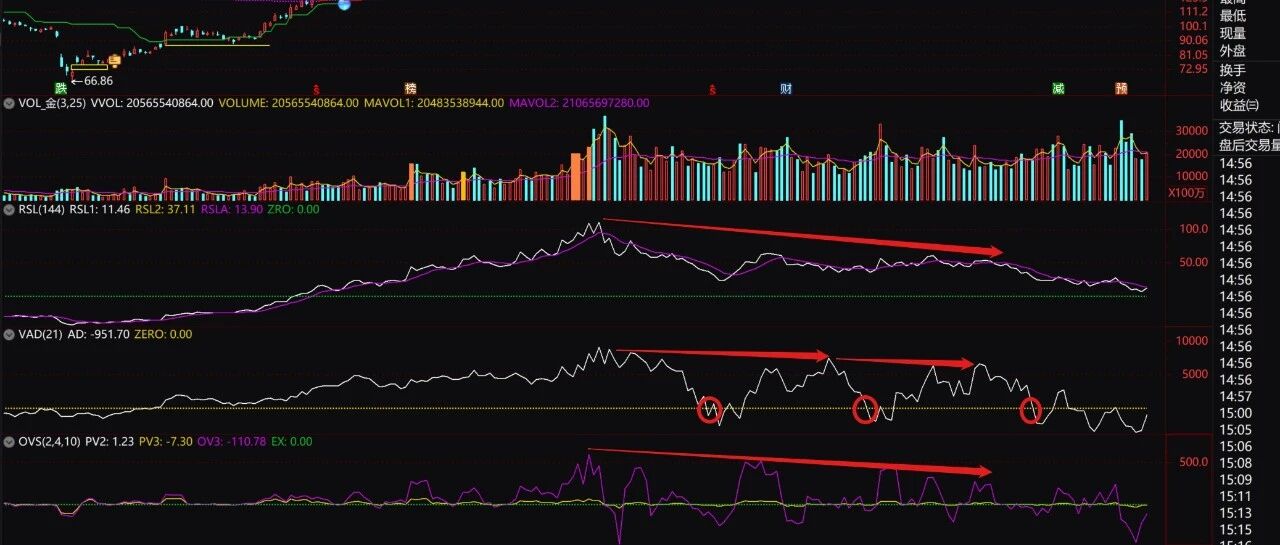
Group 1 - The article emphasizes the importance of distinguishing between different time cycles in momentum analysis, highlighting that many individuals overlook this aspect and focus solely on the visual conformity of charts [1] - It explains the relationships between various momentum indicators, such as RSL (144 days), VAD (21 days), and OVS (2-4 days), indicating that RSL represents long-term momentum, VAD represents medium-term momentum, and OVS represents short-term momentum [1] - The article notes that the hierarchical relationship between long, medium, and short-term indicators is approximately 5-7 times, which is rooted in the principles of Chan theory, where a coherent segment requires at least 5 candlesticks [1] Group 2 - The article uses the example of Zhongji Xuchuang to illustrate the differences in momentum divergence observed in long and medium-term indicators, indicating that RSL shows a clear downward momentum while remaining above the zero axis, suggesting a secondary level of momentum divergence [2][3] - It clarifies that for VAD to be considered a divergence at its level, it must show a peak decline and subsequently form a new peak, which is not the case in certain scenarios discussed [3][4] - The article stresses that the nature and severity of pullbacks caused by divergences differ across time frames, with a layered time-space model reflecting human behavioral patterns influenced by various time habits [5]
不同的生态
猛兽派选股· 2025-12-03 06:08
Group 1 - The article discusses the characteristics of the "游资生态" (speculative capital ecosystem), highlighting its features such as high turnover and poor performance, which are typical in small-cap stocks [1] - It emphasizes the distinction between the speculative capital ecosystem and the institutional ecosystem, noting that they are almost completely isolated from each other [1] - The author suggests that the current market is still undergoing adjustments and that it is premature to conclude which new main lines will emerge, as significant rebounds often occur after major market drops [1] Group 2 - The article advises a slow thinking approach when analyzing institutional information, referencing Daniel Kahneman's book "Thinking, Fast and Slow" to illustrate the common psychological traps investors fall into [2] - It points out that the market is currently experiencing a serious adjustment, indicating that it has not yet exited the adjustment framework [2] - The author describes the market's behavior as a "danger signal," with a continuous decrease in volume during convex reversals, suggesting a potential risk for investors [2]

巧用强度指标,选股游刃有余
猛兽派选股· 2025-08-31 14:06
Core Viewpoint - The article aims to enhance understanding of the Beast Momentum System for stock selection, providing updated methodologies and formulas for users to apply in their investment strategies [1]. Group 1: Basic Setup - Users are advised to set up SSV and RSL indicators, with specific formulas provided for both mobile and computer users to facilitate stock selection [1][2]. - A pre-selection stock pool can be created based on fundamental requirements, with a formula shared for identifying stocks with cumulative growth in the third quarter [2]. Group 2: Leading Stock Pool - After setting up the basic indicators, users can identify strong stocks using specific criteria, resulting in a selection of over 100 stocks that are currently performing well [5]. Group 3: Short-term Momentum Conditions - To further narrow down the stock list, short-term momentum conditions can be applied, focusing on either breakout or pullback strategies [6]. - Two short-term momentum indicators, OVS and RS_D, are highlighted for use in identifying suitable stocks for low-risk entry points [6]. Group 4: Breakout and Pivot Point Stock Pools - Breakout strategies are simplified through specific criteria that can be applied to identify stocks poised for upward movement [8]. - The article also discusses the use of pivot point indicators to capture significant entry opportunities, with recommendations to incorporate industry strength values for better selection [10]. Group 5: Final Strategy - Understanding the differences between long-term and short-term strength indicators simplifies the stock selection process, allowing for adjustments in strength thresholds to target desired stock ranges [11].

巧用强度指标,选股游刃有余
猛兽派选股· 2025-08-30 16:02
Group 1 - The article emphasizes the importance of setting up SSV and RSL indicators for stock selection, providing a comprehensive guide for both mobile and computer users [1][2][3] - It suggests creating a pre-selection stock pool based on fundamental requirements, which can be skipped if there are no fundamental criteria [2] - The article provides specific formulas for calculating RSR and RSL, indicating that the results may vary slightly but are generally similar [3][4] Group 2 - To narrow down the stock selection further, the article introduces short-term momentum conditions, highlighting two approaches: focusing on breakthroughs or on low volatility [5] - It mentions the use of short-term momentum indicators like OVS and RS_D to identify stocks suitable for low absorption strategies [5][6] - The breakthrough stock pool is defined by specific conditions that ensure stocks are in a strong momentum phase [6][7] Group 3 - The article discusses the use of pivot point indicators for stock selection, recommending this method to avoid missing important entry points [8] - It suggests incorporating industry strength values to refine the stock selection process further [8][9] - The final strategy involves understanding the differences between long-term and short-term strength, allowing for flexible stock selection based on desired thresholds [9]

中短周期动量指标VAD和OVS
猛兽派选股· 2025-08-26 04:04
Core Viewpoint - The article emphasizes the importance of momentum indicators in identifying market trends and potential investment opportunities, particularly focusing on the VAD and OVS indicators for different time frames [1][2]. Group 1: Medium-Term Momentum Indicators - The selection of medium-term momentum indicators should prioritize their divergence characteristics to effectively determine wave turning points [1]. - The VAD indicator, derived from Williams' accumulation/distribution line, integrates both price and volume factors, showcasing the relationship between price momentum divergence and volume-price divergence [1][2]. Group 2: Short-Term Momentum Indicators - A more reasonable short-term momentum indicator should consider the combination of volume and price, as trend traders emphasize the matching relationship between the two [2]. - The OVS indicator is defined as the product of price change and transaction amount, reflecting the monetary effect during trading [2]. - In the "Beast Momentum System," VAD, OVS, RSR, and RSLine are equally important, each representing core logic for different stages and cycles of momentum [2]. Group 3: Indicator Formulas - The OVS indicator formula includes components such as price efficiency ratio and daily price change, which are essential for calculating the indicator [2]. - The VAD indicator formula calculates the cumulative effect of price changes relative to the previous closing price, adjusted for transaction volume [5][6].

继续拆解一下堆量推升模式
猛兽派选股· 2025-08-18 03:43
Core Viewpoint - The article emphasizes the characteristics of the "stacking volume" model in stock trading, highlighting specific stocks that exhibit strong performance and potential for further gains [1][4]. Group 1: Characteristics of Stacking Volume Stocks - The first characteristic is a strong initial breakout, which can be described using the OVS indicator, focusing on discovering initial volatility and significant price movements [4]. - The second characteristic involves maintaining the TR level during consolidation, with RSR values remaining high, ideally above 92 [4]. - The third characteristic is a rapid convergence of the RS_D indicator during horizontal trading, indicating reduced volatility, with DR absolute values ideally below 10 for accurate entry timing [4]. Group 2: Quantitative Model Development - A simple quantitative model is proposed, consisting of pre-OVS, horizontal RSR, stable TR, and converging DR values, which can be used for stock selection [4]. - The underlying principle of this model is similar to the blue-green diamond model but represents a more intense breakout from consolidation, suggesting significant potential gains [4].