Ofev

Search documents
Boehringer Ingelheim Pharmaceuticals (:) Update / briefing Transcript
2026-03-25 10:32
Boehringer Ingelheim Pharmaceuticals 2026 Annual Press Conference Summary Company Overview - **Company**: Boehringer Ingelheim Pharmaceuticals - **Date of Conference**: March 25, 2026 - **Key Focus**: Annual results for the year 2025, insights into Human Pharma and Animal Health businesses Key Points Financial Performance - **Net Sales**: Achieved EUR 27.8 billion in 2025, representing a growth of 7.3% compared to the previous year [30] - **Human Pharma Sales**: EUR 22.7 billion with a growth of 7.4% [31] - **Key Products**: - Jardiance: EUR 8.8 billion, growth of 8.7% [31] - Ofev: EUR 3.8 billion, growth of over 5% [31] - **Animal Health Sales**: EUR 4.9 billion with a growth of 6.5% [32] - **Key Products**: - NexGard: EUR 1.4 billion, growth of 8.5% [32] - BULTAVO 3: EUR 75 million, significant due to its role in combating the bluetongue virus [33] Research and Development (R&D) - **R&D Investment**: EUR 6.4 billion, representing 23% of revenues, with Human Pharma at over 27% and Animal Health at almost 11% [37] - **R&D Focus**: - 80 projects in the Human Pharma pipeline across various therapeutic areas [39] - New launches in 2025 included Jascayd for idiopathic pulmonary fibrosis and Hernexeos for HER2 mutant non-small cell lung cancer [12][14] - **Innovation Recognition**: Ranked 9th among the most research-intensive companies in the EU [10] Market Trends and Challenges - **Animal Health Industry**: - Growth driven by increasing pet ownership and investment in animal health [22] - Significant outbreaks of transboundary animal diseases, including avian influenza and foot-and-mouth disease, impacting livestock and communities [23][24] - **Human Health Trends**: - Focus on interconnectedness of diseases, particularly in cardiorenal metabolism [16] - Emphasis on early diagnosis and treatment to prevent severe health complications [17] Future Outlook - **2026 Expectations**: Anticipated growth on a comparable basis, with a strong focus on innovation as a key driver of value [58] - **Pipeline Developments**: - Survodutide for obesity and MASH expected to have pivotal data readouts in 2026 [45] - Expansion into eye health and oncology with multiple new molecules in clinical research [46][47] Strategic Investments - **Infrastructure Investments**: EUR 1.4 billion in capital expenditures across 40 major projects globally [34] - **Technological Advancements**: Investment in AI and digital tools to enhance drug development and patient engagement [49][50] Workforce and Employment - **Global Workforce**: Over 54,000 employees, with a 2% growth in Germany [54] - **Training and Development**: More than EUR 80 million spent on employee training, emphasizing the importance of skill development [52] Conclusion - **Company Position**: Boehringer Ingelheim remains resilient and committed to innovation, with a strong pipeline and strategic investments aimed at addressing both current and future healthcare challenges [38]
GLP-1 专题深度产品迭代驱动市场扩容,关注靶点、剂型及联合疗法研发进展
2025-12-01 16:03
Summary of GLP-1 Market Conference Call Industry Overview - The GLP-1 market is experiencing rapid expansion, with leading company Eli Lilly's market capitalization increasing nearly sixfold over the past five years, surpassing $1 trillion [1][2] - The market for GLP-1 drugs is projected to grow from $2.9 billion in 2015 to nearly $50 billion by 2024, with an annual growth rate of 47% [1][6] Key Points and Arguments - **Market Performance**: In 2024, global sales for semaglutide and tirzepatide are expected to approach $50 billion, continuing strong growth [2] - **Future Trends**: The GLP-1 sector is anticipated to be one of the most focused areas in pharmaceuticals, with each drug iteration potentially doubling market size within 3 to 5 years [3] - **Drug Competition**: Tirzepatide's prescription volume has recently surpassed that of semaglutide, with combined sales exceeding $10 billion in Q3 2025 [7] - **Growth Drivers**: The primary growth will come from expanding usage among individuals with mild obesity, as current prescription rates for GLP-1 drugs in diabetes are around 7% globally and 19% in the U.S., while weight loss indications have a penetration rate of less than 0.5% [8][10] Important but Overlooked Content - **Policy Changes**: Recent adjustments in U.S. Medicare policy will significantly reduce out-of-pocket costs for obesity medications, potentially increasing market volume for new drugs like Ofev and high-dose oral semaglutide [10][11] - **Market Dynamics**: The U.S. market has seen substantial consumer education regarding weight loss medications, which will facilitate the commercialization of new oral weight loss drugs [11] - **Differentiation Strategies**: Companies can achieve differentiation through target combination strategies or by developing oral formulations that improve patient compliance [13][15] - **Domestic Market Potential**: The Chinese weight loss drug market is expected to grow rapidly, driven by a large overweight population and a shift towards self-funded purchases due to limited insurance coverage [25][26] Conclusion - The GLP-1 market is poised for significant growth driven by new drug developments, policy changes, and increasing consumer awareness. Companies in this space, particularly those focusing on oral formulations and innovative treatment strategies, are likely to benefit from these trends.


Medicare Announces Price Cuts For 15 Drugs— Novo Nordisk's Wegovy And Ozempic To Cost $274 A Month - AstraZeneca (NASDAQ:AZN), Eli Lilly (NYSE:LLY)
Benzinga· 2025-11-26 10:11
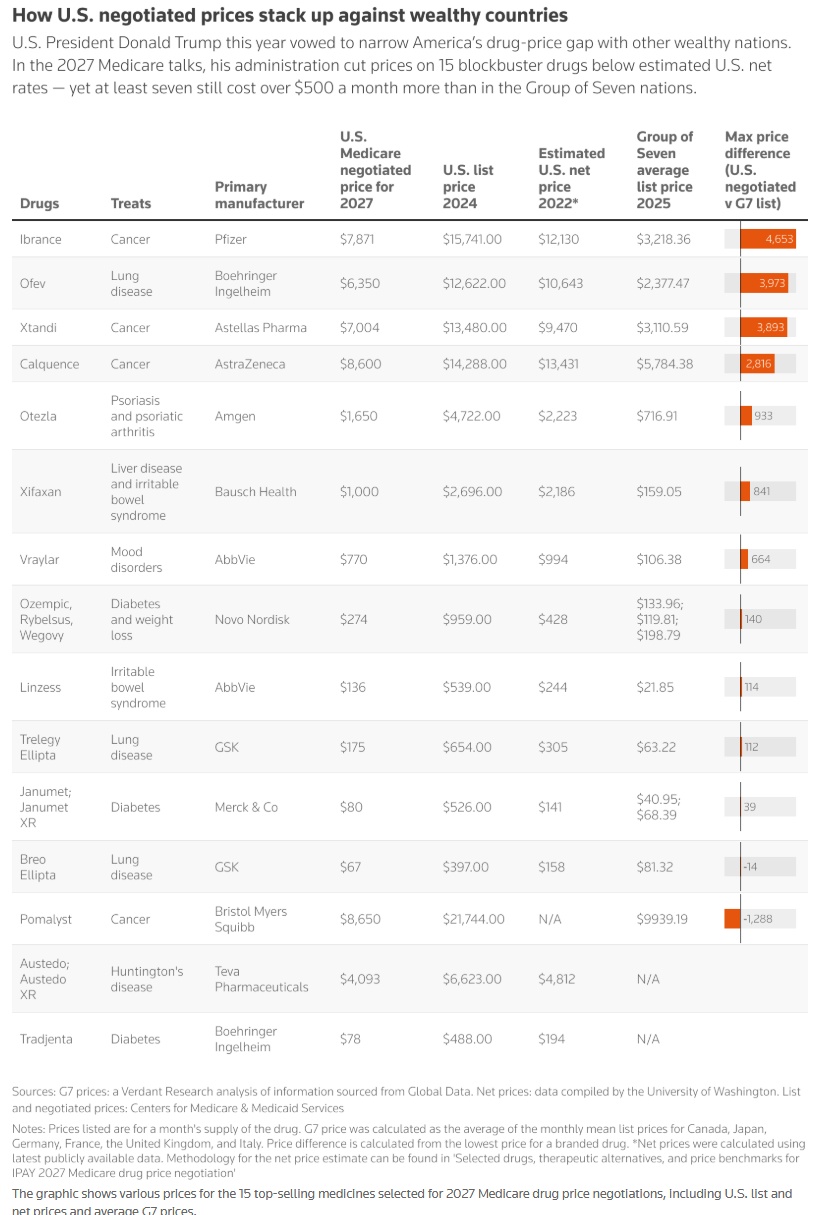
Core Insights - The U.S. Centers for Medicare and Medicaid Services (CMS) has negotiated lower prices for 15 high-cost medications, leading to significant annual savings on prescription expenses [1][3] - The new prices, effective in 2027, include a monthly cost of $274 for Novo Nordisk's GLP-1 drug, semaglutide, marketed as Wegovy, Ozempic, and Rybelsus [2] - Other drugs, such as AstraZeneca's Calquence, Boehringer's Ofev, and Pfizer's Ibrance, have seen price reductions of 40%-50% from their estimated net prices, with Medicare enrollees expected to save approximately $685 million in out-of-pocket costs and Medicare itself saving $12 billion [3] Drug Price Reductions - The changes are part of the Inflation Reduction Act (IRA) signed into law by former President Joe Biden, aimed at reducing drug costs for Medicare beneficiaries [4] - The pharmaceutical industry has faced pressure to lower drug prices, with recent agreements to reduce costs for weight-loss drugs like Zepbound and Wegovy, bringing patient costs down to $50–$350 per month from over $1,000 [5] - Pfizer was the first company to reach an agreement under the Trump administration to align U.S. drug prices with the lowest prices in other developed countries [6]


从“减肥神药”覆盖到抗癌药!“美国版集采”来势汹汹 将削减36%支出
Zhi Tong Cai Jing· 2025-11-26 08:37
Core Insights - The recent Medicare negotiations are expected to save approximately 36% on the prices of 15 high-cost drugs, translating to around $8.5 billion in net reimbursement costs [1][3][10] - The new prices will take effect in 2027, with significant reductions for popular drugs like semaglutide, which will drop over 70% to about $274 per month [1][4] - The negotiations are part of the Inflation Reduction Act signed by President Biden in 2022, which allows Medicare to negotiate drug prices for the first time [2][11] Drug Price Reductions - The estimated net prices for drugs like Calquence, Ofev, and Ibrance have been reduced by over $4,000 each in the latest negotiations [2][4] - The new pricing for other drugs includes Trelegy Ellipta at $175 (down from $654) and Linzess at $136 (down from $539) [4][10] - The average negotiated prices for these drugs are still higher than those in the Group of Seven (G7) nations, with some drugs costing over $500 more than their G7 counterparts [7][11] Comparison with Previous Negotiations - The 36% savings in the current negotiations surpasses the 22% savings achieved in the previous year's negotiations for 10 different drugs [3][10] - The pricing strategy has become more efficient, with newer products potentially having greater flexibility in pricing [4][10] Industry Response - The pharmaceutical industry has expressed strong opposition to government price negotiations, arguing that such policies are detrimental [5][10] - Industry representatives claim that government pricing policies like the Inflation Reduction Act and the Most-Favored-Nation pricing are misguided [5][12] Future Implications - The Medicare negotiations are expected to influence other payers to seek similar pricing from drug manufacturers [10] - Future negotiations will include an additional 15 drugs, with discussions set to begin in February [12]


Is IPF the Next Big Market Opportunity for United Therapeutics?
ZACKS· 2025-10-01 15:41
Core Insights - United Therapeutics (UTHR) is set to expand Tyvaso's label in the respiratory disease sector following positive results from the late-stage TETON-2 study, which demonstrated clinical benefits for idiopathic pulmonary fibrosis (IPF) patients after a year of treatment with nebulized Tyvaso [1][5] Study Results - The TETON-2 study achieved its primary endpoint, showing a 95.6 mL improvement in absolute forced vital capacity (FVC) for Tyvaso-treated patients compared to placebo, indicating enhanced lung function [2] - Treatment benefits were consistent across various patient subgroups, including those with different background therapies, smoking statuses, or oxygen use, and the safety profile was consistent with previous Tyvaso studies [2][6] Regulatory Plans - UTHR intends to meet with the FDA by the end of this year to potentially expedite the regulatory review process once results from the TETON-1 study are available, which is expected in the first half of 2026 [4][11] Market Potential - Approximately 100,000 IPF patients are estimated to be living in the United States, representing a significant untapped market with potential sales from the IPF indication possibly exceeding those from pulmonary arterial hypertension (PAH) [8] Competitive Landscape - The success of Tyvaso in IPF may also benefit smaller biotech companies like Insmed (INSM) and Liquidia Corporation (LQDA), which are developing or marketing treprostinil products [9] - Insmed is working on treprostinil palmitil inhalation powder (TPIP), which offers a once-daily dosing option, potentially positioning it as a competitor in the IPF space [10][12] - Liquidia has recently received FDA approval for Yutrepia, an inhaled treprostinil product, marking it as the first inhaled competitor for PAH and PH-ILD indications, and may also explore its application in IPF [13]




Phase II and Phase III Catalyst Monitor: Q3 2025 Outlook Report - Upcoming FDA Decisions Drive Momentum in Biopharma with Key Catalysts Across GHD, PKU, Presbyopia, and Wet AMD Treatments
GlobeNewswire News Room· 2025-07-22 14:50
Core Insights - The "Catalyst Monitor: Q3 2025 Outlook" report provides forward-looking intelligence on significant catalyst events expected in Q3 2025, derived from interviews with key opinion leaders (KOLs) [1][3] - The report highlights 18 major catalyst events, including FDA approval decisions for various drugs targeting conditions such as adult growth hormone deficiency and wet age-related macular degeneration [2][4] Company and Industry Highlights - Ascendis Pharma's Skytrofa is under review for FDA approval for adult growth hormone deficiency [2] - PTC Therapeutics' sepiapterin is being evaluated for phenylketonuria, while Lenz Therapeutics' LNZ100 is aimed at treating presbyopia [2] - Eli Lilly's orforglipron is in ongoing clinical trials for obesity, and aTyr Pharma's efzofitimod is being studied for pulmonary sarcoidosis [3][4] - The report includes insights on the commercial impact of orforglipron in the GLP-1 market if approved, based on Phase III data [7] - KOLs assess the commercial potential of Lenz Therapeutics' LNZ100 in the context of existing non-pharmacological options for presbyopia [7] - Boehringer Ingelheim's Ofev is discussed regarding its potential expansion into pediatric interstitial lung disease amid safety concerns [7] Research Methodology - The report compiles predictive intelligence based on extensive research and exclusive interviews with KOLs, focusing on market-moving events expected in Q3 2025 [3][4] - It provides a comparative analysis of expected regulatory events, trial initiations, and completions in Q3 compared to the previous quarter [7]