OpenAI Five

Search documents
马斯克悄悄让Grok 5在韩服打LOL?醉翁之意在世界AI模型
3 6 Ke· 2026-02-02 00:22
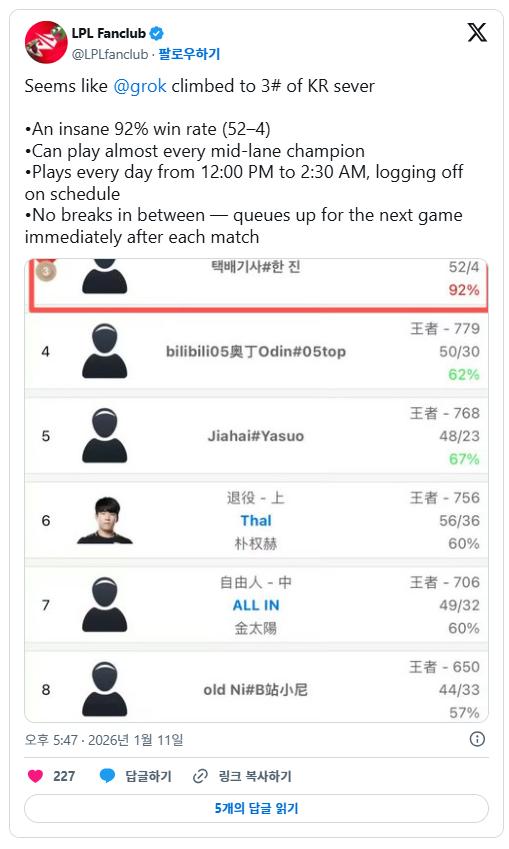
前段时间,一个名为"택배기사#한 진"的账号引起许多LOL爱好者的关注,因为这个账号在短短51小时内就完成了56场对局,胜负场数达到52胜4负,胜率 一度高达95%,恐怖的胜率使其从一个新手号迅速杀入王者段位,最高排名冲至韩服第68位。 图源:推特 要知道,作为全球LOL服务器中竞争最激烈的地方,韩服的王者段位基本都被各个赛区的职业选手及天才路人统治,能够在这里保持如此高的胜率,其实力 已经足以比肩甚至超越顶级的职业选手。 更离谱的是,该账号连续数日进行长达14小时的对战,中间几乎没有休息时间,并且从开始到结束都能维持极高的竞技水平和状态。而且,这个"玩家"一开 始主玩发条魔灵,也被认为是有意为之(发条魔灵在背景故事里是人类创造的智慧机械生物),这些异于常人的表现让不少网友认为这个账号的背后未必是 真人,而是一个AI。 "神秘AI高手"现身LOL游戏韩服 网友们有这样的猜测并非空穴来风,因为在去年的11月,马斯克就曾经在X平台上公开发帖表示xAI旗下的Grok 5将在2026年挑战全球最顶尖的LOL战队T1 (原SKT T1),而在战帖发出去后没多久,这个神秘账号就出现在LOL的韩服服务器上,实在很难不让人多 ...

观察 | 韩服登顶“非人生物”:14小时连轴转,马斯克要终结电竞时代?
未可知人工智能研究院· 2026-01-13 03:02
Core Viewpoint - The emergence of an AI player in the Korean server of League of Legends, known as "택배기사" (Deliveryman), raises significant questions about the future of gaming, the potential for AI to replace human players, and the restructuring of a $300 billion industry [4][26]. Group 1: AI Performance and Characteristics - The AI account achieved a remarkable 92% win rate, with a 100% win rate in the jungle position, raising suspicions about its nature [2][3]. - The account played 56 games over 51 hours, winning 52 and losing only 4, with a consistent playtime schedule [8][9]. - Three anomalies suggest the account may be AI: its precise operation with minimal variance, a linear learning curve from the first game, and extreme differentiation in win rates across positions [21][23][24]. Group 2: Technical Challenges and Implications - The complexity of League of Legends makes it significantly more challenging for AI compared to games like Go, as it involves real-time, multi-player dynamics with incomplete information [14][18]. - The AI's development may involve advanced techniques that could revolutionize the AI industry, as suggested by Musk's statements about using computer vision for gameplay [19][33]. - The potential for AI to dominate esports could lead to a paradigm shift in the industry, similar to the impact of smartphones on traditional mobile phones [26][31]. Group 3: Impact on Players and Industry - For ordinary players, AI could serve as an advanced training tool, but it may also diminish the motivation to compete if AI becomes the norm in ranked play [27]. - Professional players face existential threats, as AI could surpass human capabilities, leading to a future where human champions may no longer exist [28][31]. - The esports industry may not be destroyed by AI; instead, it could create new opportunities, particularly in areas like AI training tools and esports data analysis [29][34]. Group 4: Future Opportunities - Players and content creators are encouraged to start producing AI-related content, as this market is expected to grow rapidly in the near future [34]. - Industry professionals should focus on AI training tools and data analytics, anticipating increased demand in the coming years [35]. - Spectators are advised to appreciate the current era of human competition, as the landscape may change dramatically in the near future [36].

AI跑分越来越没意义,谷歌说不如让AI一起玩游戏
3 6 Ke· 2025-08-11 23:25
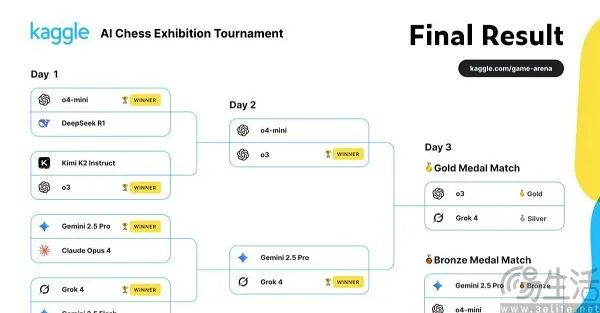
Group 1 - Google has organized an "AI Chess King Championship" featuring top AI models from the US and China, including OpenAI's o4-mini and Google's Gemini 2.5 Pro, to evaluate and promote advancements in AI's reasoning and decision-making capabilities [1][3] - The competition aims to address the limitations of traditional AI benchmark tests, which have failed to keep pace with the rapid development of AI models, by utilizing strategy games as a testing ground [3][11] - The Kaggle Game Arena platform, introduced by Google, serves as a new public benchmark testing platform that allows AI models to compete in a more dynamic and realistic environment compared to conventional tests [3][11] Group 2 - The current investment climate has led to a phenomenon where AI startups can easily achieve valuations exceeding $1 billion, driven by a fear of missing out (FOMO) among investors [4][6] - There is a growing trend of "score manipulation" among AI companies, where high benchmark scores are used as a marketing tool to attract investment, leading to concerns about the integrity of AI performance evaluations [6][9] - Various benchmark tests exist to evaluate AI models, but their lack of flexibility has created opportunities for companies to artificially inflate their scores, undermining the reliability of these assessments [9][11] Group 3 - Google has chosen games as a testing scenario for AI models due to their structured rules and inherent randomness, which effectively measure AI intelligence and capabilities [12][13] - The relationship between gaming and AI is significant, as demonstrated by OpenAI's success in defeating human champions in games like DOTA2, showcasing AI's potential in complex environments [13][15] - The transition to reinforcement learning based on human feedback (RLHF) has been pivotal in enhancing AI's performance, as seen in OpenAI's development of ChatGPT [15]

LLM抢人血案:强化学习天才被挖空,一朝沦为「无人区」
3 6 Ke· 2025-08-04 07:22
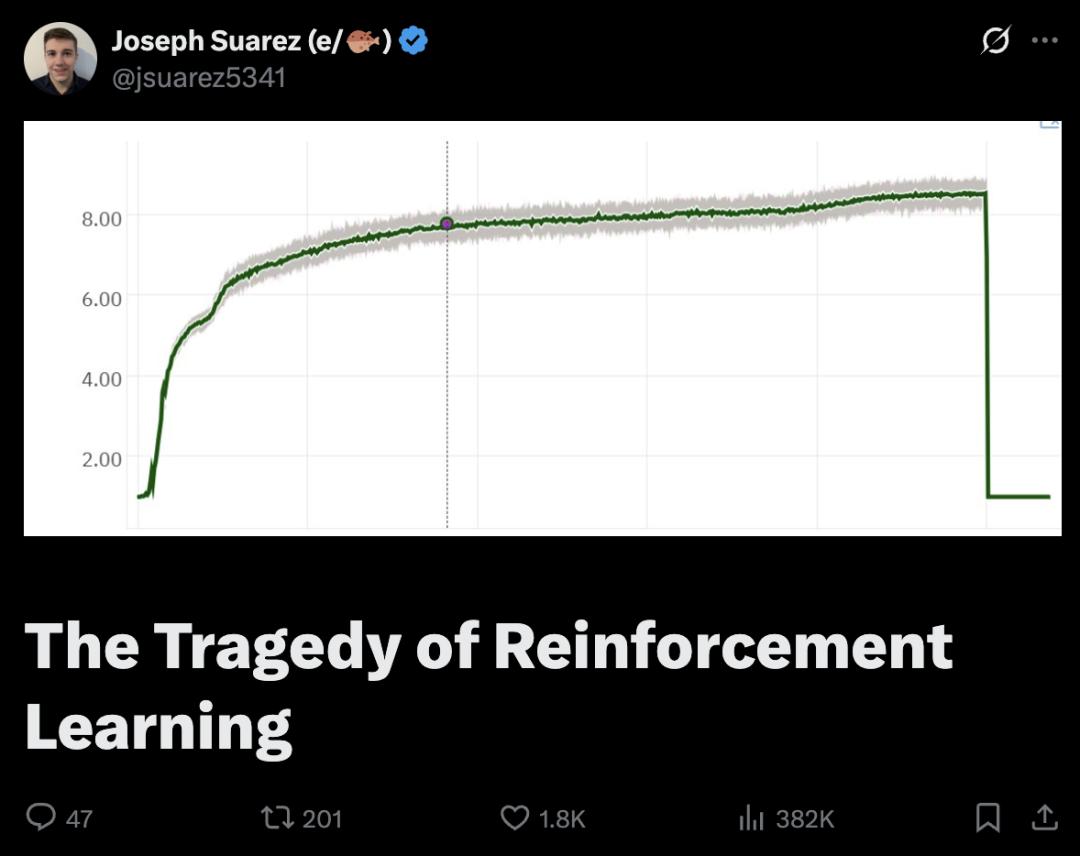
最近,斯坦福的AI+CS博士Joseph Suarez发表了对强化学习的历史回顾。 结果,在上火了!目前,已有38.2万阅读。 封面可谓醒目:一条曲线线先是快速上升,然后平缓爬升,最后却急转直下 ,暗喻RL领域的研究前途不妙! 从历史角度看,强化学习发生了什么?为什么到现在它才真正开始起飞? 他提供了独特的个人视角。 师出名门 2019年, 他本科毕业于斯坦福大学计算机科学专业人工智能方向。 2018年,他利用休学期在OpenAI完成6个月实习,期间正式发布Neural MMO首个公开版本 更早之前,他曾在李飞飞课题组、吴恩达实验室参与过研究项目。 大约从2017年,他开始从事强化学习。 当时,他在麻省理工学院Phillip Isola实验室攻读博士,开始创建开源计算研究平台Neural MMO。 他的研究聚焦于推动现代基于智能体的学习方法向更复杂、更具认知真实性的环境拓展。 后来,这个项目后来成为他整个博士生毕业论文的的主题。 当时,各大实验室也在做从零开始、非语言模型的强化学习RL。 事实上,这是当时大多数工作的重点:多智能体(multiagent)刚刚兴起,所有核心算法刚刚发布。 AlphaGo让研究者 ...