
P型HJT技术光伏电池

Search documents
700亿光伏龙头确认与马斯克团队有接触
2 1 Shi Ji Jing Ji Bao Dao· 2026-02-04 05:00
Core Viewpoint - The A-share space photovoltaic sector experienced a significant surge, with the space photovoltaic index rising by 2.73% as of midday on February 4, driven by rumors of Elon Musk's team visiting multiple Chinese photovoltaic companies to explore potential collaborations in advanced technologies [1][3]. Group 1: Market Performance - The space photovoltaic index (8841929) increased by 2.73% as of midday on February 4 [1]. - Notable stocks included Zhonglai Co., Ltd. (300393) and Tuojiri New Energy (002218), both hitting the daily limit up, while JinkoSolar, Jinjing Technology (600586), and Trina Solar also saw gains [1][6]. Group 2: Company Interactions - JinkoSolar confirmed contact with Musk's team, stating that the team inquired about the company's technological capabilities and production equipment, although specific details about potential cooperation were not disclosed [1][3]. - The staff at JinkoSolar mentioned that other leading domestic photovoltaic companies also had interactions with the visiting team [1]. Group 3: Industry Insights - Musk has previously praised China's photovoltaic industry, noting that the annual solar installation capacity exceeds 1,000 GW, with stable power supply capabilities reaching 250 GW, which is equivalent to half of the annual electricity consumption of the United States [3]. - Analysts from various brokerages suggest that space photovoltaics could become a new industrial frontier, with potential advancements in P-type HJT technology and perovskite tandem technology driving future growth [3]. - The demand for satellite internet networks is increasing, with solar wings being a critical component of satellite energy systems, representing about 12%-24% of satellite value, which is expected to rise as solar wing areas expand [3].


光伏行业预亏警报拉响!龙头股预亏近70亿元,股价却不跌反涨
2 1 Shi Ji Jing Ji Bao Dao· 2026-01-22 09:03
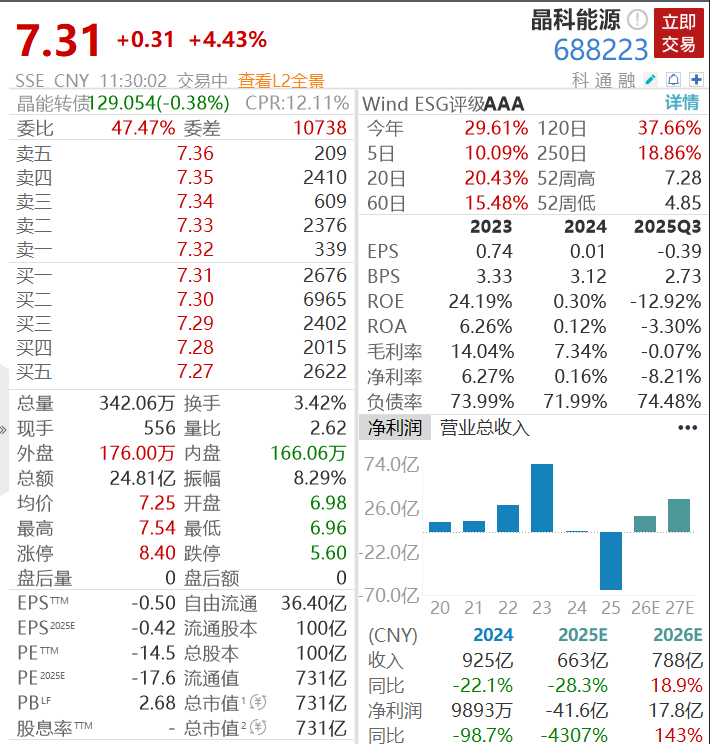
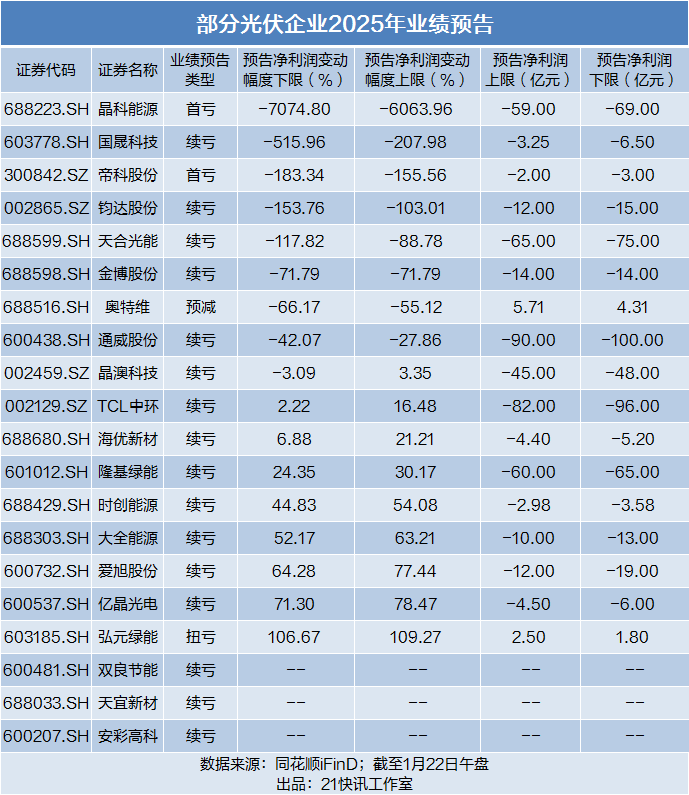
Core Viewpoint - JinkoSolar, a leading company in the photovoltaic industry, is expected to report a significant loss for the year 2025, marking its first annual loss in nearly a decade, despite a rise in its stock price on the announcement day [1] Group 1: Company Performance - JinkoSolar forecasts a net profit loss of between 59 billion to 69 billion yuan for 2025, with a non-recurring net profit loss estimated between 67 billion to 78 billion yuan, compared to a net profit of 0.99 billion yuan in the same period last year [1] - The company attributes its expected losses to intensified price fluctuations in the global photovoltaic supply chain and a general decline in profitability across various segments [1] - Other companies in the photovoltaic sector, including Trina Solar, LONGi Green Energy, and Tongwei Co., have also reported similar forecasts, indicating a trend of expected losses across the industry [2][4] Group 2: Industry Trends - As of January 22, 2023, 20 photovoltaic companies have disclosed their 2025 performance forecasts, with many expecting significant losses, highlighting a broader industry downturn [2] - Tongwei Co. anticipates losses of 90 billion to 100 billion yuan, citing ongoing supply surplus and price declines, while TCL Zhonghuan expects losses between 82 billion to 96 billion yuan due to persistent low prices [3][4] - The industry is facing challenges such as rising raw material costs and insufficient price transmission to downstream markets, which are squeezing profit margins for major players [4] Group 3: Positive Signals - Only Hongyuan Green Energy is expected to turn a profit, with a forecasted net profit of 1.8 billion to 2.5 billion yuan, attributed to its vertically integrated supply chain and strategic asset sales [5] - Some companies, like Aiko Solar, report a narrowing of loss margins compared to the previous year, indicating potential improvements in operational efficiency and cost management [5] - Analysts suggest that the space photovoltaic sector may emerge as a new growth area, driven by the demand for satellite internet and advancements in photovoltaic technologies [6]
商业航天产业趋势已来太空光伏或成下一个增长蓝海
Zhong Guo Zheng Quan Bao· 2026-01-21 21:08
Core Viewpoint - The rapid development of the commercial aerospace industry is driving the growth of space photovoltaic technology, which is expected to become a new growth area in the photovoltaic industry due to its unique advantages in energy generation efficiency in space [1][6]. Group 1: Space Photovoltaic Technology - Space photovoltaic technology utilizes satellites to collect solar energy in space and convert it into electricity, achieving 2-3 times the efficiency compared to ground-based systems due to continuous sunlight in geostationary orbit [2][3]. - The solar irradiance in space is approximately 1367 W/m², which is over 30% higher than the ground standard of 1000 W/m², significantly enhancing photovoltaic cell efficiency [2]. Group 2: Market Demand and Growth Drivers - The demand for space photovoltaic technology is driven by the increasing number of satellites launched in the commercial aerospace era, with individual satellite constellations planning thousands of satellites, leading to a substantial increase in demand for photovoltaic cells [3]. - The complexity and power requirements of future communication satellites will further increase the demand for space photovoltaic power supply, as these satellites will have more advanced functionalities [3]. Group 3: Current Industry Status - The space photovoltaic industry in China is currently in its introduction phase, with technology solutions not yet standardized and the core barriers mainly at the channel level [4]. - The extreme conditions of space require photovoltaic materials to meet higher performance standards, leading to a differentiation among companies in the photovoltaic supply chain [4]. Group 4: Investment Opportunities - The rapid growth of satellite numbers and the demand for in-orbit data and space-based computing capabilities highlight investment opportunities in the space photovoltaic sector, particularly in P-type ultra-thin HJT and perovskite photovoltaic products [5][6]. - Companies that can effectively integrate new technologies with application scenarios, as well as those leading in layered equipment and key material supply, are expected to benefit significantly from the growth of the space photovoltaic market [5].
商业航天产业趋势已来,关注太空光伏新技术方向
Caixin Securities· 2026-01-20 07:32
Investment Rating - The industry investment rating is "In line with the market" and the rating has been maintained [2][8]. Core Insights - The report highlights that the profitability pressure in the photovoltaic equipment sector remains significant, but there are signs of operational improvement [3][8]. - The commercial aerospace industry is experiencing a trend that is expected to benefit space photovoltaic technologies, driven by increased satellite launches and technological advancements [5][7]. - The report emphasizes the potential for new photovoltaic technologies, such as HJT and perovskite solar cells, to gain traction in the commercial aerospace sector [8]. Summary by Sections - **Industry Performance**: The photovoltaic equipment sector has shown a 12.22% increase over 1 month, 14.66% over 3 months, and 44.01% over 12 months, outperforming the CSI 300 index [6]. - **Commercial Aerospace Developments**: China has submitted applications for 203,000 satellites, marking the largest frequency and orbital resource application to date, which is expected to activate the entire satellite manufacturing, launching, and operation industry chain [7]. - **Investment Recommendations**: The report suggests focusing on equipment manufacturers, material suppliers, and producers with strong technological reserves in the context of accelerating commercialization in the aerospace industry [8].