PM10

Search documents
生态环境部:加严PM2.5等污染物浓度限值 将有效带动新质生产力培育与发展
Yang Guang Wang· 2025-12-27 03:10
Core Viewpoint - The Ministry of Ecology and Environment has released a draft for stricter air quality standards, aiming to reduce the concentration limits for PM2.5, PM10, SO2, and NO2, which is expected to improve air quality while supporting high-quality economic development [1][2] Group 1: Air Quality Improvement - Over the past decade, the average concentration of PM2.5 has decreased by 36%, and the number of heavily polluted days has reduced by 68%, despite a 63% increase in GDP and a 111% rise in vehicle ownership [1] - The revision of air quality standards is seen as a significant factor in improving national air quality and promoting high-quality economic development [1] Group 2: Implementation and Economic Impact - The revised air quality standards focus on goal orientation and strategic guidance, having a relatively limited direct impact on enterprise production activities compared to pollutant emission standards [1] - Achieving air quality standards is a gradual process, with supporting policies and standards being implemented progressively, ensuring a smooth transition while maintaining stable economic operations [1] - The phased implementation of PM2.5 and PM10 concentration limits is designed to minimize the impact of the standard revisions on economic and social stability [1] Group 3: Long-term Benefits - Stricter standards are expected to further reduce PM2.5 concentrations, improve air quality, and significantly decrease the risks of acute cardiovascular and respiratory diseases, enhancing public health and well-being [2] - The new standards will foster the development of new productive forces such as electric vehicles and clean energy, promote advanced processes in industries like metallurgy, building materials, and petrochemicals, and facilitate a green and low-carbon transition in industry, energy, and transportation [2]
PM2.5年均浓度提标,我国有望迎来更严环境空气质量标准
Xin Lang Cai Jing· 2025-12-19 03:50
Core Viewpoint - The Ministry of Ecology and Environment has released a draft for public consultation on the revised "Ambient Air Quality Standards," which aims to tighten concentration limits for particulate matter and gases like sulfur dioxide (SO2) and nitrogen dioxide (NO2) [1][7]. Group 1: Reasons for Revising Air Quality Standards - The current standards have led to significant improvements in air quality, with PM2.5 annual average concentration decreasing by 36% from 2015 to 2024, and the number of heavily polluted days reduced by 68% [2][8]. - The revision aims to further protect public health, as PM2.5 remains the most harmful air pollutant according to the World Health Organization (WHO) [2][8]. - The revision supports the "Beautiful China" initiative, which targets an average PM2.5 concentration of below 25 micrograms per cubic meter by 2035, addressing the gap where nearly half of the compliant cities still exceed this limit [2][8][9]. Group 2: Key Changes in the Standards - The revised standards will tighten the PM2.5 annual average and daily average secondary limits to 25 micrograms per cubic meter and 50 micrograms per cubic meter, respectively [4][10]. - PM10 annual and daily average secondary limits will also be tightened to 50 micrograms per cubic meter and 100 micrograms per cubic meter [4][10]. - The revision includes stricter limits for sulfur dioxide and nitrogen dioxide, while ozone and carbon monoxide limits will remain unchanged [11]. Group 3: Implementation of the Revised Standards - The revised standards will be implemented in two phases: the first phase (2026-2030) will introduce transitional limits of 30 micrograms per cubic meter for PM2.5 annual average and 60 micrograms per cubic meter for daily average [5][12]. - The second phase, starting in 2031, will fully enforce the revised limits for particulate matter and gases [5][12]. - The transitional limits are designed to allow for a smooth implementation and to reduce short-term pressures on economic and social development [6][12].
PM2.5等排放限值,进一步“收严”!千方百计打好“蓝天保卫战”
Yang Shi Wang· 2025-12-16 03:44
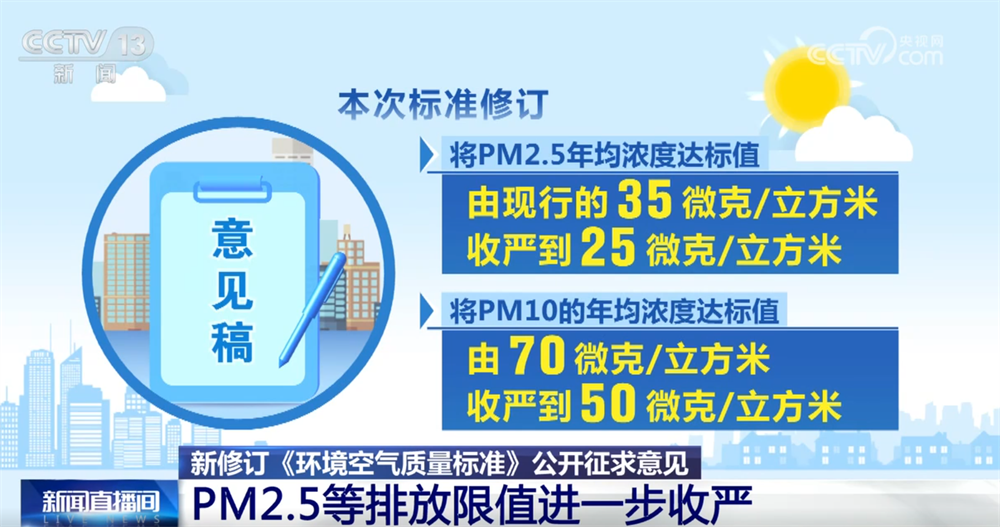
Core Viewpoint - The Ministry of Ecology and Environment has initiated a new round of revisions to the "Ambient Air Quality Standards," tightening the emission limits for air pollutants such as PM2.5, PM10, sulfur dioxide, and nitrogen dioxide to improve air quality in China [1][4]. Group 1: Revised Standards - The annual average concentration limit for PM2.5 will be tightened from 35 micrograms per cubic meter to 25 micrograms per cubic meter [1] - The annual average concentration limit for PM10 will be reduced from 70 micrograms per cubic meter to 50 micrograms per cubic meter [1] - The annual average concentration limit for sulfur dioxide will be lowered from 60 micrograms per cubic meter to 20 micrograms per cubic meter [1] - The annual average concentration limit for nitrogen dioxide will be decreased from 40 micrograms per cubic meter to 30 micrograms per cubic meter [1] Group 2: Implementation Timeline - A transitional limit for PM2.5 will be set at 30 micrograms per cubic meter from 2026 to 2030, with full implementation of the revised limits starting in 2031 [6] Group 3: Current Air Quality Status - As of 2024, 74% of 339 cities have met the current standard of 35 micrograms per cubic meter for PM2.5, but about half of these cities still exceed the new standard of 25 micrograms per cubic meter [10] - Despite improvements, PM2.5 levels remain high, particularly in key regions affected by adverse weather conditions [10] Group 4: Health and Environmental Impact - PM2.5 is linked to major health issues such as hypertension and diabetes, making it a primary focus for the new revisions [4] - The revisions also consider the health impacts of sulfur dioxide and nitrogen oxides, which are precursors to PM2.5 [4] Group 5: Future Emission Reduction Goals - To achieve the goal of reducing the national average PM2.5 concentration to 25 micrograms per cubic meter by 2035, emissions of PM2.5, sulfur dioxide, nitrogen oxides, and volatile organic compounds need to be reduced by 23%, 21%, 28%, and 22% respectively compared to 2023 levels [14]