PaaS(平台即服务)

Search documents
木头姐:这轮市场波动是算法导致,而非基本面
华尔街见闻· 2026-02-16 11:18
Core Viewpoint - The recent market volatility is primarily driven by algorithmic trading rather than fundamental changes in the economy, creating pricing errors that present opportunities for active investors [1][5]. Group 1: Algorithmic Trading and Market Dynamics - Algorithmic trading adjusts risk exposure mechanically based on rules rather than fundamental analysis, leading to indiscriminate selling during market downturns [3]. - This feedback loop can disproportionately affect both strong and weak companies, as algorithms do not differentiate between them [3][5]. - The current market environment is characterized by a "climbing a wall of worry," which historically indicates a strong bull market [5][6]. Group 2: Structural Transformation in Technology - The market is undergoing a transition from a one-size-fits-all SaaS model to highly customized AI-driven platforms, which has led to excessive market reactions against traditional SaaS companies [4][5]. - Active investors are focusing on companies that are successfully transitioning to AI platforms, as algorithmic trading fails to recognize these distinctions [5][6]. Group 3: Capital Expenditure and Market Sentiment - Concerns over the aggressive capital expenditures of major tech companies (Mag 7) are misplaced; the current environment resembles 1996, not the peak of the 1999 bubble [6][7]. - The market's reaction to increased spending by tech giants indicates a cautious investor sentiment rather than irrational exuberance [6][7]. Group 4: Macroeconomic Implications of AI - The rise in productivity driven by AI could lead to a decrease in inflation, challenging the traditional narrative that growth always leads to inflation [10][11]. - Predictions suggest that the U.S. could achieve a budget surplus by the end of the current presidential term, driven by increased productivity and economic growth [10][22]. Group 5: Employment Trends and Entrepreneurship - The labor market shows signs of weakness, with significant downward revisions in employment numbers, but there are positive trends among younger workers, indicating potential for entrepreneurial growth [15][16]. - The accessibility of AI tools is expected to spur a wave of new startups, contributing to productivity gains [17][16]. Group 6: Inflation and Consumer Sentiment - Current inflation indicators show a downward trend, with real-time metrics suggesting inflation is significantly lower than government statistics indicate [12][40]. - Consumer sentiment remains low due to job market concerns and affordability issues, despite some positive economic indicators [15][36]. Group 7: Market Indicators and Investment Strategy - The relationship between the S&P 500 and gold, as well as oil prices, suggests a favorable environment for consumers and businesses, with oil price declines acting as a tax cut [41][42]. - The current market conditions present significant investment opportunities, particularly in sectors poised for growth due to technological advancements [44][45].


木头姐:这轮市场波动是算法导致,而非基本面
Hua Er Jie Jian Wen· 2026-02-16 09:07
Group 1 - The recent volatility in the US stock market is primarily driven by algorithmic trading rather than fundamental changes in the market [1][5][12] - Algorithmic trading tends to execute indiscriminate sell orders when market conditions change, leading to mispricing opportunities for active investors [5][6][12] - The current market is experiencing a structural transformation from a one-size-fits-all SaaS model to highly customized AI platforms, which has led to excessive market reactions [4][5][12] Group 2 - The CEO of ARK Invest, Kathy Wood, argues that the current environment is more akin to 1996, the early stages of the internet revolution, rather than the peak of the 1999 bubble [6][7][12] - Concerns about the aggressive capital expenditures of major tech companies are misplaced; these investments are necessary for future growth and innovation [6][7][12] - The market is currently climbing a "wall of worry," which is often a characteristic of strong bull markets, indicating that investor sentiment is cautious rather than irrationally exuberant [7][12][34] Group 3 - Wood predicts that productivity gains driven by AI could lead to a decrease in inflation, challenging the traditional narrative that growth necessarily leads to inflation [8][19][24] - The potential for a fiscal surplus by the end of the current presidential term is highlighted, with expectations of GDP growth rates reaching 7-8% by the end of the decade [8][14][15] - The current economic environment is characterized by low consumer confidence, primarily due to a weak job market and housing affordability issues [10][27][29] Group 4 - The rise of AI is expected to spur a new wave of entrepreneurial activity, as individuals leverage AI tools to start their own businesses [10][27][28] - The current market dynamics are leading to a significant increase in new business formations, which could enhance productivity and economic growth [10][27][28] - The overall sentiment in the market reflects a cautious approach, with investors still wary of the lessons learned from past market bubbles [34][35]

我国云计算市场规模5年后将突破3万亿 有哪些挑战 | 言叶知新
Di Yi Cai Jing· 2025-08-14 14:31
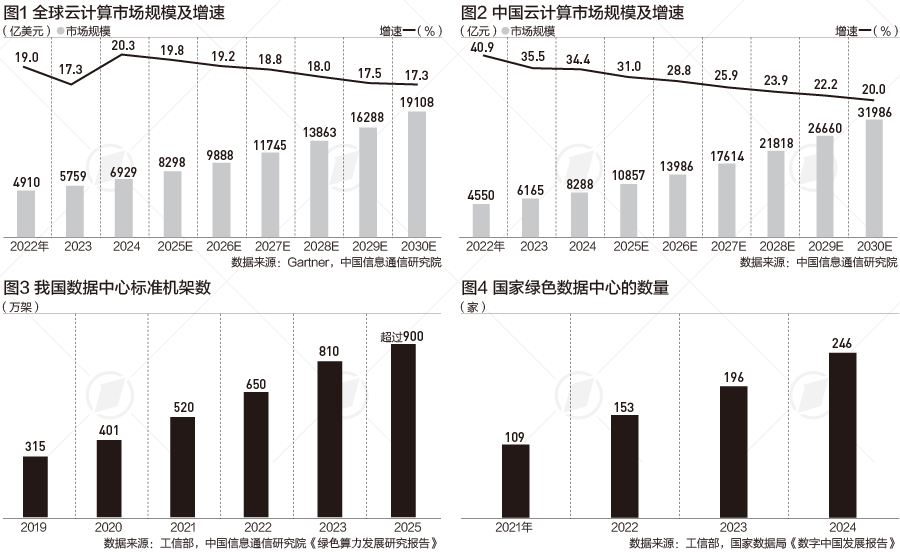
Core Insights - The global cloud computing market is projected to reach nearly $2 trillion by 2030, driven by the increasing demand for AI integration and services [2][3] - China's cloud computing market is expected to grow to 828.8 billion yuan in 2024, reflecting a year-on-year increase of 34.4% [3] - The rapid growth of AI technologies is transforming cloud computing services, shifting from traditional models to AI-driven solutions [6][7] Global Market Overview - The global cloud computing market is forecasted to reach $692.9 billion in 2024, with a year-on-year growth rate of 20.3% [2] - The demand for IaaS, PaaS, and SaaS is increasing, particularly due to AI model training and application services [2][3] China's Cloud Computing Landscape - China's cloud computing market is experiencing significant growth, with a projected market size of 828.8 billion yuan in 2024 [3] - The public cloud market is expected to reach 621.6 billion yuan, growing by 36.6%, while the private cloud market is anticipated to reach 207.2 billion yuan, growing by 29.3% [3][5] - The integration of technologies like quantum computing and blockchain with cloud computing is expected to expand market boundaries [3] Market Dynamics and Competition - The IaaS market in China is projected to reach 420.1 billion yuan in 2024, with intelligent computing services being the primary growth driver [5] - Major players in the public cloud IaaS market include Alibaba Cloud, Tianyi Cloud, Mobile Cloud, Huawei Cloud, and Tencent Cloud, while the PaaS market is led by Alibaba Cloud, Baidu Cloud, Huawei Cloud, Tencent Cloud, Tianyi Cloud, and Mobile Cloud [5] Challenges and Data Security - The surge in data volume due to AI development poses significant challenges for cloud computing, necessitating a shift towards model-as-a-service delivery [6][9] - Data security is critical for the stable operation of AI cloud services, with increasing data interactions leading to complex security challenges [9][10] - The emergence of low-quality data can adversely affect AI model performance, highlighting the need for robust data management and security measures [9][10]
我国云计算市场规模5年后将突破3万亿,有哪些挑战|言叶知新
Di Yi Cai Jing· 2025-08-14 12:24
Core Insights - The cloud computing market in China is expected to maintain a growth rate of over 20% during the "14th Five-Year Plan" period, driven by advancements in artificial intelligence large models [1][7] - The global cloud computing market is projected to reach nearly $2 trillion by 2030, with a market size of $692.9 billion in 2024, reflecting a year-on-year growth of 20.3% [2][3] - In 2024, China's cloud computing market size is anticipated to reach 828.8 billion yuan, representing a year-on-year increase of 34.4% [1][3] Market Trends - The global cloud computing market is experiencing steady growth, with significant contributions from IaaS, PaaS, and SaaS segments [2] - The public cloud market in China is expected to reach 621.6 billion yuan in 2024, growing by 36.6%, while the private cloud market is projected to reach 207.2 billion yuan, with a growth rate of 29.3% [3][5] - The integration of technologies such as quantum computing, blockchain, and artificial intelligence is expected to further expand the market boundaries of cloud computing [3] Demand Drivers - Intelligent computing services and intelligent agents are identified as the main growth drivers for the IaaS and SaaS markets [5] - The demand for intelligent computing services is a significant factor contributing to the growth of the public cloud IaaS market, which is expected to reach 420.1 billion yuan in 2024 [5] Industry Dynamics - The competitive landscape is characterized by a clear head-to-head market structure, with leading players like Alibaba Cloud, Huawei Cloud, and Tencent Cloud dominating the public cloud IaaS market [5] - Mid-tier companies are attempting to break the market structure by focusing on niche areas and enhancing AI capabilities [5] Future Outlook - The cloud computing market in China is projected to exceed 3 trillion yuan by 2030, indicating robust growth potential [3] - The shift from traditional computing power leasing to model-as-a-service is anticipated due to the increasing demand for AI model training and inference [6] Data Security Challenges - The rapid growth of data generated in cloud environments poses significant challenges, particularly in data security, as the volume of data is expected to reach approximately 58.53 zettabytes by 2029 [9] - The emergence of new business models, such as intelligent agent services, will drive collaborative development across the cloud computing industry [6][9] Regulatory Environment - National policies are increasingly focusing on data security, with regulations aimed at establishing a robust framework for AI cloud data security [10] - Recommendations include creating a comprehensive AI cloud data security standard system to address issues like data leakage and bias [10]
AI云原生革新AI架构拆除AI落地之墙
Huan Qiu Wang Zi Xun· 2025-06-15 05:47
Core Insights - The AI model, AI computing power, and AI applications are driving each other in a spiraling upward trend, leading to the evolution of traditional cloud architecture towards AI-native cloud solutions [1][2] - The public cloud market in China is expected to grow at a rate of 17.7% in the second half of 2024, according to IDC [1] - Fire Mountain Engine has reduced the cost of large model inference by over 90%, which not only lowers the cost for customers but also pressures other cloud providers to follow suit [1] - The daily token call volume for public cloud large models in China is projected to reach 952.2 billion by December 2024, a tenfold increase from 96.3 billion in June 2024 [1] Company Insights - Fire Mountain Engine holds a market share of 46.4% in the total large model call volume for 2024 [2] - The daily token call volume for Doubao's large model reached 16.4 trillion by May 2025, a 137-fold increase from 120 billion in May 2024 [2] - The transition from PC to mobile and now to AI era signifies a shift in technology focus from web pages and apps to AI agents [2] Industry Insights - The innovation in cloud computing infrastructure is being driven by changes in application paradigms, moving away from traditional IaaS, PaaS, and SaaS models [2] - AI-native cloud architecture is being redefined based on business architecture rather than technical division, focusing on optimizing computing, storage, and network architecture around agents [2] - The goal is to enhance the speed and volume of token generation in a given time frame to improve the responsiveness of AI applications [2][3]