Pax Gold

Search documents
X @Token Terminal 📊
Token Terminal 📊· 2026-04-11 10:18
RT Zeus 🇬🇧 (@ZeusRWA)Tokenized commodities market sitting above $5 billion.Tether Gold and Pax Gold run this market.Everything else is miles behind.Via @tokenterminal https://t.co/WLsHMg1rh8 ...
Will Bitcoin Price Benefit if Gold Peaks? $40M Whale Sales Surface as Peter Schiff Warns War Will Boost Bullion
Yahoo Finance· 2026-03-09 12:02
Core Insights - Gold's recent rally is under scrutiny as large holders sold significant amounts of tokenized gold, raising concerns about a potential short-term peak in prices [1][2][3] Group 1: Sales Activity - Two large investors sold approximately $40 million in tokenized gold assets, including 5,250 Tether Gold worth about $26.9 million and 560 Pax Gold valued at $2.9 million [2][3] - A second large holder sold 1,934 XAUT worth around $9.74 million, securing about $1.74 million in profit [6] Group 2: Market Sentiment - The selling activity has led to speculation among traders that gold's price may have peaked, with some suggesting that capital could rotate into riskier assets like Bitcoin [6] - Peter Schiff argues that geopolitical tensions and inflationary pressures continue to support gold prices, despite the recent profit-taking by large holders [1][7] Group 3: Economic Context - Schiff links rising gold prices to broader economic developments, stating that wars are typically financed through inflation rather than direct taxation, which benefits hard assets like gold [7] - He emphasizes that governments often rely on monetary expansion to fund military conflicts, eroding the purchasing power of fiat currencies [7]
X @CoinMarketCap
CoinMarketCap· 2026-02-17 13:39
LATEST: 📈 Wintermute has launched OTC trading for tokenized gold tokens Pax Gold and Tether Gold after the sector's volume surpassed $126 billion in Q4 2025, topping five major gold ETFs. https://t.co/02ozPlE0aY ...
These Are the 5 Biggest Cryptocurrency Winners of 2025. Can They Carry the Momentum Into 2026?
Yahoo Finance· 2026-01-11 19:45
Cryptocurrency Market Overview - The cryptocurrency market in 2025 experienced unusual trends, with major cryptocurrencies like Bitcoin and Ethereum declining, while lesser-known cryptocurrencies saw significant gains [1] - The five biggest winners of 2025 included Bitcoin Cash, Zcash, Monero, Pax Gold, and MYX Finance [1] Bitcoin Cash - Bitcoin Cash, a spinoff of Bitcoin, increased in value by over 30% in 2025, contrasting with Bitcoin's 5% decline [1][2] Privacy Coins - Privacy coins gained significant attention in 2025, with Zcash surging by 782% and Monero by 122% [3] - Despite their impressive returns, privacy coins may lose appeal for average investors, with Zcash already down 17% in the current year [4][6] Gold Stablecoins - Gold stablecoins, particularly Pax Gold, rose nearly 70% in 2025, reflecting the nearly 70% increase in gold prices [5][6] - Pax Gold is expected to maintain its upward momentum as a safe-haven asset amid macroeconomic and geopolitical uncertainties [7] MYX Finance - MYX Finance, a decentralized perpetual futures exchange, initially traded flat before experiencing a significant rise to $19 in September and October 2025, but has since fallen to $5 [6][8]
3 Types of Cryptocurrencies That Can Diversify a Tech-Heavy Portfolio
Yahoo Finance· 2026-01-10 20:39
Core Insights - Diversifying a tech-heavy portfolio with cryptocurrency requires caution due to the historical positive correlation between cryptocurrencies and the tech market [1] Group 1: Bitcoin - Bitcoin is favored by hedge fund managers and institutional investors, often trading independently of tech stocks, earning it the title "digital gold" [3][4] - A study from WisdomTree indicates that Bitcoin's correlation with the stock market has remained between 0.2 and -0.1 from 2012 to 2023, highlighting its unique value as it can move independently of other assets [4] Group 2: Gold Stablecoins - Gold stablecoins, such as Pax Gold and Tether Gold, are pegged to the price of gold and have market caps exceeding $1.6 billion, making them a strong hedge against stock market declines [5][6] - In 2025, gold prices increased by nearly 70%, and gold stablecoins followed this trend, becoming top-performing cryptocurrencies [6] Group 3: Small Niche Altcoins - Small niche altcoins, particularly privacy coins, may experience significant value increases independent of tech stock performance, driven by tech upgrades and new product features [9]
观点:USDT 负溢价,持有稳定币还亏钱,到底该怎么看和怎么办?
Xin Lang Cai Jing· 2026-01-03 17:12
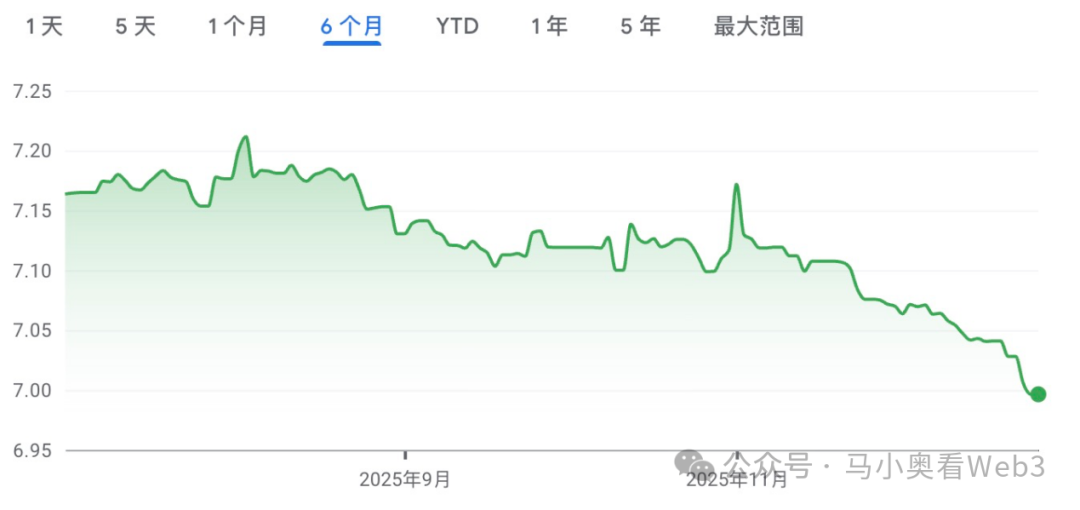
Core Viewpoint - The article discusses the reasons behind the appreciation of the Chinese Yuan (RMB) and the negative premium of USDT, highlighting the economic factors influencing these trends. Group 1: Reasons for RMB Appreciation - The appreciation of the RMB is primarily driven by three factors: attracting foreign investment, boosting domestic consumption, and alleviating international trade tensions [5][6][7]. - Attracting foreign investment enhances investment expenditure, as a stronger RMB makes it easier for China to draw in capital, especially in light of debt issues faced by both the US and China [5]. - The appreciation of the RMB reduces costs for consumers and businesses when purchasing foreign goods, thereby increasing consumption expenditure and corporate profit margins [6]. - A stronger RMB can help mitigate political friction arising from trade surpluses, as it may reduce the trade deficit for other countries, leading to less governmental expenditure on trade disputes [7]. Group 2: Implications of RMB Appreciation - The article emphasizes that the appreciation of the RMB must be stable and orderly, as rapid appreciation could negatively impact net exports and economic growth targets for the following year [8][10]. - The current economic environment, with a GDP growth target of around 5%, allows for a controlled appreciation of the RMB to facilitate economic transition and opportunity exploration [8]. Group 3: USDT Negative Premium - The negative premium of USDT is attributed to three main factors: a sluggish cryptocurrency market, increased demand for RMB during year-end settlements, and tighter regulations on stablecoins by the Chinese government [12][13]. - The article suggests that the negative premium of USDT is likely a short-term phenomenon influenced by supply and demand dynamics rather than a structural risk [13]. Group 4: Currency Strategy Recommendations - The article advises that unless USDT constitutes a significant portion of an investment portfolio, it may be prudent to maintain a certain level of stablecoin assets due to the potential for short-term losses from currency exchange [14]. - The opportunity cost of holding stablecoins is highlighted, especially in the context of China's economic challenges and the potential for lower returns in the domestic market [14]. - The article discusses strategies for hedging against RMB appreciation, including investing in stablecoins from Hong Kong, Japan, and South Korea, as well as gold-backed assets and Euro stablecoins [18][19].

The Best Cryptocurrency to Buy With $500 Right Now (Hint: It's Not Bitcoin)
Yahoo Finance· 2025-12-31 20:27
Core Insights - Bitcoin has been the top-performing cryptocurrency over the past decade, but Pax Gold (PAXG) is currently considered a better investment option due to its 1-to-1 peg with gold and a 74% increase in value this year [1][8] Group 1: Gold-Backed Stablecoins - Gold-backed stablecoins, such as Pax Gold and Tether Gold, are gaining traction, with both having market caps exceeding $1.6 billion [3] - Pax Gold is preferred over Tether Gold due to its availability on more U.S.-based cryptocurrency trading platforms [3] - Pax Gold trades at the price of gold, currently valued at $4,563, rather than the typical $1 peg of traditional stablecoins [4] Group 2: Investment Advantages - Pax Gold offers a more cost-effective and simpler way to gain exposure to gold compared to traditional gold ETFs [8] - Each Pax Gold token is backed by 1 fine troy ounce of gold stored in a London vault, providing a direct link to physical gold [5][6] - The ability to exchange Pax Gold for physical gold at any time adds to its appeal as a digital gold alternative [6]
RWA的崛起与数字金融新范式-高朋律师事务所&苏税迅通
Sou Hu Cai Jing· 2025-09-16 08:46
Core Insights - The report focuses on the rise of Real-World Assets (RWA) tokenization, analyzing its concept, value, regulation, practice, and trends, highlighting its role in bridging traditional finance and the Web3.0 ecosystem [1][11][13]. Group 1: RWA Concept and Background - RWA refers to the tokenization of physical assets like real estate, bonds, and commodities using blockchain technology, enhancing asset liquidity, transparency, and accessibility [1][18]. - The emergence of RWA addresses traditional financial pain points such as low liquidity, high entry barriers, and lack of transparency, leveraging blockchain's immutable nature and smart contracts for automation [1][23][25]. - The global RWA market has surpassed hundreds of billions of dollars, with expectations for explosive growth in the coming years [13][24]. Group 2: Investment Value and Advantages - RWA significantly enhances asset liquidity and market efficiency, with tokenized real estate trading cycles averaging 47 days compared to traditional commercial real estate's 6-9 months [2][39]. - RWA improves investment accessibility and promotes financial inclusion by lowering entry barriers, allowing broader participation in high-value assets [2][39]. - The tokenization process increases transparency and security, although challenges regarding the credibility of off-chain data remain [2][39]. Group 3: RWA Asset Categories and Examples - RWA encompasses diverse asset categories, including stablecoins (e.g., USDT, USDC), private credit, U.S. Treasury bonds, real estate, commodities, intellectual property, and emerging sectors like renewable energy and agriculture [2][29][30]. - Stablecoins serve as foundational RWA, providing a stable value anchor and facilitating the integration of Web3.0 with the real economy [2][34][37]. - The tokenization of real estate allows fractional ownership, significantly reducing investment thresholds and enhancing liquidity [2][30]. Group 4: Global Regulatory Landscape - The global regulatory framework for RWA is evolving, with a focus on compliance and risk management, as seen in the U.S. GENIUS Act and the EU MiCA regulation [3][4]. - Different jurisdictions are adopting varied approaches to RWA regulation, with the U.S. and EU leading in establishing comprehensive frameworks [3][4]. - In China, RWA is in a regulatory gray area, with initiatives focusing on private chains and sectors like renewable energy and agriculture [3][4]. Group 5: Future Trends and Challenges - The RWA market is expected to grow significantly, driven by institutional participation and the increasing importance of stablecoins as a liquidity infrastructure [3][6][12]. - Emerging asset categories like computing power are gaining traction, presenting new opportunities and legal challenges [3][6][12]. - The report emphasizes the need for ongoing research into the intersection of law and technology to support the healthy development of RWA [3][6].

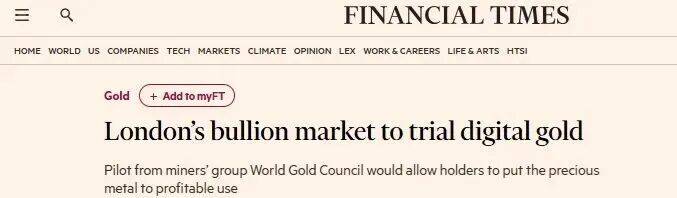
重大消息!“数字黄金”也要来了?英媒:世界黄金协会正计划推出“数字黄金”
Sou Hu Cai Jing· 2025-09-03 08:43
Core Viewpoint - The World Gold Council is seeking to launch digital gold, which could revolutionize the $900 billion physical gold market in London [1][3]. Group 1: Digital Gold Initiative - The new digital unit called "Pool Gold Interests" (PGIs) will pilot in London with commercial participants in the first quarter of next year [3]. - Digital gold aims to expand market coverage despite many investors valuing gold for its physical characteristics and lack of counterparty risk [3][4]. - The digitalization of gold could allow it to be used as collateral and meet margin requirements, transforming it from a static asset on balance sheets [3][5]. Group 2: Market Structure and Participants - The London wholesale gold market is the largest physical trading center globally, supported by major banks like HSBC and JPMorgan [6]. - Currently, there are two types of trading in the London market: "allocated" gold trading involving specific bars and "unallocated" gold trading without specific bars [7]. - The proposal for PGIs will create a third trading type in the London over-the-counter gold market [7]. Group 3: Challenges and Competition - Despite rising gold prices, the asset faces competition from cryptocurrencies and stablecoins, which could surpass traditional gold investments [9]. - Efforts to create gold-backed stablecoins have largely failed, with the most successful ones managing around $1.3 billion in assets compared to $400 billion held in gold-backed ETFs [9]. - The adoption of blockchain initiatives in the gold market has been slow, but there is a positive reception among refiners, with 96% of good delivery list refiners participating [9].