
Pixel 9 系列

Search documents
Counterpoint Research:尽管关税问题持续存在 2025年Q3美国智能手机出货量仍同比小幅增长
Zhi Tong Cai Jing· 2025-12-11 02:08
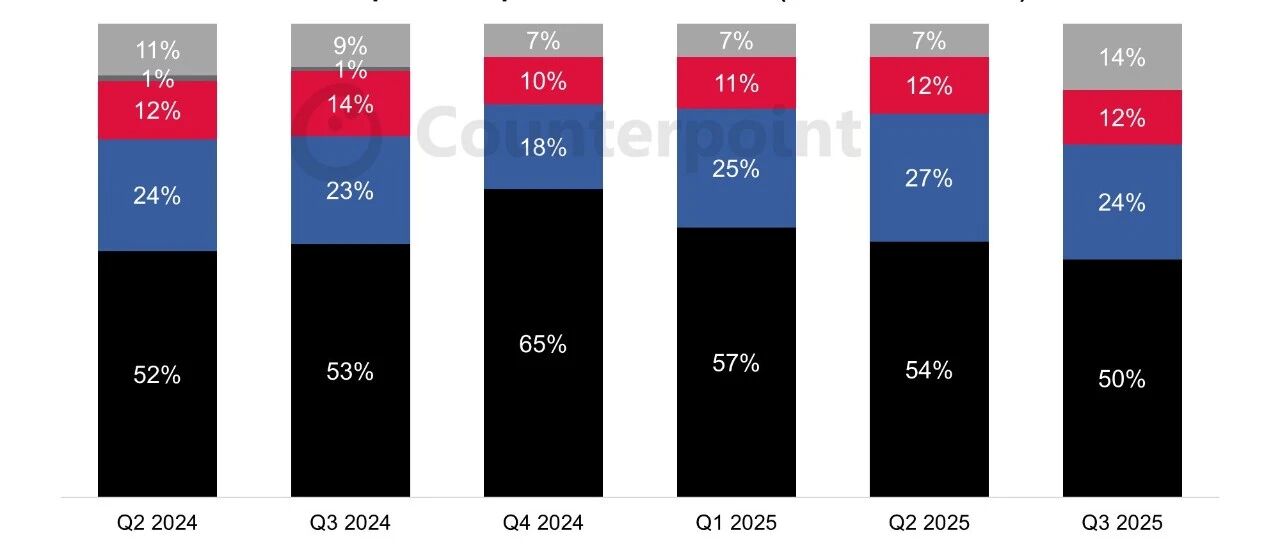
Core Insights - Despite ongoing tariff issues, U.S. smartphone shipments are expected to see a slight year-on-year increase in Q3 2025, driven by rising imports from Vietnam and India, even as imports from China decline [1][2] Group 1: Market Performance - In Q2 2025, U.S. smartphone shipments grew by 2% year-on-year, attributed to increased imports from regions outside China [2] - Apple's market share has declined both year-on-year and quarter-on-quarter, although the iPhone 16e has shown strong performance, maintaining annual shipment growth [1][3] - Samsung experienced a slight year-on-year increase of 1 basis point, but a quarter-on-quarter decline of 3 basis points, primarily due to strong growth from Google [1][3] - Motorola's performance weakened in Q3, with declines in both year-on-year and quarter-on-quarter market share, attributed to soft prepaid demand influenced by macroeconomic and political factors [1] Group 2: Competitive Landscape - Samsung achieved a double-digit year-on-year growth, benefiting from increased shipments of high-end models, raising its market share by 3 basis points to 27% [3] - Motorola has maintained a double-digit market share for five consecutive quarters, driven by competitive pressure in the prepaid market and an early launch of the RAZR 2025 series [3][4] - HMD's exit from the U.S. market creates new opportunities for other smartphone brands to capture market share [4] Group 3: Historical Trends - In Q1 2025, smartphone shipments increased by 9% year-on-year, largely due to preemptive stocking to avoid potential tariff impacts, especially in March [5] - Apple's market share reached a record high of 57% in Q1 2025, driven by the launch of the iPhone 16e and early shipments before April [5] - Samsung's market share fell from 31% in Q1 2024 to 25%, partly due to increased shipments from Apple and weaker performance of the S25 model [5]


美国智能手机市场份额:季度数据(2023 年 Q2 - 2025 年 Q3)
Counterpoint Research· 2025-12-11 01:42
Core Insights - The article discusses the smartphone market trends and shipment volumes, highlighting the performance of major brands in the U.S. market for Q3 2025 and the impact of various economic factors on these trends [4][8][11]. Market Highlights - Despite ongoing tariff issues, U.S. smartphone shipments saw a slight year-on-year increase in Q3 2025, attributed to a rise in imports from Vietnam and India, compensating for the decline in imports from China [8][11]. - Apple experienced a decline in market share both year-on-year and quarter-on-quarter, yet maintained growth in annual shipments due to strong performance from the iPhone 16e. The iPhone 17 series shipments remained stable but faced challenges from strong demand [8][11]. - Samsung's market share saw a minor increase of 1 basis point year-on-year but a decrease of 3 basis points quarter-on-quarter, primarily due to strong growth from Google [8][11]. - Motorola's performance weakened in Q3 due to soft prepaid demand influenced by macroeconomic and political factors, leading to a decline in its market share [8][11]. - HMD exited the U.S. market, prompting a cessation of tracking for this brand by the research firm [8][11]. Brand Performance - In Q2 2024, Apple held a 52% market share, which increased to 53% in Q3 2024, but dropped to 50% by Q3 2025. Samsung's share fluctuated, reaching 24% in Q3 2024 and stabilizing at 24% in Q3 2025. Lenovo's share remained consistent at 12% during the same period [9][15]. - The overall smartphone shipment volume in Q1 2025 increased by 9% year-on-year, driven by preemptive stocking to avoid potential tariff impacts, particularly in March [15][21]. - Motorola achieved its highest market share of 11% in Q1 2025, attributed to the early launch of its G series and improved positioning in the prepaid market [15][21]. Economic Impact - The article notes that the U.S. smartphone market faced a 9% year-on-year decline in Q4 2024, influenced by low upgrade rates and extended upgrade cycles. Apple and Samsung both experienced declines in shipments during this period [18][21]. - In Q3 2024, the U.S. smartphone market saw a 6% year-on-year decline, primarily due to weak demand in both prepaid and postpaid channels [21].


电子行业2025年度中期策略:端侧AI继续升级,ASIC需求景气高企
Xiangcai Securities· 2025-07-04 13:52
Group 1 - The report highlights that large model technology continues to iterate, leading to an innovation wave in consumer electronics driven by AI integration [5][21][30] - Traditional consumer electronics have entered a phase of slow growth, with smartphones and PCs stabilizing in sales, while TWS devices are also experiencing low growth [15][19] - The development of model compression technology lays the foundation for deploying large models on edge devices, which offer low cost, high performance, and privacy advantages [6][30] Group 2 - The penetration rate of AI terminals is expected to rise rapidly as major companies like Google and Huawei launch AI-enabled devices, enhancing user experience [6][34] - The report predicts a compound annual growth rate of approximately 115% for high-end AI PCs and 32% for AI smartphones from 2023 to 2027 [6][52] - The introduction of system-level AI capabilities in smartphones and PCs is anticipated to set new standards in the industry, prompting other manufacturers to follow suit [36][40] Group 3 - The demand for ASICs is strong, driven by their cost-effectiveness compared to GPUs, leading many tech companies to develop their own ASICs [7][75] - The global market for ASICs is projected to grow from $6.6 billion in 2023 to $55 billion by 2028, with a compound annual growth rate of 53% [7][76] - OpenAI's recent decision to rent Google TPU for its products marks a significant milestone for ASICs, indicating their acceptance by leading AI firms [7][76] Group 4 - The report suggests focusing on companies within the edge AI and ASIC supply chains, maintaining an "overweight" rating for the electronics sector [8][9] - Specific companies to watch in the edge AI sector include Rockchip, Hengxuan Technology, and Espressif Technology, while those in the ASIC space include Chipone and Aojie Technology [8][9]