
RoboTruck

Search documents
曹旭东谈Momenta百年使命:从“给每个家庭一个AI司机”到实现“更好的人工智能、更好的生活”
Xin Lang Cai Jing· 2025-12-24 10:42
Core Viewpoint - The CEO of Momenta, Cao Xudong, emphasizes the company's dual strategy focusing on mass production of autonomous driving for individual consumers and scalable Robo solutions, including RoboTaxi, RoboDelivery, and RoboTruck services [1][3]. Group 1: Company Strategy - Momenta's strategy consists of two main legs: one is the mass production of autonomous driving aimed at personal consumers, and the other is the scaling of Robo services [1][3]. - The company aims to provide an AI driver for every household, enhancing the quality of life for families [1][3]. Group 2: Future Vision - The future mission of Momenta is to achieve "better artificial intelligence" and "better living" [1][3]. - Cao Xudong expresses a long-term commitment to this vision, stating that it is worth pursuing for 100 years [1][3]. - In five years, the company hopes to be recognized as a "pioneer" and "icebreaker" in the industry [1][3].

赴港IPO,小马智行的「新玩法」是什么?
Sou Hu Cai Jing· 2025-10-27 09:56
Core Viewpoint - The company Xiaoma Zhixing is set to become the first enterprise in the autonomous driving sector to achieve a dual listing in both the US and Hong Kong, coinciding with a trend of Chinese tech companies returning to Hong Kong for IPOs [1][14] Financial Performance - In Q2, Xiaoma Zhixing reported total revenue of $21.5 million, a year-on-year increase of 75.9% and a quarter-on-quarter increase of 53.5% [2] - The Robotaxi business generated $1.5 million in revenue, with a year-on-year growth of 157.8%, and passenger fare revenue increased over threefold [2][4] - The company’s revenue structure is primarily composed of RoboTruck (48.48%), technology licensing (42%), and Robotaxi (9.2%) [1][4] Profitability Signals - Xiaoma Zhixing is on the verge of profitability, with a stable gross margin projected to reach 10.5% in 2024 and 16.3% in 2025, despite a decrease from 46.9% in 2022 [4][6] - The company has transitioned from a high-margin but unsustainable R&D phase to a more sustainable profit model aligned with commercialization [4][6] Fundraising and Strategic Intent - The company aims to raise a total of $16.3 billion in its IPO, significantly exceeding its peers and reflecting confidence in long-term industry prospects [7][10] - The funds will be allocated as follows: 40% for commercialization and market expansion, 40% for technology R&D, and 20% for potential strategic investments and acquisitions [10] Competitive Positioning - Xiaoma Zhixing has demonstrated superior operational efficiency compared to competitors, with a lower loss rate of 256% against a higher 396% for a peer company [12][14] - The company has shown a faster revenue growth rate of 43.3% year-on-year in the first half of the year, indicating effective market expansion and operational execution [11][14] Industry Impact - The dual listing of Xiaoma Zhixing is not just a capital event but may signify a turning point for the autonomous driving industry, moving from chaotic growth to a more rational development phase [14]
6个月敲钟,自动驾驶赛道跑出百亿新秀
汽车商业评论· 2025-09-30 06:41
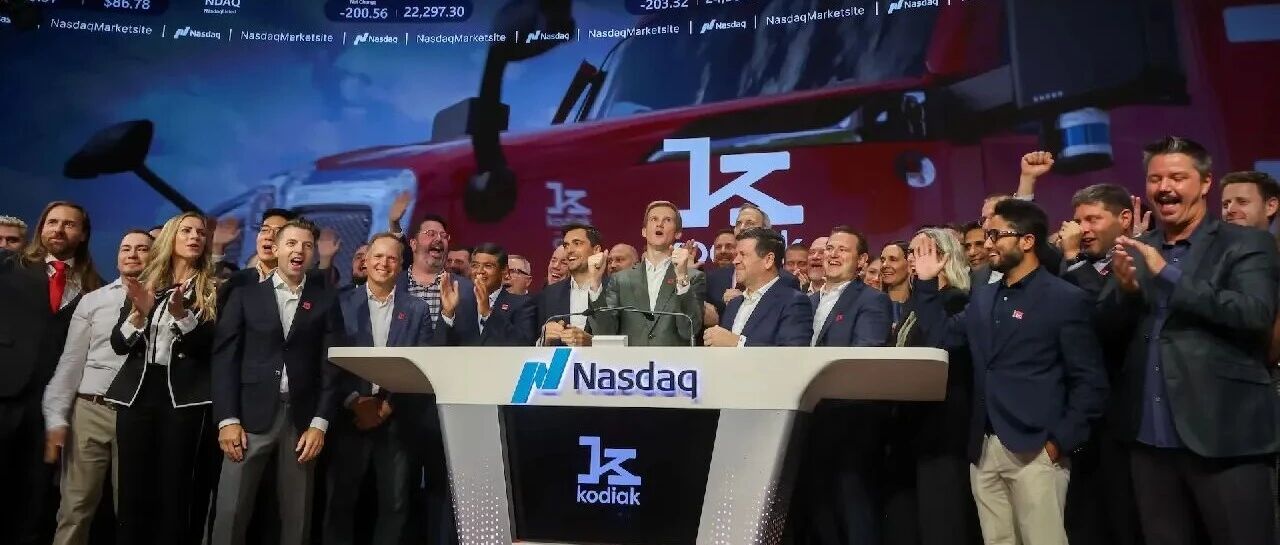
Core Viewpoint - The article discusses the rapid public listing of Kodiak AI, an autonomous trucking company, through a SPAC merger, highlighting its strategic focus on commercial freight and the potential for growth in the autonomous driving sector [4][5][9]. Group 1: Company Overview - Kodiak AI completed its merger with Ares Acquisition Corporation II on September 24, 2023, and began trading on NASDAQ the following day, achieving a valuation of approximately $2.5 billion [4]. - The company aims to automate long-haul trucking, focusing on highway routes between cities, and plans to integrate human-operated vehicles for the first and last mile [4][14]. - Kodiak's funding from the merger, totaling around $275 million, will primarily be used to expand its autonomous fleet and enhance research and development efforts [4][8]. Group 2: Market Position and Strategy - The choice of a SPAC route was driven by the need for timely capital and efficient financing, allowing Kodiak to accelerate production and expansion [5][8]. - Kodiak's strategy includes leveraging its technology in both commercial freight and defense sectors, indicating a dual growth trajectory [8][10]. - The company is focusing on a "hub-to-hub" model, which simplifies integration into existing transportation management systems and enhances operational efficiency [14][15]. Group 3: Competitive Landscape - The autonomous trucking sector is competitive, with key players like Aurora, Waabi, and Volvo Autonomous Solutions actively expanding their operations [19][21]. - Kodiak's approach contrasts with Waymo, which has shifted focus away from trucking to concentrate on robotaxi services [21]. - Regulatory changes in states like Texas and California are shaping the operational landscape for autonomous vehicles, potentially benefiting Kodiak's business model [23]. Group 4: Future Outlook - The successful conversion of raised funds into stable operations and diverse applications will be crucial for Kodiak's market acceptance and growth [9][24]. - The company is positioned to capitalize on the growing demand for autonomous freight solutions, especially in controlled environments like industrial logistics [15][16].
汽车行业双周报:海外Robotaxi支付意愿或较强,国内关注To-BRoboX放量-20250903
Hua Yuan Zheng Quan· 2025-09-02 23:40
Investment Rating - The investment rating for the automotive industry is "Positive" (maintained) [1] Core Insights - The willingness to pay for Robotaxi services in high-income markets is stronger than for traditional ride-hailing services. Waymo's pricing is higher than Uber and Lyft, with users prioritizing safety over cost [4][7] - Domestic markets may still view Robotaxi as a substitute for traditional taxis, while in regions like the Middle East, Europe, and North America, Robotaxi is seen as a premium service [4][7] - Technological advancements in Robotaxi are converging with passenger vehicles, but significant gaps remain in performance metrics compared to leading companies like Waymo [4][25][26] - The domestic To-B solutions, such as RoboTruck and RoboVan, may see faster commercialization compared to To-C Robotaxi due to clearer demand from businesses [4][32] - Companies benefiting from the overseas Robotaxi market and the acceleration of domestic To-B solutions include WeRide, Pony.ai, Horizon Robotics, and others [4][36] Summary by Sections Robotaxi Market Insights - Waymo's average daily orders in California exceeded 20 per vehicle by the end of 2024, with a fleet size of approximately 730 vehicles [7] - In California, Waymo's pricing is significantly higher than that of Uber and Lyft, with average fares being 41% and 31% higher, respectively [16][18] - Users of Robotaxi services prioritize safety and technology over price, with 70% of users preferring Waymo over traditional ride-hailing services [19][22] Technological Developments - Waymo is advancing towards a multimodal model (EMMA) that integrates various sensor inputs for improved navigation [25][31] - Tesla's Full Self-Driving (FSD) technology still lags behind Waymo in terms of operational efficiency, with significant differences in miles driven before requiring human intervention [26][30] Domestic Market Opportunities - The RoboTruck market is projected to reach a potential market size of approximately 400 billion yuan by 2030, driven by cost savings for businesses [32][35] - Companies like WeRide are expanding their Robotaxi operations internationally, with a focus on partnerships with ride-hailing platforms in various regions [36][37]