Robobus(自动驾驶小巴)

Search documents
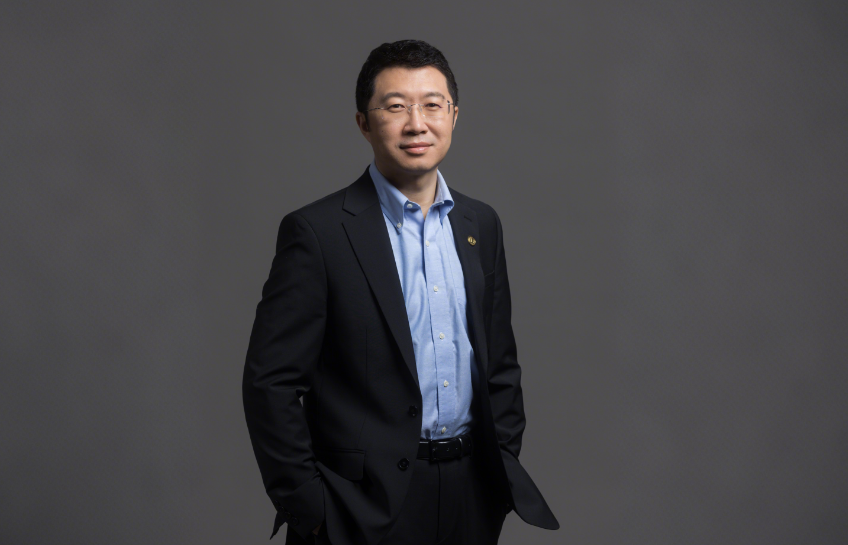
文远知行创始人韩旭:从示范到规模商用自动驾驶企业的破局之路
Zhong Guo Jing Ji Wang· 2025-12-11 01:50
Core Viewpoint - The "14th Five-Year Plan" serves as a precise navigation map for the Chinese technology industry, particularly highlighting four key concepts: new quality productivity, new type of national system, new security pattern, and Chinese-style modernization, which align closely with the development of the autonomous driving industry [2][3]. Group 1: New Quality Productivity - Autonomous driving exemplifies new quality productivity by leveraging cutting-edge technologies such as AI, big data, and IoT to revolutionize transportation, urban sanitation, and logistics efficiency [3]. - The plan emphasizes the full implementation of the "AI+" initiative and promotes deep integration of innovation chains, industry chains, capital chains, and talent chains, facilitating the technological iteration and commercialization from Level 2 (partial automation) to Level 4 (high automation) [3][4]. - The autonomous driving services, including Robotaxi, Robobus, and Robovan, significantly enhance travel efficiency, reduce operational costs, and create new employment opportunities, aligning with the plan's focus on high-level technological self-reliance [3][4]. Group 2: New Type of National System - The new type of national system provides crucial support for overcoming key core technologies in the autonomous driving industry, which is complex and involves multiple foundational elements such as chips, operating systems, high-precision maps, and sensors [4]. - The system is characterized by market-based mechanisms guided by national strategies, enabling coordinated resource integration to tackle critical challenges [4]. - National-level coordination accelerates infrastructure development and standardization, creating a conducive environment for the large-scale deployment of autonomous driving technologies [4]. Group 3: New Security Pattern - Safety is paramount in autonomous driving, encompassing functional safety, expected functional safety, network security, data security, and national-level technology and supply chain security [4]. - The heightened national focus on safety will drive the establishment of stricter and unified safety standards and certification systems, purging non-compliant entities from the market [4]. - Policies addressing data security will lead to improved data governance frameworks, enhancing public trust, which is essential for large-scale commercialization [4]. Group 4: Chinese-style Modernization - The development of autonomous driving is integral to the journey of Chinese-style modernization, with the country's vast transportation and logistics demands providing an ideal testing ground for world-class autonomous driving technologies [5][6]. - The emphasis on new urbanization, rural revitalization, and a strong transportation nation within the plan supports diverse application scenarios for autonomous driving, contributing to modernization efforts [5][6]. Group 5: Future Industry Integration - The "14th Five-Year Plan" encourages forward-looking layouts in future industries, with 6G and brain-computer interfaces highlighted as key areas that can synergize with autonomous driving [7][8]. - 6G technology is crucial for achieving high-level vehicle-road collaboration, enabling real-time awareness of dynamic environments and enhancing safety [7]. - Brain-computer interfaces offer unique applications in semi-autonomous driving scenarios, allowing for emergency control and improved interaction within smart cabins [8]. Group 6: Breakthroughs in Commercialization - The next five years are expected to be pivotal for achieving significant breakthroughs in Level 4 autonomous driving commercialization, focusing on three main areas: establishing unified access standards, clarifying liability, and opening typical scenarios for commercialization [9]. - A national-level initiative to create a unified certification system for Level 4 autonomous driving will facilitate large-scale operational networks [9]. - Clear legal frameworks for accident liability are essential to remove barriers to commercialization, while the systematic opening of urban public transport and logistics scenarios will enhance technology iteration and business model validation [9]. Group 7: Industry Outlook - The planning suggestions are viewed as both a compass and an accelerator for the autonomous driving industry, with expectations for a historic leap from demonstration operations to large-scale commercialization in the next five years [10].

文远知行港股上市,全场景布局迎战商业化深水区
Sou Hu Cai Jing· 2025-11-07 07:08
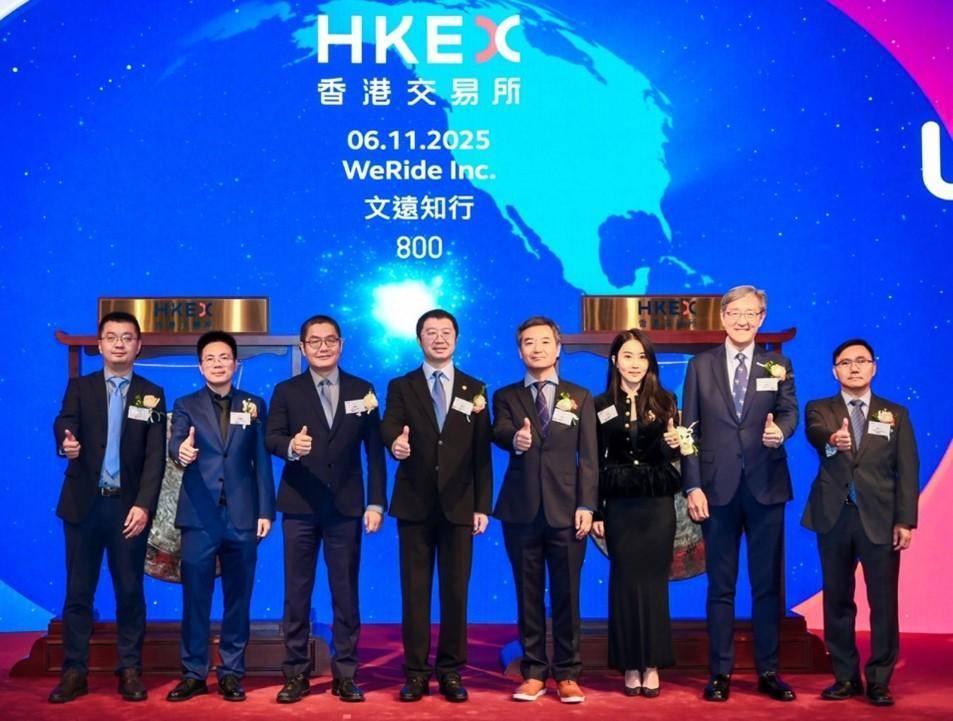
Core Insights - Company Wenyan Zhixing (0800.HK) officially listed on the Hong Kong Stock Exchange on November 6, 2025, with an issue price of HKD 27.1 per share, raising a total of HKD 2.39 billion through the global offering [1] - The company has established a dual primary listing structure in both the US and Hong Kong, becoming the first in the autonomous driving industry to achieve a dual financing platform layout [3] Group 1: IPO and Capital Structure - The IPO saw international placements oversubscribed by 9.85 times and the Hong Kong public offering oversubscribed by 73.44 times, indicating strong market demand [4] - The dual primary listing requires compliance with regulations from both exchanges, increasing compliance costs but significantly enhancing risk resilience, allowing for continuous financing support even if one market experiences volatility [4] - The company has received backing from industry giants such as Uber, Grab, and Bosch, as well as sovereign funds from Asia and the Middle East, creating a deep binding model of "capital + industry" [4] Group 2: Use of Proceeds - The funds raised will be allocated as follows: 40% for the development of autonomous driving technology stack, 40% for the commercial production and operation of L4-level fleets, and the remaining 20% for market expansion and working capital [4] Group 3: Business Strategy and Global Presence - The core competitiveness of the company lies in its strategy of "universal technology platform + multi-scenario implementation + global layout," with a product matrix covering five categories: Robotaxi, Robobus, Robosweeper, Robovan, and ADAS [5] - The company has obtained autonomous driving licenses in seven countries, including China, the US, UAE, and Singapore, covering over 30 cities across 11 countries, making it one of the most well-licensed companies in the global autonomous driving sector [7] - The company operates a fleet of over 1,500 L4-level autonomous vehicles, including more than 700 Robotaxis, with plans to deploy tens of thousands of Robotaxis by 2030 [7] - The company has achieved a breakthrough in cost control, reducing the cost of its GXR autonomous driving suite by 50% through the integration of NVIDIA's latest HPC 3.0 computing platform [7]
从“掐架”到双双赴港,你打的无人车正在港股集体上市!
Sou Hu Cai Jing· 2025-10-24 14:33
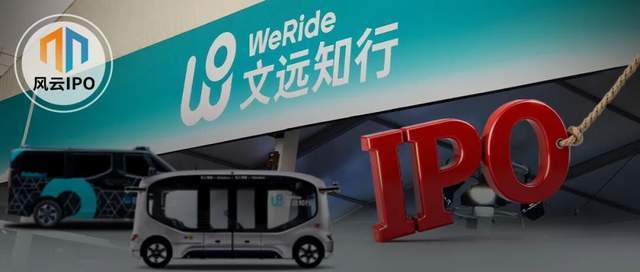
Core Insights - WeRide Inc. is a leading player in the autonomous driving sector, aiming to deploy driverless vehicles in over 30 cities globally, including Robotaxi services in cities like Guangzhou and Abu Dhabi [5][9] - The company has recently completed its IPO on NASDAQ and is seeking a dual primary listing on the Hong Kong Stock Exchange, potentially becoming the first Robotaxi stock in Hong Kong [5][12] - Despite a significant increase in revenue from its Robotaxi business, WeRide has accumulated substantial losses since its inception, totaling approximately 9.4 billion RMB [5][12] Financial Performance - WeRide's Robotaxi business revenue surged over 800% year-on-year in the latest quarter, contributing 36.1% to total revenue, which reached 127 million RMB, a 60.8% increase year-on-year [9][12] - The company has faced continuous revenue decline over the past three years, with reported revenues of 528 million RMB in 2022, 402 million RMB in 2023, and 200 million RMB in the first half of 2025 [12] - Cumulative losses since 2017 have reached 9.4 billion RMB, highlighting the financial challenges faced by the company [12][20] Business Strategy - WeRide has developed a unique commercial engine centered around its "WeRide One" technology platform, designed for L4-level autonomous driving, adaptable to various vehicle types and applications [7][9] - The company has diversified its product offerings into a "1+5" matrix, including Robotaxi, Robobus, Robovan, Robosweeper, and Advanced Driver Assistance Systems (ADAS) to mitigate risks associated with the lengthy commercialization cycle of Robotaxi [9][12] - Partnerships with major players like Uber and GAC Group have been established to enhance operational capabilities and market reach [13][20] Market Position and Competition - WeRide holds the largest autonomous taxi fleet in the Middle East, with operations in Abu Dhabi and Riyadh, and has plans for commercial operations in Dubai by 2026 [10][12] - The competitive landscape includes other autonomous driving companies like Pony.ai, which also aims for a public listing and has shown strong revenue growth, indicating a competitive market environment [14][20] - The ongoing rivalry has led to public exchanges between executives of WeRide and competitors, reflecting the intense competition in the autonomous driving sector [15][20]
小马智行、文远知行两大自动驾驶龙头同日获港股IPO备案
Xin Lang Cai Jing· 2025-10-14 21:42
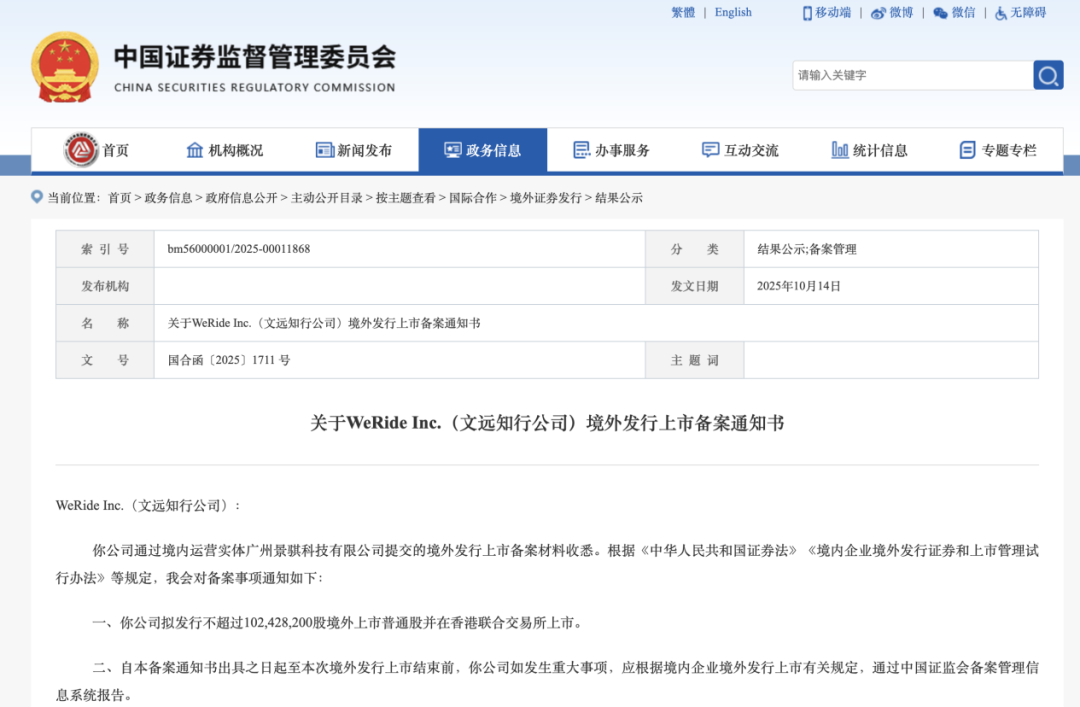
Core Insights - The article highlights the recent developments in the autonomous driving sector, particularly focusing on the dual listings of WeRide Inc. and Pony AI Inc. in Hong Kong, as well as the significant growth in revenue for WeRide Inc. and Pony AI Inc. [1][4] Company Developments - WeRide Inc. plans to issue up to 102,428,200 shares for its listing on the Hong Kong Stock Exchange, as approved by the China Securities Regulatory Commission [1] - Pony AI Inc. intends to issue up to 102,146,500 shares for its listing on the Hong Kong Stock Exchange, also receiving approval from the China Securities Regulatory Commission [1] - WeRide Inc. reported a revenue of 127 million yuan (approximately 17.5 million USD) for Q2 2025, marking a year-on-year increase of 60.8% [3] - Pony AI Inc. achieved a total revenue of 154 million yuan (approximately 21.5 million USD) in Q2 2025, reflecting a year-on-year growth of 75.9% [4][5] Business Performance - WeRide Inc.'s autonomous taxi business revenue reached 45.9 million yuan (approximately 6.3 million USD) in Q2 2025, showing a substantial year-on-year increase of 836.7% [3] - The share of autonomous taxi business revenue in WeRide's total revenue rose to 36.1%, the highest since 2021 [3] - Pony AI Inc. reported that its Robotaxi business revenue reached 10.9 million yuan (approximately 1.5 million USD) in Q2 2025, with a year-on-year growth of 157.8% [5] Global Expansion - WeRide Inc. has expanded its operations to 11 countries and over 30 cities, holding autonomous driving licenses in seven countries [2] - Pony AI Inc. has initiated Robotaxi services in major cities like Beijing, Shanghai, Guangzhou, and Shenzhen, covering over 2,000 square kilometers [4] - Both companies are actively pursuing international collaborations, with WeRide partnering with Grab in Southeast Asia and Pony AI collaborating with transportation companies in Qatar and Singapore [2][5] Industry Trends - The global autonomous driving market is projected to grow from approximately 158.3 billion USD in 2023 to 273.8 billion USD by 2025, reflecting a year-on-year growth of 29.97% [7] - The article emphasizes the increasing commercialization of autonomous driving services, with companies like WeRide and Pony AI leading the charge in urban areas [6]

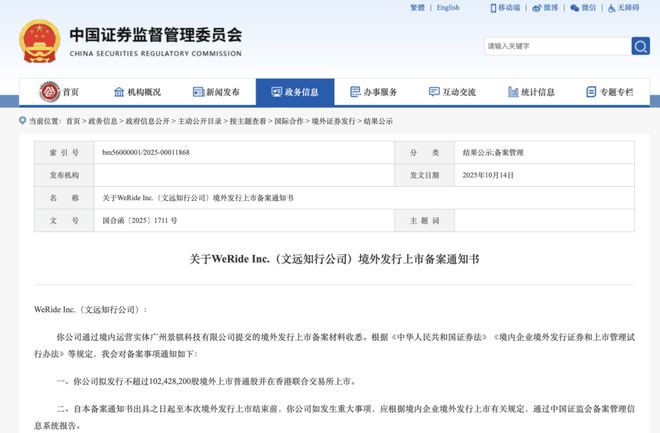
两大自动驾驶龙头,同日获港股IPO备案
Shang Hai Zheng Quan Bao· 2025-10-14 13:56
Core Insights - The dual listing of Hesai Technology on both US and Hong Kong stock exchanges has led to two major autonomous driving companies, WeRide Inc. and Pony AI Inc., receiving approval from the China Securities Regulatory Commission (CSRC) for their IPOs in Hong Kong [1][2] WeRide Inc. Summary - WeRide plans to issue up to 102,428,200 shares for its overseas listing on the Hong Kong Stock Exchange [1] - The company reported a revenue of 127 million yuan in Q2 2025, marking a year-on-year growth of 60.8% [2] - The autonomous taxi business generated 45.9 million yuan in revenue during the same quarter, a significant increase of 836.7%, setting a new quarterly record for the company [2] - The gross profit increased by 40.6% year-on-year, indicating a steady growth trend [2] Pony AI Inc. Summary - Pony AI plans to issue up to 102,146,500 shares for its overseas listing on the Hong Kong Stock Exchange [1] - The company achieved a total revenue of 154 million yuan in Q2 2025, reflecting a year-on-year increase of 75.9% and a quarter-on-quarter increase of 53.5% [3] - As of Q2 2025, Pony AI's cash and cash equivalents, along with short-term investments, amounted to 5.356 billion yuan (748 million USD) [3] Global Expansion Efforts - WeRide has been actively expanding its global footprint, with its first batch of Robotaxi vehicles arriving in Singapore for testing [2] - The company has received regulatory approval to conduct driverless public road passenger services in Shanghai [2] - Pony AI has also announced partnerships in Qatar and Singapore to advance autonomous driving technology and services [4] Industry Trends - The autonomous driving sector is experiencing rapid development, supported by favorable policies in major cities like Beijing and Shanghai [4] - The market for autonomous driving is projected to grow significantly, with an estimated size of approximately 158.3 billion USD in 2023, expected to reach 273.8 billion USD by 2025 [5]
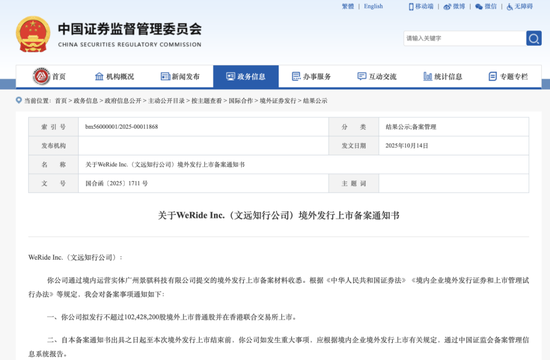
两大自动驾驶龙头 同日获港股IPO备案
Shang Hai Zheng Quan Bao· 2025-10-14 13:54
Core Insights - WeRide Inc. and Pony AI Inc. have received approval from the China Securities Regulatory Commission (CSRC) for their overseas listings in Hong Kong, indicating a growing trend of Chinese autonomous driving companies seeking international capital markets [1][6]. WeRide Inc. (文远知行) - WeRide plans to issue up to 102,428,200 shares for its listing on the Hong Kong Stock Exchange [1]. - The company reported a revenue of 127 million yuan (approximately 17.5 million USD) in Q2 2025, marking a year-on-year increase of 60.8% [3]. - The revenue from its autonomous taxi business reached 45.9 million yuan (approximately 6.3 million USD), a significant increase of 836.7% year-on-year, setting a new quarterly record since its establishment [3]. - WeRide has expanded its global presence, having obtained autonomous driving licenses in seven countries and operating in over 30 cities across 11 countries [2][3]. Pony AI Inc. (小马智行) - Pony AI plans to issue up to 102,146,500 shares for its listing on the Hong Kong Stock Exchange [1]. - The company reported total revenue of 154 million yuan (approximately 21.5 million USD) in Q2 2025, reflecting a year-on-year growth of 75.9% and a quarter-on-quarter increase of 53.5% [8]. - Pony AI's Robotaxi business generated revenue of 10.9 million yuan (approximately 1.5 million USD) in Q2 2025, with a year-on-year growth of 157.8%, driven by increased user demand and expansion of its operational fleet [8]. - The company has established operations in major cities like Beijing, Shanghai, Guangzhou, and Shenzhen, covering over 2,000 square kilometers [8]. Industry Trends - The autonomous driving industry is experiencing rapid growth, with significant policy support from various cities in China, including the issuance of new operational licenses and standards [11][12]. - The global autonomous driving market is projected to reach approximately 273.8 billion USD by 2025, growing from about 158.3 billion USD in 2023, indicating a compound annual growth rate of nearly 30% [13].