Rubin架构产品

Search documents
黄仁勋来上海了:逛菜场、现身新办公室
财联社· 2026-01-24 14:12
Core Viewpoint - Huang Renxun, the founder of Nvidia, visited China for the first time in 2026, signaling the company's commitment to the Chinese market and focusing on the sales of the H200 chip [4][10]. Group 1: Nvidia's Operations in China - Nvidia has three core locations in China: Beijing, Shanghai, and Shenzhen, with the new Shanghai office located at 600 Naxian Road, Zhangjiang, covering an area of approximately 23,300 square meters [9]. - The company has nearly 4,000 employees in China, with a growth rate of about 50% to 60% over the past few years, and the Shanghai R&D center alone has over 2,000 employees [9][10]. - The new office in Shanghai will focus on chip design verification, product optimization, and autonomous driving research tasks [9]. Group 2: Importance of the Chinese Market - Nvidia's revenue from the Chinese market was $17 billion in the 2024 fiscal year, accounting for approximately 13% of total revenue [10]. - Huang Renxun emphasized the significance of the Chinese AI market, predicting it will reach $50 billion in the next two to three years, indicating that American companies could face substantial losses if they do not participate [10]. Group 3: Strategic Focus During the Visit - Huang Renxun's visit included attending New Year parties and supplier appreciation events in Shanghai, Beijing, and Shenzhen, aimed at maintaining team morale and partner confidence [10]. - A key objective of the visit was to clarify compliance and operational details regarding the sales of the H200 chip in China, addressing uncertainties about who can purchase the chip and how to ensure compliance with regulations [10]. - Nvidia is also focusing on deepening its ecosystem and supply chain collaborations in China, including partnerships with TSMC and Foxconn, and localizing the CUDA software ecosystem [10]. Group 4: Shanghai's Industry Advantages - Shanghai has established itself as a hub for the integrated circuit industry, with projected revenue exceeding 480 billion yuan by 2025 [13]. - The city is home to over 1,200 enterprises in the integrated circuit sector, accounting for about 40% of the national talent in this field, and ranks first in the number of listed companies on the Science and Technology Innovation Board [13]. - Shanghai's integrated circuit industry has developed a comprehensive collaborative development system, attracting top global chip design companies and high-level talent [13].



资深科技分析师:英伟达真的很便宜
美股IPO· 2025-12-24 09:24
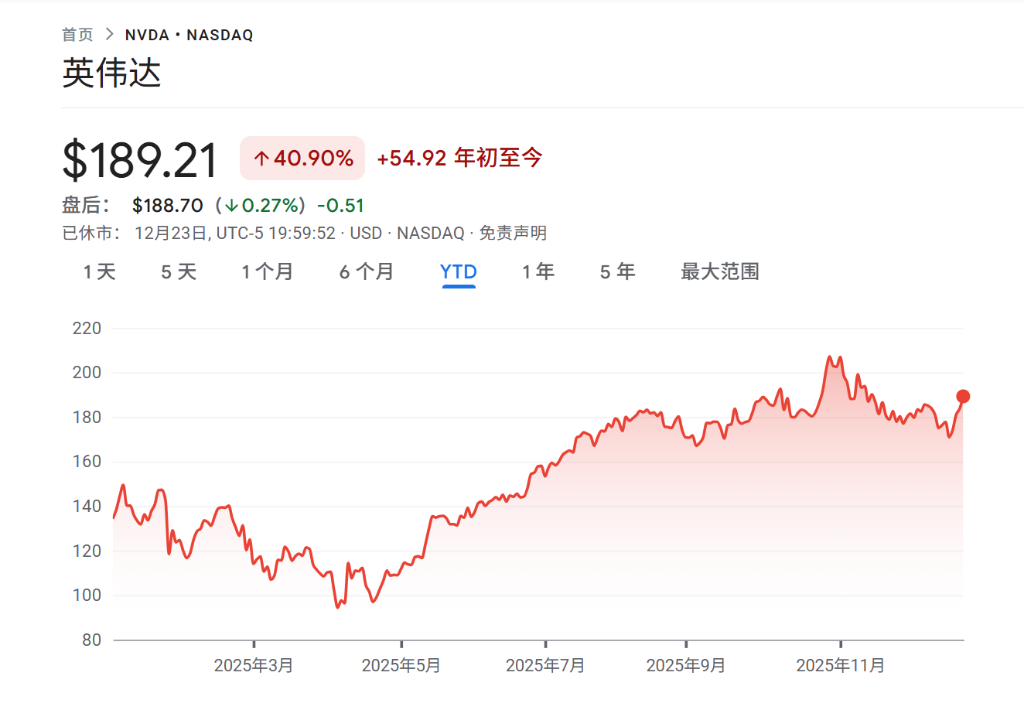
Core Viewpoint - Bernstein's report indicates that Nvidia's valuation has dropped to a historical low, with the expected price-to-earnings ratio falling below 25 times, representing a rare discount relative to the semiconductor industry. Despite recent stagnation in stock price, earnings continue to be revised upward, and new architectures like Blackwell are on the horizon. Analysts believe this is an excellent buying opportunity, with a target price set at $275 [1][3][6]. Group 1 - Nvidia's stock price has stagnated since July, with a year-to-date increase of approximately 30%, underperforming the Philadelphia Semiconductor Index (SOX) which rose by 38%. This stagnation, coupled with rising earnings, has led to a significant drop in the expected price-to-earnings ratio (P/FE) to below 25 times [3][5]. - Analysts from Bernstein assert that Nvidia is currently extremely "cheap" in both absolute and relative valuation terms, trading at about a 13% discount compared to the overall semiconductor industry, placing it in the first percentile of the past decade [5][6]. - Historical data shows that investors buying Nvidia when the price-to-earnings ratio is below 25 times typically see substantial returns, with an average one-year return exceeding 150%, and no negative returns during such periods [5][6]. Group 2 - Bernstein's analysis indicates that a 25 times expected price-to-earnings ratio places Nvidia's valuation in the 11th percentile of the past decade, marking it as an absolute low. Notably, there have only been 13 trading days in the past ten years where Nvidia's price relative to the SOX index was cheaper than it is now [6]. - Addressing market concerns regarding the sustainability of AI capital expenditures, analysts note that current capital expenditure intentions remain healthy, and the competitive narrative of GPUs versus ASICs is regaining momentum. Upcoming events like CES and GTC are expected to provide further catalysts, with new products based on the Rubin architecture set to launch [6]. - Bernstein reaffirms its "outperform" rating for Nvidia, setting a target price of $275, suggesting that current market expectations may be too low given the company's guidance of over $500 billion from Blackwell/Rubin [6].
资深科技分析师:英伟达真的很便宜
Hua Er Jie Jian Wen· 2025-12-24 08:33
Core Viewpoint - Bernstein's report indicates that despite Nvidia's decent stock performance this year, its valuation has undergone significant compression, currently sitting at an attractive historical low [1][4]. Group 1: Stock Performance and Valuation - Since July, Nvidia's stock price has stagnated, with a year-to-date increase of approximately 30%, underperforming the Philadelphia Semiconductor Index (SOX) which rose by 38% [1]. - This stagnation in stock price, coupled with rising earnings expectations, has led to a substantial decline in its expected price-to-earnings ratio (P/FE) to below 25 times [1][4]. Group 2: Relative Valuation - Nvidia is currently trading at about a 13% discount relative to the overall semiconductor industry, placing it in the first percentile of its valuation over the past decade [4]. - Historical data shows that when Nvidia's P/E ratio falls below 25 times, investors typically see substantial returns, with an average one-year return exceeding 150%, and no negative returns during such periods [4]. Group 3: Future Catalysts - Bernstein estimates that a 25 times expected P/E ratio indicates Nvidia's valuation is at the 11th percentile of its range over the past ten years, marking an absolute low [5]. - The report highlights that there are multiple catalysts on the horizon, including healthy capital expenditure intentions and the upcoming CES and GTC conferences, which are expected to provide further momentum [5]. - The anticipated release of the Rubin architecture products and potential market opportunities in China due to the Trump administration's approval of H200 chips are also noted as positive developments [5]. Group 4: Analyst Rating and Price Target - Bernstein reaffirms its "outperform" rating for Nvidia, setting a target price of $275, suggesting that current market expectations may be too low given the company's guidance of over $500 billion from Blackwell/Rubin [5].