
TPU AI算力集群

Search documents
英伟达业绩即将来袭 “AI算力牛市叙事”能否击溃“AI泡沫”?
智通财经网· 2026-02-25 09:49
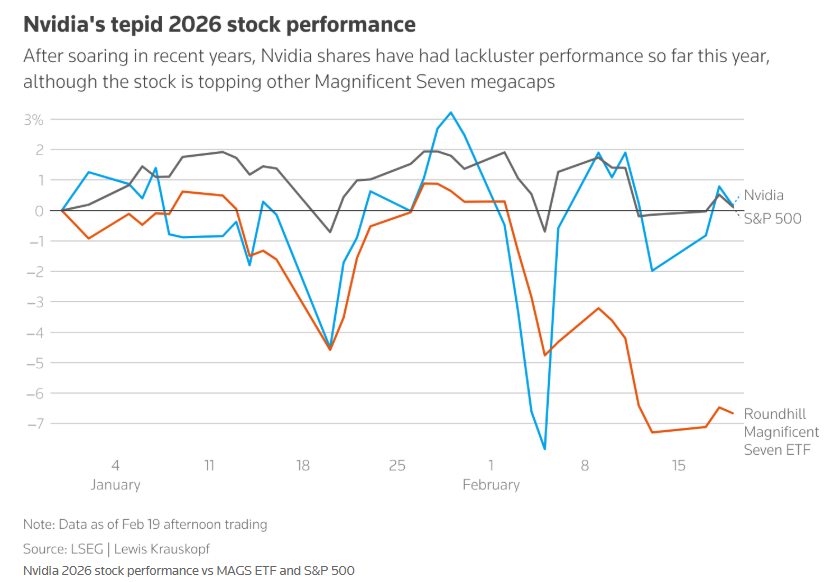
Core Viewpoint - Nvidia, referred to as the "AI chip leader," is set to report quarterly earnings, which will serve as a "stress test" for AI computing investments, with investors looking for evidence of profit growth linked to the substantial AI capital expenditures of major tech companies [1][10]. Group 1: Nvidia's Market Position and Competition - Nvidia's stock has only risen about 2% in 2026, primarily due to concerns over AI-related narratives impacting software stocks and increased competition from hyperscalers developing their own AI ASIC chips [2]. - Google has emerged as a strong competitor to Nvidia in AI computing infrastructure, having secured a deal to provide TPU AI computing clusters to Anthropic, a developer of AI products [5]. - Nvidia's market dominance in AI chips is under threat as hyperscalers announce plans for more cost-effective self-developed AI ASIC chips, which could challenge Nvidia's long-standing leadership [1][5][9]. Group 2: Financial Expectations and Market Reactions - Analysts expect Nvidia's Q4 revenue to surge over 68% to $66.16 billion, with a forecast for Q1 2027 revenue growth of 64.4% to $72.46 billion, although the growth rate is anticipated to slow compared to previous quarters [11][14]. - The options market indicates a potential stock price volatility of about ±5% following Nvidia's earnings report, reflecting the company's significant influence on the broader market [17]. - There are concerns regarding the sustainability of AI capital expenditures, with expectations that the ongoing investment cycle may only be in its early to mid-stages, despite the potential for substantial returns [14][16]. Group 3: AI Infrastructure Investment Trends - The total AI infrastructure investment wave is projected to reach $3 trillion to $4 trillion by 2030, driven by unprecedented demand for AI computing capabilities [14]. - The demand for DRAM and NAND storage chips is expected to remain strong due to the increasing importance of storage in AI training and inference systems [15]. - Nvidia's recent partnership with Groq for AI inference technology aims to solidify its market share, as the company seeks to maintain its 80% dominance in the AI chip sector [9][20]. Group 4: Supply Chain and Regulatory Factors - Nvidia faces potential supply chain constraints that could limit chip output, particularly as it competes for capacity with TSMC's advanced manufacturing processes [19]. - The company is optimistic about regaining access to the Chinese market for AI chip sales, which could enhance revenue and profit expectations [19]. - Analysts believe Nvidia's pricing power and secured high-bandwidth memory allocations will protect it from the adverse effects of rising storage chip prices [20].


英伟达(NVDA.US)业绩重磅来袭 “AI算力牛市叙事”能否击溃“AI泡沫”?
智通财经网· 2026-02-25 09:19
Core Viewpoint - Nvidia, referred to as the "AI chip leader," is set to report its quarterly earnings, which will serve as a "stress test" for AI computing infrastructure investments, with a focus on whether its profits can align with the substantial AI capital expenditure budgets of major tech companies [1][10]. Group 1: Nvidia's Market Position and Competition - Nvidia's stock has only risen about 2% in 2026, primarily due to concerns over AI-related narratives impacting software stocks and increased competition from hyperscalers developing their own AI ASIC chips [2][6]. - Google has emerged as a strong competitor to Nvidia in AI computing infrastructure, having secured a deal to provide TPU AI computing clusters to Anthropic, a developer of AI chatbots [5][10]. - Nvidia's dominance in the AI chip market is under threat as hyperscalers accelerate their self-developed, cost-effective AI ASIC chip strategies [1][5]. Group 2: Earnings Expectations and Market Reactions - Analysts expect Nvidia's Q4 revenue to surge over 68% to $66.16 billion, with a forecast for Q1 2027 revenue growth of 64.4% to $72.46 billion [11][14]. - The options market indicates a potential stock price fluctuation of approximately ±5% following Nvidia's earnings report, reflecting its significant market capitalization and weight in the S&P 500 index [10][16]. - Nvidia's earnings report is critical in addressing concerns about the sustainability of AI capital expenditures and whether the company can continue to deliver strong profit growth [10][16]. Group 3: AI Infrastructure Investment Trends - The total AI capital expenditure by major U.S. tech companies is expected to exceed $700 billion this year, indicating a potential 60% increase [6][10]. - The global AI infrastructure investment wave is anticipated to reach $3 trillion to $4 trillion by 2030, driven by unprecedented demand for AI computing capabilities [14][15]. - The demand for DRAM/NAND storage chips is surging due to the increasing importance of storage in AI training and inference systems, highlighting the exponential growth in global AI computing demand [15]. Group 4: Nvidia's Strategic Moves - Nvidia has secured a $20 billion deal to license chip technology from AI startup Groq, aiming to enhance its leadership position in the AI inference market [8][10]. - The company is also negotiating to sell millions of AI chips to Meta, further solidifying its role in the AI infrastructure landscape [8][10]. - Nvidia's management has indicated ongoing discussions with major clients regarding data center orders for the upcoming year, suggesting a robust backlog of AI computing infrastructure orders [17][18].
AI基建热潮下的ASIC盛世到来! 华尔街向迈威尔(MRVL.US)投来看涨研报
智通财经网· 2025-12-04 07:23
Core Viewpoint - Wall Street analysts expect Marvell Technology (MRVL.US) to experience substantial growth over the next two years, driven by the increasing demand for customized AI ASIC chips in large AI data centers as global AI infrastructure expands rapidly [1][2]. Financial Performance - Marvell's Q3 FY2026 earnings report exceeded Wall Street's expectations, with a revenue forecast for Q4 of approximately $2.2 billion, significantly higher than the analyst average of $2.18 billion [2]. - The company projects a Non-GAAP EPS range of $0.74 to $0.84, with a Non-GAAP gross margin expected between 58.5% and 59.5% [2]. - Management anticipates total revenue of around $10 billion for the next fiscal year, with a 25% growth in data center business revenue [2]. Market Dynamics - The surge in generative AI has accelerated the development of AI chips by cloud computing and chip giants, with Marvell and its competitor Broadcom focusing on customized AI ASIC solutions for major cloud providers like Amazon and Google [3]. - The AI ASIC market is witnessing explosive growth, with significant investments from companies like Meta and Anthropic in AI infrastructure [3]. Analyst Sentiment - Analysts have raised their target prices for Marvell, with Morgan Stanley increasing its target from $86 to $112, citing a realistic 20% growth rate for 2026 and a remarkable 100% growth for 2027 [4][5]. - Jefferies analyst Blayne Curtis noted that confidence in Marvell's customized ASIC chip business is rising, with expectations of a 20% growth next year and strong order backlog [5]. - Analysts from Needham and other firms have also raised their target prices significantly, indicating a strong outlook for Marvell's revenue growth in the semiconductor industry [6].

AI ASIC需求继续狂飙!迈威尔(MRVL.US)净利润暴增876% 豪掷32.5亿美元押注光互连
智通财经网· 2025-12-03 00:28
Core Viewpoint - Marvell Technology (MRVL) reported strong Q3 earnings and raised its revenue outlook, highlighting the robust demand for AI ASIC chips in the data center market, particularly in competition with Nvidia's AI GPU technology [1][3]. Financial Performance - For Q3 of FY2026, Marvell's total revenue reached $2.07 billion, a 37% year-over-year increase, slightly above Wall Street's expectation of $2.05 billion [3]. - Non-GAAP earnings per share (EPS) were approximately $0.76, exceeding the analyst consensus of $0.74 and up from $0.43 in the same quarter last year [3]. - The company reported a GAAP net profit of approximately $1.9 billion, a significant increase from a net loss of $676 million in the same quarter last year [3]. Future Outlook - Marvell's management expects Q4 revenue to be around $2.2 billion, which is significantly higher than the analyst average estimate of $2.18 billion [2]. - The company anticipates total revenue for the next fiscal year to reach approximately $10 billion, with a projected 25% growth in data center business revenue [2]. Strategic Acquisition - Marvell announced a $3.25 billion acquisition of Celestial AI, a startup focused on optical interconnect technology, to enhance its networking product portfolio [1][4]. - The acquisition is expected to leverage Celestial AI's research in silicon photonics, which could significantly improve AI model performance and energy efficiency in data centers [4][5]. Market Dynamics - The demand for AI ASIC technology is expected to grow exponentially, driven by the increasing need for AI computing infrastructure [8]. - Marvell and its competitor Broadcom are collaborating with major cloud providers like Amazon and Google to develop customized AI ASIC solutions for their data centers [3][4]. Competitive Landscape - The competition in the AI ASIC market is intensifying, particularly with Broadcom, as both companies aim to capture a larger share of the growing demand for AI computing solutions [1][4]. - Analysts have noted a bullish sentiment towards both Marvell and Broadcom, with target price increases reflecting confidence in their future performance [13].
