
Tranium芯片

Search documents
科创100ETF鹏华(588220)涨超1.2%,A股算力芯片概念午后拉升
Xin Lang Cai Jing· 2026-02-26 06:17
Group 1 - The core viewpoint of the news highlights the positive momentum in the A-share computing chip sector, driven by OpenAI's discussions to expand cloud service agreements to include Amazon's Tranium chips and Nvidia's strong Q4 2026 financial results, which exceeded market expectations [1] - Dongguan Securities notes that the semiconductor industry is experiencing an overall upward trend, with AI significantly driving demand in sub-sectors such as computing chips, storage chips, and wafer foundry, while non-AI related segments are showing moderate recovery [1] - The report suggests continued focus on high-growth investment opportunities in AI-driven sub-sectors, including computing, storage, advanced packaging, advanced process wafer foundry, and semiconductor equipment and materials [1] Group 2 - As of February 26, 2026, the STAR Market 100 Index (000698) saw a strong increase, with notable gains from stocks such as Anlu Technology (up 13.11%), Huazhu Gaoke (up 13.05%), and Huafeng Technology (up 11.26%) [1] - The STAR Market 100 Index is composed of 100 medium-sized and liquid securities selected from the STAR Market, reflecting the overall performance of different market capitalization companies [2] - The top ten weighted stocks in the STAR Market 100 Index as of January 30, 2026, include Huahong Semiconductor, Yuanjie Technology, and Dongxin Technology, collectively accounting for 27.42% of the index [2]
黄仁勋抛出5000亿美元AI算力蓝图 英伟达(NVDA.US)站在AI盛世与泡沫争议的十字路口
智通财经网· 2025-11-18 02:04
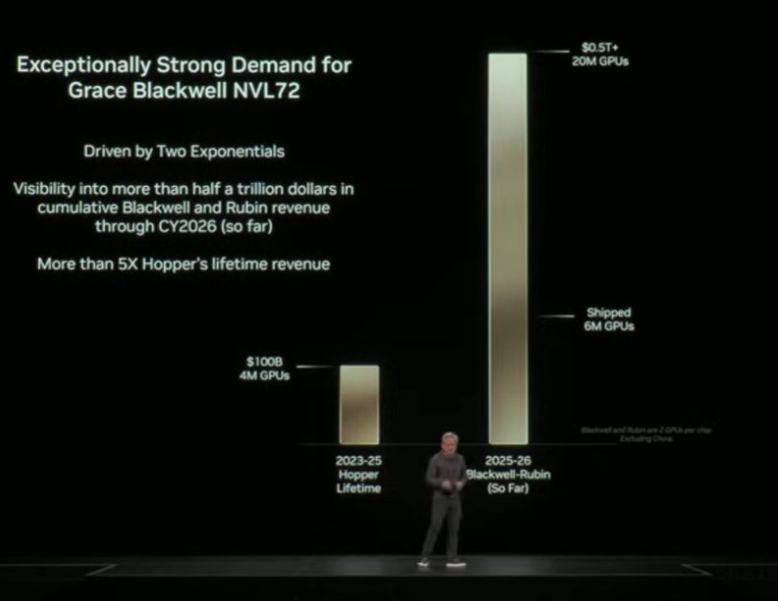
Core Insights - Nvidia's CEO Jensen Huang announced at the GTC conference that the company has up to $500 billion in AI GPU infrastructure orders for the years 2025 to 2026, driven by the Blackwell architecture and the upcoming Rubin architecture [1][3][4] - Huang's statement has sparked significant interest among investors, as it suggests a strong growth outlook for Nvidia amidst ongoing debates about an "AI bubble" in the market [1][2][6] Financial Performance - Nvidia's revenue has grown nearly 600% over the past four years, indicating strong market demand for AI chips [2] - Analysts expect Nvidia's Q3 earnings per share to be $1.25, with revenue around $54.9 billion, reflecting a year-over-year growth of 56% [7] - The anticipated revenue for Nvidia in 2026 is projected to be approximately $286.7 billion, significantly higher than previous Wall Street estimates [7][6] Market Dynamics - The demand for AI computing power is surging globally, supported by substantial investments from the U.S. government and major tech companies [2][4] - Nvidia's market share in the AI GPU sector exceeds 90%, but competition is increasing from companies developing custom AI chips [11][12] - Major clients like Amazon and Google are increasingly promoting their own AI ASIC chips, which could impact Nvidia's market position [11] Strategic Partnerships - Nvidia has made significant investments, including a potential $100 billion investment in OpenAI, which will purchase millions of Nvidia GPUs [10] - The company has also invested $5 billion in Intel to enhance collaboration between their CPU and GPU technologies [10] - Nvidia's recent $1 billion investment in Nokia aims to integrate its AI GPU infrastructure into Nokia's cellular network hardware [10] Future Outlook - Huang expressed confidence in achieving the $500 billion revenue target, indicating a "clear visibility" of this growth [8] - Analysts believe that the ongoing AI capital expenditure trend reflects a persistent demand for AI computing resources, despite concerns about potential overinvestment [10][12] - The potential for the Chinese market remains uncertain, with Nvidia's previous AI chip sales being restricted, but analysts see it as a future opportunity [12]


Counterpoint:台积电(TSM.US)在AI和高端制程的主导地位进一步扩大
智通财经网· 2025-10-21 01:43
Group 1 - TSMC has further expanded its dominance in the semiconductor foundry sector, with Q3 revenue reaching $33.1 billion, driven by strong demand for 3nm processes and high utilization rates of 4/5nm processes [1] - Apple is the main driver behind TSMC's increased 3nm production, while Nvidia and AMD continue to push high demand for 4nm and 5nm chips, keeping production capacity fully loaded [1] - Major cloud computing companies, including Google's TPU, Amazon AWS's Tranium chip, and Meta's MTIA accelerator, are also increasing demand for TSMC's services [1] Group 2 - Intel expects its foundry customers' wafer commitments to begin mass production in 2026, with major clients anticipated to ramp up production between 2026 and 2027 [2] - Intel has adjusted its foundry strategy to be customer commitment-oriented rather than speculative capacity building, ensuring capacity expansion is directly linked to confirmed demand [2] - Samsung's advanced process utilization and wafer consumption increased in Q2 2025, with expectations for this trend to continue, driven by smartphone chips based on 2nm technology [2] - The future of Samsung's advanced nodes largely depends on the success of its 2nm chips, with collaborations, particularly with Tesla, being crucial for attracting more customers and securing additional orders [2]
