3纳米制程芯片

Search documents
台积电3nm,持续短缺
半导体芯闻· 2026-03-27 10:26
Core Insights - The demand for advanced process capacity, particularly in 3nm technology, is becoming increasingly tight due to the surge in cloud AI requirements, leading to significant supply shortages [1][2] - Major companies are facing pressure to secure advanced process capacity, resulting in rising prices and limited order acceptance, making capacity procurement a critical operational challenge [1] - TSMC's conservative expansion strategy has drawn criticism, prompting some firms to consider shifting orders to Samsung Electronics to ensure future chip supply [1] Group 1: Advanced Process Capacity - The current advanced process capacity at TSMC is prioritized for cloud AI-related orders, including those from major players like Nvidia and AMD, as well as custom chips from companies like Broadcom and Marvell [1] - Long-term core customers, such as Apple and MediaTek, are also given priority for their consumer electronics products, while other applications must compete for remaining capacity [1] Group 2: Market Dynamics - High-end networking chips are increasingly utilizing advanced processes, but the majority of this capacity is currently occupied by computing chips, intensifying competition for network communication-related chips [2] - Many chip manufacturers are signing long-term large orders to secure priority supply rights amid the tight capacity situation [2] - The expectation is that the capacity shortage will last for one to two years, but the ongoing demand for AI chips suggests that the competition for advanced process capacity will remain a core issue for chip giants [2]


国台办:民进党当局对美日献媚输诚,坑的是广大台湾民众
Ren Min Ri Bao· 2026-02-11 04:07
Group 1 - TSMC plans to mass-produce 3nm chips in Kumamoto, Japan, marking the first domestic production of such chips in Japan [1] - The spokesperson from the Taiwan Affairs Office criticized the Taiwanese government for using TSMC as a tool to curry favor with the US and Japan, suggesting it harms Taiwan's industrial prospects and the interests of the Taiwanese people [1] Group 2 - Following the victory of Japan's Liberal Democratic Party in the House of Representatives election, Taiwan's Lai Ching-te congratulated the new leader and expressed hopes for continued cooperation between Taiwan and Japan [2] - The Taiwan Affairs Office emphasized the sensitivity of the Taiwan issue and urged Japan to adhere to the One China principle, calling for the retraction of any erroneous statements regarding Taiwan [2] - The spokesperson condemned Lai Ching-te's remarks as disrespectful, highlighting Japan's historical actions during its colonial rule over Taiwan [2]
台积电,还能走多远
新财富· 2026-02-03 08:06
Core Viewpoint - TSMC expresses strong confidence in the long-term demand for AI, emphasizing that current capacity constraints are internal rather than external, and is determined to face competition head-on [2][3]. Group 1: Investment and Growth Plans - TSMC plans a capital expenditure of $56 billion for 2026, with 70%-80% allocated to advanced processes and 10%-20% to advanced packaging, significantly exceeding the $100 billion spent over the past three years [4]. - The company expects its revenue to reach $122 billion in 2025, a 36% year-on-year increase, driven by high demand for advanced process technologies [4]. - Advanced process technologies contributed 77% of total wafer revenue, with 3nm, 5nm, and 7nm processes accounting for 28%, 35%, and 14% respectively in Q4 [5]. Group 2: Profitability and Cost Pressures - TSMC's gross margin for 2026 is projected to be influenced by high capacity utilization and improved manufacturing efficiency, but may face a 2%-3% dilution from overseas expansions [7][10]. - The introduction of 2nm technology is expected to begin mass production in late 2026, which may dilute gross margins by approximately 1% [8]. - TSMC's advanced process roadmap includes the rollout of 2nm and enhanced N2P technologies, which are crucial for maintaining its market position [8]. Group 3: Competitive Landscape - TSMC remains confident in its ability to maintain its market position despite competition from Intel, which is also advancing its 2nm technology [14][15]. - The upcoming three years (2026-2028) will be critical for both TSMC and Intel as they compete in the advanced process technology space [17]. - TSMC's long-standing focus on foundry services and deep customer relationships provide a significant competitive advantage over Intel, which is still establishing its external foundry capabilities [16][23]. Group 4: Geopolitical and Market Dynamics - TSMC's global expansion strategy, including facilities in the US, Japan, and Germany, aims to mitigate geopolitical risks while addressing local production demands [10][26]. - The semiconductor industry is becoming a focal point of national strategy, with both TSMC and Intel navigating the complexities of local production and supply chain security [26][27]. - The global wafer market is expected to grow significantly from 2023 to 2026, driven by structural demand, marking a super cycle rather than a typical recovery [27].

【招商电子】台积电25Q4跟踪报告:26年资本开支指引大超预期,上修24-29年AI芯片增速
招商电子· 2026-01-15 15:58
Core Viewpoint - TSMC's Q4 2025 financial results exceeded guidance, driven by improved capacity utilization and cost optimization, indicating strong demand for advanced process technologies [1][11]. Financial Performance - Q4 2025 revenue reached $33.73 billion, surpassing the guidance range of $32.2-33.4 billion, with a year-over-year increase of 25.5% and a quarter-over-quarter increase of 1.9% [1]. - Gross margin was 62.3%, up 3.3 percentage points year-over-year and 2.8 percentage points quarter-over-quarter, attributed to cost optimization and favorable exchange rates [1][11]. - GAAP net profit was $16.37 billion, reflecting a year-over-year increase of 34.98% and a quarter-over-quarter increase of 11.82% [1]. - For the full year 2025, revenue was $122 billion, a 35.9% year-over-year increase, with a gross margin of 59.9% [1][12]. Advanced Process Technology - Advanced process nodes (3nm, 5nm, 7nm) accounted for 77% of revenue, with 3nm contributing 28%, 5nm 35%, and 7nm 14% [2][11]. - High-Performance Computing (HPC) revenue was $18.55 billion, slightly down 1.67% quarter-over-quarter, while smartphone revenue increased by 8.7% to $10.79 billion [2][12]. Future Guidance - For Q1 2026, TSMC expects revenue between $34.6 billion and $35.8 billion, with a year-over-year increase of 38.6% and a quarter-over-quarter increase of 7.3% [3]. - Gross margin is projected to be between 63% and 65%, with potential dilution from overseas expansion and the ramp-up of 2nm technology expected to impact margins by 2-3% [3][16]. Capital Expenditure and AI Growth - Q4 2025 capital expenditure was $11.51 billion, with a full-year capex of $40.9 billion, and 2026 capex is expected to be between $52 billion and $56 billion [4][17]. - AI-related revenue is projected to account for 15% of total revenue in 2025, with a compound annual growth rate (CAGR) for AI accelerator business expected to be 55-59% from 2024 to 2029 [4][19]. Global Manufacturing Expansion - TSMC is expanding its manufacturing footprint in Arizona, with plans for multiple fabs to meet strong demand, particularly in AI and HPC applications [20][21]. - The company is also establishing special process fabs in Japan and Germany, with ongoing investments in Taiwan to enhance advanced process capabilities [22][23]. Technology Development - The 2nm process is set to begin volume production in late 2026, with expectations for significant revenue contributions [23][33]. - TSMC is also introducing N2P technology, an extension of the 2nm series, aimed at optimizing performance and power consumption [23]. Customer Demand and Market Outlook - TSMC's customers, particularly in AI, are signaling strong demand for increased capacity, with ongoing efforts to address supply constraints [24][30]. - The company remains confident in the sustainability of semiconductor demand driven by AI and other high-performance applications [19][34].
台积电25Q4跟踪报告:26年资本开支指引大超预期,上修24-29年AI芯片增速
CMS· 2026-01-15 15:40
Investment Rating - The report maintains a positive outlook on the semiconductor industry, particularly for TSMC, with expectations of strong revenue growth and profitability in the coming years [4][23]. Core Insights - TSMC's Q4 2025 revenue reached $33.73 billion, exceeding guidance, with a year-over-year growth of 25.5% and a gross margin of 62.3% [1][19]. - The company anticipates Q1 2026 revenue between $34.6 billion and $35.8 billion, reflecting a year-over-year increase of 38.6% [3][23]. - TSMC's capital expenditure for 2026 is projected to be between $52 billion and $56 billion, with a significant portion allocated to advanced process technologies [4][25]. - The AI market is expected to drive substantial growth, with AI accelerator revenue projected to account for 15% of total revenue in 2025 [4][26]. Summary by Sections Financial Performance - TSMC's Q4 2025 revenue was $33.73 billion, with a gross margin of 62.3%, driven by improved capacity utilization and cost optimization [1][19]. - The company reported a net profit of $16.37 billion for Q4 2025, a year-over-year increase of 34.98% [1][19]. - For the full year 2025, TSMC's revenue was $122 billion, reflecting a 35.9% year-over-year growth [1][22]. Advanced Technology and Market Segmentation - Advanced process technologies (3nm, 5nm, and 7nm) accounted for 77% of TSMC's revenue, with 3nm technology representing 28% [2][20]. - The high-performance computing (HPC) segment generated $18.55 billion in revenue, while smartphone revenue was $10.79 billion [2][20]. Capital Expenditure and Growth Projections - TSMC's capital expenditure for 2025 was $40.9 billion, with 70%-80% allocated to advanced process technologies [4][25]. - The company has raised its CAGR forecast for AI-related revenue from 2024 to 2029 to 55%-59% [4][26]. Future Outlook - TSMC expects Q1 2026 gross margin to be between 63% and 65%, with potential dilution from overseas expansion and new technology ramp-up [3][24]. - The company plans to enhance production efficiency and expand capacity to meet growing demand, particularly in AI and HPC sectors [26][27].
消息称台积电亚利桑那州工厂 3 纳米量产时间提前至 2027 年,较原计划早一年
Xin Lang Cai Jing· 2025-12-30 11:09
Core Viewpoint - TSMC is significantly accelerating the mass production timeline for its 3nm process at its Arizona facility, with large-scale production expected to start in 2027, one year earlier than originally planned [1][6]. Group 1: Investment and Production Plans - TSMC's Arizona factory is one of the company's largest projects, with plans to invest up to $300 billion (approximately 2.1 trillion RMB) across the U.S. to build a resilient supply chain [3][8]. - The first factory in Arizona has already begun production of 4nm chips, while the second factory is set to focus on 3nm mass production, targeting a launch in 2027 [5][8]. Group 2: Market Demand and Competitive Landscape - The acceleration in production is driven by a surge in demand for advanced processes like 4nm, 3nm, and even 2nm, particularly from high-performance computing clients [5][9]. - TSMC faces intense competition from regional rivals, notably Intel and Samsung, with Samsung planning to skip 4nm production in favor of 2nm technology and securing Tesla as a key customer [9]. Group 3: Operational Challenges - TSMC is currently dealing with rising capital expenditures and labor shortages while also advancing its technology strategy in the Japanese market [6][9]. - Given the explosive market demand, TSMC has little choice but to expand its production capacity [10].
台积电将在美国量产3nm
半导体芯闻· 2025-12-18 10:24
Core Viewpoint - TSMC plans to transfer chip manufacturing tools to its second factory in Arizona by summer 2026, paving the way for 3nm production to start in 2027, marking a significant step in advanced chip manufacturing overseas [1][3]. Group 1: Equipment Installation and Production Timeline - The installation of equipment is expected to be completed between July and September 2024, aligning with TSMC's CEO's goal to accelerate U.S. chip production by several quarters [1]. - After the equipment installation, it may take up to a year for the production line to complete validation and ramp up output, especially for advanced chips which require over 1,000 production steps [3]. Group 2: Financial and Market Impact - TSMC's first overseas advanced chip factory in Arizona has begun producing chips for Apple and the latest Blackwell AI chips for NVIDIA, as part of a $165 billion project that includes five chip manufacturing plants and two advanced packaging facilities [3]. - TSMC expects that approximately 30% of its advanced chips will be produced domestically in the U.S. once the project is completed [3]. - The revenue contribution from U.S. customers rose to 76% in the July to September quarter, driven by the AI boom, with major clients including NVIDIA, Apple, AMD, Intel, and Google [3]. Group 3: Expansion and Strategic Decisions - TSMC has paused the construction of its second factory in Kumamoto, Japan, to assess future demand and consider producing more advanced chips in the country, influenced by the slow recovery in demand for mature chips in consumer electronics, industrial, and automotive applications [4]. - The company is focusing on expanding capacity in Arizona with strong support from major U.S. customers and government entities [4][5].
Counterpoint:台积电(TSM.US)在AI和高端制程的主导地位进一步扩大
智通财经网· 2025-10-21 01:43
Group 1 - TSMC has further expanded its dominance in the semiconductor foundry sector, with Q3 revenue reaching $33.1 billion, driven by strong demand for 3nm processes and high utilization rates of 4/5nm processes [1] - Apple is the main driver behind TSMC's increased 3nm production, while Nvidia and AMD continue to push high demand for 4nm and 5nm chips, keeping production capacity fully loaded [1] - Major cloud computing companies, including Google's TPU, Amazon AWS's Tranium chip, and Meta's MTIA accelerator, are also increasing demand for TSMC's services [1] Group 2 - Intel expects its foundry customers' wafer commitments to begin mass production in 2026, with major clients anticipated to ramp up production between 2026 and 2027 [2] - Intel has adjusted its foundry strategy to be customer commitment-oriented rather than speculative capacity building, ensuring capacity expansion is directly linked to confirmed demand [2] - Samsung's advanced process utilization and wafer consumption increased in Q2 2025, with expectations for this trend to continue, driven by smartphone chips based on 2nm technology [2] - The future of Samsung's advanced nodes largely depends on the success of its 2nm chips, with collaborations, particularly with Tesla, being crucial for attracting more customers and securing additional orders [2]
AI需求引爆业绩新高,台积电Q3净利大增39%!
Ge Long Hui· 2025-10-16 07:34
Core Viewpoint - TSMC reported strong Q3 2025 earnings driven by robust demand for AI chips, with net profit increasing by 39.1% year-over-year, exceeding market expectations and setting a new record [1][4]. Financial Performance - Q3 2025 revenue reached NT$989.92 billion, a year-over-year increase of 30.3% and a quarter-over-quarter increase of 6% [4]. - Net profit for Q3 2025 was NT$452.3 billion, surpassing the expected NT$405.47 billion, marking a record high with a year-over-year increase of 39.1% and a quarter-over-quarter increase of 13.6% [4][6]. - In USD terms, Q3 2025 revenue was $33.1 billion, reflecting a 40.8% increase year-over-year and a 10.1% increase quarter-over-quarter [5][8]. - Gross margin for Q3 2025 was 59.5%, with operating margin at 50.6% and net profit margin at 45.7% [6][8]. Earnings Per Share - Earnings per share (EPS) for Q3 2025 was NT$17.44, equivalent to $2.92 per American Depositary Share [7][8]. Product and Market Insights - Advanced process nodes contributed significantly to revenue, with 3nm process accounting for 23% and 5nm for 37% of wafer sales [8]. - High-Performance Computing (HPC) represented 57% of revenue, surpassing the smartphone segment at 30%, indicating strong demand for AI chips [11]. Future Outlook - TSMC raised its revenue growth forecast for 2025 to approximately 30% due to increasing demand for AI and semiconductor products [14]. - For Q4 2025, TSMC expects consolidated revenue between $32.2 billion and $33.4 billion, with a gross margin forecast of 59% to 61% [16][17]. - Capital expenditures for 2025 are projected to be between $40 billion and $42 billion, up from previous estimates [16].
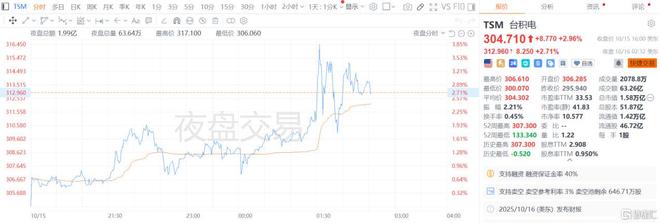
AI芯片需求激增!台积电Q3净利润飙升39%创纪录
Ge Long Hui· 2025-10-16 07:24
Core Viewpoint - TSMC reported strong Q3 2025 earnings driven by robust demand for AI chips, with net profit increasing by 39.1% year-over-year, exceeding market expectations and reaching a record high [1][4]. Financial Performance - Q3 2025 revenue was NT$989.92 billion, a year-over-year increase of 30.3% and a quarter-over-quarter increase of 6% [4]. - Net profit for Q3 2025 was NT$452.30 billion, surpassing the expected NT$405.47 billion, marking a record high with a year-over-year increase of 39.1% and a quarter-over-quarter increase of 13.6% [4][8]. - In USD terms, Q3 2025 revenue was $33.10 billion, reflecting a 40.8% increase year-over-year and a 10.1% increase quarter-over-quarter [5][14]. - Gross margin for Q3 2025 was 59.5%, operating margin was 50.6%, and net profit margin was 45.7% [6][8]. Earnings Per Share - Earnings per share for Q3 2025 was NT$17.44, equivalent to $2.92 per American Depositary Share [7][8]. Product and Market Insights - Advanced process nodes contributed significantly to revenue, with 3nm process accounting for 23%, 5nm for 37%, and 7nm for 14% of wafer sales [8]. - High-Performance Computing (HPC) represented 57% of revenue, surpassing the smartphone segment at 30%, indicating strong demand for AI chips [9]. Future Outlook - TSMC raised its revenue growth forecast for 2025 to approximately 30%, up from earlier estimates [12]. - Q4 2025 revenue is projected to be between $32.2 billion and $33.4 billion, with a gross margin forecast of 59% to 61% [12][14]. - Capital expenditures for 2025 are expected to be between $40 billion and $42 billion, an increase from previous forecasts [12].