
VR200

Search documents
研报 | 英伟达多元产品线分攻AI训练与推理需求,以应对CSP自研ASIC规模升级
TrendForce集邦· 2026-03-18 09:09
Core Insights - NVIDIA is shifting its focus from cloud AI training to AI inference applications, emphasizing a diverse product line including GPU, CPU, and LPU to meet AI training and inference demands [2] - The market share of ASIC AI servers is projected to increase from 27.8% in 2026 to nearly 40% by 2030, driven by major cloud service providers like Google and Amazon expanding their in-house chip development [2] Group 1: NVIDIA's Strategies - To solidify its leadership in the AI market, NVIDIA is promoting integrated solutions like GB300 and VR200, which combine CPU and GPU for scalable AI inference applications [5] - The Vera Rubin system, introduced at GTC, is a highly integrated system featuring seven chips and five cabinets, expected to enhance NVIDIA's product offerings [5] - The GB300 has already replaced GB200 as the main product in Q4 2025, with an expected shipment share of nearly 80% by 2026 [6] Group 2: Technological Developments - NVIDIA is addressing latency and memory bandwidth bottlenecks in AI inference by introducing the Groq3 LPU, designed for low-latency inference with 500MB SRAM per chip, and up to 128GB per cabinet [6][7] - The "Disaggregated Inference" architecture proposed by NVIDIA aims to separate the processing of AI tasks, utilizing Vera Rubin for heavy computations and a larger memory LPU cabinet for latency-sensitive tasks [7] - The third-generation Groq LPU, manufactured by Samsung, has entered mass production and is expected to be shipped in the second half of 2026, with plans for a more efficient LP40 chip in the next generation [7]



TrendForce集邦咨询:预估2026年全球AI服务器出货同比增逾28%
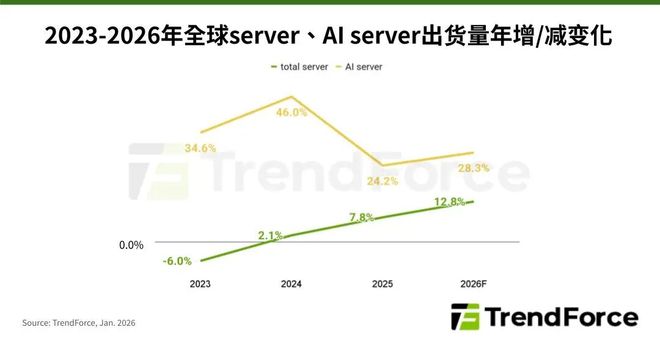
Zhi Tong Cai Jing· 2026-01-20 09:13
Core Insights - North American cloud service providers (CSPs) are significantly increasing investments in AI infrastructure, leading to a projected annual growth rate of over 28% in global AI server shipments by 2026 [1] - The demand for AI inference services is driving a replacement and expansion cycle for general servers, with an expected annual growth rate of 12.8% in global server shipments (including AI servers) by 2026 [1] Group 1: Market Trends - From 2024 to 2025, the server market will focus on training advanced large language models (LLMs) using AI servers equipped with GPUs and HBM for parallel computing [3] - Starting in the second half of 2025, the development of AI inference services such as AI Agents, LLaMA model applications, and Copilot upgrades will prompt CSPs to shift towards monetization and profit models [3] - The total capital expenditure growth rate for the five major North American CSPs (Google, AWS, Meta, Microsoft, Oracle) is projected to reach 40% in 2026, driven by large-scale infrastructure investments and the replacement of general servers purchased during the 2019-2021 cloud investment boom [3] Group 2: AI Server Market Dynamics - The 2026 AI server market will be primarily driven by North American CSPs, government sovereign cloud projects, and large CSPs accelerating their own ASIC development and edge AI inference solutions [4] - GPUs are expected to account for 69.7% of AI chip usage, with NVIDIA's GB300 models becoming the mainstream for shipments, while VR200 will gradually ramp up in the second half of the year [4] Group 3: ASIC Development - The share of ASIC AI servers in shipments is expected to rise to 27.8% by 2026, the highest since 2023, with growth rates surpassing those of GPU AI servers [6] - Google is leading the investment in self-developed ASICs, with its TPU not only serving Google Cloud Platform infrastructure but also being sold to external companies like Anthropic [6]





英伟达不满足于只卖GPU,谋划颠覆
半导体行业观察· 2025-11-15 01:42
Core Insights - Nvidia plans to launch the Vera Rubin platform for AI and high-performance computing next year, which could significantly impact the AI hardware supply chain [2] - The company intends to deliver L10-level VR200 computing racks pre-installed with all necessary hardware, simplifying the design and integration work for original design manufacturers (ODMs) while potentially compressing their profit margins [2][3] - Nvidia is shifting from allowing partners to build their own components to providing fully integrated solutions, which may enhance production efficiency and reduce costs [3][4] Summary by Sections - **Nvidia's Strategy**: Nvidia is moving towards a model where it provides complete computing racks, including CPUs, GPUs, and cooling systems, rather than individual components, which marks a significant shift in its supply chain strategy [2][5] - **Impact on Partners**: Partners will transition from system designers to system integrators and support service providers, focusing on assembly and logistics while Nvidia standardizes and produces the core computing engines [5] - **Market Implications**: The integration of advanced cooling systems and the potential for Nvidia to expand its role in the supply chain raises questions about the future dynamics of the server market, particularly with the introduction of the Kyber NVL576 rack-level solution [4][5]
TrendForce集邦咨询:预计2026年CSP合计资本支出增至6000亿美元以上
智通财经网· 2025-11-06 06:49
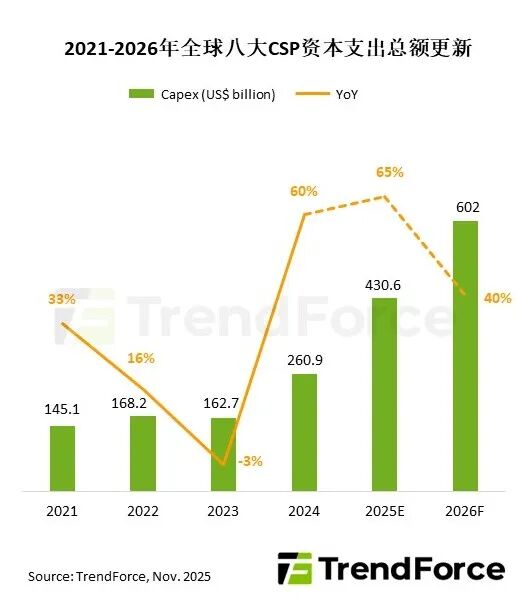
Core Insights - TrendForce has revised the global capital expenditure (CapEx) growth rate for the top eight North American cloud service providers (CSPs) from 61% to 65% for 2025, with expectations of exceeding $600 billion in total CapEx by 2026, reflecting a 40% year-on-year increase driven by AI infrastructure growth [1][3] Group 1: CSPs Capital Expenditure - The eight major CSPs include Google, AWS, Meta, Microsoft, Oracle, Tencent, Alibaba, and Baidu [3] - Google has raised its 2025 CapEx forecast to $91-93 billion to meet the surging demand for AI data centers and cloud computing [3] - Meta has also increased its 2025 CapEx to $70-72 billion, with significant growth expected in 2026 [3] - Amazon has adjusted its 2025 CapEx estimate to $125 billion, while Microsoft anticipates higher CapEx in 2026 compared to 2025 [3] Group 2: Impact on AI Hardware and Supply Chain - The increase in CapEx by CSPs is expected to boost demand for AI servers, driving growth in upstream supply chains such as GPU/ASIC, memory, and packaging materials, as well as downstream systems like liquid cooling modules and power supplies [3][4] - NVIDIA's integrated solutions are projected to gain stronger growth momentum due to the increased CapEx from CSPs, with expected shipments of GB300 and VR200 models surpassing previous forecasts [4] - Oracle is expected to benefit significantly from North American government projects and cloud AI database leasing services [4] Group 3: Competitive Landscape - NVIDIA plans to launch a new generation of VR200 Rack, while AMD will promote its Helios integrated solution, which includes Venice CPU and MI400 GPU [4] - Meta is set to adopt both NVIDIA's GB/VR Rack and its self-developed ASIC solutions, planning a substantial 65% increase in its 2026 CapEx to $118 billion [5]
研报 | 预计2026年CSP合计资本支出增至6,000亿美元以上,AI硬件生态链迎新成长周期
TrendForce集邦· 2025-11-06 06:36
Core Insights - The article highlights the upward revision of capital expenditure (CapEx) growth for major North American Cloud Service Providers (CSPs) from 61% to 65% for 2025, with expectations of further growth to over $600 billion in 2026, reflecting the long-term growth potential of AI infrastructure [2][4]. Group 1: Capital Expenditure Trends - The eight major CSPs include Google, AWS, Meta, Microsoft, Oracle, Tencent, Alibaba, and Baidu. Google has raised its 2025 CapEx forecast to $91-93 billion to meet the increasing demand for AI data centers and cloud computing [4]. - Meta has also increased its 2025 CapEx to $70-72 billion, indicating significant growth in 2026 [4]. - Amazon has adjusted its 2025 CapEx estimate to $125 billion, while Microsoft expects its 2026 CapEx to exceed that of 2025 [5]. Group 2: Impact on AI Hardware Ecosystem - The surge in CapEx is expected to stimulate demand for AI servers, driving growth in upstream supply chains such as GPU/ASIC, memory, packaging materials, and downstream systems like liquid cooling modules and power supplies [5][6]. - NVIDIA is anticipated to benefit significantly from this CapEx growth, with expected shipments of its GB300 and VR200 products surpassing previous forecasts, primarily driven by the top five North American CSPs [5]. - Oracle is expected to see substantial growth due to demand from North American government projects and cloud AI database leasing services [5]. Group 3: Future Developments in AI Solutions - The market is expected to adopt integrated AI solutions more aggressively in 2026, with NVIDIA planning to launch a new generation of VR200 racks [6]. - Competitor AMD is also set to promote its Helios integrated solutions, with Meta and Oracle being among the first adopters [6]. - Meta plans to significantly increase its CapEx by 65% to $118 billion in 2026 to support its initiatives in NVIDIA's GB/VR Rack and self-developed ASIC solutions [6].

NVIDIA GB300, Vera Rubin – 未来印刷电路板 - 覆铜板(PCB_CCL)及电源设计变革
2025-08-25 03:24
Summary of NVIDIA (NVDA US) GB300 and Future Developments Company Overview - **Company**: NVIDIA (NVDA US) - **Focus**: Updates on the GB300 compute tray design, power system changes, and future R&D projects related to the Vera Rubin architecture Key Points GB300 Compute Tray Design - The GB300 features a new design compared to the GB200 to avoid U.S. government scrutiny and improve production yields for ODM manufacturers. It utilizes a single large PCB design, reverting to the UBB + OAM structure from earlier HGX products [3][4] - The GB300 UBB is an 18-layer PTH board with an average selling price (ASP) of approximately $750–$800, supplied by WUS in mainland China and TTM in the U.S. The OAM has two variants: a high-end version with 2 Grace CPUs and 4 Blackwell GPUs, and a low-end version with 1 Grace CPU and 4 Blackwell GPUs, with ASPs around $100 [6] Power Design Changes - The GB300 uses 60A SPS products, reducing costs compared to the 90A SPS used in GB200. The average load for GB300 is assumed to be ~12A, requiring 516 SPS units per compute tray, compared to 300 for GB200 [10][11] - AOSL is expected to become the major supplier for GB300's VRM module, capturing 60–70% of the market share, while MPS may secure 20–30% [12] Heat Dissipation and Design Considerations - The increase in SPS units raises heat dissipation concerns, prompting NVIDIA to consider adding heatsinks to assist with cooling [13][14] - Vertical VRM designs are being considered but are not planned for immediate adoption due to higher costs and manufacturing complexities [15] Future Technology Upgrades - NVIDIA is evaluating gallium nitride (GaN) MOSFETs for the next-generation PDB module, with potential suppliers including TI, Inneon, and Innoscience. GaN modules are unlikely to be ready for the GB300 launch but may debut in subsequent systems [18] - The upcoming Vera Rubin architecture will feature a VR200 system with 72 GPUs, doubling the power consumption to ~260kW, necessitating an upgrade of the PSU from 5.5kW to 12kW [21][22] Material Innovations - For high-frequency signal transmission, NVIDIA is testing PTFE resin materials, which offer lower dielectric constant and dissipation factor, improving electrical performance [32][33] - Global players in PTFE CCL production include Rogers, AGC, and Doosan, with Rogers being the leading producer [36] Conclusion - NVIDIA is making significant advancements in its GB300 compute tray design and power systems, focusing on cost reduction, efficiency, and future technology upgrades. The company is strategically positioning itself for the upcoming Vera Rubin architecture while addressing challenges related to heat dissipation and material performance.