
Zigbee芯片

Search documents
泰凌微(688591):AIoT与音频领域稳中有进,公司行业地位稳固
Guotou Securities· 2026-03-03 11:18
Investment Rating - The investment rating for the company is "Buy-A" with a target price of 50.29 CNY, maintaining the rating [3][10]. Core Insights - The company reported a revenue of 1.016 billion CNY for 2025, representing a year-on-year growth of 20.32%, and a net profit of 128 million CNY, up 31.53% year-on-year [1]. - The AIoT market is expected to grow significantly, with the number of IoT device connections projected to reach 21.1 billion by 2025 and 39 billion by 2030, benefiting the company's performance [2]. - The company has established itself as a leading player in the low-power wireless IoT chip sector, with its Bluetooth low-power SoC chips ranking among the top globally [2]. - The company has seen structural growth across its business segments, with traditional IoT business revenue around 850 million CNY, and notable growth in audio products, which achieved a 50% increase [3][10]. Financial Performance - The company’s comprehensive gross margin is approximately 50.33%, an increase from the previous year [3]. - Revenue projections for 2025 to 2027 are 1.016 billion CNY, 1.449 billion CNY, and 1.923 billion CNY respectively, with net profits expected to be 128 million CNY, 258 million CNY, and 376 million CNY [10][12]. - The company’s earnings per share (EPS) is projected to grow from 0.53 CNY in 2025 to 1.56 CNY in 2027 [12].

8.5亿!泰凌微并购磐启微
是说芯语· 2026-01-28 09:57
Core Viewpoint - The acquisition of 100% equity of Panqiwei by Tailinwei for 850 million yuan aims to enhance Tailinwei's competitive edge in the low-power wireless IoT chip market through technology and business integration [1][9]. Group 1: Acquisition Details - Tailinwei plans to acquire Panqiwei through a combination of share issuance and cash payment, valued at 850 million yuan, and will simultaneously raise supporting funds [1]. - Post-acquisition, Panqiwei will become a wholly-owned subsidiary of Tailinwei, and this transaction does not constitute a major asset restructuring [1]. Group 2: Market Position and Technology - In the global low-power wireless IoT chip market, international leaders dominate due to their first-mover advantage, while domestic companies like Tailinwei have made significant progress but still lag in revenue scale and product ecosystem [3]. - Tailinwei, established in 2010, has positioned itself among the global top tier in short-range wireless communication chips, with over 40% of its revenue coming from overseas markets [3]. - The company’s product range includes low-power Bluetooth, dual-mode Bluetooth, Zigbee, Matter, and WiFi, with applications in various sectors such as smart homes and industrial systems [3]. Group 3: Panqiwei's Strengths - Panqiwei, founded in 2011, has been recognized as a national-level "little giant" enterprise, focusing on differentiated technology in short-range wireless communication chips [5]. - Its core products emphasize BLE and 2.4G proprietary protocols, achieving significant cost advantages and lower power consumption compared to mainstream products [5]. Group 4: Strategic Benefits of the Acquisition - The merger is expected to enhance Tailinwei's overall competitiveness by integrating Panqiwei's low-power technology, which can optimize Tailinwei's main products and address industry challenges related to power consumption in edge AI chips [7]. - The acquisition will also fill Tailinwei's gap in wide-area wireless communication, leveraging Panqiwei's expertise in Sub-1G and 5G-A passive cellular IoT technologies [7]. Group 5: Financial Implications - The acquisition may have a short-term negative impact on Tailinwei's profitability, but it is expected to significantly enhance long-term growth potential [8]. - Financial data indicates that Tailinwei's revenue is projected to increase post-acquisition, while Panqiwei's revenue has stabilized between 90 million to 120 million yuan, with a trend of narrowing losses [8]. - Panqiwei has committed to achieving a cumulative net profit of no less than 114 million yuan from 2026 to 2028, providing a safeguard for long-term profitability growth [8]. Group 6: Industry Impact - This acquisition is not only a strategic move for Tailinwei but also a significant step in strengthening the domestic IoT chip industry, potentially narrowing the gap with international competitors [9].


预见2025:《2025年中国通信芯片行业全景图谱》(附市场现状和发展趋势等)
Qian Zhan Wang· 2025-11-20 10:15
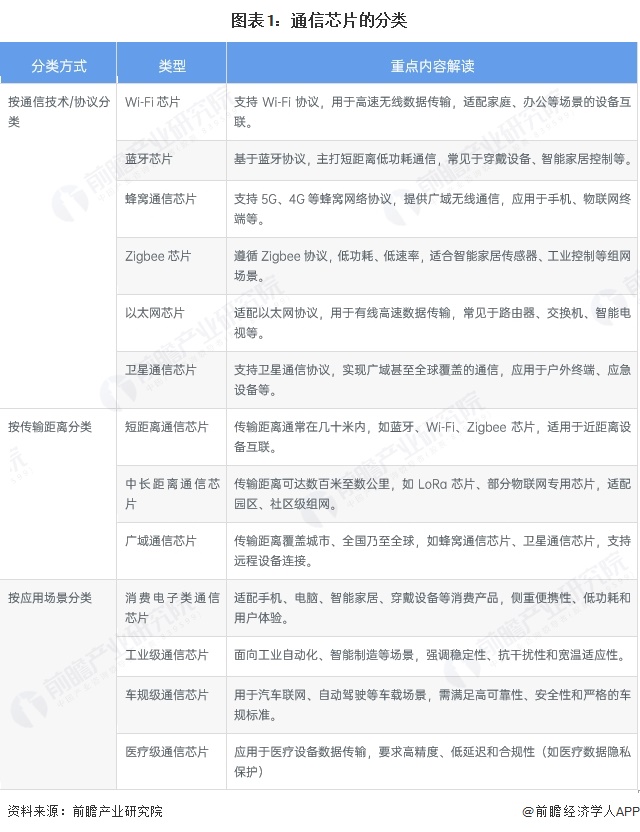
Industry Overview - The communication chip industry in China is defined as integrated circuits specifically designed for data transmission and communication protocols, playing a crucial role in various electronic devices [1][2] - Communication chips are categorized into several types, including Wi-Fi, Bluetooth, Zigbee, cellular communication, RFID, Ethernet, and GPS chips, widely used in smartphones, smart home devices, industrial automation, and medical equipment [2][3] Industry Chain Analysis - The upstream of the communication chip industry consists of raw material and equipment suppliers, while the midstream includes manufacturers who design, produce, and test chips, and the downstream involves terminal device manufacturers integrating these chips into various applications [5][7] Industry Development History - The Chinese communication chip industry has evolved over 40 years, transitioning from technology gaps to self-sufficiency, with significant advancements from 2G to 5G technologies, and is now making strides towards 6G [8][11] Policy Background - Current policies in China focus on key areas such as 5G/6G and satellite communication, promoting breakthroughs in critical technologies through various support measures [12][13] Current Industry Status - The global communication chip industry is at a critical stage with ongoing 5G advancements and steady progress in 6G research, characterized by a competitive landscape where international giants hold significant advantages, while local companies like HiSilicon and Unisoc are making notable progress [16][17] Competitive Landscape - The Chinese communication chip industry can be divided into three tiers based on technical strength and market influence, with leading companies like HiSilicon and Unisoc at the forefront, followed by mid-tier firms like Zhaoxin and Espressif, and smaller innovative companies focusing on niche markets [21][23] Future Development Trends - The industry is expected to see trends such as leading in 6G technology, deepening domestic substitution, and cross-industry integration, with a focus on high-quality development and support for digital economy growth [24][28]
泰凌微前三季盈利1.4亿翻倍增长 近三年研发投入5.79亿夯实竞争力
Chang Jiang Shang Bao· 2025-10-28 23:51
Core Insights - The company, Tailin Microelectronics, has significantly improved its operating performance, achieving a revenue of 766 million yuan and a net profit of 140 million yuan in the first three quarters of 2025, marking a year-on-year growth of 30.49% and 117.35% respectively [1][2][3] Financial Performance - In the first three quarters of 2025, Tailin Microelectronics reported a revenue of 766 million yuan, a 30.49% increase year-on-year, and a net profit of 140 million yuan, reflecting a 117.35% growth [1][2] - The net profit margin improved to 18.23% in 2025 from 10.94% in 2024, indicating a significant enhancement in product value and cost control [2] - The company generated a net cash flow from operating activities of 179 million yuan, up 89.05% year-on-year [2] Growth Trajectory - The company has shown a consistent growth trajectory, with revenue increasing from 462 million yuan in 2020 to 609 million yuan in 2022, and a notable recovery in 2023 with revenue reaching 636 million yuan [2][3] - The introduction of new products, such as low-power AI chips and Zigbee chips, has driven growth, particularly in high-margin sectors like smart headphones and medical devices [3][4] Research and Development - Tailin Microelectronics has invested heavily in R&D, with cumulative expenditures reaching 579 million yuan from 2023 to the first three quarters of 2025 [1][4] - The company holds 91 invention patents and 19 integrated circuit layout design rights, showcasing its strong technological foundation [1][4] Global Expansion - The company is preparing to issue H-shares and apply for a listing on the Hong Kong Stock Exchange, aiming to enhance its global strategy and optimize its capital structure [5] - Tailin Microelectronics has established a global customer network, supplying major companies like Xiaomi and Logitech, which enhances its competitive position in the market [4][5]