通信芯片

Search documents
芯片,全面涨价
半导体芯闻· 2026-03-30 10:36
Group 1 - The semiconductor price increase is spreading beyond storage semiconductors to non-storage sectors, driven by AI infrastructure investments impacting DRAM and NAND flash prices, as well as other products like analog chips, power semiconductors, communication chips, and CPUs experiencing supply disruptions and price hikes [1] - Major semiconductor companies, including Intel and AMD, are reportedly planning to raise CPU prices by an average of 10% to 15% due to increased demand from AI and supply constraints, with delivery times for some PC manufacturers extending from 1-2 weeks to up to 6 months [3] - Companies like NXP, Texas Instruments, and Infineon Technologies are also set to increase prices, indicating a clear trend of rising costs starting from memory chips and extending to analog and power semiconductor sectors [1][2] Group 2 - The price surge in semiconductors is attributed to stable demand in the automotive and industrial sectors, alongside a production bottleneck caused by a significant portion of mature semiconductor nodes being redirected towards AI and data center applications [2] - Communication chips and network components are also affected, with Broadcom noting that the surge in demand for AI chips and network components has strained the production capacity of its main manufacturing partner, TSMC [2] - The delivery timelines for optical communication components like lasers and PCBs have extended from confirmed orders to several months, indicating increasing procurement pressure for high-performance chips and network integration components [2]



工作狂55岁创业,如今公司市值两万亿美元
Sou Hu Cai Jing· 2026-02-25 13:56
Core Insights - TSMC's success is attributed to its focus on helping customers succeed, embodying an "altruistic" philosophy [2][20] - TSMC reached a market capitalization of $2 trillion, achieving this milestone just 16 months after hitting the $1 trillion mark [3][5] - The company serves 534 clients and produces 12,682 different products, primarily focusing on logic chips and specialized process chips [6] Company Background - TSMC, founded by Morris Chang, is a leading semiconductor foundry that specializes in manufacturing chips designed by clients [6][20] - Morris Chang, born in Ningbo, China, has a rich background in the semiconductor industry, having worked at Texas Instruments for over 20 years before founding TSMC [8][10][12] - TSMC's business model is based on precision division of labor in semiconductor design, manufacturing, and sales, which Chang believes is more cost-effective than vertical integration [12][16] Business Strategy - TSMC's strategy focuses on high yield and low cost, leveraging Taiwan's advantages in chip production [18][20] - The company does not design or sell its own branded products, which minimizes direct competition and fosters trust within the industry [20] - TSMC's principle of being a partner to its clients has been a cornerstone of its business model since its inception [20] Market Position - TSMC has positioned itself well in the market, benefiting from the rise of smartphones, smartwatches, and electric vehicles, which require chips manufactured by TSMC [28][30] - The company has also capitalized on the AI boom, with its high-performance computing (HPC) chips being in high demand [30][31] - TSMC holds a 71% market share in the pure foundry market as of Q2 2025, solidifying its leading position [33] Financial Outlook - TSMC's executives project a nearly 30% increase in overall revenue in 2026, indicating strong growth prospects [35] - The company's client base includes major tech firms like Nvidia, AMD, and Qualcomm, with Nvidia currently accounting for 13% of TSMC's total revenue [30][31]

中部六省加快构建增长新引擎
Jing Ji Wang· 2026-02-10 06:04
Group 1: Economic Growth and Investment - The GDP of the central region is expected to approach 30 trillion yuan by 2025, with Henan leading at a growth rate of 5.6% [1] - The focus for 2026 among central provinces is on "stabilizing growth and expanding domestic demand," leveraging local resources and insights into new consumption trends [1] - Effective investment is crucial for stabilizing economic growth, with provinces exploring investment potential in water conservancy and other sectors [4] Group 2: New Consumption Trends - Central provinces are focusing on "emotional value" and "emotional economy" in their government work reports, indicating a shift in consumer trends [2] - Various provinces are cultivating new consumption growth points, such as the "first launch economy" and "night economy," to enhance consumer vitality [2][3] - Specific initiatives include promoting local business innovations and developing new consumption scenarios in provinces like Henan and Shanxi [2] Group 3: Modern Manufacturing and High-Tech Industries - The central region aims to build a modern industrial system with a focus on new energy, new materials, and optoelectronic information [6] - Provinces like Hubei and Hunan are advancing projects in high-tech sectors, including lithium batteries and new energy systems [6][7] - Jiangxi is enhancing its capabilities in aircraft manufacturing and electric vehicles, while Shanxi is focusing on high-end equipment manufacturing and new materials [7]
布局新消费 促进有效投资 中部六省加快构建增长新引擎
Shang Hai Zheng Quan Bao· 2026-02-09 18:33
Core Insights - The central provinces of China are focusing on "stabilizing growth and expanding domestic demand" as key priorities in their 2026 government work reports, with a projected GDP nearing 30 trillion yuan for 2025 [1][2] - The concept of "emotional value" and "emotional economy" has emerged as a significant trend in consumer behavior, prompting these provinces to innovate in consumption and investment [1][2] Economic Growth and Investment - Henan leads the central provinces with a GDP growth rate of 5.6%, while Hubei, Anhui, and Jiangxi also report growth rates exceeding 5% [1] - The provinces are enhancing their investment in sectors like water conservancy and logistics to strengthen their roles as key hubs in the domestic and international economy [3][5] New Consumption Trends - Provinces are actively cultivating new consumption growth points such as the "first release economy," "exhibition economy," and "silver economy" to meet evolving consumer demands [2] - Specific initiatives include promoting local business innovations and developing diverse consumption scenarios to stimulate economic activity [2] Industrial Development - The central region aims to establish a modern industrial system with a focus on new energy, new materials, and high-tech industries [5][6] - Hubei is working on a world-class integrated storage and computing industry base, while other provinces are advancing projects in electric vehicles, lithium batteries, and aerospace [5][6] Infrastructure and Project Development - Significant infrastructure projects are being prioritized, with Hunan announcing 389 key projects totaling 2 trillion yuan in investment [3] - The provinces are also focusing on enhancing their logistics and transportation networks to facilitate economic growth and connectivity [3][5]
强战新 扩投资 防风险 河南:加大“险资入豫”“基金入豫”力度
Shang Hai Zheng Quan Bao· 2026-01-26 19:16
Economic Growth Targets - The GDP of Henan is projected to reach 6.66 trillion yuan by 2025, with a growth rate of 5.6% [1] - For 2026, the expected GDP growth target is around 5%, with specific goals including a 6.5% increase in industrial added value and a 5% growth in fixed asset investment [1][2] Investment and Financing Initiatives - Henan aims to enhance "insurance capital" and "funds" inflow, strengthen venture capital, and support quality enterprises in going public and mergers [2] - The government plans to implement over 1,000 key provincial projects in 2026, with an annual investment target of 1 trillion yuan [2] Industrial Development - The province will support industries such as new electric power equipment and modern food production to enter national advanced manufacturing clusters [3] - Key projects include upgrades for Chery passenger cars, BYD new energy commercial vehicles, and the development of a global manufacturing center for robotics [3] Financial Risk Management - Henan will enhance the management of debt funds and complete the exit of local government financing platforms, while also addressing overdue enterprise payments [3] - The province aims to reduce the number of high-risk financial institutions and combat illegal financial activities [3] Agricultural and Green Development - The government plans to implement a grain production capacity enhancement project, aiming for a total grain production capacity of 1.4 trillion jin [4] - In low-carbon development, Henan will optimize existing coal power projects and promote the upgrade of traditional industries, including steel and coal [4]
星思当前融资进度为B+轮,短期内资金储备良好
Sou Hu Cai Jing· 2026-01-09 06:32
Core Viewpoint - The development of Xingsi Semiconductor illustrates a transition from capital infusion to self-sustaining capabilities, having completed B+ round financing and entering a more mature phase of development [1][3]. Short-term Perspective - Xingsi Semiconductor has received full funding from previous financing rounds, which, combined with current order payments, supports core R&D, product mass production, and market expansion needs, ensuring a solid operational cash flow [1][4]. - The company is focusing on continuous R&D investment in cutting-edge technologies such as 5G and satellite communications, preparing for mass production of validated products, and expanding its target market and ecosystem [1]. Long-term Perspective - Xingsi Semiconductor has entered a critical phase of "technology validation - small batch shipment - large-scale commercialization," having achieved small batch shipments and possessing a robust reserve of potential orders [3][4]. - As commercial scale expands, revenue will gradually support R&D investments, with the company achieving breakthroughs from "0 to 1" across multiple product lines, enhancing its industry reputation [3]. - The B+ round financing has solidified the company's financial foundation, and with a clear product development strategy and pragmatic business approach, it is steadily building a virtuous cycle driven by technology and commercial feedback to R&D [3].

中芯国际406亿全资收购!12英寸晶圆代工龙头整合,半导体设备材料需求引爆?
Jin Rong Jie· 2025-12-30 06:37
Core Viewpoint - The semiconductor industry is experiencing significant activity, particularly in the areas of computing chips and wafer foundry, with notable developments such as SMIC's acquisition of a 49% stake in SMIC North from its shareholders for approximately 40.6 billion yuan, enhancing its control over the 12-inch wafer foundry market [1][2]. Group 1: Company Developments - SMIC announced plans to acquire a 49% stake in SMIC North for about 40.6 billion yuan, which will result in SMIC fully controlling SMIC North, a company specializing in 12-inch wafer foundry services [1][2]. - The valuation of 100% of SMIC North's equity was assessed at approximately 82.86 billion yuan as of August 31, 2025, indicating a strong market position [1]. - The acquisition is expected to improve SMIC's asset quality and business synergy, promoting long-term development [1]. Group 2: Industry Trends - Recent reports highlight a growing interest in the semiconductor supply chain, with companies like Nvidia acquiring assets to enhance their computing chip architecture [2]. - The domestic semiconductor equipment industry is benefiting from both technological cycles and domestic substitution demands, extending beyond equipment to chip design and wafer manufacturing [2]. - The integration and potential expansion of wafer manufacturing capacity are expected to drive demand for essential manufacturing equipment and materials, such as photolithography machines and silicon wafers [3]. Group 3: Market Implications - The consolidation of wafer manufacturing capacity is likely to stabilize or increase demand for upstream equipment and materials, providing reliable capacity assurance for downstream chip design companies [2][3]. - The collaboration between domestic foundries like SMIC and chip design firms is crucial for the development of AI computing chips, communication chips, and various specialized processors, fostering innovation and commercialization [3].

显盈科技(301067.SZ)拟出售奥康银华5%股权 聚焦核心业务
智通财经网· 2025-12-09 10:10
Core Viewpoint - The company is divesting its 5% stake in Jiangsu Aokang Yinhua Technology Co., Ltd. for 22.823 million yuan to optimize resource allocation and focus on core business development [1] Group 1: Company Actions - The company announced the transfer of its 5% equity in Jiangsu Aokang Yinhua Technology Co., Ltd. for 22.823 million yuan [1] - The divestment is part of a strategy to optimize resource allocation and concentrate on core business areas [1] Group 2: Industry Context - Jiangsu Aokang Yinhua Technology Co., Ltd. operates in the integrated circuit sector, focusing on communication chips and navigation chips [1] - The company provides integrated solutions including chips, modules, and terminal products [1] - Currently, there has been no substantial business collaboration between the company and Aokang Yinhua due to market cultivation cycles and resource investment rhythms [1]
开放创芯,成就未来——ICCAD-Expo 2025成功举办!
半导体芯闻· 2025-11-27 10:49
Core Insights - The ICCAD-Expo 2025 was successfully held in Chengdu, focusing on the theme "Open Innovation, Achieving the Future," featuring a series of activities including a summit forum, specialized forums, and an industry exhibition [2][4]. Event Overview - The event attracted over 2,000 domestic and international integrated circuit companies, with more than 6,300 guests including industry leaders and experts [2]. - The forum structure included 1 summit forum, 10 specialized forums, and 1 industry exhibition, creating a high-end communication platform for the integrated circuit industry [2]. Industry Insights - Professor Wei Shaojun presented a report indicating that the sales revenue of the entire industry is expected to reach 835.73 billion yuan by 2025, with a year-on-year growth rate of 29.4%, signaling a strong recovery [6]. - The report highlighted that the industry scale could exceed 1 trillion yuan by 2030, with Shanghai, Shenzhen, and Beijing leading in sales revenue [6]. Structural Challenges - The integrated circuit design industry faces structural challenges characterized by a "small, scattered, and weak" structure, with a product mix skewed towards low-end products [7]. - Communication and consumer electronics chips account for nearly two-thirds of sales, while computer chips only represent 7.7% of the market, significantly lower than the global average of about 25% [7]. Future Directions - The report emphasized the need for differentiated competition and avoiding homogenization to ensure sustainable industry development [7]. - The industry must focus on strengthening core technology and product competitiveness through systematic innovation to build a fully autonomous and reliable Chinese chip industry [7]. Forum Highlights - The summit forum featured 23 industry leaders discussing global trends, industry chain collaboration, and ecological construction in the integrated circuit sector [9]. - Topics included EDA and IP innovation, heterogeneous computing, DPU data center transformation, and AI integration, showcasing the technological forefront of the industry [9]. Specialized Forums - Ten specialized forums were held, with nearly 200 industry elites sharing insights on EDA innovation, automotive-grade chips, and generative AI [12]. Exhibition Overview - The exhibition showcased the entire integrated circuit industry chain, covering key areas such as IP licensing, EDA tools, and wafer manufacturing, with over 300 top semiconductor companies participating [14]. - The exhibition spanned 20,000 square meters and highlighted the strong gathering effect of the Chengdu-Chongqing region's integrated circuit industry [14]. Future Events - The next ICCAD-Expo 2026 will be held in Beijing, marking a continuation of the event's success and its role in promoting innovation and competitiveness in the integrated circuit industry [16].

预见2025:《2025年中国通信芯片行业全景图谱》(附市场现状和发展趋势等)
Qian Zhan Wang· 2025-11-20 10:15
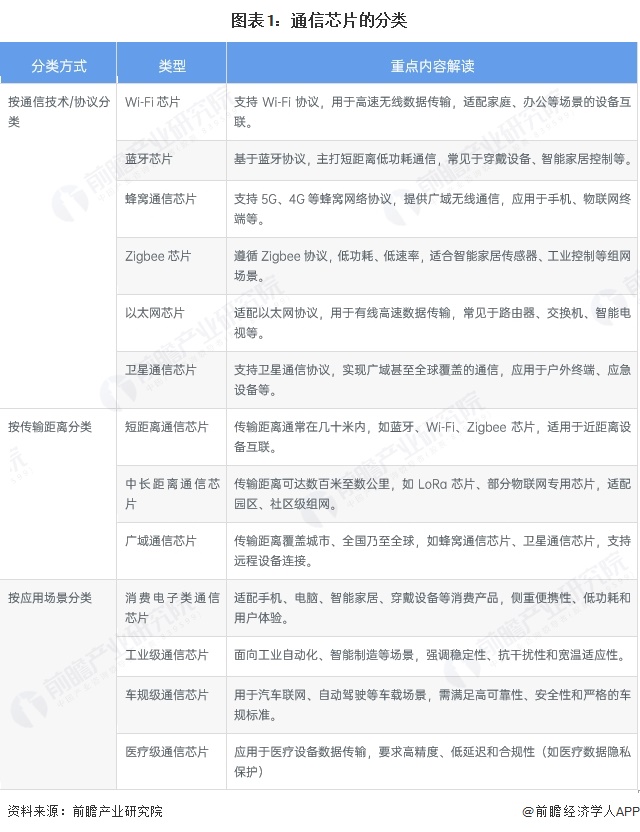
Industry Overview - The communication chip industry in China is defined as integrated circuits specifically designed for data transmission and communication protocols, playing a crucial role in various electronic devices [1][2] - Communication chips are categorized into several types, including Wi-Fi, Bluetooth, Zigbee, cellular communication, RFID, Ethernet, and GPS chips, widely used in smartphones, smart home devices, industrial automation, and medical equipment [2][3] Industry Chain Analysis - The upstream of the communication chip industry consists of raw material and equipment suppliers, while the midstream includes manufacturers who design, produce, and test chips, and the downstream involves terminal device manufacturers integrating these chips into various applications [5][7] Industry Development History - The Chinese communication chip industry has evolved over 40 years, transitioning from technology gaps to self-sufficiency, with significant advancements from 2G to 5G technologies, and is now making strides towards 6G [8][11] Policy Background - Current policies in China focus on key areas such as 5G/6G and satellite communication, promoting breakthroughs in critical technologies through various support measures [12][13] Current Industry Status - The global communication chip industry is at a critical stage with ongoing 5G advancements and steady progress in 6G research, characterized by a competitive landscape where international giants hold significant advantages, while local companies like HiSilicon and Unisoc are making notable progress [16][17] Competitive Landscape - The Chinese communication chip industry can be divided into three tiers based on technical strength and market influence, with leading companies like HiSilicon and Unisoc at the forefront, followed by mid-tier firms like Zhaoxin and Espressif, and smaller innovative companies focusing on niche markets [21][23] Future Development Trends - The industry is expected to see trends such as leading in 6G technology, deepening domestic substitution, and cross-industry integration, with a focus on high-quality development and support for digital economy growth [24][28]