aise宝褓系列智能床垫

Search documents
AI床垫引爆睡眠经济:喜临门、慕思等上市公司加码布局,国标落地开启规范化新阶段
Cai Jing Wang· 2026-02-09 09:35
Group 1: Industry Overview - The sleep industry is undergoing a transformative breakthrough with the integration of artificial intelligence into traditional mattresses, creating innovative products that offer health management and smart interaction features [1] - The Chinese sleep economy has grown from 261.6 billion yuan in 2016 to 377.8 billion yuan in 2020, with an average annual growth rate of 9.6%, and is expected to exceed 1 trillion yuan by 2030 [3] - The acceptance of smart mattresses among consumers is still in its early stages, with features like adjustable firmness, heating, ventilation, and massage functions becoming key drivers for purchasing decisions [3] Group 2: Company Developments - Xilinmen's smart sleep ecosystem brand, aise Baobao series, has achieved sales in the tens of millions, establishing a strong competitive position and positive brand image in the market [1] - In 2025, Xilinmen reported a revenue of 6.196 billion yuan, a year-on-year increase of 3.68%, and a net profit of 399 million yuan, up 6.45% [3] - Xilinmen has invested over 1.2 billion yuan in research and development over the past decade, successfully launching the aise Baobao smart mattress series [4] Group 3: Technological Advancements - The AI smart mattress T11+ launched by Mousse Co. in March 2025 claims to improve average sleep onset speed by nearly 50%, reduce turning frequency by 14.6%, and increase sleep duration by 38% [1][7] - The industry is witnessing a shift towards smart and health-oriented innovations, with companies focusing on technology research and scenario-based services to build brand competitive barriers [7] Group 4: Regulatory Environment - The national standard for smart mattresses (GB/T 46272—2025) was officially released in August 2025 and will be implemented in March 2026, providing a unified standard for the intelligence, functionality, and safety of smart mattress products [2] Group 5: Market Expansion - Xiangxin Home is expanding its investment in smart furniture production, including a new project in Cambodia with an investment of 150 million yuan, aimed at enhancing production capacity to meet growing market demand [8][9] - The North American market for functional sofas is projected to grow from approximately 12.55 billion USD in 2020 to about 15 billion USD by 2024, with a compound annual growth rate of around 4.6% [8]

喜临门战略投资今日宜休背后,与资本、科技布局下一代睡眠生态
Sou Hu Wang· 2026-01-22 09:46
Core Insights - The article discusses the seed round financing of "Today Yixiu," a sleep technology company founded by former Xiaomi executive Wang Teng, which raised several million yuan with notable investors including Xilinmen, highlighting a long-term strategic approach in the industry [1][3] Group 1: Company Overview - "Today Yixiu" focuses on health and energy management, utilizing sensor technology to monitor environmental factors and develop proactive products for users [2] - The company was established on January 6, 2026, and is based in Beijing [2] Group 2: Investment and Strategic Partnerships - The investment from Xilinmen reflects a deeper industry strategy, emphasizing support for startups rather than seeking immediate returns [1][3] - Xilinmen's previous investments, such as in Qushui Technology, demonstrate a consistent strategy of "empowerment" rather than "control" over startups [3] Group 3: Technological Advancements - Xilinmen has invested over 1.2 billion yuan in R&D over the past decade, holding 2,472 valid patents, and has collaborated with Tsinghua University to develop advanced sleep technology [5] - The company has received international media attention for its innovations in sleep technology, indicating a growing global interest [5] Group 4: Market Potential - The global sleep technology market is projected to reach $27.46 billion by 2025 and exceed $102.76 billion by 2033, with a compound annual growth rate of 17.96% [7] - In China, the sleep economy is valued at 437 billion yuan in 2023, with smart sleep products expected to surpass 60 billion yuan by 2025, maintaining a growth rate of over 20% [7] Group 5: Competitive Landscape - The sleep technology sector is becoming increasingly competitive, with major players like Huawei and Xiaomi leveraging their ecosystems to offer high-value products [8] - Xilinmen differentiates itself by focusing on core capabilities in sleep technology rather than chasing trends, exemplified by its collaboration with hotels to create "Deep Sleep Room 2.0" [8] Group 6: Long-term Vision - The ultimate value of sleep technology lies in transforming health management, with companies that possess industry chain capabilities and long-term vision being more likely to succeed [9] - Xilinmen's commitment to enhancing sleep health is seen as a key strategy for maintaining its leading position in the industry [9]


喜临门联手高瓴、云九、智元投资王腾创业,在下一盘什么棋?
Quan Jing Wang· 2026-01-22 07:43
Core Insights - Xiaomi's former executive Wang Teng founded a sleep technology company "Today Yixiu," which recently completed a seed round financing of several tens of millions, attracting attention due to the involvement of industry leader Xilinmen [1] - Xilinmen's investment strategy reflects a long-term vision, focusing on empowering startups rather than seeking immediate returns, indicating a shift towards sustainable industry development [1] Investment and Collaboration - The collaboration originated from Wang Teng's personal experience with sleep issues, leading to a strategic partnership with Xilinmen after product feedback discussions [2] - Xilinmen's investment approach emphasizes "empowerment" rather than "control," providing startups like Today Yixiu with valuable industry resources, including a global production base and a comprehensive quality control system [2][3] - The diverse composition of investors, including Hillhouse Capital and Cloud Nine Capital, indicates an open ecosystem that integrates various technological advancements in sleep innovation [2] Technological Development - Xilinmen has invested over 1.2 billion in R&D over the past decade, holding 2,472 valid patents and collaborating with Tsinghua University to develop advanced sleep technology [4] - The company has gained international media attention, with reports highlighting the significance of Chinese sleep technology in the global market [4] Market Potential - The global sleep technology market is projected to reach $27.46 billion by 2025 and exceed $102.76 billion by 2033, with a compound annual growth rate of 17.96% [5] - In China, the sleep economy is valued at 437 billion, with smart sleep products expected to surpass 60 billion by 2025, indicating a robust growth trajectory [5] Competitive Landscape - The sleep technology sector is becoming increasingly competitive, with major players like Huawei and Xiaomi leveraging their ecosystems to offer high-value products [6] - Xilinmen differentiates itself by focusing on core capabilities in sleep technology rather than chasing trends, exemplified by its strategic investments and innovative product offerings [6] - The ultimate value of sleep technology lies in transforming health management, with companies that possess industry chain capabilities and a long-term vision poised for greater development potential [6]

AI喜临门:率先响应“人工智能+消费”政策
Quan Jing Wang· 2025-12-06 08:25
Group 1 - The core viewpoint of the article emphasizes the Chinese government's initiative to promote the expansion and upgrading of consumer goods, particularly in the smart home sector, with a focus on health-related smart sleep technology [1] - The shift in consumer focus from basic functionalities like connectivity to the effectiveness of smart technology in improving sleep quality reflects the alignment of market demands with policy guidance [1][2] - The establishment of industry standards, such as the national standard for smart furniture, is crucial for defining product classifications and ensuring quality, with the highest level requiring products to have adaptive closed-loop capabilities [1][2] Group 2 - The integration of advanced sensors and AI algorithms in smart sleep products represents a transition from passive to proactive health care solutions, enhancing user experience through features like sleep monitoring and personalized adjustments [2] - The introduction of national standards and the certification of leading products will help create a transparent market evaluation system, reducing the prevalence of "pseudo-intelligence" marketing [2] - Companies are beginning to implement innovative technologies, such as non-invasive EEG for direct monitoring of brain waves, which could significantly impact sleep quality and user experience [2][3] Group 3 - The collaboration between companies like Xilinmen and BrainCo to launch the world's first AI mattress incorporating brain-computer interface technology exemplifies practical applications of advanced research in the smart sleep industry [3] - The overall development of the smart sleep industry is guided by the "artificial intelligence + consumption" policy, aiming to create a rational and innovative market ecosystem [3] - The success of companies in translating "smart" into tangible, reliable sleep improvement solutions will be essential for fostering a healthier market environment and driving the upgrade of home consumption [3]

喜临门第三季度营收同比增长7.78% ,产品、研发、渠道齐头并进
Cai Fu Zai Xian· 2025-11-01 06:53
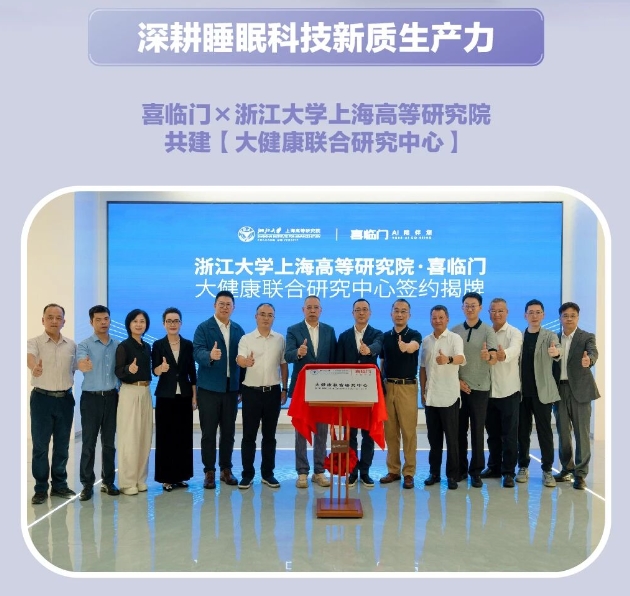
Core Insights - The company reported a revenue of 2.176 billion yuan for Q3 2025, marking a year-on-year growth of 7.78%, with a net profit attributable to shareholders of 133 million yuan and earnings per share of 0.35 yuan, indicating steady overall performance growth [1] Group 1: AI Product Innovation - The company has made significant technological breakthroughs in AI sleep products, transitioning into a technology-driven sleep solution provider, highlighted by the launch of the "BrainCo" AI mattress in collaboration with Strong Brain Technology, which captures users' brainwave signals and physiological data [2] - The company has accumulated a total of 2,795 patent applications, with 2,224 effective patents, including 30 international patents and 54 domestic invention patents, establishing a strong technological barrier for product innovation and supporting its AI sleep strategy [5] Group 2: Industry Collaboration - The company has established a "Big Health Joint Research Center" in collaboration with Zhejiang University Shanghai Advanced Research Institute, focusing on comprehensive processes related to spinal health and exploring the integration of sleep and overall health [3] Group 3: Market Position and Channel Development - The company has strengthened its online and offline channel development, consistently ranking first in mattress sales categories during major promotional events like "Double Eleven," showcasing its leading position in e-commerce channels [6] - As of the end of the reporting period, the company operates a total of 5,264 stores, including 4,855 exclusive stores and 409 MD exclusive stores, creating a broad market coverage network [7] - The company is expected to open new growth paths through its AI sleep strategy while maintaining steady growth in traditional business, capitalizing on the increasing demand for smart sleep solutions [9]