Business Insider

Search documents
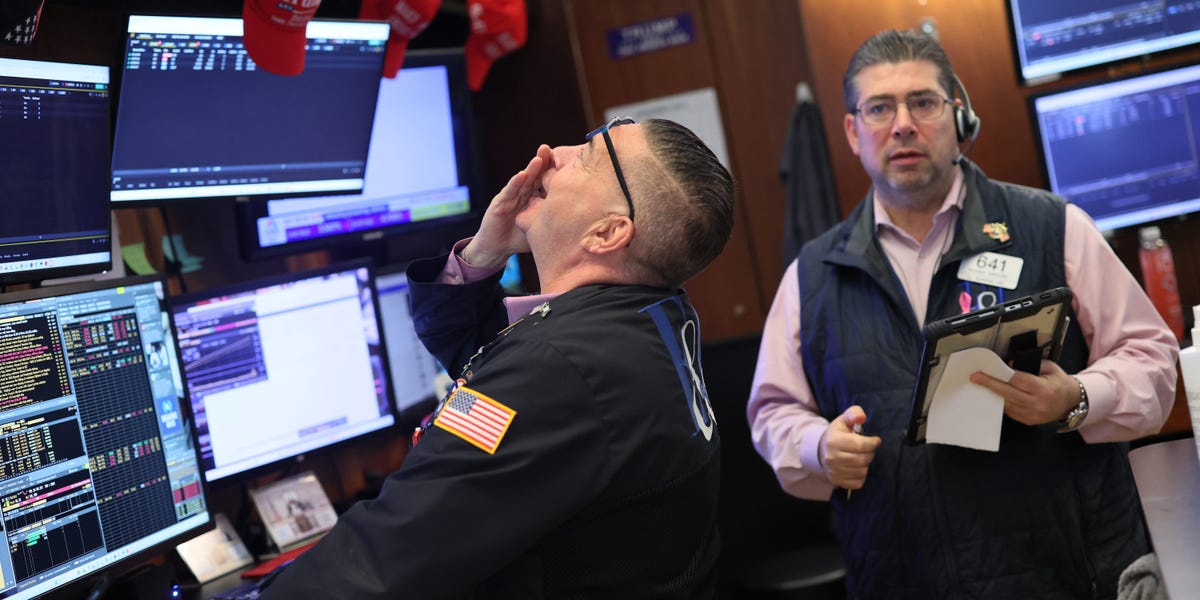
How bitcoin's crash could be feeding into stock-market selling pressure
Business Insider· 2025-11-21 16:44
Core Viewpoint - The stock market experienced a significant reversal on Thursday, with the Dow initially rising by 700 points before ending the day down by 300 points, potentially influenced by a major sell-off in bitcoin [1][2]. Group 1: Market Dynamics - The volatility in the stock market may be attributed to growing fears surrounding an AI bubble, which have overshadowed strong earnings reports from leading companies like Nvidia [2]. - Bitcoin is undergoing its worst sell-off since 2022, with prices dropping over 30% from recent highs, raising liquidity concerns among investors [2][5]. - The correlation between bitcoin's price and the TQQQ ETF, which aims for three times the daily performance of the Nasdaq-100 Index, suggests that declines in bitcoin may force investors to liquidate stock positions [5]. Group 2: Investor Behavior - Margin calls from brokerages due to losses in bitcoin may compel investors to sell stocks to maintain liquidity, as crypto brokerages typically offer higher leverage than stock brokerages [5]. - Algorithmic traders may have reacted to bitcoin's decline by selling stocks, as the drop triggered new sell signals, indicating a reliance on bitcoin as a risk sentiment indicator [6][7]. - The perception of bitcoin as a proxy for speculative behavior suggests that its performance is closely monitored by market participants, influencing broader market movements [7][8].


3 Investing Trends That Have Defined Retail Trading, Day Traders in 2025
Business Insider· 2025-11-21 12:48
Core Insights - 2025 has been a record year for retail traders, with activity up 50% compared to the previous year, indicating increased volatility [1] Group 1: Investment Trends - **Dip-Buying Bonanza**: Three major dip-buying events occurred in the first four months of 2025, with 75% of current stock-market positioning happening during this period, benefiting Nvidia and Tesla [2] - **ETFs Dominating**: ETFs accounted for 75% of retail-trader inflows in 2025, with a notable shift from single-stock buying to ETFs and options after February to April volatility [4] - **AI Stock Purchases**: Retail traders are selling off broader market stocks, referred to as the "SPX 470," to finance purchases of the top 30 AI stocks, leading to increased concentration in mega-cap tech names [6] Group 2: Market Dynamics - **Recent Retail Investor Behavior**: Retail investors have shown less enthusiasm for dip-buying recently, opting to stay on the sidelines during market weakness, with day traders becoming net sellers due to valuation concerns [3] - **Interest in Gold ETFs**: The SPDR Gold Shares ETF has attracted significant retail interest, coinciding with a more-than-60% surge in gold prices year-to-date [5] - **Potential Exhaustion of AI Trade**: There are concerns that the AI trade may be reaching exhaustion, which could lead to a shift in dynamics, especially with renewed valuation concerns despite strong earnings from Nvidia [7]

Tesla's robotaxi clears a key hurdle in Nevada
Business Insider· 2025-11-21 05:11
Group 1: Tesla's Robotaxi Deployment - Tesla has completed the self-certification process for its robotaxi in Nevada, allowing for deployment on state roads, pending approval from the Nevada Transportation Authority for commercial operation [1] - CEO Elon Musk aims to expand ride-hailing services to up to 10 metropolitan areas by the end of the year, with a fleet exceeding 1,000 vehicles, including operations in Nevada, Florida, and Arizona [2] - Tesla's robotaxis are already operating commercially in San Francisco and Austin, with ongoing hiring in cities like Las Vegas, Dallas, Houston, Tampa, and Orlando to support deployment [3] Group 2: Competitive Landscape and Regulatory Environment - A competitive landscape is emerging in California, with companies like Uber, Tesla, and Waymo vying to influence robotaxi regulations [4] - Waymo has proposed that companies offering autonomous ride-hailing services submit quarterly reports, a suggestion opposed by Tesla [4] - Amazon has launched its Zoox robotaxi service in San Francisco, providing free rides to select members of the public [4] Group 3: Stock Performance - Tesla's stock price experienced a decline of approximately 2% on Thursday, although it has increased by over 15% in the past year [5]

Gap CEO says its viral denim campaign wasn't just a hit online — it drove double-digit growth in sales, fueled by Gen Z
Business Insider· 2025-11-21 03:04
Gap is taking a victory lap after the success of its viral denim ad campaign over the summer. Richard Dickson, CEO of Gap Inc., said the brand's "Better in Denim" ad campaign, in addition to being a huge hit on social media, converted into significant sales."With more than 8 billion impressions and 500 million views, Better in Denim culminated in a global cultural takeover and has become one of the brand's most successful campaigns to date, generating significant traffic and double-digit growth in denim," ...


Will Saudi Arabia End up Buying a Big Part of Hollywood?
Business Insider· 2025-11-20 21:42
Core Viewpoint - The potential involvement of Middle Eastern sovereign wealth funds in Paramount's bid for Warner Bros. Discovery has sparked significant discussion, with conflicting reports about the nature of this financial backing [1][2][3]. Group 1: Bid for Warner Bros. Discovery - Paramount's bid for Warner Bros. Discovery is reportedly valued at $71 billion, with speculation about the involvement of Saudi Arabia's Public Investment Fund and other regional officials [2]. - Despite denials from Paramount regarding the initial reports of Arab sovereign wealth funds backing the bid, other publications have suggested that such partnerships could be possible [1][2]. - The interest from petrostates in American media assets indicates a shift in the landscape, where oil money is increasingly seen as a viable source of funding for major deals [3]. Group 2: Historical Context of Petrostate Investments - Petrostate investments in high-profile assets, including media properties, have been on the rise, with examples such as Saudi Arabia's investments in sports and gaming [4]. - The historical context shows that foreign investments in American media are not new, with notable examples including Rupert Murdoch's Fox and Sony's acquisition of Columbia Pictures [10]. - The acceptance of foreign money, particularly from petrostates, has fluctuated based on political climates and events, such as the Khashoggi incident, which initially caused American firms to distance themselves from Saudi investments [7][8]. Group 3: Implications of Petrostate Financing - The potential for oil money to influence content creation in media companies raises questions about editorial independence and the nature of the content produced [12]. - The current political climate suggests that American companies may feel compelled to engage with petrostates for financial support, despite past controversies [8][12]. - The ongoing debate about whether these investments are primarily for profit or to improve the reputation of the investing countries continues to shape perceptions of such deals [5].


Google offers voluntary buyouts to UK employees
Business Insider· 2025-11-20 20:35
Group 1 - Google is offering voluntary buyouts to employees in its UK offices as part of a strategy to support future work and align with company priorities [1][2] - The voluntary exit program follows similar initiatives in the US, indicating a broader trend among Big Tech firms to reduce headcount and streamline operations [3][5] - The specific buyout package for UK employees will vary based on their tenure with the company, and Google employs over 7,000 people in the UK [4] Group 2 - The move to offer buyouts is part of Google's reorientation towards AI, with the company encouraging employees who are not aligned with this focus to consider leaving [5] - Other major tech companies, including Amazon, Meta, and Microsoft, have also implemented layoffs and voluntary exit programs this year, reflecting a shift towards efficiency and AI integration [3]


Walmart execs are 'optimistic' about holiday sales — but 'keeping an eye' on this group of customers' spending
Business Insider· 2025-11-20 16:59
Core Insights - Walmart is optimistic about holiday sales, contrasting with warnings from other retailers about consumer spending pullbacks [1][2] - The company reported third-quarter same-store sales exceeding analysts' expectations, driven by upper- and middle-income shoppers [2] - The National Retail Federation anticipates holiday sales to reach $1 trillion, but with slower growth compared to the previous year [3] Group 1: Sales Performance - Walmart's executives noted strong sales events in the second half of 2025, indicating positive trends for the holiday season [1] - The retailer's scale allows it to mitigate the impact of tariffs, contributing to its competitive pricing strategy [4] - Despite some spending pullback among lower-income consumers, Walmart is benefiting from trade-down behavior among more affluent customers [5][6] Group 2: Market Position - Walmart's ability to attract diverse income groups positions it favorably against discretionary-focused competitors like Target [7] - The company is monitoring spending moderation among lower-income consumers, indicating a bifurcated consumer landscape [6]


'Big Short' investor Michael Burry takes aim at Nvidia after its earnings blowout
Business Insider· 2025-11-20 15:19
Core Viewpoint - Michael Burry continues to express concerns about Nvidia and the AI sector, arguing that the current market may be experiencing a bubble despite Nvidia's strong earnings report and optimistic growth forecasts [1][2][8]. Company Performance - Nvidia reported record revenue and profit for the last quarter, leading to a 5% increase in stock price during premarket trading [2]. - The company's finance chief, Colette Kress, indicated visibility to $0.5 trillion in revenue from Blackwell and Rubin over 2025 and 2026, and projected $3 trillion to $4 trillion in annual AI infrastructure spending by 2030 [3]. Management's Perspective - CEO Jensen Huang dismissed concerns about an AI bubble, stating that the company sees a different reality [3]. - Kress emphasized the longevity of Nvidia's older chips due to the CUDA software, which allows older systems to run current applications effectively [3]. Investor Concerns - Burry criticized Nvidia's accounting practices, suggesting that the extended use of older chips does not equate to profitability, drawing parallels to airlines retaining old planes for capacity [4][5]. - He highlighted the inefficiency of older chips compared to newer models, implying that customers using them incur higher operational costs [4]. Market Dynamics - Burry pointed out the complex financial relationships between Nvidia and other AI companies, suggesting that true demand for AI products is limited and often reliant on dealer funding [6][9]. - He expressed skepticism about the sustainability of investments in the AI sector, comparing it to the dot-com bubble and warning of potential overinvestment [9]. Stock Buybacks and Compensation - Burry noted that Nvidia has repurchased nearly $113 billion in stock since 2018, yet the number of shares outstanding has increased by 47 million, raising concerns about stock-based compensation diluting owner earnings [7].

Bath & Body Works CEO slams chain as 'slow and inefficient,' says it has 'not attracted a younger consumer'
Business Insider· 2025-11-20 15:13
Core Insights - Bath & Body Works reported weaker-than-expected Q3 results, with a decline in sales and earnings, leading to a cut in full-year guidance [1][2] - CEO Daniel Heaf acknowledged that the company has made mistakes, including failing to attract younger consumers and becoming overly reliant on discounting, which has harmed brand value [2] - The company plans to simplify its product offerings by eliminating hair care and men's grooming products, focusing instead on core areas like body care and home fragrances to attract a younger audience [3][4] Strategic Initiatives - The company aims to "reignite its brand" and transform into a faster and more efficient organization by breaking down silos and speeding up decision-making processes [4] - Bath & Body Works is launching on Amazon to reach new customers, estimating that $60 million to $80 million of its products are sold via the grey market on the platform, presenting a significant sales opportunity [5] - The stock price of Bath & Body Works has decreased by 25% today and 58% this year, indicating market concerns about its performance [5]


Verizon says it will lay off 13,000 employees as its new CEO seeks a 'faster and more focused' company
Business Insider· 2025-11-20 13:50
Core Points - Verizon plans to lay off 13,000 employees to become "faster and more focused" according to CEO Dan Schulman [1] - The job cuts are aimed at reducing costs and enhancing customer satisfaction [1] - Schulman emphasizes the need for the company to capture new growth opportunities while delivering for customers [1] Company Strategy - Schulman, who became CEO last month, aims to create a "simpler, leaner, and scrappier" organization [2] - The layoffs are part of a broader strategy to streamline operations and improve efficiency [1][2]