WitsView睿智显示

Search documents
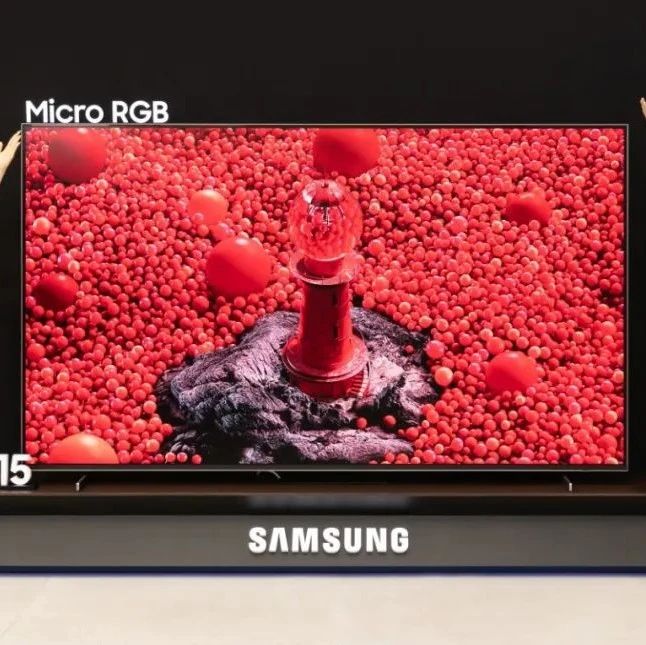
23.27万元,三星发布115英寸Micro RGB背光电视
WitsView睿智显示· 2025-08-13 07:53
Core Viewpoint - Samsung Electronics has launched the world's first Micro RGB backlight television, a 115-inch display product, priced at 45 million KRW (approximately 232,700 RMB) [1]. Group 1: Product Features - The Micro RGB backlight television utilizes Samsung's self-developed Micro RGB technology, featuring red, green, and blue Micro LEDs smaller than 100μm, allowing for individual control of each LED for precise backlight adjustment [2]. - It boasts a 4K resolution, a variable refresh rate of 144Hz, and approximately 15,000 dimming zones, significantly enhancing color accuracy and contrast for high-end large-screen televisions [5]. - The television is equipped with Samsung's Micro RGB AI engine, which optimizes picture and sound through real-time frame analysis and automatic color adjustment, providing a more immersive viewing experience [5]. - The Micro RGB Precision Color technology ensures 100% coverage of the BT.2020 color gamut, enhancing color presentation [6]. - Anti-glare technology reduces reflections in bright environments, offering a comfortable viewing experience [6]. Group 2: Market Strategy - Following its launch in South Korea, the Micro RGB backlight television is set to enter the U.S. market, with plans for a global rollout in various sizes [7]. - Other manufacturers, including Sony, Hisense, and TCL, are also showcasing or releasing RGB backlight television products this year, indicating a competitive trend in the industry towards RGB LED technology to improve color purity, saturation, contrast, brightness control, and energy efficiency [9]. Group 3: Competitor Analysis - Hisense released the RGB-Mini LED UX series in March, featuring a 116-inch version with 4K resolution, 97% BT.2020 color gamut coverage, a refresh rate of 165Hz, and a peak brightness exceeding 5000 nits, priced at 99,999 RMB [10].

传维信诺再采购OLED设备,产能将翻倍
WitsView睿智显示· 2025-08-12 06:04
Core Viewpoint - Visionox plans to order vapor deposition equipment from Canon Tokki for its 6th generation OLED V2 line expansion, aiming to double its monthly production capacity from 15K to 30K units [1][2]. Group 1: Production Capacity and Equipment - The current monthly production capacity of the existing V2 line is 15K units, and Visionox intends to expand this to 30K units [2]. - The V2 line has been using Canon Tokki's vapor deposition equipment, and it is likely that the same equipment will be used for the expansion to avoid process discrepancies [2]. - Visionox's production lines include the 5.5 generation V1 line (15K/month), the 6th generation V2 line (15K/month), and the 3rd generation V3 line (30K/month) [2]. Group 2: Market Dynamics and Technology - The operating rate of China's 6th generation OLED production lines is currently high, recovering from previous low rates due to over-investment [3]. - The decline in OLED product prices has led to increased utilization rates, as smartphone manufacturers have shifted to low-cost OLEDs, making it difficult to revert to LCDs due to consumer preferences [3]. - Visionox's V5 line is expected to use ViP vapor deposition equipment from Applied Materials' subsidiary AKT, as the 6th generation ViP pilot line has already utilized AKT's equipment [3]. Group 3: Technology Implementation - In the V5 line, one-quarter of the 8K monthly production will prioritize ViP technology, while the remaining three-quarters may use FMM technology, although specific investment execution details and timelines remain unclear [5].

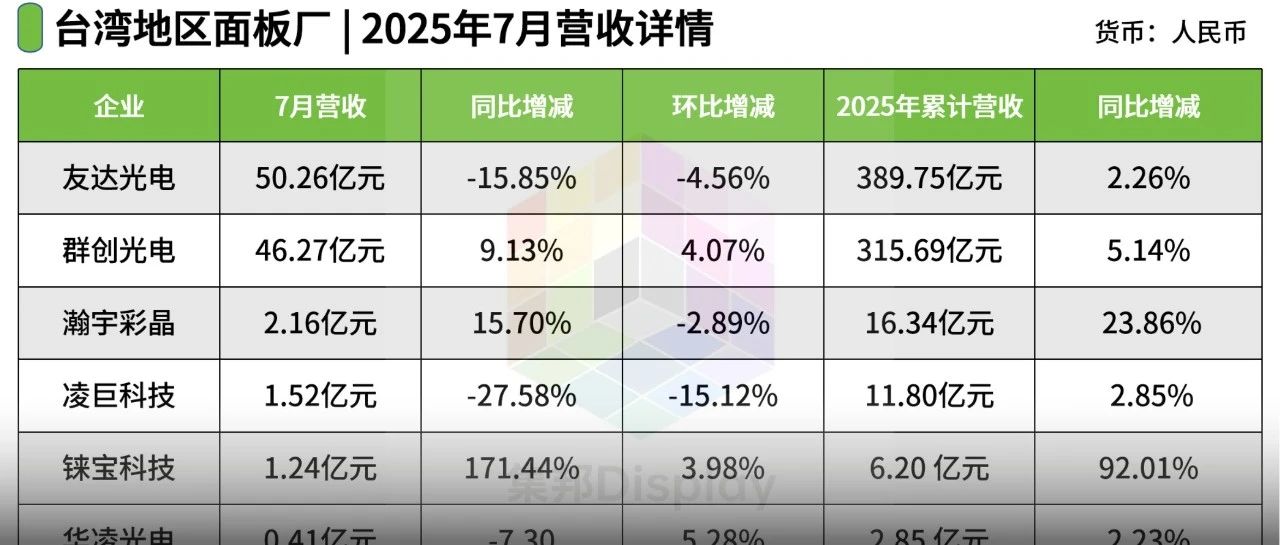
友达、群创、彩晶、凌巨等6家面板厂公布7月营收
WitsView睿智显示· 2025-08-12 06:04
Group 1: Core Insights - The article highlights the revenue performance of six Taiwanese panel manufacturers for July 2025, indicating mixed results with some companies experiencing declines while others saw growth [1] - AUO and Innolux reported a year-on-year revenue decrease of 15.85% and 27.58% respectively, while Qunxing and Raibo achieved year-on-year increases of 9.13% and 171.44% [1] - The overall market for TV panels remains weak, with price declines noted, while demand for monitor panels has also started to slow down [2][3] Group 2: Market Trends - TrendForce reported that TV panel prices continued to decline in July, while prices for monitor and laptop panels remained stable [2] - The demand for TV panels is expected to improve in August and September, but July's demand was relatively weak, leading to price drops [2][3] - The monitor panel market is experiencing a slowdown, with prices stabilizing despite some optimistic forecasts for laptop panel demand [3] Group 3: Company Developments - Innolux plans to consolidate production capacity from its Nanke 5 plant to other facilities, with the migration expected to be completed by mid-2026 [5] - Lianju Technology announced a significant order for a 2.4-inch display module, expected to contribute NT$700-800 million in annual revenue starting next year [5] - AUO is undergoing organizational restructuring to enhance operational efficiency and adapt to external market changes, with new leadership roles established [5] Group 4: Future Outlook - Both AUO and Innolux expressed cautious outlooks for the third quarter due to uncertainties related to tariffs and early inventory pulls by brands [6]
诚志股份:上半年LCD液晶材料销量年增破30%
WitsView睿智显示· 2025-08-12 06:04
Core Viewpoint - The company reported a significant decline in net profit for the first half of 2025, despite a slight increase in revenue, indicating challenges in its core clean energy business while the semiconductor display materials segment showed strong performance [1][3]. Financial Performance - The company achieved revenue of 5.981 billion yuan, a year-on-year increase of 5.65% [2]. - Net profit attributable to shareholders was 19.13 million yuan, a decrease of 89.75% compared to the previous year [2]. - The net profit after deducting non-recurring gains and losses was 29.69 million yuan, down 82.51% year-on-year [2]. - The net cash flow from operating activities was 636.94 million yuan, a decline of 30.20% [2]. - Basic and diluted earnings per share were both 0.0157 yuan, down 89.81% from the previous year [2]. - The weighted average return on net assets was 0.11%, down 0.95% from the previous year [2]. Business Segments - The company's main business includes clean energy, semiconductor display materials, and life sciences, with products such as methanol, ethylene, and various types of liquid crystal materials [2]. - The clean energy segment faced significant challenges, with declining sales prices and gross margins for key products like octanol, negatively impacting overall performance [3]. - Conversely, the semiconductor display materials segment, particularly liquid crystal products, achieved record sales and profitability, contributing positively to the company's performance [3]. - The subsidiary Chengzhi Yonghua is preparing for an IPO and has seen a market share increase, with sales revenue and net profit both rising over 30% year-on-year [3]. - The subsidiary Anhui Chengzhi reported sufficient orders and significant increases in both revenue and net profit compared to the previous year [3]. Intellectual Property - As of the report date, Chengzhi Yonghua holds a total of 1,670 patents, including those acquired from DIC Corporation, with a transaction value of 240 million yuan for 1,183 patents [4]. - The patents include liquid crystal, OLED, and new product patents, distributed across various regions including mainland China, Japan, Taiwan, the United States, and several European countries [4].


50亿,江苏年产2400万套OLED显示模组项目投产
WitsView睿智显示· 2025-08-12 06:04
Group 1 - The core viewpoint of the articles highlights the advancements in semiconductor and display technologies in Jiangsu province, particularly focusing on the production capabilities of Chengsheng Technology and Chuanqi Optoelectronics [1][3]. Group 2 - Chengsheng Technology has partially launched its chip packaging testing and OLED display module project with a total investment of 5 billion yuan, aiming for full production by the end of the year [1]. - The project is expected to produce 800,000 high-power IGBT modules, 12 billion semiconductor optical communication chip devices, 70 million power devices, and 24 million OLED display modules annually [1]. - The products from Chengsheng Technology will serve various industries including power energy, rail transportation, home appliances, industrial electronics, photovoltaics, and new energy vehicles [1]. Group 3 - Chuanqi Optoelectronics has successfully launched its first 75-inch color electronic ink screen, which has improved color saturation by 30% and can operate in a temperature range of -15℃ to 65℃ [3]. - The company has achieved full production capacity and reported an export value of 975 million yuan from January to June this year [3]. - Chuanqi Optoelectronics is a subsidiary of E Ink Holdings and plays a significant role in the global electronic paper industry [3].
7.14亿,歌尔股份间接投资Micro LED技术商Plessey
WitsView睿智显示· 2025-08-11 06:54
Core Viewpoint - The article discusses GoerTek's strategic investment in Haylo to enhance its Micro LED technology and support its AI smart glasses and AR business development [3][9]. Investment Announcement - GoerTek announced a loan of up to $100 million (approximately 714 million RMB) to Haylo to promote the maturity of Micro LED technology and products [3][9]. - The loan will be used by Haylo to acquire 100% of Plessey Semiconductors Limited and to increase Plessey's capital for purchasing Micro LED-related fixed assets and supplementing working capital [5]. Plessey Semiconductors Overview - Plessey, established in 2000, focuses on developing ultra-high-resolution Micro LED displays for AR and VR devices [5]. - Plessey has collaborated with companies like Vuzix and Meta to develop AR/VR micro-display technology [5]. Technological Achievements - Plessey has launched several products, including a monochrome passive matrix Micro LED display and the world's first silicon-based InGaN red LED [6]. - In January 2023, Plessey and Meta announced a breakthrough in developing the highest brightness red Micro LED display, achieving up to 6,000,000 nits brightness at high resolution (<5 microns) [6]. Financial Performance - Despite being in the early stages of Micro LED technology, Plessey reported profitability in recent years, with revenues of approximately $74.79 million and a net profit of about $12.41 million for the fiscal year 2024 [6]. - For the fiscal year 2025, Plessey's revenue is projected to be around $72.72 million, with a net profit of approximately $2.8 million [6]. GoerTek's Business Transition - GoerTek, known for precision components and smart hardware manufacturing, aims to reduce reliance on major clients by expanding its VR/AR headset and smart gaming console business [7]. - In the first half of 2022, smart hardware became GoerTek's largest business segment, boosting the company's overall gross margin [7]. Optical Technology Development - GoerTek established GoerTek Optics in 2012 to focus on the R&D and production of optical display technologies for VR & AR and micro-projection [8]. - The company has developed various AR optical products based on DLP, LCoS, and Micro LED technologies [8]. Strategic Goals - The investment aims to enhance GoerTek's resource integration capabilities in the upstream supply chain and strengthen strategic cooperation with leading industry clients [9]. - This investment is expected to further promote the maturity of Micro LED technology and products, benefiting GoerTek's AI smart glasses and AR business in the future [9].


550亿!合肥国显第8.6代AMOLED生产线主厂房封顶
WitsView睿智显示· 2025-08-11 06:54
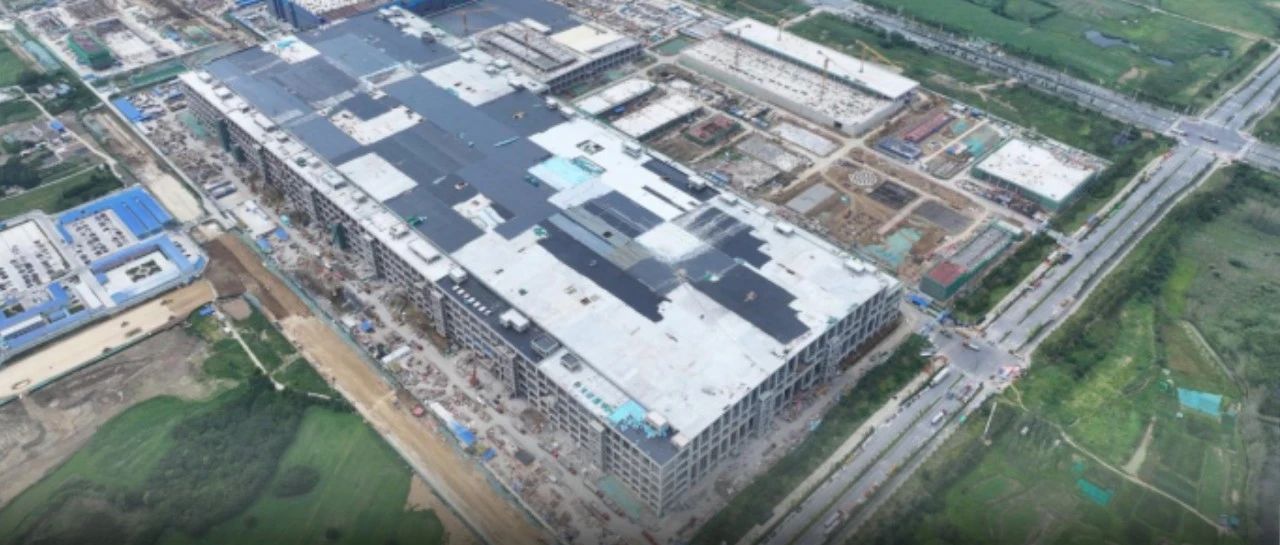
Core Viewpoint - The completion of the main plant for the 8.6-generation AMOLED production line in Hefei marks a significant advancement in the mass production of the ViP technology, which is a breakthrough in AMOLED manufacturing [4]. Group 1: Project Overview - The 8.6-generation AMOLED production line is located in Hefei New Station High-tech Zone and is constructed and operated by Hefei Guoxian, which is funded by Visionox and Hefei's investment platform [4]. - The total investment for the production line is 55 billion yuan, with a designed capacity of 32,000 glass substrates per month (2290mm × 2620mm) [4]. - The main plant was topped out in just 168 days since the civil construction began in February 2025 [4]. Group 2: Technology and Advantages - The production line utilizes Visionox's self-developed ViP technology, which employs semiconductor photolithography to produce AMOLED pixels, eliminating the limitations of traditional FMM processes [4]. - ViP technology offers independent pixels, high precision, and high yield, significantly improving the cutting efficiency and cost-effectiveness of AMOLED panels [4]. - This technology aims to provide more solutions for the mid-to-large size high-end display markets, including tablets, laptops, and automotive displays [4].
供货京东方等,2家显示相关龙头申请上市
WitsView睿智显示· 2025-08-08 12:02
Core Viewpoint - The article highlights the recent IPO applications of two companies in the display industry, Yuanli Optoelectronics and Zhongdao Optoelectronic Equipment, indicating a growing trend in the sector towards capital market engagement and expansion of domestic production capabilities [1][9]. Company Summaries Zhongdao Optoelectronic Equipment - Zhongdao Optoelectronic, established in 2006, focuses on the research, production, and sales of automatic optical inspection (AOI) equipment for flat panel displays and semiconductor wafers [2][4]. - The company is recognized as a "little giant" enterprise by the state and has a significant market share in the AOI field, serving major clients like BOE and TCL Huaxing [4]. - In June 2025, Zhongdao Optoelectronic won a project for low-precision automatic optical inspection machines, further solidifying its market position [4]. - The company aims to accelerate its expansion into the semiconductor wafer inspection sector post-IPO, potentially increasing its funding and resources [4][13]. Yuanli Optoelectronics - Yuanli Optoelectronics, founded in 2010, is a leading manufacturer in the medium and large-sized light guide plate industry and is also recognized as a "little giant" enterprise [5][8]. - The company specializes in the development and production of optical products, including light guide plates for various applications, and has a strong market presence globally [8]. - In 2024, Yuanli Optoelectronics reported revenues of 287.7 million yuan, a year-on-year increase of 22.94%, and a net profit of 31.16 million yuan, up 25.66% [8]. - The company has been actively investing in new technology and expanding its business layout, including the establishment of two wholly-owned subsidiaries [8]. Industry Trends - The display panel industry is experiencing a surge in IPO applications, with Zhongdao Optoelectronic and Yuanli Optoelectronics being part of a broader trend that includes other companies in the upstream equipment and materials sectors [9][10]. - The total investment in panel manufacturing projects in the first half of 2025 reached approximately 224.43 billion yuan, indicating strong growth and expansion in the sector [10][11]. - Domestic manufacturers are gradually moving from mid-range to high-end markets in key processes such as inspection and etching, reflecting a shift towards increased localization and technological advancement [13].

1.5V,全球最低工作电压白光OLED器件问世
WitsView睿智显示· 2025-08-08 12:02
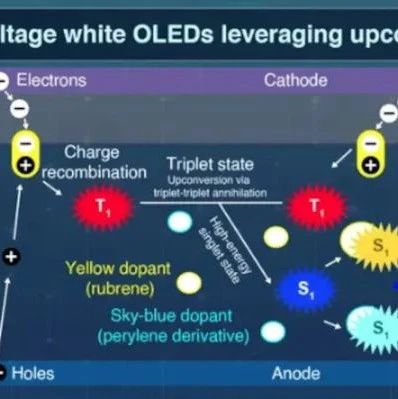
Core Viewpoint - Tokyo Science Research Institute has developed the world's lowest operating voltage white OLED device, which operates at 1.5V [1]. Group 1: Research and Development - The research team, led by Professor Seiichiro Izawa, previously focused on low-voltage blue OLED devices using triplet-triplet annihilation (TTA) for blue light emission [2]. - The new OLED devices, named up-conversion OLED or UC OLED, incorporate a sky-blue dopant (polyvinyl dopant, Tbpe) and a yellow dopant (red fluorescent), which together produce white light [2]. - Despite the low operating voltage, the OLED devices currently face challenges related to efficiency and color stability, with ongoing efforts to improve performance [2].
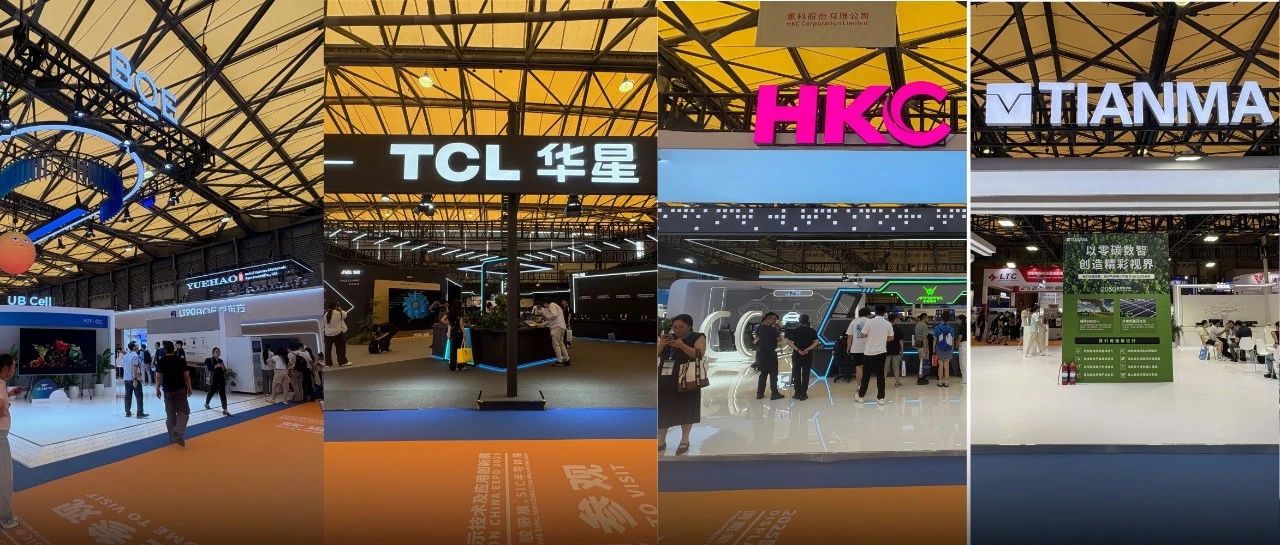
DIC 2025 直击:京东方/TCL华星/惠科/深天马等28企亮点一览
WitsView睿智显示· 2025-08-08 12:02
Core Viewpoint - The DIC EXPO 2025 showcased innovative display technologies and applications from various companies, highlighting advancements in display panels, materials, and equipment across multiple sectors including consumer electronics, medical, and automotive [1][140]. Panel Companies - BOE introduced the UB Cell display technology, which enhances image quality and power efficiency through AI integration, applicable in TVs, monitors, and notebooks [2]. - BOE's 31.5-inch 4K medical display meets DICOM800 standards with over 100% NTSC color coverage and a contrast ratio of 2000:1 [4]. - TCL Huaxing presented the world's first mass-produced under-screen camera OLED laptop display with a 98% screen-to-body ratio and 4K resolution [15]. - TCL Huaxing's 27-inch 4K 120Hz printed OLED monitor features a peak brightness of 600 nits and a DCI-P3 color gamut of 99% [17]. - HKC showcased the world's first 800Hz ultra-high refresh rate display [22]. Display Materials and Equipment - Corning displayed advanced glass solutions, including a 57-inch 8K curved gaming screen with a 240Hz refresh rate [76]. - North Huachuang presented magnetic sputtering coating equipment for LCD and touch screens, essential for transparent conductive films [57]. - Koyun Laser introduced precision repair equipment for LCD and OLED displays, enhancing production quality [60]. Emerging Technologies - Visionox exhibited a flexible AMOLED solution with high efficiency and color purity, marking a significant advancement in display technology [31]. - Tianma Microelectronics showcased a 16-inch 480Hz gaming panel, pushing the boundaries of refresh rates in laptops [47]. - Longteng Optoelectronics presented a 14-inch AI dynamic privacy display, allowing users to switch between wide and narrow viewing angles [48]. Conclusion - The DIC 2025 highlighted the latest developments in display technology, showcasing innovations in high refresh rates, high resolutions, and flexible displays, indicating a new phase of growth in the display industry [140].