WitsView睿智显示

Search documents
青岛市新型显示产业园2025年营收预计超520亿元
WitsView睿智显示· 2026-01-14 07:45
Core Viewpoint - The Qingdao New Display Industry Park is projected to achieve a revenue of 52 billion yuan by 2025, accounting for approximately 32.6% of the city's new generation information technology industry revenue [1]. Group 1: Industry Overview - The Qingdao New Display Industry Park is one of the ten emerging industrial parks planned in Qingdao, covering three main areas: module panel area (5,754 acres), materials and equipment area (7,650 acres), and terminal application area (900 acres) [1]. - Since its establishment in 2022, the park has advanced the construction of over 14,000 acres and attracted several key industry players, including Hisense, BOE, and Wanda Optoelectronics [2]. Group 2: Industry Structure and Development - The park has formed a dual-chain structure led by Hisense (terminal application) and BOE (module panel), with material and equipment companies developing in coordination [2]. - The local supply rate for BOE's backlight sources has reached 100%, while the local supply rate for Hisense's metal back panels and diffusion plates is nearly 80% [2]. Group 3: Investment and Future Plans - A total of 17 projects have been put into operation with a total investment of 35.6 billion yuan, and there are 28 projects under discussion with a cumulative investment of 174.9 billion yuan [2]. - By 2025, the park is expected to have attracted 37 key projects with a total investment exceeding 70 billion yuan [2]. - According to the Qingdao Economic Development Zone's "2.0 version of the New Display Industry Park Construction Implementation Plan (2025-2030)," the park aims to strengthen its liquid crystal display sector, actively cultivate MLED micro-displays, and make breakthroughs in OLED displays, targeting a scale of 55 billion yuan by 2026 and 70 billion yuan by 2030 [2].




净利润超80亿元!TCL华星发布2025年业绩预告
WitsView睿智显示· 2026-01-13 11:18
Core Viewpoint - TCL Technology expects a significant increase in net profit for 2025, projecting a range of 4.21 billion to 4.55 billion yuan, representing a year-on-year growth of 169% to 191% [1][2]. Financial Performance - The projected net profit for 2025 is between 4.21 billion and 4.55 billion yuan, compared to 1.564 billion yuan in the previous year, indicating an increase of 169% to 191% [2]. - The net profit attributable to shareholders after deducting non-recurring gains and losses is expected to be between 2.89 billion and 3.2 billion yuan, up from 298 million yuan last year, reflecting a growth of 869% to 973% [2]. - Basic earnings per share are projected to be between 0.2174 yuan and 0.2350 yuan, compared to 0.0842 yuan per share in the previous year [2]. Business Operations - TCL Huaxing's operating revenue surpassed 100 billion yuan, with net profit exceeding 8 billion yuan and net operating cash flow exceeding 40 billion yuan, indicating high-quality growth [2]. - The company maintains a competitive advantage in large-size products such as TVs and commercial displays, while also experiencing rapid growth in the small and medium-size product sector [2]. - TCL completed the acquisition of 100% of the shares of the former LG Display (China) Co., Ltd., enhancing its capacity layout for large and medium-size LCD panels [2]. - The company also acquired a minority stake in Shenzhen Huaxing Optoelectronics Semiconductor Display Technology Co., Ltd., which is expected to boost the profit attributable to shareholders [2]. - Expansion of the G5.5 generation printed OLED production line and the establishment of the world's first high-generation printed OLED production line are underway, laying the foundation for future display technology upgrades [2]. Industry Position - The panel industry continues to see strong performance, with companies like Zhonghuan leading with over 5.7 billion yuan in revenue, maintaining the top position in domestic shipments [3]. - Miao Jia Technology is expanding its leading advantage, solidifying its position in TV OEM business and experiencing rapid growth in the display and gaming monitor OEM sectors, significantly enhancing profitability [3].


三星显示:公司IT业务今年有望增长最高30%
WitsView睿智显示· 2026-01-13 09:48
Core Viewpoint - Samsung Display is expanding its product lineup in the IT business, with the introduction of the 8.6-generation OLED products expected to increase sales by 20% to 30% compared to the previous year [1]. Group 1: Product Development - The 8.6-generation OLED features a glass substrate size that is 2.2 times larger than the current mainstream 6th generation OLED, significantly improving production efficiency [4]. - For example, the annual production capacity for a 14-inch tablet using 6th generation OLED panels is approximately 4.5 million units, while the 8.6-generation OLED can increase this capacity to 10 million units [4]. Group 2: Investment Plans - Samsung Display announced plans to transform its LCD production line L8 and build a dedicated A6 production line for IT OLED, with an investment amounting to 4.1 trillion Korean won [4]. - The new production line is expected to achieve mass production by the second or third quarter of 2026, with plans to supply panels to Apple [4]. Group 3: Market Position - Despite the rapid development of Chinese display companies, there remains a gap in the OLED sector compared to Samsung Display [4]. - However, Chinese companies are actively investing in new display technologies such as micro-displays and OLEDoS to seize market opportunities [4].
广西、安徽3个显示项目迎新进展
WitsView睿智显示· 2026-01-13 09:48
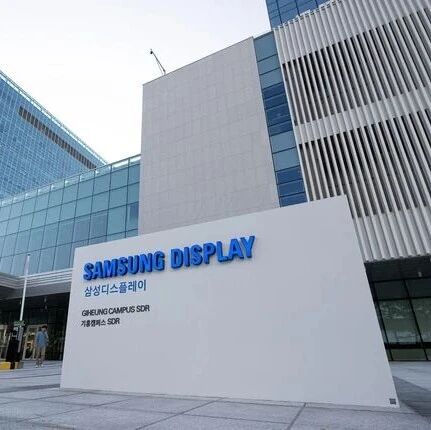
Group 1 - Three display-related companies have made significant progress with their projects, covering LCD, OLED, and automotive displays [1] - Two optical display projects have been successfully signed in Yulin, Guangxi, with a total investment of 470 million yuan [2] - Shenzhen Xike Touch Electronics is investing 310 million yuan to establish a smart production line for LCD and OLED displays, occupying 31,000 square meters [2] - Shenzhen Kelemei Display is investing 160 million yuan to set up a fully automated production line for LCD and OLED polarizers and key raw materials, occupying 16,000 square meters [2] - The projects are expected to enhance the industrial capabilities of the Yulin Economic Development Zone and attract more suppliers [2] Group 2 - Anhui New Power Optoelectronics has officially commenced production, with a project investment of 200 million yuan [3][4] - The project aims to produce TFT display modules and automotive electronics, with an expected annual output of 2.4 million electronic display products [4] - The anticipated annual revenue from the project is approximately 300 million yuan, generating 12 million yuan in tax revenue and creating over 100 jobs [4]
中国大陆LCD显示器面板市占近70%
WitsView睿智显示· 2026-01-13 09:48
Core Viewpoint - The Chinese panel manufacturers have gained a dominant position in the LCD display panel market, holding nearly 70% market share, while their share in the LCD laptop panel market has just surpassed 50% and is expected to reach close to 70% in the next 4 to 5 years [1][4][7]. LCD Display Panel Market - By 2025, Chinese panel manufacturers are projected to hold 68% of the LCD display panel market, with Taiwanese and Korean manufacturers each holding about 16% [4]. - In 2026, the market share of Chinese manufacturers is expected to grow to 72%, while Taiwanese and Korean shares are anticipated to decline to 15% and 13%, respectively [4]. - The increase in market share for Chinese manufacturers is attributed to capacity expansion through mergers and new constructions, along with aggressive pricing strategies, leading to the exit of Taiwanese and Korean manufacturers due to poor profitability [4]. LCD Laptop Panel Market - In 2024, Chinese panel manufacturers hold 48% of the LCD laptop panel market, which is expected to exceed 50% in 2025, reaching 52%, and further increase to 54% in 2026 [5]. - Taiwanese manufacturers' market share is projected to decline from 37% in 2024 to 34% in 2025, and further to 32% in 2026 [5]. - Korean manufacturers are expected to maintain a market share of around 12% from 2024 to 2026, while Japanese manufacturers are projected to have shares of 3%, 2%, and 2% over the same period [6]. Long-term Outlook - Long-term projections indicate that Chinese panel manufacturers will continue to grow their market share until they reach nearly 70%, establishing dominance in the LCD laptop panel market [7]. - Taiwanese manufacturers face challenges due to overlapping customers and cost disadvantages, leading to a gradual erosion of their market share by Chinese manufacturers [7]. - Japanese manufacturers are expected to exit the LCD laptop panel market in the long run due to cost disadvantages [7]. - The LCD laptop market is anticipated to experience intense competition for market share, which will pressure product profit margins and accelerate the exit of overseas panel manufacturers, further increasing the market share of Chinese manufacturers [7].

韩国团队研发出新OLED结构和设计,发光效率提升超一倍
WitsView睿智显示· 2026-01-12 08:04
为此,研究团队提出了一种全新的OLED设计方法,能够在每个像素尺寸内最大限度地高效导出光 线。该方法充分考虑了实际显示设备中有限的像素尺寸,即使在相同尺寸的像素中,也能显著提 升外部出光量。 此外,研究团队还开发了一种"准平面光提取结构"。这种结构极为轻薄,厚度与传统的MLA相 当,却能实现接近半球形透镜的高光提取效率。同时,它还能轻松应用于可弯曲的柔性OLED。 通过应用上述技术,即使在小型像素中,发光效率也提升了两倍以上。这有望延长移动设备的电 池使用时间、降低发热、延长显示屏的使用寿命。 研究团队表示:"此前虽然提出了许多光提取结构,但大多适用于大面积照明,而在由大量小像素 构成的显示屏上应用时,往往难度较大或效果不明显。而此次提出的准平面光提取结构,不仅能 够有效减少相邻像素间的光干涉现象,还能进一步最大化光提取效率。"(译自ETnews) 【集邦Display显示产业交流群】 图片来源:韩国科学技术院 1月11日,韩国科学技术院研究团队开发了一种新的OLED结构和设计方法,解决了OLED显示器长期 存在的内部光损耗问题。新研究在保持OLED固有平面结构优势的同时,将发光效率提高了一倍以 上。 据介绍 ...

超1亿元,惠科采购多款显示器制造设备
WitsView睿智显示· 2026-01-12 08:04
据韩媒报道,近日,惠科近期在设备采购方面动作频频,累加金额已超1亿元人民币。 1月8日,Narae Nanotech宣布与惠科旗下两家控股公司签订显示器制造设备供应合同。其中, 与滁州惠科显示科技有限公司(简称"滁州惠科")的合同金额约43亿韩元(约合人民币2043万 元),与长沙惠科科技有限公司(简称"长沙惠科")的合同金额约56亿韩元(约合人民币2660万 元)。 | 销售或供应宣同 | | | 销售或供应合同 | | | | --- | --- | --- | --- | --- | --- | | 1. 合同详情 | | 显示器制造设备 | 1. 合同详情 | | 显示屏制造设备 | | 2. 合同详情 | 附条件合同 | 不 | 2. 合同详情 | 附条件合同 | K | | | 固定合约金额(韩元) | 5,594,859,000 | | 固定合约金额(韩元) | 4,258,002,000 | | | 有条件合同金额(韩 | | | 有条件合同金额(韩 | | | 元) | | | | 元) | | | | 合同总金额(韩元) | 5,594,859,000 | | 合同总金额(韩元) | 4, ...
韩媒:苹果考虑2027年推出更轻薄的iPhone Air
WitsView睿智显示· 2026-01-12 08:04
Core Viewpoint - Apple is considering the release of a thinner iPhone Air in 2027, coinciding with the 20th anniversary of the iPhone series, and is exploring the use of Color Filter Encapsulation (CoE) technology to achieve ultra-thin panels [1][2]. Group 1: CoE Technology - CoE technology replaces the polarizer used in current OLEDs with color filters, improving light transmittance, reducing power consumption, and decreasing thickness [2]. - Apple plans to first implement CoE technology in its first foldable product, expected to launch in the second half of 2026, before potentially using it in the iPhone Air [2]. Group 2: Industry Response - Samsung Display is preparing for the market demand for CoE technology by discussing supplementary investments in its 6th generation OLED production line [3]. - LG Display has announced a significant investment of 1.26 trillion KRW before 2027, with 700 billion KRW allocated for CoE equipment at its Paju plant [3]. Group 3: Market Uncertainty - There is uncertainty in the market regarding the launch of the iPhone Air with CoE technology, as delays could lead to blind investments by Korean panel manufacturers [5]. - The sales performance of the recently launched iPhone 17 Air was below expectations, prompting Apple to cancel the Air model in the upcoming iPhone 18 series [5].

友达、群创等6家面板厂公布12月营收
WitsView睿智显示· 2026-01-09 09:51
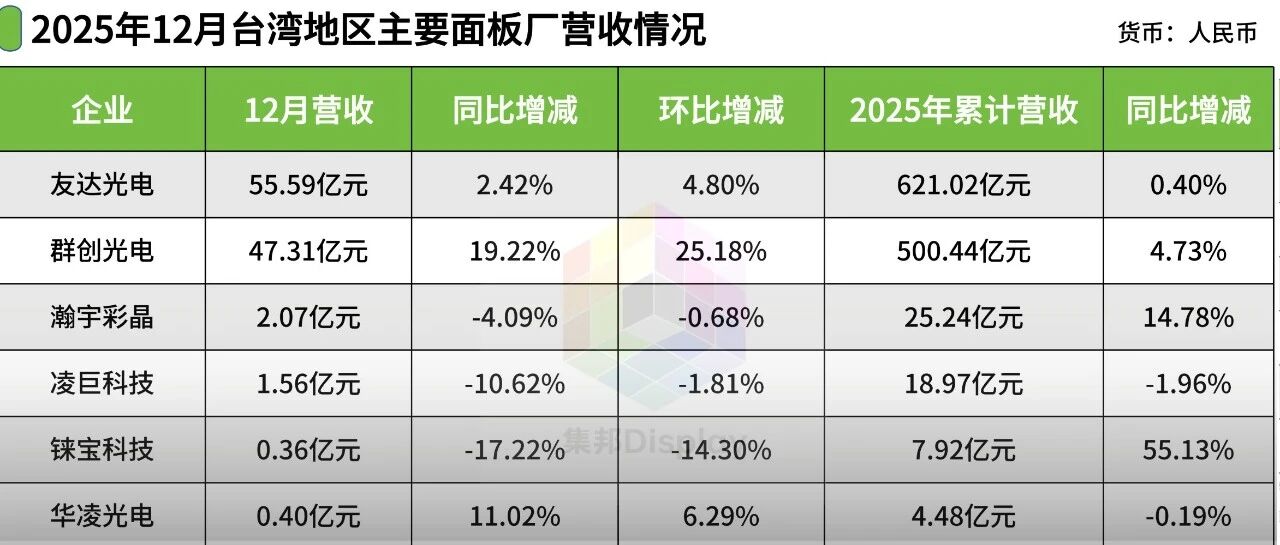
Core Viewpoint - The revenue performance of major Taiwanese panel manufacturers in December 2025 shows strong growth for large-size panels, while small and medium-sized manufacturers exhibit mixed results [1][2]. Group 1: Revenue Performance - AUO's December revenue reached NT$ 55.59 billion (approximately RMB 5.559 billion), with a month-on-month increase of 4.8%, marking a nine-month high [2]. - Innolux reported December revenue of NT$ 47.31 billion (approximately RMB 4.731 billion), a significant month-on-month increase of 25.18% and a year-on-year increase of 19.22%, achieving a 45-month high [2]. - Han's Semiconductor's revenue in December was NT$ 2.07 billion (approximately RMB 0.207 billion), showing a year-on-year decrease of 4.09% [1]. - Lianji Technology's December revenue was NT$ 1.56 billion (approximately RMB 0.156 billion), down 10.62% year-on-year [1]. - Ralco Technology's December revenue was NT$ 0.36 billion (approximately RMB 0.036 billion), with a year-on-year decrease of 17.22% but an impressive annual cumulative revenue growth of 55.13% [1][2]. - Hualing's December revenue was NT$ 0.40 billion (approximately RMB 0.04 billion), with a month-on-month increase of 6.29% [1]. Group 2: Business Developments - In December, AUO showcased smart medical solutions at the Taiwan Medical Technology Exhibition, with a compound annual growth rate of 20% in its smart medical business over the past five years, expecting to maintain double-digit growth [3]. - On December 2, Innolux completed the acquisition of Pioneer, aiming to leverage its advantages in audio, HMI, and software platforms to create a comprehensive smart cockpit system [4]. - Innolux announced the termination of its collaboration with Japan Display (JDI) due to the inability to reach a commercialization agreement [4]. - Han's Semiconductor announced the closure of its Nanke plant, focusing on reallocating resources to areas with lower capital expenditure needs and higher profit margins [4]. Group 3: Market Outlook - Looking ahead to January 2026, the market is expected to see a rise in television panel prices, supported by strong procurement momentum from TV brands and pre-holiday stockpiling, while notebook panel demand is anticipated to weaken, impacting related companies' revenues [5][8].
加码TAC膜项目建设,天禄科技子公司完成增资扩股
WitsView睿智显示· 2026-01-08 05:42
Core Viewpoint - Tianlu Technology has successfully completed a capital increase for its subsidiary Anhui Jiguang New Materials, introducing new investor Chengdu Yuanhe Yuandian Venture Capital Partnership, which aims to enhance the capital strength of Anhui Jiguang and promote the construction of the TAC film project [1][3][5]. Group 1: Capital Increase Details - The registered capital of Anhui Jiguang will increase from RMB 369 million to RMB 433 million, with Tianlu Technology investing RMB 43.33 million and Yuanhe Yuandian investing RMB 30 million [3]. - After the capital increase, Tianlu Technology's shareholding will rise from 56.0046% to 56.4603%, maintaining its controlling position [3][4]. - The shareholding structure will change, with Yuanhe Yuandian holding 6.0450% of Anhui Jiguang's shares post-investment [3][4]. Group 2: Financial Performance of Anhui Jiguang - As of September 30, 2025, Anhui Jiguang reported total assets of RMB 402 million and net assets of RMB 349 million, but has not yet achieved profitability, with a net loss of RMB 10.99 million for 2024 and RMB 10.42 million for the first three quarters of 2025 [5]. - The company was established in March 2023 and focuses on manufacturing and R&D of electronic specialty materials and optoelectronic devices [4][5]. Group 3: Strategic Implications - The capital increase is part of Tianlu Technology's strategy to expand its presence in the upstream materials sector of the display industry [5]. - The introduction of external fund Yuanhe Yuandian is expected to optimize the shareholding structure and improve the internal governance of Anhui Jiguang [5]. - The TAC film is a key raw material in the polarizer manufacturing process, and this investment aims to accelerate the development of TAC film business, enhancing domestic production capacity and reducing reliance on imports [5].