数字生命卡兹克

Search documents
扣子空间上线极致拟人的AI播客,这次真是降维打击了。
数字生命卡兹克· 2025-05-27 17:24
Core Viewpoint - The article discusses the advancements in AI podcasting technology, particularly focusing on the capabilities of "扣子空间" (Coze Space) to generate highly realistic and engaging audio content from written material, thus transforming the content creation landscape for creators and listeners alike [1][2][10]. Group 1: AI Podcasting Technology - The AI podcasting feature from Coze Space allows users to convert written articles into audio podcasts with a human-like quality, making the experience more immersive and engaging [1][2]. - Users can easily generate podcasts by uploading text files and providing a simple prompt, eliminating the need for complex setups or additional plugins [2][4]. - The technology not only generates audio but also creates a visual webpage that displays subtitles alongside the audio, enhancing the user experience [6][21]. Group 2: User Experience and Market Impact - The article highlights the emotional responses elicited by the AI-generated podcasts, ranging from shock to excitement, indicating a significant leap in audio content quality [2][3]. - AI podcasts are seen as a solution to the high production costs and time associated with traditional human-hosted podcasts, potentially democratizing content creation [9][10]. - The rise of AI podcasts may blur the lines between auditory and visual content consumption, as users may prefer listening to news or articles during activities like driving or cooking [12][13]. Group 3: Future of Content Creation - The article suggests that AI podcasts could evolve into a new medium, allowing for various content types (text, audio, video) to be transformed into engaging audio formats [11][14]. - There is a belief that while AI podcasts can provide knowledge and entertainment, they cannot fully replicate the unique connection and emotional engagement that human hosts offer [28][30]. - The expansion of AI podcasting is viewed as an opportunity to broaden the podcasting audience rather than replace human creators, fostering a more inclusive content landscape [29][30].


Dify、n8n、扣子、Fastgpt、Ragflow到底该怎么选?超详细指南来了。
数字生命卡兹克· 2025-05-27 00:56
Core Viewpoint - The article provides a comprehensive comparison of five mainstream LLM application platforms: Dify, Coze, n8n, FastGPT, and RAGFlow, emphasizing the importance of selecting the right platform based on individual needs and use cases [1][2]. Group 1: Overview of LLM Platforms - LLM application platforms significantly lower the development threshold for AI applications, accelerating the transition from concept to product [2]. - These platforms allow users to focus on business logic and user experience innovation rather than repetitive underlying technology construction [3]. Group 2: Platform Characteristics - **n8n**: Known for its powerful general workflow automation capabilities, it allows users to embed LLM nodes into complex automation processes [4]. - **Coze**: Launched by ByteDance, it emphasizes low-code/no-code AI agent development, enabling rapid construction and deployment of conversational AI applications [5]. - **FastGPT**: An open-source AI agent construction platform focused on knowledge base Q&A systems, offering data processing, model invocation, and visual workflow orchestration capabilities [6]. - **Dify**: An open-source LLM application development platform that integrates BaaS and LLMOps concepts, providing a one-stop solution for rapid AI application development and operation [7]. - **RAGFlow**: An open-source RAG engine focused on deep document understanding, specializing in knowledge extraction and high-quality Q&A from complex formatted documents [8][40]. Group 3: Detailed Platform Analysis - **Dify**: Described as a "Swiss Army Knife" of LLM platforms, it offers a comprehensive set of features including RAG pipelines, AI workflows, monitoring tools, and model management [8][10][12]. - **Coze**: Positioned as the "LEGO" of LLM platforms, it allows users to easily create and publish AI agents with a wide range of built-in tools and plugins [21][25]. - **FastGPT**: Recognized for its ability to quickly build high-quality knowledge bases, it supports various document formats and provides a user-friendly interface for creating AI Q&A assistants [33][35]. - **RAGFlow**: Distinguished by its deep document understanding capabilities, it supports extensive data preprocessing and knowledge graph functionalities [40][42]. - **n8n**: A low-code workflow automation tool that connects various applications and services, enhancing business process automation [46][49]. Group 4: User Suitability and Recommendations - For beginners in AI application development, Coze is recommended as the easiest platform to start with [61]. - For businesses requiring automation across multiple systems, n8n's robust workflow capabilities can save significant time [62]. - For building internal knowledge bases or Q&A systems, FastGPT and RAGFlow are suitable options, with FastGPT being lighter and RAGFlow offering higher performance [63]. - For teams with long-term plans to develop scalable enterprise-level AI applications, Dify's comprehensive ecosystem is advantageous [63]. Group 5: Key Considerations for Platform Selection - Budget considerations include the costs of self-hosting open-source platforms versus subscription fees for cloud services [68]. - Technical capabilities of the team should influence the choice of platform, with no-code options like Coze being suitable for those with limited technical skills [68]. - Deployment preferences, such as the need for local data privacy, should also be evaluated [69]. - Core functionality requirements must be clearly defined to select the platform that best meets specific needs [70]. - The sustainability of the platform, including update frequency and community support, is crucial for long-term viability [71]. - Data security and compliance are particularly important for enterprise users, with self-hosted solutions offering greater control over data [72].

豆包上了视频通话后,我妈再也不用攒着问题等我回家了。
数字生命卡兹克· 2025-05-25 13:38
Core Viewpoint - The article emphasizes the role of technology, particularly AI, in bridging the gap between generations and enhancing communication and support for the elderly, showcasing how tools like video calls can empower users to solve problems independently and stay connected with loved ones [1][9][12]. Summary by Sections - The author reflects on personal experiences with family communication and the challenges faced by older generations in adapting to new technology [2][3]. - The introduction of the AI tool "豆包" (Doubao) is highlighted as a solution to assist the author's mother in using technology more effectively, demonstrating its user-friendly nature [4][5]. - The article discusses the initial struggles of the author's mother in using technology and how the introduction of video calls made it easier for her to engage with AI, leading to a newfound curiosity and independence [6][7]. - The emotional connection between the author and their mother is explored, illustrating how technology can provide companionship and support, especially after the loss of a family member [8][9]. - The conclusion reinforces the idea that technology can not only create distance but also shorten it, allowing for meaningful interactions and support for those who may feel isolated [10][11][12].

现在,你终于可以用飞书搭自己的AI知识库了。
数字生命卡兹克· 2025-05-22 17:09
我在过去,写过N次飞书了。 我在过去,也安利过好多次AI知识库产品了,混沌之初交大家用dify、扣子搭知识库,后来也写过腾讯ima。 但是,我一直希望,飞书能出自己的AI知识库产品。 无他。 因为我的公司开在飞书上,因为我自己,也是飞书的深度用户。 因为我所有的工作和知识数据,整体数据量能跟微信相媲美的,只有飞书。 我根本不知道我现在飞书里面到底存了我的多少数据,我只知道,我每天都会操作一堆乱七八糟的文档。 而且我这个人,其实没有那么的爱整理。 我最常干的一件事,就是经常在飞书上,直接新起一个文档,然后写了一堆信息,分享给别人,就完事了。 过了一段时间,我想回想一下那个文档叫什么名字,根本找不到了,因为,那玩意叫未命名文档。。。 还有各种,未命名多维表格。 | 我曾经试图把我的一些资料导入到NotebookLM中,作为我的知识库。 | | --- | | 下载文件,重新命名,分类整理。 | | 干了半小时,我就放弃了,因为实在太累了。 | | 想一想,还是等等吧,因为飞书不可能不出AI知识库产品的,等就完了。 | | 因为绝大多数的AI知识库产品,它们都是你搭好了AI,再想办法喂知识。 | | 而在飞书里,在 ...

Agent真的卷疯了,AI办公Agent也来了。
数字生命卡兹克· 2025-05-21 16:53
Core Viewpoint - The article discusses the emergence of specialized agents in various industries, highlighting the introduction of the Skywork Super Agents by Kunlun Wanwei, specifically designed for office tasks [1][3][5]. Group 1: Product Overview - Skywork Super Agents is a new product by Kunlun Wanwei aimed at enhancing office productivity [3][5]. - The product features distinct modes for document creation, PPT presentations, and spreadsheet management, catering to specific office scenarios [5][6][59]. - The platform offers both overseas and domestic versions, with dedicated websites for each [5][87]. Group 2: User Experience - The author had a five-day testing experience with the product, noting its comprehensive functionality and user-friendly interface [4][5]. - The agent allows users to input themes and requirements for document and PPT creation, streamlining the process [8][9][18]. - A notable feature is the confirmation step before finalizing tasks, enhancing user control over the output [15][18][19]. Group 3: Features and Capabilities - The Skywork Super Agents include specialized modes for creating documents, PPTs, and spreadsheets, with the ability to handle various types of content [6][59]. - Users can upload files or provide prompts, and the agent will generate content based on the input, including the ability to edit generated text directly [27][30][63]. - The PPT generation process is highlighted for its aesthetic appeal and structured output, with options for users to confirm or modify the generated content [22][23][30]. Group 4: Pricing and Market Position - The pricing strategy for the overseas version is positioned as mid-range compared to similar products, while the domestic version is significantly cheaper, being one-third of the overseas price [78][84]. - The product operates on a point system, where more complex tasks consume more points, reflecting the computational resources used [77][78]. Group 5: Company Insights - Kunlun Wanwei is recognized for its commitment to improving AI usability, with recent initiatives including the open-sourcing of the DeepResearch Agent framework [86][90][92]. - The company aims to address everyday office challenges through innovative engineering solutions, indicating a strong focus on user needs [93].

一文看懂2025 Google I/O开发者大会 - 250刀Ultra会员、Veo3、Imagen4等等全线开花。
数字生命卡兹克· 2025-05-20 23:34
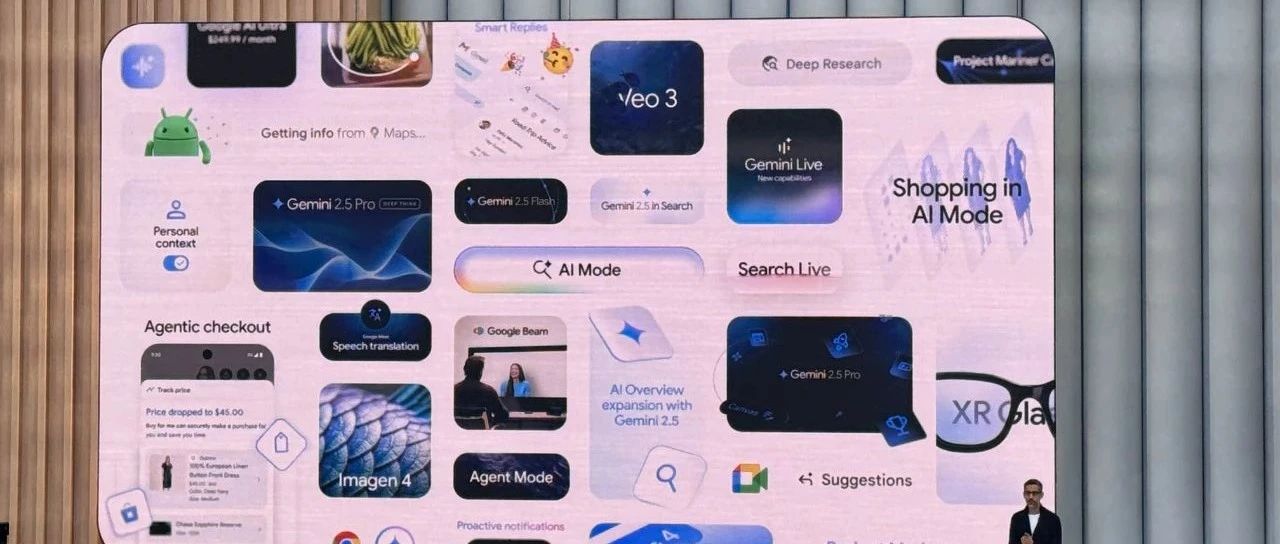
Core Insights - Google has made significant advancements in AI technology, showcasing a range of new products and features during the Google I/O developer conference, indicating a strategic shift towards integrated AI solutions [3][10][99] Group 1: AI Models - The introduction of the Google AI Ultra membership at $249.99 per month signifies a comprehensive strategy to unify various AI offerings under one subscription [6][10] - Gemini 2.5 Pro emerged as a standout model, outperforming competitors in all LMArena categories, particularly excelling in language, reasoning, and coding tasks [15][21] - Gemini 2.5 Flash is positioned as a speed-focused model, set to launch in June, with improvements across multiple dimensions [19][20] - Gemini 2.5 Pro Deep Think enhances the capabilities of the Pro model, particularly in complex mathematical and programming benchmarks [21][24] - Gemini Diffusion represents a cutting-edge research initiative, utilizing a novel approach to content generation that significantly reduces latency [26][28] Group 2: Gemini Products - Gemini Live integrates multimodal interaction, allowing users to engage with AI through visual inputs, with a new visual question-answering feature launching on Android and iOS [30][31] - The Personal Context feature personalizes user interactions by accessing data from Google applications, enhancing the relevance of AI responses [34][36] - DeepResearch and Canvas upgrades allow users to upload files for in-depth research and convert reports into various formats, including web pages and podcasts [38][39] - Gemini's integration into Chrome enables real-time content understanding and summarization while browsing [41] - The introduction of Agent Mode allows users to delegate tasks to AI, streamlining processes like house hunting [43][44] Group 3: Visual Generation - Flow, a new AI film production tool, combines capabilities from various Google models to create and edit videos based on user prompts [46][48] - Veo 3 enhances video realism with native audio generation, allowing for synchronized sound effects and dialogue [53][55] - Imagen 4, the latest text-to-image model, boasts significant improvements in image quality and detail, now available for general use [60][64] Group 4: Google Search Enhancements - AI Overviews have been adopted by over 1.5 billion users monthly, improving search result relevance and user engagement [67][68] - AI Mode represents a transformative shift in search functionality, enabling complex queries and personalized results based on user data [70][72] Group 5: Agent Systems - Project Mariner, an AI-driven automation tool, has advanced to handle multiple tasks simultaneously and learn from user demonstrations [76][80] - Jules, an AI programming agent, is currently in global testing, allowing users to automate code management tasks [81][82] Group 6: Other Innovations - The Project Moohan headset and Android XR smart glasses showcase advancements in augmented reality, enhancing user interaction with their environment [89][91] - Google Beam technology enables realistic 3D video calls, enhancing remote communication experiences [93][95] - The upgraded SynthID digital watermarking technology addresses challenges in identifying AI-generated content [98]
DeepSeek们越来越聪明,却也越来越不听话了。
数字生命卡兹克· 2025-05-19 20:14
Core Viewpoint - The article discusses the paradox of advanced AI models, where increased reasoning capabilities lead to a decline in their ability to follow instructions accurately, as evidenced by recent research findings [1][3][10]. Group 1: Research Findings - A study titled "When Thinking Fails: The Pitfalls of Reasoning for Instruction-Following in LLMs" reveals that when models engage in reasoning, they often fail to adhere to given instructions [2][3]. - The research team from Harvard, Amazon, and NYU conducted tests on 15 models, finding that 13 out of 14 models showed decreased accuracy when using Chain-of-Thought (CoT) reasoning in simple tasks [4][6]. - In complex tasks, all models tested exhibited a decline in performance when employing CoT reasoning [4][6]. Group 2: Performance Metrics - In the IFEval test, models like GPT-4o-mini and Claude-3.5 experienced significant drops in accuracy when using CoT, with GPT-4o-mini's accuracy falling from 82.6% to 76.9% [5]. - The results from ComplexBench also indicated a consistent decline across all models when CoT was applied, highlighting the detrimental impact of reasoning on task execution [4][6]. Group 3: Observed Behavior Changes - The models, while appearing smarter, became more prone to disregarding explicit instructions, often modifying or adding information that was not requested [9][10]. - This behavior is attributed to a decrease in "Constraint Attention," where models fail to focus on critical task constraints when reasoning is involved [10]. Group 4: Proposed Solutions - The article outlines four potential methods to mitigate the decline in instruction-following accuracy: 1. **Few-Shot Learning**: Providing examples to the model, though this has limited effectiveness due to input length and bias [11][12]. 2. **Self-Reflection**: Allowing models to review their outputs, which works well for larger models but poorly for smaller ones [13]. 3. **Self-Selective Reasoning**: Enabling models to determine when reasoning is necessary, resulting in high recall but low precision [14]. 4. **Classifier-Selective Reasoning**: Training a smaller model to decide when to use CoT, which has shown significant improvements in accuracy [15][17]. Group 5: Insights on Intelligence - The article emphasizes that true intelligence lies in the ability to focus attention on critical aspects of a task rather than processing every detail [20][22]. - It suggests that AI should be designed to prioritize key elements of tasks, akin to how humans effectively manage their focus during critical moments [26][27].

HDRimg,30秒一键生成亮瞎眼的HDR表情包。
数字生命卡兹克· 2025-05-18 19:27
| | 7 HDR vs SDR 技术参数对比 (通俗版) | | | --- | --- | --- | | 对比维度 | SDR (Standard Dynamic Range) | HDR (High Dynamic Range) | | 亮度范围 | 最高大约 100~300 尼特 | 可达到 1000~2000+ 尼特甚至更高 | | 色域范围 | sRGB (标准红绿蓝) | DCI-P3 / BT.2020 (更广的色彩) | | 对比度 | 约 1,000:1 | 约 1,000,000:1 (部分HDR设备) | | 色彩深度 | 8-bit (每种颜色256个等级) | 通常为 10-bit (每种颜色1024等级) | | 细节表现 | 高光易"糊"、暗部易"黑成一团" | 高光不过曝、暗部保细节 | | 视觉感受 | 画面平淡,像照片 | 圈面通透,有立体感,像"真实现场" | | 应用范围 | 传统电视、网页图片、普通视频 | 高端手机、4K电视、流媒体视频、PS5游戏等 | | 编码标准 | Rec.709 | Rec.2020、HDR10、Dolby Vision 等 | 而这次 ...

这才是现在最强的AI声音模型。
数字生命卡兹克· 2025-05-15 15:40
几个月前,我写过一篇MiniMax的AI声音模型。 我说,那就是当时最强的中文AI音频。数据也有点小爆。 而在去年12月之后,至今将近半年时间,在AI声音模型这块,我觉得还是没有能超越MiniMax的。 直到昨天,我看到 MiniMax在X上发了他们新一代声音模型的技术报告,Speech-02来了。看来想突破Speech-01的上限,还是得他们自己。 | MiniMax (official) & | ... | | --- | --- | | @MiniMax AI | | | | Language | WER J | | SIM ↑ | | | --- | --- | --- | --- | --- | --- | | | | MiniMax | 11LABS | MiniMax | 11LABS | | | Chinese | 2.252 | 16.026 | 0.780 | 0.677 | | | English | 2.164 | 2.339 | 0.756 | 0.613 | | | Cantonese | 34.111 | 51.513 | 0.778 | 0.670 | | | Japanese ...

今天我替煤炭给AI正个名。。。
数字生命卡兹克· 2025-05-14 20:05
Core Viewpoint - The article critiques the quality of industry research reports, particularly highlighting a specific report on coal that mistakenly references a video game, illustrating a broader issue of poor research practices in the industry [1][6][9]. Group 1: Quality of Research Reports - A research report priced at 8200 yuan incorrectly states that coal is a renewable resource and references a video game for its data [1][6]. - The report's content reflects a common practice in the industry where reports are hastily compiled through copying and pasting without proper verification [12][13]. - The prevalence of low-quality reports has led to a situation where many professionals rely on these flawed documents for decision-making, rather than conducting thorough research [17][18]. Group 2: Role of AI in Research - The article argues that the blame for poor-quality reports is often misplaced on AI, while the actual issue stems from human negligence in research practices [7][9]. - AI has exposed the superficiality of many reports, revealing that what was once considered professional may just be a facade [15][18]. - The emergence of AI-generated content has prompted a reevaluation of what constitutes true professionalism in research and reporting [15][18]. Group 3: Professionalism in Research - True professionalism is defined as a commitment to information quality, thorough verification, and the ability to communicate clearly [17][18]. - The article emphasizes that professionalism should not be based on superficial attributes like formatting or jargon, but rather on the integrity and accuracy of the content [17][18]. - There is a call for a cultural shift in how the industry perceives and values research, moving away from reliance on poorly constructed reports [17][18].