
Beijing (833429)

Search documents
康比特完成首次股份回购,近期股价震荡偏弱
Jing Ji Guan Cha Wang· 2026-02-12 03:04
Group 1 - The core viewpoint of the article is that Kangbiter (920429.BJ) has completed its first share buyback to instill market confidence amid weak stock performance influenced by market sentiment and sector adjustments [1][2]. Group 2 - In the past week, the main highlight for Kangbiter has been its share buyback action, where on February 10, 2026, the company announced the completion of its first buyback, acquiring 51,000 shares, which represents 0.04% of the total share capital, for a total amount of approximately 785,400 yuan, with a maximum transaction price of 15.43 yuan per share and a minimum of 15.36 yuan per share [2]. Group 3 - The recent stock performance of Kangbiter has shown a weak and volatile trend, consistent with the overall performance of the food and beverage sector. As of February 12, 2026, the closing price was 15.20 yuan, reflecting a cumulative decline of 1.68% over the past five days, with a price fluctuation range of 4.84%. On the day of the buyback announcement, February 10, the stock price fell by 0.71%, with a trading volume of approximately 13.26 million yuan and a turnover rate of 0.76%. During the same period, the food and beverage sector index decreased by 2.90%, indicating that the company's stock price volatility is primarily driven by market sentiment and sector-wide adjustments [3].
康比特:首次回购公司股份51000股
Zheng Quan Ri Bao Wang· 2026-02-10 13:09
Core Viewpoint - The company completed its first share buyback on February 10, 2026, utilizing its own funds to repurchase shares through a continuous bidding transfer method [1] Group 1: Buyback Details - The company repurchased a total of 51,000 shares, which represents 0.04% of the total share capital [1] - This amount constitutes 2.55% of the estimated total buyback quantity limit [1] - The highest transaction price was 15.43 yuan per share, while the lowest was 15.36 yuan per share [1] - The total amount paid for the buyback was 785,449.84 yuan, excluding transaction fees such as stamp duty and commission [1] - This expenditure accounts for 1.57% of the total buyback fund limit [1] Group 2: Implementation Status - As of the current date, the implementation status of the buyback aligns with the proposed share repurchase plan [1]
晚间公告|2月10日这些公告有看头
Di Yi Cai Jing· 2026-02-10 10:15
Group 1 - Baichuan Co., Ltd. announced that recent price increases of some main products are influenced by market supply and demand, but the sustainability of these price fluctuations is uncertain, making it difficult to predict the impact on company performance [2] - Jincheng Co., Ltd. plans to acquire an additional 42.5% stake in CMH Company, adjusting the payment terms to a fixed cash amount of $128 million, which will increase its ownership to 97.5% if the transaction is completed [3] - Runtou Co., Ltd. reported that the sustainability of price fluctuations in disperse dyes is uncertain, making it difficult to estimate the impact on company performance, despite recent price increases [4] Group 2 - Zhongtung High-tech announced a project to implement an additional 30 million PCB drill rods per year with an investment of 145 million yuan, aiming to expand market share and secure raw material needs [5] - ST Xinhua Jin indicated that if it fails to recover approximately 406 million yuan in occupied funds within six months, it may face stock suspension and potential delisting [6] - Lian De Co., Ltd. stated that its gas turbine business currently only generates limited revenue, accounting for less than 1% of total revenue, thus having a minimal impact on overall performance [7] Group 3 - Xinhang New Materials plans to raise up to 1 billion yuan through a private placement to fund projects related to high-performance resins and composite materials [8] - Changfei Optical Fiber noted that its products for data centers currently represent a small portion of global market demand, and the impact of price fluctuations on future performance will depend on market conditions [9] Group 4 - SMIC reported a net profit of 1.223 billion yuan for Q4 2025, a 23.2% increase year-on-year, driven by increased wafer sales and improved capacity utilization [11] - CITIC Securities announced that its subsidiary, Huaxia Fund, achieved a net profit of 2.396 billion yuan in 2025 [12] - Xinzhou Bang reported a net profit of 1.098 billion yuan for 2025, a 16.56% increase year-on-year, attributed to improved sales and operational efficiency [13] Group 5 - Youyan Silicon reported a net profit decline of 10.14% for 2025, with total revenue of 1.005 billion yuan, primarily due to increased investment losses and higher share-based payment expenses [14] - Kangbiter completed its first share buyback, acquiring 51,000 shares for a total of 785,400 yuan [15] - Linyang Energy announced its first share buyback of 8.35 million shares, totaling 52.325 million yuan [16] Group 6 - Hanwei Technology's shareholder plans to reduce its stake by up to 1.8639% due to personal funding needs [19] - Jiuzhitang's major shareholder reduced its stake by 1.02%, following a pre-planned reduction strategy [20] Group 7 - China State Construction signed new contracts worth 399.5 billion yuan in January 2026, reflecting a 1.8% year-on-year increase [21] - Senyuan Electric is expected to win a bid for a project worth 272 million yuan from the Southern Power Grid [22] - Jinguang Electric announced a successful bid for a project worth approximately 28.87 million yuan from the Southern Power Grid [23]





康比特:首次回购0.04%公司股份
Jin Rong Jie· 2026-02-10 09:40
Core Viewpoint - The company completed its first share buyback on February 10, 2026, utilizing its own funds to repurchase shares through a continuous bidding transfer method [1] Group 1: Buyback Details - The company repurchased a total of 51,000 shares, which represents 0.04% of the total share capital [1] - This buyback accounts for 2.55% of the anticipated total buyback quantity [1] - The highest transaction price was 15.43 yuan per share, while the lowest was 15.36 yuan per share [1] - The total amount paid for the buyback was 785,400 yuan, excluding transaction fees such as stamp duty and commissions [1] - This amount represents 1.57% of the company's planned total buyback fund limit [1]
食品加工板块1月22日涨0.41%,交大昂立领涨,主力资金净流出2882.63万元
Zheng Xing Xing Ye Ri Bao· 2026-01-22 09:01
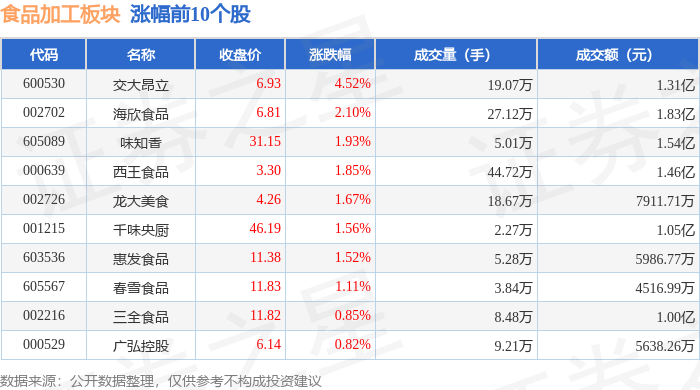
Group 1 - The food processing sector increased by 0.41% on January 22, with Jiaoda Onlly leading the gains [1] - The Shanghai Composite Index closed at 4122.58, up 0.14%, while the Shenzhen Component Index closed at 14327.05, up 0.5% [1] - Key stocks in the food processing sector showed various performance, with Jiaoda Onlly closing at 6.93, up 4.52%, and Hai Xin Food at 6.81, up 2.10% [1] Group 2 - The food processing sector experienced a net outflow of 28.83 million yuan from main funds, while retail investors saw a net inflow of 51.78 million yuan [2] - The trading volume and turnover for key stocks varied, with Jiaoda Onlly having a trading volume of 190,700 shares and a turnover of 131 million yuan [1][2] - The stock performance of several companies showed mixed results, with some stocks like ST Chuntian and Xianle Health declining by 1.39% and 1.27% respectively [2] Group 3 - Main fund inflows were observed in stocks like Jiaoda Onlly with a net inflow of 14.38 million yuan, while retail investors showed a net inflow of 11.80 million yuan [3] - Stocks such as Shuanghui Development and Jinzi Ham also saw significant main fund inflows of 11.39 million yuan and 10.64 million yuan respectively [3] - The overall sentiment in the food processing sector appears mixed, with some stocks attracting retail interest despite main fund outflows [3]


趋势研判!2026年中国营养功能食品合同生产行业壁垒、政策、市场规模、细分格局、竞争格局及发展趋势:市场将持续扩容,健康零食占比最大[图]
Chan Ye Xin Xi Wang· 2026-01-21 01:27
Core Insights - The nutritional functional food industry is experiencing significant growth driven by national policies, increased health awareness, and rising living standards. The market is projected to reach 288 billion yuan by 2025 and 328 billion yuan by 2026 [1][5]. Industry Overview - Nutritional functional foods are defined as foods that contain ingredients beneficial to human health, excluding health foods that require special approval. This category includes special dietary foods and regular packaged foods [2][3]. - The industry is characterized by a diverse range of products and applications, with health snacks being the largest segment, followed by gut health, beauty nutrition, weight management, and sports nutrition [1][5]. Market Size and Growth - The market size for nutritional functional foods in China is expected to grow from 144 billion yuan in 2019 to 288 billion yuan in 2025, with a further increase to 328 billion yuan by 2026 [5][6]. - Specific market segments for 2025 include health snacks at 103 billion yuan (35.76%), gut health at 65 billion yuan (22.57%), beauty nutrition at 39 billion yuan (13.54%), weight management at 36 billion yuan (12.50%), and sports nutrition at 22 billion yuan (7.64%) [1][5]. Industry Structure - The industry operates on a contract manufacturing model, where one party (the client) outsources production to another party (the contractor). This model allows for specialization in production while the client focuses on marketing and brand management [3][4]. - The supply chain includes upstream raw materials such as vitamins, proteins, and minerals, while the midstream involves research, production, and marketing [6]. Competitive Landscape - The competitive landscape is fragmented, with a few leading companies dominating the market. The top five companies accounted for 17.3% of the market share in 2023, up from 13.9% in 2022 [8]. - Major players in the industry include Hengmei Health, Xianle Health, Dajiang Biotechnology, and others, each with unique advantages [7][8]. Regulatory Environment - Recent government policies, such as the "National Food and Nutrition Development Outline (2025-2030)," aim to promote the nutritional functional food industry by emphasizing innovation and quality in food production [7]. Future Trends - The demand for health-oriented products is expected to grow due to rising income levels and an aging population, creating a favorable environment for the nutritional functional food industry [8].


市场监管总局办公厅关于45批次食品抽检不合格情况的通报
Zhong Guo Zhi Liang Xin Wen Wang· 2026-01-13 07:59
Core Viewpoint - The State Administration for Market Regulation (SAMR) reported that out of 2,387 food samples tested, 45 batches were found to be non-compliant with food safety standards, indicating ongoing concerns regarding food safety in the market [2][3]. Summary by Category Non-compliant Food Products - A total of 45 batches of food products were identified as non-compliant, with specific issues related to various food safety standards [2][4]. - Examples of non-compliant products include: - Hand-made vermicelli from Shanxi Province containing non-compliant levels of food colorants [4]. - Red sugar cubes from Sichuan Province with excessive levels of sulfur dioxide [4]. - Grain liquor from Hubei Province with non-compliant levels of sweeteners [4]. - Various products sold online, including health supplements and snacks, with issues ranging from non-compliant colorants to microbial contamination [4][5][6][7][8][9][10][11][12][13][14][15][16][17]. Regulatory Actions - Provincial market regulation departments have initiated investigations and corrective actions regarding the identified non-compliant food products [3]. - The report emphasizes the importance of adhering to food safety standards to protect consumer health and maintain market integrity [2][3].
康比特:拟3000万元至5000万元回购公司股份

Jing Ji Guan Cha Wang· 2026-01-13 02:00
Group 1 - The company, Kangbiter (920429), announced a share repurchase plan amounting to between 30 million and 50 million yuan [1] - The maximum repurchase price is set at 25 yuan per share [1]
康比特:持股5%以上股东权益变动触及5%整倍数的提示性公告
Zheng Quan Ri Bao· 2026-01-08 14:16
Core Viewpoint - The announcement from Kangbiter indicates significant shareholding changes among major shareholders, with both Zhang Wei and Chen Qingyue reducing their stakes in the company, resulting in a combined ownership drop below 10% [2] Group 1: Shareholder Changes - Zhang Wei reduced his shareholding by 105,000 shares, decreasing his ownership from 8.9237% to 8.8394% [2] - Chen Qingyue reduced her shareholding by 693,800 shares, decreasing her ownership from 1.7179% to 1.1606% [2] - The combined shareholding of Zhang Wei and Chen Qingyue fell from 10.6416% to 10.0000%, triggering a change in the percentage of shares held above the 5% threshold [2]
康比特:2026年第一次临时股东会决议公告
Zheng Quan Ri Bao· 2026-01-08 14:09
Group 1 - The company, Kangbiter, announced the approval of two key resolutions at its first extraordinary general meeting of shareholders in 2026, including the repurchase and cancellation of certain restricted stocks and the adjustment of the repurchase price [2] - The second resolution involves a reduction in the company's registered capital and the corresponding amendments to its articles of association [2]