Beijing (833429)

Search documents
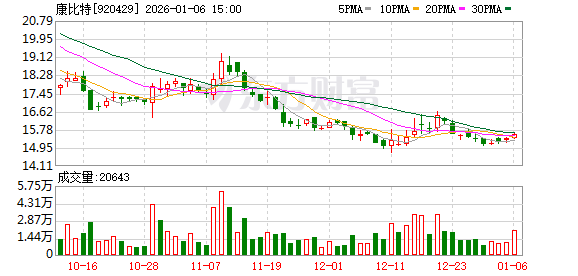
康比特:张炜、陈庆玥持股比例已降至10.00%
Mei Ri Jing Ji Xin Wen· 2026-01-08 10:35
Core Viewpoint - The announcement indicates that shareholders Zhang Wei and Chen Qingyue, due to their concerted action relationship, have reduced their stake in the company, which may signal potential future selling pressure on the stock [1] Group 1: Shareholder Actions - Zhang Wei and Chen Qingyue collectively reduced their holdings by 798,800 shares through centralized bidding from January 6 to January 7, 2026 [1] - Following the reduction, their combined ownership in the company decreased from 10.6416% to 10.00% of the total shares [1] - After the reduction, Zhang Wei and Chen Qingyue hold a total of 12.45 million shares, representing 10.00% of the total share capital [1] Group 2: Future Implications - The shareholders indicated that the reduction was based on personal funding needs and may continue to sell shares within the next twelve months [1]
康比特:关于注销募集资金专项账户的公告
Zheng Quan Ri Bao· 2026-01-06 13:11
Group 1 - The company announced the cancellation of two fundraising special accounts established at China Minsheng Bank, Beijing Fuchengmen Branch, as the funds have been fully utilized as planned [2] - The cancellation of the accounts will be completed by December 31, 2025, with the remaining interest balance of 1,116.87 yuan and 0.02 yuan transferred to the company's general bank account [2] - Following the cancellation of these accounts, the related tripartite supervision agreement with the sponsor and China Minsheng Bank will also be terminated [2]

食品加工板块1月6日涨0.15%,盖世食品领涨,主力资金净流入2284.36万元
Zheng Xing Xing Ye Ri Bao· 2026-01-06 08:56
Core Viewpoint - The food processing sector experienced a slight increase of 0.15% on January 6, with Gai Shi Food leading the gains. The Shanghai Composite Index rose by 1.5%, while the Shenzhen Component Index increased by 1.4% [1]. Group 1: Market Performance - Gai Shi Food closed at 13.85, up by 2.82%, with a trading volume of 59,000 shares and a transaction value of 81.20 million yuan [1]. - Other notable performers included Jiao Da Ang Li, which rose by 2.17% to close at 6.58, and De Li Si, which increased by 1.65% to close at 4.94 [1]. - The overall trading volume in the food processing sector showed varied performance, with significant transactions recorded for companies like Anjiu Food and Xiwang Food [1]. Group 2: Capital Flow - The food processing sector saw a net inflow of 22.84 million yuan from institutional investors, while retail investors experienced a net outflow of 15.49 million yuan [2]. - The main capital inflows were observed in companies like Anjiu Food, which had a net inflow of 39.28 million yuan, and Sanquan Food, with a net inflow of 10.55 million yuan [3]. - Conversely, companies like Xiwang Food and Tang Chen Bei Jian faced significant net outflows from retail investors, indicating a shift in investor sentiment [3].


康比特:三大股东拟减持不超249万股,占总股本2%
Zheng Quan Ri Bao Wang· 2025-12-12 07:45
Core Viewpoint - Kangbiter announced that shareholders holding more than 5% of shares, including Zhang Wei, Chen Qingyue, and Silver Hui International Limited, plan to reduce their holdings by up to 2% of the total share capital, which amounts to 2.49 million shares, within three months after the announcement [1] Summary by Categories Shareholder Actions - Major shareholders intend to reduce their holdings through centralized bidding or block trading [1] - The reduction is due to personal funding needs [1] Shareholding Details - The total shares to be reduced represent 2% of the total share capital [1] - The shares being sold were acquired before the listing on the Beijing Stock Exchange [1]
【前瞻分析】2025年中国轻食企业融资轮次及行业发展趋势分析
Sou Hu Cai Jing· 2025-12-02 11:08
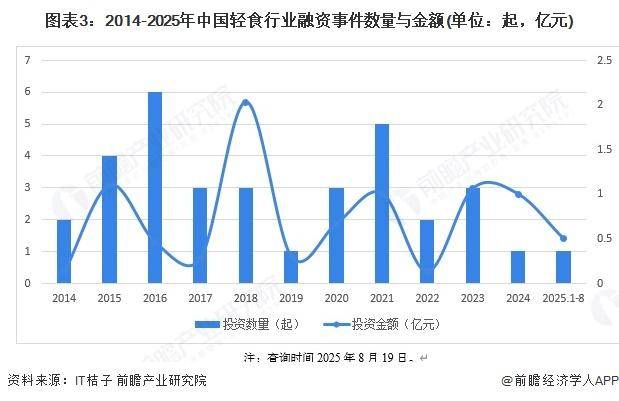
Financing Scale Analysis - From 2014 to August 2025, the financing events and amounts in China's light food industry showed fluctuations, with a total of 34 events. The highest number of events occurred in 2016 (6 events), while 2019, 2024, and January-August 2025 had the least (1 event each). Overall, there was no significant upward or downward trend in the number of events [1] - The total financing amount reached 867 million yuan, with the highest amount in 2018 (203 million yuan) and the lowest in 2014 and 2022 (both 13 million yuan) [1] Mergers and Acquisitions - The current number of mergers and acquisitions in China's light food sector is very limited, with a notable event on September 20, 2022, when Anhong Capital announced the acquisition of 60% of Wagas from its founder, who will continue to manage daily operations. This collaboration aims to expand market presence and strengthen brand development, including product supply and menu research, as well as operational infrastructure [2] Industry Distribution - The distribution of enterprises in the light food industry is concentrated in economically developed regions with active consumer markets and well-established industrial chains, covering both domestic and international capital market listed entities [4] Industry Development History - The light food concept officially entered the Chinese market in 2013, gradually gaining public awareness and understanding. From 2015 to 2017, the industry experienced a critical phase of concentrated capital investment, leading to rapid growth. However, from 2018 to 2019, the industry faced a deep reshuffling period due to immature development models and market regulations, resulting in accelerated capital withdrawal and slowed growth [5][8] - Since 2020, the light food industry has entered a new development phase, driven by a significant increase in the number of supply-side enterprises and a shift in consumer dietary habits towards healthier and lighter options due to the pandemic. This dual push has led to unprecedented attention on the industry [5][8] Industry Development Stages - Brand Incubation (2013-2014): Light food began to enter the Chinese market, with initial consumer exposure [8] - Capital Intensive Investment Period (2015-2017): The industry saw a surge in capital investment, leading to rapid development [8] - Cooling Period (2018-2019): The industry faced a reshuffling phase due to immature development, resulting in quick capital withdrawal [8] - Rising Attention Period (2020-Present): The industry has regained momentum with a rapid increase in supply-side enterprises and changing consumer habits, leading to unprecedented focus [8]



近一个月超140只个股评级调整食品饮料行业上调最多
Zhong Guo Zheng Quan Bao· 2025-11-21 20:09
Core Viewpoint - The A-share market is experiencing a notable shift towards stock selection and sector rotation, with over 50 stocks upgraded and more than 90 downgraded in ratings, indicating a more cautious market sentiment and a focus on structural opportunities in technology, consumption, and dividend sectors [1][2][3]. Stock Rating Adjustments - Over the past month, 52 stocks have been upgraded, with the food and beverage sector having the highest number of upgrades at 7 stocks, followed by electronics and power equipment with 5 each, and pharmaceuticals and light industry with 4 each [1]. - Conversely, 92 stocks have been downgraded across 25 industries, with the automotive sector leading with 12 downgrades, followed by food and beverage with 10, and basic chemicals with 9 [2][3]. Sector Analysis - In the food and beverage sector, several companies such as Baba Foods and Ximai Foods have seen their ratings upgraded due to improved revenue growth and store efficiency [2]. - The electronics sector is expected to benefit from a recovery in terminal demand, with companies like Crystal Technology and Green Link Technology receiving upgrades [2]. - The automotive sector has faced downgrades due to short-term performance pressures, with companies like Meihu and New Spring seeing their ratings lowered [3]. Market Trends and Strategies - Analysts suggest that the market is moving towards a balanced style, with a preference for large-cap stocks and a potential shift towards value stocks [4]. - The focus on growth stocks remains, but the key is whether the underlying valuation logic changes, which could drive future performance [4]. - Investment opportunities are seen in themes such as anti-involution and dividend stocks, with a particular emphasis on technology sectors that align with national strategies and possess real technological barriers [5].



【前瞻分析】2025年中国轻食行业区域竞争及上市企业对比分析
Sou Hu Cai Jing· 2025-10-30 08:35
Group 1: Industry Overview - The Chinese light food industry is characterized by a competitive landscape concentrated in economically developed regions with active consumer markets and well-established supply chains [1] - Major listed companies in the light food sector include Nayuki Tea (02150.HK), Three Squirrels (300783.SZ), and others [1] Group 2: Brand Rankings - The top ten brands in the "2025 CNPP Weight Loss Meal Brand List" include Wagas, gaga Fresh Language, and others, indicating a diverse range of offerings in the light food market [3] - The popularity ranking of weight loss meal brands highlights the competitive positioning of various companies, with Wagas and gaga Fresh Language being notable mentions [4][5] Group 3: Company Profiles - Wagas, founded in 1999, is a pioneer in the light food industry, focusing on healthy eating with over 100 stores across major cities [4] - gaga Fresh Language, established in 2010, emphasizes a combination of food and social space, with over 100 locations primarily in first-tier cities [4] - Super Bowl FOODBOWL, launched in 2015, offers a self-service model catering to urban consumers, with a presence in major cities [5] Group 4: Sales Channels - Nayuki Tea has a balanced sales strategy with over 30 dedicated light food stores and a significant number of offline and online outlets [7][8] - Three Squirrels primarily focuses on online sales, while other companies like Liuyuan and KEEP also emphasize online channels [7][8] - Companies like Nayuki Tea and Good Products have a balanced approach, utilizing both online and offline sales channels effectively [7][8] Group 5: Financial Comparison - The light food industry shows significant variation in company performance, with Nongfu Spring leading in revenue at 42.896 billion yuan for 2024, while Baihe shares reported the lowest at 800 million yuan [6]
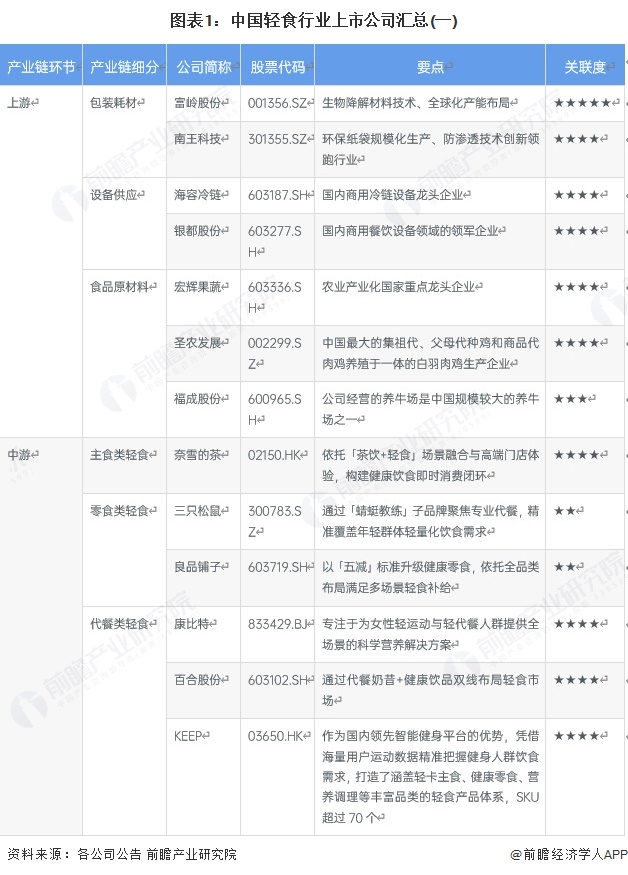
【干货】轻食产业链全景梳理及区域热力地图
Qian Zhan Wang· 2025-10-22 07:38
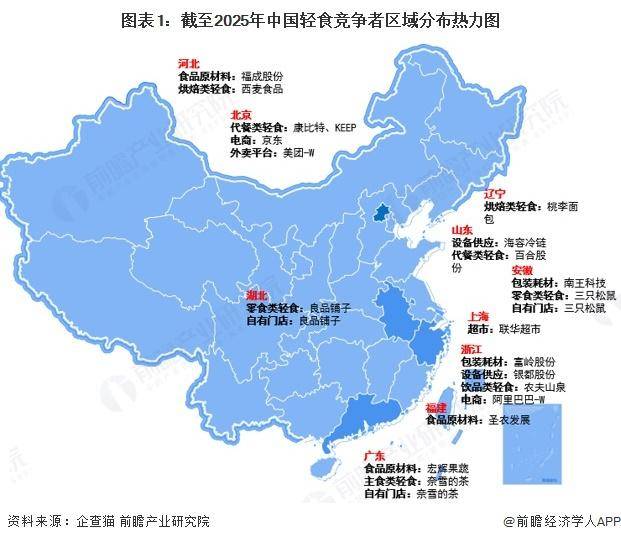
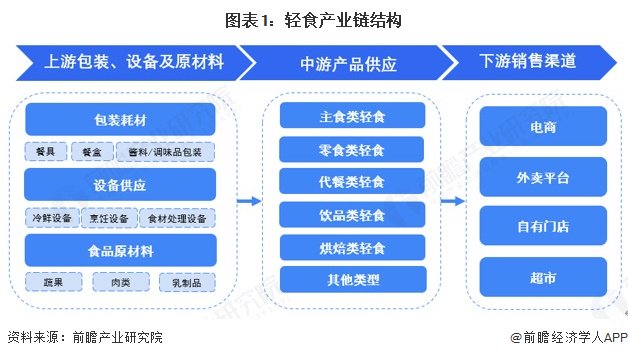
Core Insights - The light food industry is characterized by a well-defined supply chain, with upstream suppliers focusing on packaging, equipment, and raw materials, while the midstream includes various light food products, and downstream sales channels encompass e-commerce, delivery platforms, and physical stores [1][2]. Industry Overview - The upstream of the light food industry includes suppliers such as 富岭股份, 南王科技, 海容冷链, and others, providing packaging, equipment, and raw materials [2]. - The midstream features key players like 奈雪的茶, 三只松鼠, and 良品铺子, which supply a range of light food products [2]. - The industry is concentrated in economically developed regions of China, where consumer markets are active and the supply chain is well-supported [4]. Company Performance - In 2024, 奈雪的茶 is expected to have significant sales of light food products with a strong cost-performance ratio, while 三只松鼠's sub-brand is seeing impressive single product sales [7]. - 康比特's sports nutrition packages are performing well in terms of sales and repurchase rates, and 西麦食品 leads in market share for instant oatmeal on Douyin [7]. Recent Developments - In 2025, 奈雪的茶 launched the "No Sugar Natural Nutrition+" initiative, introducing new light food products and establishing over 30 "奈雪 Green" light food stores in major cities [9]. - 三只松鼠 introduced a low-fat, high-protein meal replacement snack, while 良品铺子 launched a non-fried, reduced-fat crispy biscuit [9]. - 百合股份 targeted women with new product lines, and KEEP initiated collaborations to promote a "food and exercise" approach [9].
毒株与去年不同,流感季或提前!抗流感概念异动拉升
Di Yi Cai Jing· 2025-10-21 03:55
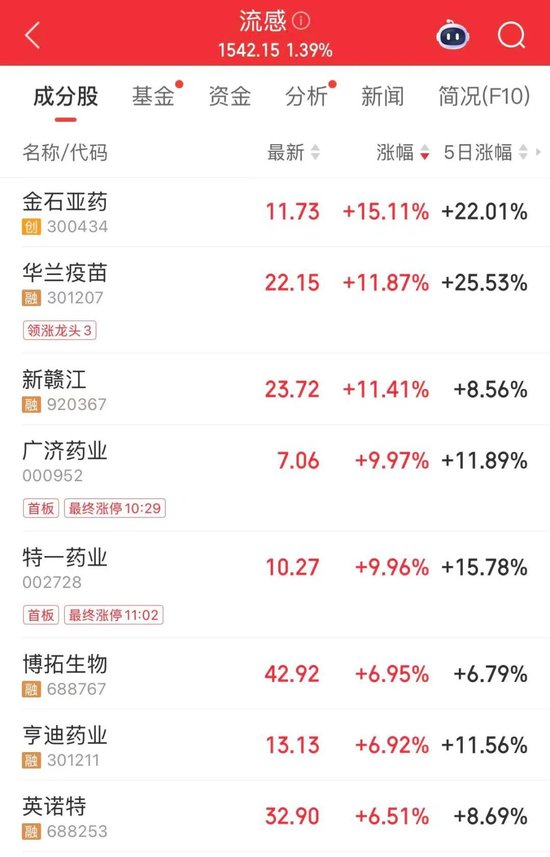
Group 1 - The core viewpoint of the article highlights a significant rise in flu-related stocks, with companies like Te Yi Pharmaceutical hitting the daily limit, and others like Jinshi Yao, Hualan Vaccine, and Xin Ganjing seeing increases of over 10% [1][2] - The flu activity in southern China is on the rise, with experts predicting an earlier flu season this year compared to last, and the circulating strain being different from the previous year [2][3] - The predominant strain this year is H3N2, which may lead to lower immunity in the population compared to last year's H1N1 strain, necessitating increased attention [4][5] Group 2 - Vaccination is emphasized as the most effective method to prevent flu and reduce severe cases, with recommendations for vaccination between September and November to ensure effective immunity before peak season [6][7] - The article discusses the differences between trivalent and quadrivalent flu vaccines, noting that while quadrivalent vaccines cover an additional strain, the practical difference in effectiveness is minimal [10] - High-risk groups, including children under 5, the elderly over 65, pregnant women, and those with chronic health conditions, are advised to prioritize flu vaccination [12]



【最全】2025年中国轻食行业上市企业全方位对比(附业务布局汇总、业绩对比、业务规划等)
Qian Zhan Wang· 2025-09-28 07:40
Core Insights - The article discusses the current landscape of the light food industry in China, highlighting the limited number of publicly listed companies and their cross-industry expansions into the light food sector [1][6]. Group 1: Overview of Listed Companies - The light food industry has few listed companies, with many being cross-industry brands such as Nayuki Tea, Three Squirrels, and others venturing into the light food market [1]. - Key players include Nayuki Tea (02150.HK), Three Squirrels (300783.SZ), and others, each focusing on different segments of the light food market [1][2]. Group 2: Company Profiles and Financials - Nayuki Tea is projected to generate 49.2 billion yuan in revenue in 2024, focusing on a health-oriented dining experience [4]. - Three Squirrels is expected to achieve 106.2 billion yuan in revenue, targeting the casual snack market with its sub-brands [4]. - Farmer Spring leads with 428.96 billion yuan in revenue, while Baihe Co. has the lowest at 8.01 billion yuan [8]. Group 3: Business Strategies and Market Positioning - Nayuki Tea and KEEP target young professionals and fitness enthusiasts, offering specialized stores and meal options to meet all-day light food needs [9][10]. - Three Squirrels and Liangpinpuzi focus on low-calorie snacks for the general health-conscious market, while West Oats and Taoli Bread cater to fitness consumers with nutritious and convenient food options [9][10]. - Companies like Kangbiter and Baihe Co. provide products aimed at sports enthusiasts, focusing on body management and post-exercise nutrition [9][10]. Group 4: Sales Channels and Performance - Nayuki Tea operates a balanced online and offline sales strategy, with over 1,453 stores and a significant presence on delivery platforms [11]. - Three Squirrels primarily focuses on online sales, while companies like Taoli Bread and Farmer Spring rely more on offline channels [11]. - In 2024, Nayuki Tea's energy bowl packages are expected to sell over 29.2 million units, showcasing strong market demand [12][13]. Group 5: Future Plans and Innovations - Companies are planning to expand their light food offerings through new store formats, product innovations, and enhanced distribution channels [15]. - Nayuki Tea plans to launch a new store type, "Nayuki Green," focusing on low-calorie and healthy options for urban consumers [10].