
HSBC HOLDINGS(00005)

Search documents
8点1氪丨小米通报两起汽车起火事件;嫣然基金会已筹款超2300万;信用卡分期还款能享受财政贴息
3 6 Ke· 2026-01-21 00:03
Group 1 - Xiaomi reported two incidents of car fires involving its vehicles, with no injuries reported. The first incident occurred in Haikou, where a vehicle caught fire shortly after being parked, and the second incident involved a collision in Henan, which also resulted in a fire after the vehicle was safely pulled over [1][2][3] - Gree Electric plans to mass-produce silicon carbide chips for automotive applications, with the CEO stating that half of the chips used by GAC Group in the future will be supplied by Gree [5][6] - The Renminbi cash payment regulations will take effect on February 1, 2026, prohibiting the refusal of cash payments and allowing the public to report discriminatory practices against cash [8][9] Group 2 - The personal consumption loan subsidy policy has been extended until the end of 2026, with credit card installment payments now included in the subsidy program [2][3] - The charity organization, Yanyuan Foundation, has raised over 23 million yuan for medical assistance to patients, with funds being allocated based on donor specifications [2] - HSBC's market value is approaching 300 billion pounds, with expectations of significant stock price increases [11]





汇丰警告:日元结构性疲软难有“速效药” 年中前将跌至1美元兑160日元
智通财经网· 2026-01-20 23:53
Core Viewpoint - Japanese Prime Minister Fumio Kishida announced the dissolution of the House of Representatives on January 23, with early elections scheduled for February 8, emphasizing the need for bold investment in risk management and a departure from excessive tightening [1] Group 1: Economic Policies and Market Reactions - Kishida's administration is characterized by expansionary fiscal and monetary policies, raising concerns about rapid government spending and the resurgence of inflation [1] - The traditional correlation between the yen and U.S. Treasury yields is breaking down, prompting HSBC strategists to revise their forecasts for the yen's performance in the coming months [1] - Since early October, the yen has depreciated approximately 7% against the dollar, despite a narrowing yield gap of nearly 60 basis points between Japanese and U.S. 10-year bonds [1] Group 2: Currency Dynamics and Predictions - HSBC strategists noted a "wedge difference" reflecting an expanded "risk premium" for the yen, driven by concerns over debt monetization, declining purchasing power, and persistent inflation with negative real interest rates [1] - The recent sell-off in Japanese government bonds has led to a spike in yields, prompting calls for market participants to remain calm from Japan's Finance Minister [4] - HSBC now predicts the yen will depreciate to around 160 yen per dollar by mid-year, a shift from previous expectations of strengthening to 150 yen per dollar [4] Group 3: Potential Factors Influencing the Yen - Factors that could potentially prevent further short-term depreciation of the yen include a slowdown in the U.S. economy, positive real yields on Japanese bonds, credible fiscal consolidation plans, and checks on aggressive fiscal expansion within the parliament [5][6] - The Bank of Japan's upcoming interest rate decision is expected to maintain the current benchmark rate, which may not provide direct support for the yen [6] Group 4: Government Intervention and Market Sentiment - Traders are on high alert for potential intervention by Japanese authorities if the yen continues to weaken, especially as it approaches critical levels [7] - Japan's Finance Minister indicated that all options, including direct market intervention, are on the table to address excessive volatility [7] - The upcoming press conference by Bank of Japan Governor Kazuo Ueda is anticipated to provide insights into the central bank's stance amid the yen's depreciation [8]


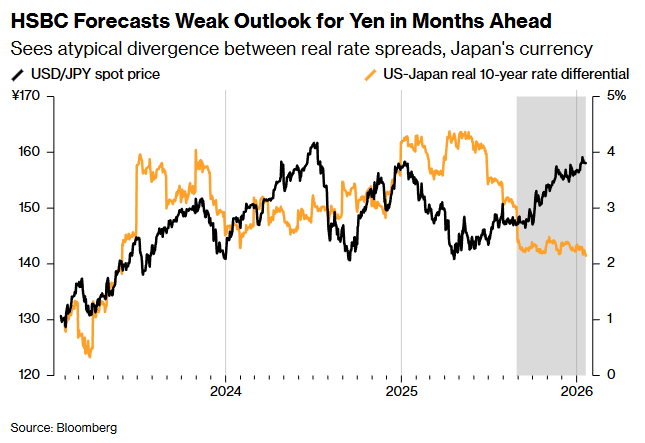
汇丰大幅调整日元预测:从看涨150转向看跌160 传统利率关联失效
Xin Hua Cai Jing· 2026-01-20 23:02
Core Viewpoint - The market's concerns over Japan's significant increase in government spending and the resurgence of inflation are leading to a breakdown in the traditional correlation between the yen and the dollar, prompting HSBC strategists to revise their forecasts for the yen's trajectory in the coming months [1] Group 1: Economic Factors - Two catalysts for the "sudden revaluation" of the yen are identified: the substantial rise in Japanese inflation that began in 2022 and the ascension of Prime Minister Kishi Matsumoto in October [1] - HSBC now predicts that the yen will fall to 160 yen per dollar by mid-year, contrary to previous expectations of strengthening to 150 yen [1] Group 2: Market Dynamics - The complexity of the situation is highlighted by the potential for Japanese authorities to intervene in the foreign exchange market if the yen falls below 160 [1] - Several potential factors that could halt the yen's recent decline are noted, with the most feasible being an economic slowdown in the United States, which is beyond the control of Japanese policymakers [1]
智通ADR统计 | 1月21日
智通财经网· 2026-01-20 22:29
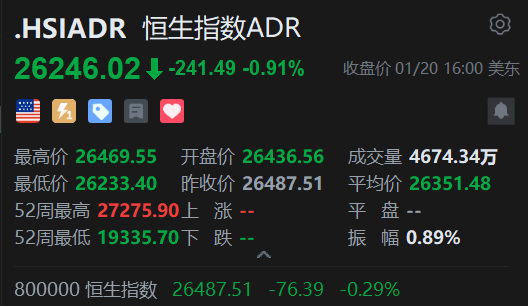
Market Overview - The Hang Seng Index closed at 26,246.02, down by 241.49 points or 0.91% [1] - The index reached a high of 26,469.55 and a low of 26,233.40 during the trading session [1] - The average price for the day was 26,351.48, with a trading volume of 46.7434 million [1] Major Blue-Chip Stocks Performance - HSBC Holdings closed at HKD 128.682, up by 0.22% compared to the Hong Kong close [2] - Tencent Holdings closed at HKD 593.183, down by 1.30% compared to the Hong Kong close [2] - Alibaba Group (W) closed at HKD 159.700, down by 0.44% [3] - Xiaomi Group (W) closed at HKD 35.480, down by 2.74% [3] - Meituan (W) closed at HKD 97.350, down by 1.17% [3] Stock Price Changes - Tencent Holdings saw a decrease of HKD 9.000, or 1.48% [3] - HSBC Holdings increased by HKD 1.400, or 1.10% [3] - China Ping An rose by HKD 0.600, or 0.88% [3] - BYD Company experienced a decline of HKD 3.700, or 3.67% [3] - Kuaishou Technology (W) fell by HKD 0.700, or 0.91% [3]





從港股Podcast觀點看匯豐:為何需警惕短期高槓桿衍生品的“時間值陷阱”?
Ge Long Hui· 2026-01-20 14:29
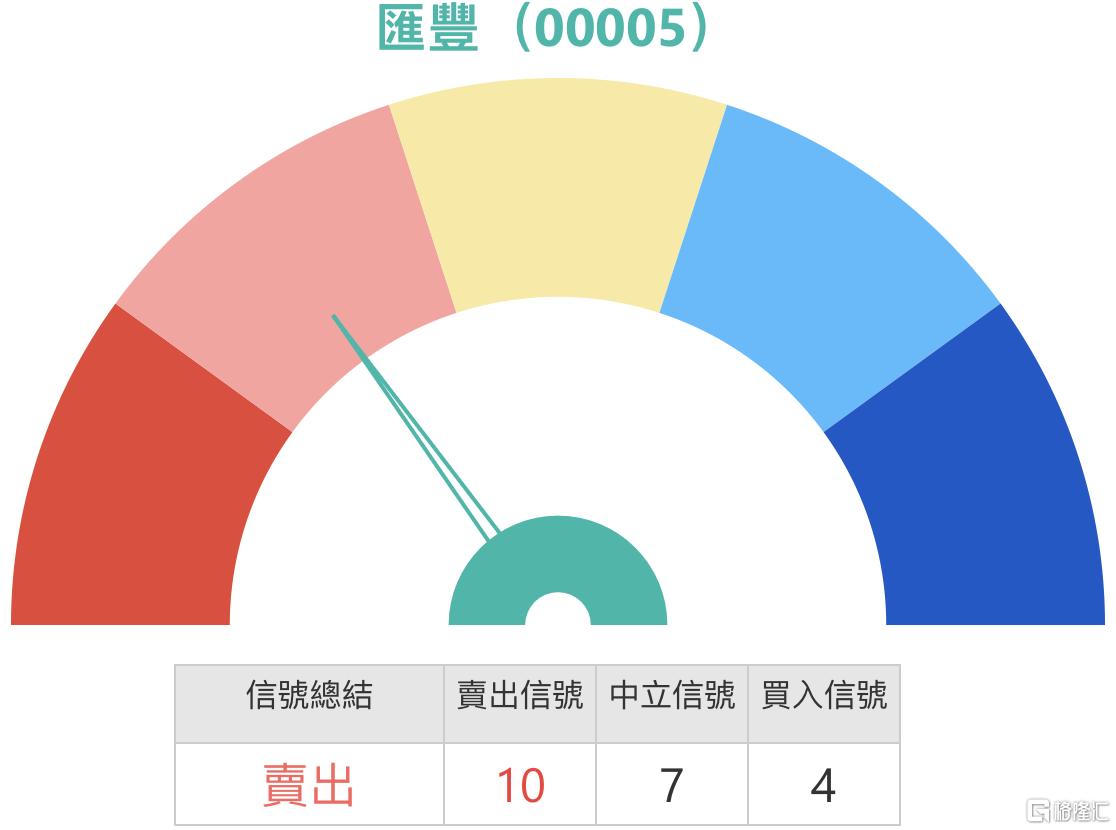
Core Viewpoint - HSBC Holdings (00005.HK) has entered a critical adjustment and consolidation phase after reaching a peak price of approximately 130 HKD, with the market cautiously evaluating the tension between short-term technical trends and long-term fundamental value [1]. Technical Analysis - HSBC's stock price failed to maintain its upward momentum after hitting around 130 HKD in early January, adjusting to close at 127 HKD on January 19, indicating a pessimistic short-term outlook [1]. - The stock is currently testing key technical support levels, with the 10-day moving average at approximately 124.29 HKD and the 50-day moving average at 113.58 HKD, suggesting a weakening short-term upward momentum [1]. - Divergent market signals increase uncertainty in the short-term trend, with the Relative Strength Index (RSI-14) at 63, indicating a strong area but showing a decline from its peak [3]. - The first critical support level is at 123.1 HKD, while a stronger second support level is between 118-118.9 HKD, which is significant for technical analysis [3]. Derivative Products Review and Strategy Value - Recent performance in the derivatives market shows that leveraged effects can amplify investment returns during clear but moderate directional movements in the underlying stock [4]. - For investors confident in long-term value and expecting a rebound post-adjustment, call options with strike prices near upper resistance levels are recommended, while put options are suggested for those anticipating deeper corrections [6]. Current Market Derivative Tool Deployment Thoughts - Investors should carefully select products with terms closely tied to key support and resistance levels, adhering strictly to risk control disciplines [6]. - For bullish investors, choosing bull certificates with recovery prices significantly below key technical support levels is advisable, while bearish investors should select bear certificates with recovery prices above key resistance levels [11]. High Leverage Traps and Expiry Date Risks - A common misconception highlighted is the attraction to high leverage without considering expiry dates, as short-term options can suffer rapid time value decay, leading to potential losses even if the stock moves in the right direction [14].
港股20日跌0.29% 收报26487.51点
Xin Hua Wang· 2026-01-20 09:51
Market Overview - The Hang Seng Index fell by 76.39 points, a decrease of 0.29%, closing at 26,487.51 points [1] - The total turnover on the main board was HKD 2,377.66 million [1] - The National Enterprises Index dropped by 39.69 points, closing at 9,094.76 points, a decline of 0.43% [1] - The Hang Seng Tech Index decreased by 66.54 points, closing at 5,683.44 points, a drop of 1.16% [1] Blue-Chip Stocks - Tencent Holdings decreased by 1.48%, closing at HKD 601 [1] - Hong Kong Exchanges and Clearing fell by 1.11%, closing at HKD 427 [1] - China Mobile remained unchanged, closing at HKD 79.3 [1] - HSBC Holdings increased by 1.1%, closing at HKD 128.4 [1] Local Hong Kong Stocks - Cheung Kong Holdings rose by 0.74%, closing at HKD 43.34 [1] - Sun Hung Kai Properties decreased by 0.99%, closing at HKD 110.2 [1] - Henderson Land Development increased by 0.52%, closing at HKD 31.12 [1] Chinese Financial Stocks - Bank of China fell by 0.45%, closing at HKD 4.47 [1] - China Construction Bank decreased by 0.51%, closing at HKD 7.76 [1] - Industrial and Commercial Bank of China dropped by 0.47%, closing at HKD 6.31 [1] - Ping An Insurance rose by 0.88%, closing at HKD 69 [1] - China Life Insurance increased by 4.31%, closing at HKD 33.4 [1] Oil and Petrochemical Stocks - China Petroleum & Chemical Corporation fell by 0.61%, closing at HKD 4.92 [1] - China National Petroleum Corporation decreased by 0.12%, closing at HKD 8.21 [1] - CNOOC Limited dropped by 1.74%, closing at HKD 21.52 [1]





1月20日隔夜要闻一览
Sou Hu Cai Jing· 2026-01-19 22:57
Group 1 - President Trump is expected to meet with global business leaders, including CEOs from financial services, cryptocurrency, and consulting industries, at the World Economic Forum in Davos [1] - OpenAI's policy head, Chris Leonne, announced plans to release the company's first hardware device in the second half of 2026, although no commitment was made for a formal launch this year [3] - HSBC's corporate and investment banking head stated that the company's market value is now aiming to exceed £300 billion (approximately $402 billion) after recently surpassing £200 billion (approximately $268 billion) [8] Group 2 - JPMorgan's strategists downgraded their outlook on emerging market currencies from "overweight" to "neutral," citing that short-term positions have become "overbought" after a year of strong gains [9]

HSBC is on course for £300 billion valuation, top executive says
The Economic Times· 2026-01-19 11:14
Core Viewpoint - HSBC is on track to increase its market capitalization from £210 billion to potentially over £300 billion, driven by a successful restructuring and growth strategies despite geopolitical challenges [1][8]. Company Restructuring - HSBC has undergone a significant restructuring over the past year, which included job cuts, merging and closing certain business lines, and selling others to simplify operations and reduce costs [1][8]. - The revamp phase is largely complete, and the bank is now focused on driving future growth [1][8]. Market Position - HSBC's current share price is approximately 1,223 pence, positioning it as the largest financial institution in Europe, surpassing competitors like Banco Santander, UBS, and BNP Paribas [1][8]. Technological Integration - The bank is exploring the integration of artificial intelligence and digital assets into its operations, with the belief that AI will enhance productivity rather than lead to mass layoffs [5][9]. - HSBC is also a leader in adopting quantum computing technology, which has shown potential to improve asset pricing in trading [7][8][9]. Future Outlook - The bank anticipates a fundamental change in trading across all asset classes due to the increasing use of digital assets and tokenization in financial markets [7][9]. - HSBC's leadership is optimistic about the company's growth potential, suggesting that the current valuation does not fully reflect its profit-generating capabilities [1][8].

特朗普“强夺格陵兰”,欧洲开始考虑“反胁迫工具”,“资本战”一触即发?
Hua Er Jie Jian Wen· 2026-01-19 01:24
Core Viewpoint - The recent statement by President Trump linking tariffs to the purchase of Greenland has escalated tensions between the U.S. and its European allies, marking a significant shift from traditional trade negotiations to geopolitical coercion [1][2]. Group 1: Tariff Implications - Trump announced a 10% tariff on goods exported from Denmark, Norway, Sweden, France, Germany, the UK, the Netherlands, and Finland starting February 1, until an agreement on the "complete and total purchase of Greenland" is reached [1]. - HSBC noted that this represents a major escalation, as tariffs are now being used as a tool for territorial negotiations rather than just trade discussions [2]. Group 2: European Response - European leaders, including EU Commission President Ursula von der Leyen and French President Emmanuel Macron, have condemned the tariffs, warning of potential damage to transatlantic relations [6]. - There is a serious discussion within Europe about potential countermeasures, including the suspension of a previously negotiated EU-U.S. trade agreement and the implementation of reciprocal tariffs [6][7]. Group 3: Anti-Coercion Instrument (ACI) - The EU is considering activating the Anti-Coercion Instrument (ACI), designed to counter economic coercion from third countries, which could involve a range of non-tariff measures [7][8]. - The initiation of ACI signals a shift in strategy, moving beyond simple tariff retaliation to a broader consideration of capital and regulatory responses [8]. Group 4: Economic Impact - Goldman Sachs estimates that a 10% tariff could reduce the GDP of affected countries by approximately 0.1% to 0.2%, with Germany facing a larger impact [9]. - The potential for tariffs to rise to 25% could increase the GDP impact to 0.25% to 0.5% [9]. Group 5: Market Uncertainty - The primary concern for markets is not the immediate tariff changes but the resurgence of trade and geopolitical uncertainty, which could lead to increased risk premiums and volatility in asset pricing [12]. - Geopolitical risk premiums are already being factored into asset prices, with the euro declining against the dollar and increased volatility expected as deadlines approach [12].

香港金融科技集团 WeLab 完成 2.2 亿美元 D 轮战略融资,汇丰银行领投
Xin Lang Cai Jing· 2026-01-17 05:22
Core Viewpoint - WeLab, a Hong Kong fintech company, has completed a $220 million financing round, marking its largest funding to date [1] Group 1: Financing Details - The financing round includes both equity and debt financing [1] - Investors in this round include HSBC, Prudential Hong Kong, Fubon Bank (Hong Kong), a Hong Kong investment company, Allianz X, and TOM Group [1] Group 2: Use of Funds - WeLab plans to use the funds to expand into the Southeast Asian market and for acquisitions [1] Group 3: Company Background - WeLab is a member of the Hong Kong Web3.0 Association and operates WeLab Bank, which received a virtual banking license from the Hong Kong Monetary Authority in 2019 [1] - WeLab Bank is also a member of the Hong Kong Institute of Bankers (HKIB) [1]