SKYWORTH GROUP(00751)

Search documents
京东方的同行冲刺IPO,曾与第一大客户同步申报A股,来自浙江嘉兴
格隆汇APP· 2025-09-28 10:21
Core Viewpoint - The article discusses the IPO ambitions of a competitor of BOE Technology Group, which previously filed for A-shares simultaneously with its largest customer, indicating a competitive landscape in the display panel industry [1] Group 1: Company Developments - A competitor from Jiaxing, Zhejiang, is making strides towards an IPO, highlighting the ongoing competition in the display panel sector [1] - The timing of the IPO filing in relation to BOE's largest customer suggests strategic alignment and potential market implications for both companies [1] Group 2: Industry Insights - The display panel industry is experiencing increased activity as companies seek to capitalize on market opportunities through public offerings [1] - The competitive dynamics in the industry may lead to shifts in market share and innovation as companies vie for investor attention and capital [1]



创维集团(00751) - 董事名单与其角色及职能
2025-09-28 10:21
香港交易及結算所有限公司及香港聯合交易所有限公司對本公告的內容概不負責,對其準確 性或完整性亦不發表任何聲明,並明確表示,概不對因本公告全部或任何部分內容而產生或 因倚賴該等內容而引致的任何損失承擔任何責任。 SKYWORTH GROUP LIMITED 創 維 集 團 有 限 公 司 (於百慕達註冊成立之有限公司) (股份代號:00751) 董事名單 與其角色及職能 自2025年9月28日起創維集團有限公司董事會(「董事會」)共有八位董事,其名字、角色 及職能載列如下: | | | 董事委員會 | 審核 | 薪酬 | 提名 | | --- | --- | --- | --- | --- | --- | | 董事會成員 | | | 委員會 | 委員會 | 委員會 | | 執行董事 | | | | | | | 林勁先生 (CB) | | | - | - | - | | 施馳先生 | (CEO) | | - | - | - | | 林衛平女士 | | | - | M | M | | 吳启楠先生 | | | - | - | - | | 林成財先生 | (公司秘書) | | - | - | - | | 獨立非執行董事 ...
智通港股空仓持单统计|9月26日
智通财经网· 2025-09-26 10:33
Group 1 - The top three companies with the highest short positions as of September 19 are ZTE Corporation (00763) at 15.35%, COSCO Shipping Holdings (01919) at 14.10%, and CATL (03750) at 13.44% [1][2] - The companies with the largest absolute increase in short positions are China Education Holdings (00839) with an increase of 2.61%, Dongfang Electric (01072) with an increase of 2.06%, and Xiexin Technology (03800) also with an increase of 2.06% [1][2] - The companies with the largest absolute decrease in short positions are Hua Hong Semiconductor (01347) with a decrease of -2.52%, Chifeng Jilong Gold Mining (06693) with a decrease of -1.77%, and Laikai Pharmaceutical-B (02105) with a decrease of -1.72% [1][2] Group 2 - The latest short position data shows that ZTE Corporation maintained 116 million shares, COSCO Shipping Holdings had 406 million shares, and CATL had 20.95 million shares [2] - The companies with the largest increase in short positions include China Education Holdings, which rose from 3.73% to 6.33%, and Dongfang Electric, which rose from 7.34% to 9.40% [2] - The companies with the largest decrease in short positions include Hua Hong Semiconductor, which fell from 9.00% to 6.48%, and Chifeng Jilong Gold Mining, which fell from 3.30% to 1.53% [2][3]
《BOE解忧实验室》第四季圆满收官 以科技重塑文化生活新范式
Jing Ji Guan Cha Wang· 2025-09-22 08:55
Core Insights - BOE's self-produced technology popular science variety show "BOE's Worry-Free Laboratory" Season 4 has achieved a cumulative exposure of over 479 million across all platforms, setting a benchmark for marketing in the tech industry [2][4] - The show combines "Chinese landmarks + major technological events," collaborating with Beijing Broadcasting Television Station and various celebrities to illustrate how BOE's innovations in LCD, OLED, automotive, digital art, and sustainable development integrate into daily life [2][5] - The program has garnered significant viewership, with the highest single-episode rating on Beijing TV reaching 35 cities, ranking third nationally, and topping the cultural new releases chart on Youku [4] Marketing Innovation - "BOE's Worry-Free Laboratory" has established a new marketing paradigm for tech companies, transitioning from "technology output" to "value resonance" [4] - The show has received multiple prestigious awards for its social significance and innovative format, pushing the vision of "display technology empowering a better life" to new heights [5] - The narrative strategy of "landmarks as the scroll, technology as the pen" creates a chemical reaction between technology and Chinese civilization, enhancing cultural memory [5] Cross-Industry Collaboration - Industry leaders from companies like Hisense, Vivo, and Geely participated as "technology enablers," providing insights into the innovation logic behind the technology [7] - These cross-industry dialogues add professional depth to the program and demonstrate BOE's collaboration with upstream and downstream partners to integrate technology into everyday scenarios [7] Brand Engagement - BOE continuously explores innovative marketing paths to communicate technology knowledge to the public, establishing deep interactions with consumers through the show [8] - "BOE's Worry-Free Laboratory" has become a crucial online platform for communication between BOE and consumers, significantly enhancing brand promotion [8] - The company aims to uphold its vision of becoming "the most respected great enterprise on Earth" while pursuing a development strategy that integrates "technology + humanity" [8]
感谢超高清升级,才知道家里是4K电视!
第一财经· 2025-09-22 07:07
Core Viewpoint - The article discusses the rapid adoption and market penetration of 4K televisions, highlighting the importance of content and signal quality to fully utilize the capabilities of these devices. Group 1: Market Overview - 4K televisions have become a significant selling point in the market, transitioning from high-end products to mainstream options with prices starting from around 1,000 yuan for 50-inch models and up to over 10,000 yuan for 100-inch models [2][4] - In 2023, global shipments of 4K televisions reached approximately 150 million units, accounting for over 70% of total television shipments, with a projected increase to 160 million units in 2024, representing a year-on-year growth of about 6.7% [4] Group 2: Industry Participants - Major global players in the 4K/8K ultra-high-definition television market include Sharp, Sony, LG, and Samsung, while domestic brands in China consist of TCL, Hisense, Haier, Changhong, Konka, as well as emerging brands like Huawei, Honor, and Xiaomi [5] Group 3: Content and Signal Development - The availability of 4K content and signals is crucial for enhancing the viewing experience, with the National Radio and Television Administration planning to launch 13 new ultra-high-definition channels by the end of 2025 and an additional 11 channels in 2026 [10][11] - By 2025, the number of ultra-high-definition channels in China is expected to reach 12, with platforms like iQIYI, Youku, and Tencent planning to have over 50% of their newly added programs in ultra-high-definition [11] Group 4: Consumer Engagement and Upgrades - The "Oriental Cable Ultra HD AI Upgrade Action" launched in Shanghai aims to provide free upgrades of ultra-high-definition AI set-top boxes to cable television users, facilitating access to enhanced viewing experiences [10][11] - Consumers can also benefit from a television renewal service, allowing them to purchase 4K televisions at discounted prices, further promoting the adoption of ultra-high-definition technology [13]





中国制造业500强榜单发布,23家深企上榜
2 1 Shi Ji Jing Ji Bao Dao· 2025-09-21 07:49
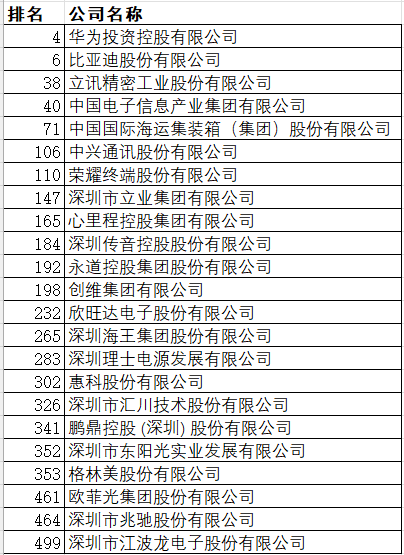
Core Insights - The "2025 China Manufacturing Enterprises Top 500" list was released, highlighting Shenzhen's strength with 23 companies listed, showcasing its status as the "Industrial First City" [1][5] - Huawei and BYD ranked 4th and 6th respectively, with revenues of 862.1 billion and 777.1 billion yuan, indicating strong performance among leading companies [2][3] Company Performance - Shenzhen's top companies include Huawei, BYD, Luxshare Precision, China Electronics Corporation, and ZTE, among others, reflecting a diverse industrial base [2][5] - The overall revenue scale of the top 500 companies remains stable, with R&D investment as a growing focus, reaching a research intensity of 2.45%, up by 0.03 percentage points from the previous year [2][3] R&D and Innovation - Shenzhen companies are characterized by high R&D intensity, with five out of the top ten companies in R&D intensity being from Shenzhen, led by Huawei at 20.84% [3] - The emphasis on R&D is evident as these companies continue to invest significantly in innovation, contributing to their competitive edge [3][5] Global Expansion - Shenzhen companies are increasingly expanding internationally, with notable mentions of Transsion Holdings, Pegatron, and Jiangbolong Electronics, which have high overseas revenue ratios [3] - Transsion Holdings leads with 99.73% of its revenue from overseas markets, particularly in Africa and Southeast Asia, indicating successful global strategies [3] Industry Landscape - The listed Shenzhen companies span multiple strategic industries, including electronics, new energy, high-end equipment manufacturing, and smart terminals, creating a collaborative industrial ecosystem [5] - Shenzhen's commitment to high-end, intelligent, and green manufacturing continues to drive its industrial development, supporting the overall growth of China's manufacturing sector [5]





农民工稳岗就业在行动丨政策红利转化为岗位增量
Ren Min Ri Bao· 2025-09-17 02:59
Group 1: Company Operations - The production facility of Skyworth Group in Shenzhen is operating efficiently with advanced automation technologies, including autonomous transport vehicles and AI visual systems for quality control [1] - The company has seen an increase of over 800 employees in its Shenzhen base for the color TV business in the first half of the year, driven by the implementation of the "old for new" home appliance policy [2] Group 2: Employee Benefits and Compensation - Employee compensation at the Shenzhen base has increased by 20% to 25% this year, with various benefits being enhanced alongside [2] - Employees in training can earn between 5,000 to 6,000 yuan, while those who have completed training report salaries of 6,000 to 7,000 yuan, with some exceeding 7,000 yuan [2] Group 3: Market Dynamics - The "national subsidy" policy is expected to continue supporting production and employment, with upcoming holidays and shopping events likely to stimulate consumer demand [2] - Guangdong province has implemented measures to stabilize employment, resulting in a year-on-year increase of 4.2% in urban employment, with a total of 1.0921 million new jobs created by the end of August [3]
家电股普涨 海尔智家涨超5% 美的集团涨约2%
Ge Long Hui· 2025-09-17 02:06
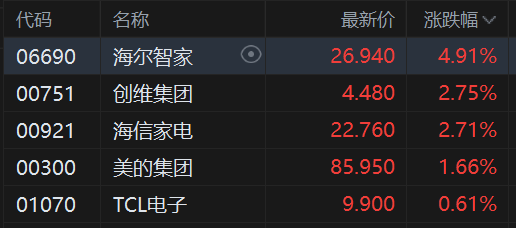
Group 1 - The core viewpoint of the news is that the home appliance sector in Hong Kong has seen a collective rise, with notable increases in stock prices for companies like Haier Smart Home and Skyworth Group, driven by positive retail growth trends despite some fluctuations [1][2] - In August, China's home appliance retail sales saw a year-on-year growth of 14.3%, indicating a good growth trend, although the growth rate has slowed compared to previous months [1] - The arrival of the third batch of national subsidy funds has boosted offline retail sales of home appliances, while online sales growth for essential categories has slowed down, but optional categories like robotic vacuum cleaners and floor washers continue to grow rapidly [1] Group 2 - Haier Smart Home's stock price increased by 4.91% to 26.940, while Skyworth Group and Hisense Home Appliances rose by 2.75% and 2.71% respectively [2] - Midea Group's stock rose by 1.66%, and TCL Electronics saw a smaller increase of 0.61% [2] - The overall outlook for China's home appliance exports is expected to return to a stable growth path as tariff policies become clearer, with significant potential for overseas development in Southeast Asia [1]
港股异动丨家电股普涨 海尔智家涨超5% 美的集团涨约2%
Ge Long Hui· 2025-09-17 01:59
Group 1 - The core viewpoint of the article highlights the collective rise of Hong Kong's home appliance stocks, with Haier Smart Home increasing over 5% and other companies like Skyworth Group and Hisense Home Appliances also showing gains [1] - According to Guosen Securities, China's home appliance retail sales in August experienced a year-on-year growth of 14.3%, although the growth rate has slowed compared to the previous month, indicating a still positive growth trend [1] - The report notes that with the arrival of the third batch of national subsidy funds, offline home appliance retail has seen an increase in growth, while online sales for essential categories have slowed down, but optional categories like robotic vacuum cleaners and floor washers continue to grow rapidly [1] Group 2 - The article mentions that Chinese home appliance companies are accelerating their capacity expansion overseas, particularly in Southeast Asia, which is expected to impact the growth rate of home appliance exports from China [1] - It is anticipated that as tariff policies become clearer, China's home appliance exports are likely to return to a stable growth path, indicating significant potential for the overseas development of home appliances [1] - The stock performance of major home appliance companies is as follows: Haier Smart Home at 26.940 with a rise of 4.91%, Skyworth Group at 4.480 with a rise of 2.75%, Hisense Home Appliances at 22.760 with a rise of 2.71%, Midea Group at 85.950 with a rise of 1.66%, and TCL Electronics at 9.900 with a rise of 0.61% [1]
江苏南京:机电“压舱”,“智”造破浪前行
Nan Jing Ri Bao· 2025-09-17 01:43
Group 1: Industry Overview - In the first half of 2025, Nanjing's electromechanical product exports reached 95.44 billion yuan, a year-on-year increase of 7.8%, accounting for 52.2% of the city's total exports [1] - Electromechanical products are crucial high-tech components that stabilize foreign trade and illustrate Nanjing's innovative manufacturing capabilities [1] Group 2: Company Highlights - Hansan Technology, which recently went public, exported smart speakers worth several million yuan, achieving over 97% of its sales from exports [3][5] - Despite global tariff changes, Hansan Technology experienced growth due to its comprehensive core technology capabilities and strong partnerships with overseas clients [5][6] - Nanjing Lijin Panda Electric Co. saw an 8% increase in exports from January to August, with European and South American markets growing by 14% [6] - Skyworth Group's overseas market revenue reached 8.053 billion yuan in the first half of the year, a 7.1% increase, as it aims for a revenue target of 100 billion yuan within two years [8] - Sumida Energy's export revenue reached 2.93 billion USD in the first half of the year, a 14% increase, as it transitions from product export to integrated energy solutions [9] Group 3: Market Trends - The global consumer electronics market is witnessing innovative products like AI glasses and compact TV sticks, showcasing the technological strength of Chinese brands [6][8] - The demand for automotive transport ships is rising due to the expansion of the global automotive market and the rapid growth of new energy vehicles [12] - The Nanjing electromechanical industry benefits from a complete industrial system and strong cluster advantages, enhancing its competitiveness in international markets [12][13]