PETROCHINA(00857)

Search documents
曾被西方断言是贫油区,如今却遥遥领先,中国石油怎样完成逆袭的
Sou Hu Cai Jing· 2025-12-16 11:49
Core Viewpoint - The article discusses China's remarkable transformation from being labeled a "desperate oil region" to becoming a global leader in oil production and energy security, highlighting the pivotal role of a single well discovered in 1959 that changed perceptions and strategies in the oil industry [1][9][22]. Group 1: Historical Context - In the early 20th century, foreign experts, including those from Standard Oil and German teams, declared China a "desperate oil region" after unsuccessful drilling attempts [1][4]. - By the time of the founding of New China, the annual crude oil production was only 120,000 tons, reflecting a dire energy situation [4][18]. Group 2: Strategic Shift - Faced with external pressures and limited resources, Chinese geologists made a bold decision to explore the northeastern region, previously deemed unpromising by Western experts [4][6]. - The breakthrough came in 1959 with the discovery of the Songji No. 3 well in Heilongjiang, which not only revealed significant oil reserves but also challenged existing theories about oil formation [7][9]. Group 3: Cultural and Collective Efforts - The determination and spirit of the workers, exemplified by figures like Wang Jinxi, played a crucial role in overcoming harsh conditions to achieve rapid production increases [16][20]. - By 1963, China announced that it had achieved basic self-sufficiency in oil, marking a significant milestone in its energy independence [18][20]. Group 4: Current Position and Future Outlook - Today, China has transformed from a mere participant in the global oil market to a key player, with refining capacity exceeding 900 million tons, making it the world's largest [22][25]. - The country is now not only involved in oil exploration but also in setting global energy standards, particularly in green and low-carbon technologies [22][27]. - China's advancements in energy have reshaped global energy dynamics, and the country is poised to influence future developments in the renewable energy sector [27][29].


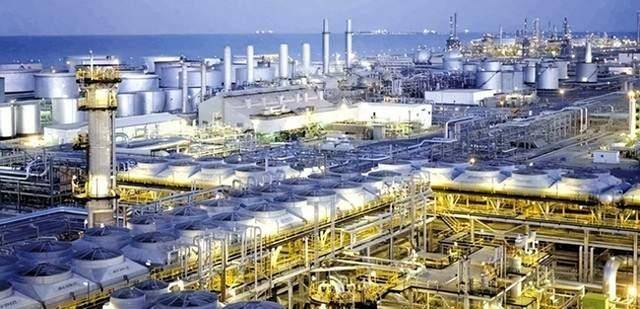
港股通红利低波ETF(159117)跌1.46%,成交额809.18万元
Xin Lang Cai Jing· 2025-12-16 11:28
Core Viewpoint - The Penghua Hong Kong Stock Connect Low Volatility Dividend ETF (159117) experienced a decline of 1.46% in its closing price on December 16, with a trading volume of 8.09 million yuan [1]. Group 1: Fund Overview - The fund was established on September 30, 2025, and is officially named Penghua S&P Hong Kong Stock Connect Low Volatility Dividend ETF [1]. - The management fee for the fund is set at 0.30% annually, while the custody fee is 0.10% annually [1]. - The fund's performance benchmark is the S&P Hong Kong Stock Connect Low Volatility Dividend Index return (adjusted for exchange rates) [1]. Group 2: Fund Size and Liquidity - As of December 15, the latest share count for the ETF is 155 million shares, with a total size of 160 million yuan [1]. - Over the past 20 trading days, the cumulative trading amount for the ETF reached 100 million yuan, with an average daily trading amount of 5.01 million yuan [1]. Group 3: Fund Management - The current fund managers are Yan Dong and Yu Zhanchang, both of whom have managed the fund since its inception on September 30, 2025, achieving a return of 3.58% during their tenure [1]. Group 4: Top Holdings - The ETF's top holdings include: - Hang Lung Properties: 1.08% holding, 496,000 shares valued at 4.07 million yuan - Jiangxi Copper: 1.08% holding, 122,000 shares valued at 4.06 million yuan - China Shenhua: 1.05% holding, 110,000 shares valued at 3.97 million yuan - Far East Horizon: 0.99% holding, 588,000 shares valued at 3.72 million yuan - CNOOC: 0.96% holding, 210,000 shares valued at 3.62 million yuan - Sino Land: 0.94% holding, 384,000 shares valued at 3.54 million yuan - PetroChina: 0.87% holding, 496,000 shares valued at 3.29 million yuan - Hengan International: 0.87% holding, 134,500 shares valued at 3.26 million yuan - Henderson Land: 0.81% holding, 122,000 shares valued at 3.05 million yuan - Bank of China Hong Kong: 0.81% holding, 91,000 shares valued at 3.06 million yuan [2].



智通港股通活跃成交|12月16日
智通财经网· 2025-12-16 11:04
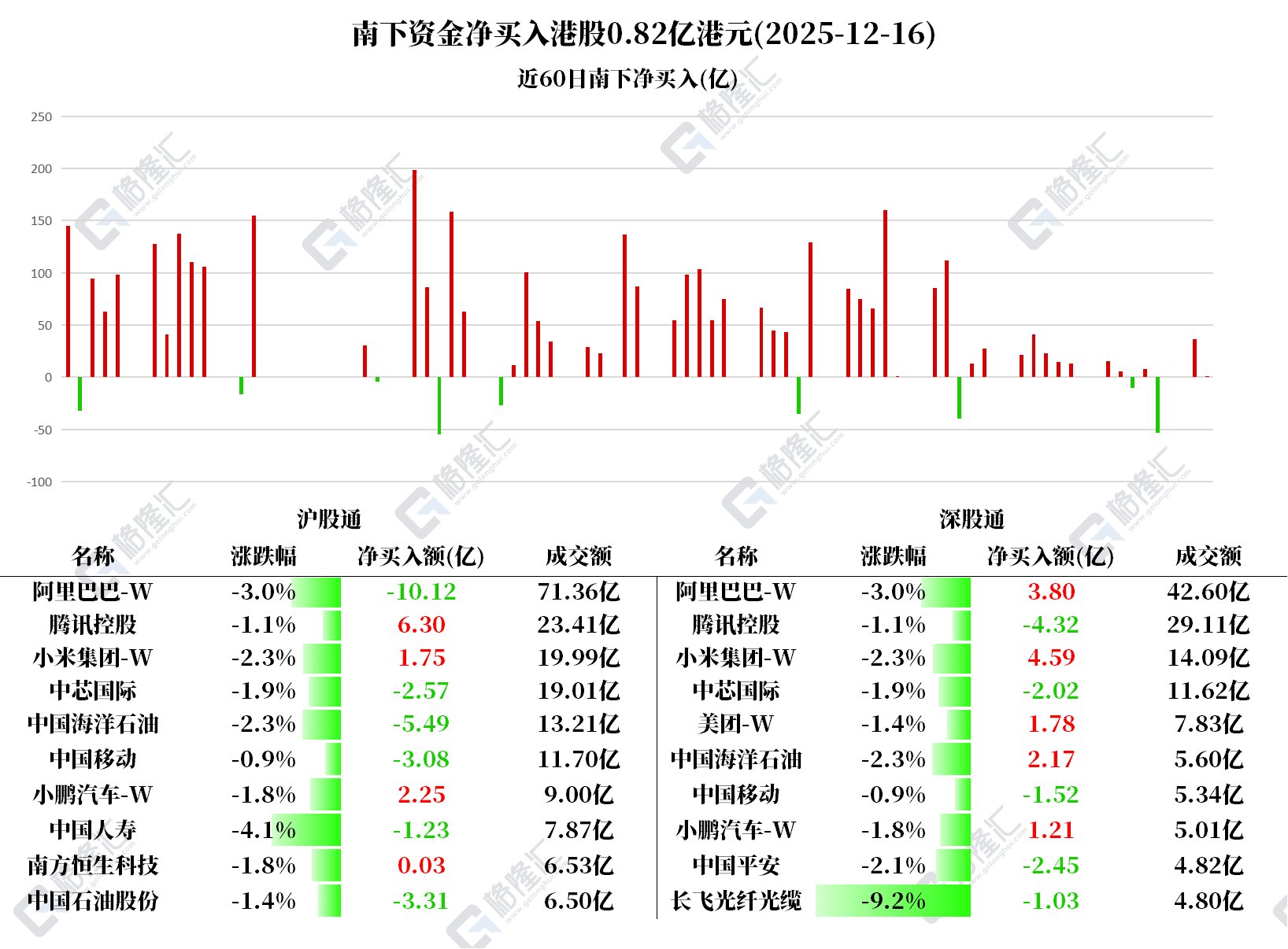
Core Insights - On December 16, 2025, Alibaba-W (09988), Tencent Holdings (00700), and Xiaomi Group-W (01810) ranked as the top three companies by trading volume in the southbound trading of the Stock Connect, with trading amounts of 7.136 billion, 2.341 billion, and 1.999 billion respectively [1][2] - The same companies also led in the Shenzhen-Hong Kong Stock Connect southbound trading, with trading amounts of 4.260 billion, 2.911 billion, and 1.409 billion respectively [1][2] Southbound Trading Highlights - **Top Active Companies in Southbound Trading (Hong Kong Stock Connect)** - Alibaba-W (09988): Trading amount of 7.136 billion, net buy of -1.012 billion - Tencent Holdings (00700): Trading amount of 2.341 billion, net buy of +0.630 billion - Xiaomi Group-W (01810): Trading amount of 1.999 billion, net buy of +0.175 billion - Other notable companies include SMIC (00981) and CNOOC (00883) with trading amounts of 1.901 billion and 1.321 billion respectively [2] - **Top Active Companies in Southbound Trading (Shenzhen-Hong Kong Stock Connect)** - Alibaba-W (09988): Trading amount of 4.260 billion, net buy of +0.380 billion - Tencent Holdings (00700): Trading amount of 2.911 billion, net buy of -0.432 billion - Xiaomi Group-W (01810): Trading amount of 1.409 billion, net buy of +0.459 billion - Other notable companies include Meituan-W (03690) and CNOOC (00883) with trading amounts of 0.783 billion and 0.560 billion respectively [2]




中国石油化工股份(00386)12月16日斥资512.78万港元回购118万股
Zhi Tong Cai Jing· 2025-12-16 10:47
Core Viewpoint - China Petroleum & Chemical Corporation (Sinopec) announced a share buyback of 1.18 million shares at a total cost of HKD 5.1278 million, with a buyback price range of HKD 4.32 to HKD 4.40 per share [1] Group 1 - The company plans to repurchase shares to enhance shareholder value [1] - The total expenditure for the buyback is approximately HKD 5.1278 million [1] - The number of shares being repurchased is 1.18 million [1]

中国石油化工股份(00386.HK)12月16日耗资512.8万港元回购118万股
Ge Long Hui· 2025-12-16 10:43
Group 1 - The core point of the article is that China Petroleum & Chemical Corporation (Sinopec) announced a share buyback plan, intending to repurchase 1.18 million shares at a cost of HKD 5.128 million [1] - The buyback price is set between HKD 4.32 and HKD 4.40 per share [1]
中国石油化工股份12月16日斥资512.78万港元回购118万股
Zhi Tong Cai Jing· 2025-12-16 10:43
中国石油化工股份(00386)发布公告,于2025年12月16日该公司斥资512.78万港元回购118万股,回购价 格为每股4.32-4.40港元。 ...
图解丨南下资金净买入小米,净卖出阿里
Ge Long Hui A P P· 2025-12-16 10:02
Group 1 - Southbound funds net bought Hong Kong stocks worth 82.029 million HKD today [1] - Notable net purchases included Xiaomi Group-W at 633 million, Xpeng Motors-W at 345 million, Tencent Holdings at 197 million, and Meituan-W at 177 million [1] - Significant net sales were observed for Alibaba-W at 631 million, China Mobile at 460 million, SMIC at 459 million, CNOOC at 332 million, and PetroChina at 330 million [1] Group 2 - Southbound funds have net bought Xiaomi for 13 consecutive days, totaling 12.78378 billion HKD [1] - Meituan has seen net purchases for 5 consecutive days, amounting to 4.80742 billion HKD [1] - SMIC has experienced net sales for 6 consecutive days, totaling 2.44528 billion HKD [1] - CNOOC has faced net sales for 4 consecutive days, amounting to 1.73379 billion HKD [1]

港股16日跌1.54% 收报25235.41点
Xin Hua Wang· 2025-12-16 09:31
Market Performance - The Hang Seng Index fell by 393.47 points, a decrease of 1.54%, closing at 25,235.41 points [1] - The H-share Index dropped by 159.77 points, closing at 8,757.93 points, a decline of 1.79% [1] - The Hang Seng Tech Index decreased by 95.91 points, closing at 5,402.51 points, down by 1.74% [1] Blue Chip Stocks - Tencent Holdings decreased by 1.08%, closing at 596.5 HKD [1] - Hong Kong Exchanges and Clearing fell by 1.93%, closing at 396 HKD [1] - China Mobile declined by 0.94%, closing at 84.3 HKD [1] - HSBC Holdings remained unchanged, closing at 116.2 HKD [1] Local Hong Kong Stocks - Cheung Kong Holdings fell by 1.78%, closing at 38.7 HKD [1] - Sun Hung Kai Properties decreased by 2.23%, closing at 94.35 HKD [1] - Henderson Land Development rose by 0.34%, closing at 29.16 HKD [1] Chinese Financial Stocks - Bank of China fell by 1.82%, closing at 4.32 HKD [1] - China Construction Bank decreased by 2.12%, closing at 7.39 HKD [1] - Industrial and Commercial Bank of China dropped by 1.81%, closing at 5.98 HKD [1] - Ping An Insurance fell by 2.07%, closing at 63.9 HKD [1] - China Life Insurance decreased by 4.13%, closing at 27.38 HKD [1] Oil and Petrochemical Stocks - Sinopec fell by 1.13%, closing at 4.37 HKD [1] - PetroChina decreased by 1.35%, closing at 8.03 HKD [1] - CNOOC dropped by 2.32%, closing at 20.2 HKD [1]


可燃冰板块12月16日涨0.07%,中国石油领涨,主力资金净流出5.89亿元
Sou Hu Cai Jing· 2025-12-16 09:24
Group 1 - The core viewpoint of the article indicates that the combustible ice sector experienced a slight increase of 0.07% on December 16, with China National Petroleum Corporation leading the gains [1] - The Shanghai Composite Index closed at 3824.81, down by 1.11%, while the Shenzhen Component Index closed at 12914.67, down by 1.51% [1] - The net capital flow in the combustible ice sector showed a significant outflow of 589 million yuan from main funds, while retail investors contributed a net inflow of 669 million yuan [1] Group 2 - The article provides a detailed overview of the capital flow within the combustible ice sector, highlighting that the main funds saw a net outflow of 589 million yuan and the speculative funds had a net outflow of 80.74 million yuan [1] - Retail investors were the only group to show a positive trend, with a net inflow of 669 million yuan into the sector [1] - The article includes a table summarizing the individual stock performance and capital flow within the combustible ice sector [1]
供应端扩产高峰已过,“反内卷”助力景气度回升
Bank of China Securities· 2025-12-16 07:16
Investment Rating - The report assigns a "Strong Buy" rating for the chemical industry, indicating a positive outlook for investment opportunities [2]. Core Insights - The chemical industry is currently at the bottom of the cycle, with the "anti-involution" trend expected to accelerate the optimization of the competitive landscape, driving an upward trend in industry prosperity. Leading companies are likely to see improvements in both profitability and valuation, with recommendations for companies such as Wanhua Chemical, Hualu Hengsheng, China Petroleum, Baofeng Energy, and New Hope Liuhe [3]. - The report highlights the importance of self-discipline in production cuts within sub-industries like polyester filament, agrochemicals, fluorochemicals, and organosilicon, recommending companies such as Tongkun Co., New Fengming, Lier Chemical, and others [3]. - The refining industry, currently at a cyclical low, is expected to benefit from the elimination of backward production capacity, leading to a rapid recovery in prosperity, with recommendations for China Petroleum, Hengli Petrochemical, and others [3]. Summary by Sections Supply Side - The peak of capacity expansion has passed, with fixed asset investment in the chemical raw materials and chemical products manufacturing industry showing a negative year-on-year growth for the first time in nearly five years as of June 2025. The total fixed assets of listed companies in the basic chemical industry reached 14,628.58 billion yuan, a year-on-year increase of 15.56% [14][46]. - The construction of new projects has also seen a downturn, with the amount of ongoing projects decreasing by 15.11% year-on-year as of Q3 2025 [46]. Demand Side - Domestic demand is expected to be boosted by stimulus policies, while exports of chemical products continue to grow. The demand from downstream industries such as real estate, automotive, and textiles is showing positive trends [3][14]. - The resilience of chemical product exports is highlighted, with the export quantity index for the chemical raw materials and chemical products manufacturing industry reaching 122.40 as of September 2025 [3]. Global Industry Landscape - The report notes a shift in the global industrial landscape, with Chinese chemical companies enhancing their competitiveness. In 2023, China's chemical sales reached 2,238.1 billion euros, accounting for 43.1% of the global market [3][14]. - The report emphasizes the ongoing adjustments in the global chemical industry, with many overseas chemical production capacities exiting the market due to high costs and aging facilities, thereby strengthening the competitive position of domestic companies [3]. Policy and Industry Self-Regulation - The "anti-involution" actions initiated in 2024, including self-regulation and production cuts by industry associations and leading companies, are expected to help restore product prices and profits [3]. - The report discusses various policies aimed at energy conservation and carbon reduction, which are likely to optimize supply and improve product structures in the petrochemical industry [3].