石油行业

Search documents
当输入型通胀遇上去库存,国内物价和产业周期如何演绎
East Money Securities· 2026-03-20 13:24
Group 1: Macroeconomic Insights - Input-driven inflation combined with inventory reduction leads to limited price increases in downstream sectors[4] - Historical data shows that during inventory reduction cycles, domestic PPI remained negative despite external inflation pressures[10] - Current economic conditions indicate that most downstream industries are in an active inventory reduction phase, limiting their ability to pass on price increases[14] Group 2: Asset Allocation Opportunities - In the context of localized inflation, essential consumer goods are expected to see stable demand and limited price resistance, presenting investment opportunities[22] - Bond yields are expected to remain stable due to insufficient evidence of rising interest rates, despite input-driven inflation[24] - Commodity prices may see long-term upward adjustments, contingent on demand-side validation and inventory cycle rotations[27] Group 3: Risks and Uncertainties - Domestic economic fundamentals may change unexpectedly, impacting growth trajectories[28] - Geopolitical risks could spill over, affecting global economic stability and asset prices[28] - Uncertainties in overseas market fluctuations may lead to volatility in global asset prices, influencing domestic markets[28]
首席点评:地缘冲突持续,原油推动能化板块走强
Shen Yin Wan Guo Qi Huo· 2026-03-16 05:14
1. Report Industry Investment Rating - The report provides a "Cautiously Bullish" or "Cautiously Bearish" rating for various commodities and financial instruments. Cautiously Bullish ratings are given to indices (IH, IF, IC, IM), crude oil, methanol, rubber, coking coal, coke, manganese silicon, ferrosilicon, gold, silver, aluminum, lithium carbonate, cotton, and corn. Cautiously Bearish ratings are given to rebar, hot-rolled coil, iron ore, and apples [6]. 2. Core Viewpoints of the Report - Geopolitical conflicts, especially the US-Iran conflict, have a significant impact on the global financial and commodity markets. The conflict has led to a rise in oil prices, fluctuations in the US dollar and US Treasury bonds, and has also affected the prices of various commodities and financial instruments [1]. - The market is in a transition from "expectation-driven" to "profit-driven" as the annual and first-quarter reports of listed companies are gradually disclosed. Industries with strong performance certainty are expected to attract more funds, while stocks without performance support may continue to be weak [4][13]. - The performance of different commodities and financial instruments is affected by a combination of factors, including supply and demand, geopolitical risks, and macroeconomic policies. 3. Summary by Relevant Catalogs 3.1. Daily Main News 3.1.1. International News - Japan plans to release about 80 million barrels of oil reserves starting from March 16 to ease the oil price increase caused by the tense Middle East situation. The government also plans to resume providing price subsidies to oil wholesalers on the 19th to stabilize oil prices [7]. 3.1.2. Domestic News - In 2025, the supervision and sampling pass rate of major food products in China reached 99.37%, and the overall food safety level continued to improve. Food production and operation enterprises have equipped a large number of food safety supervisors and staff, achieving full coverage of large-scale food enterprises [8]. 3.1.3. Industry News - In 2026, the first convertible bond conversion and capital increase case in the banking industry was realized by Chengdu Bank. The bank's registered capital increased from 3.736 billion yuan to 4.238 billion yuan, with a conversion rate of 99.94%. More than 80 city commercial banks, rural commercial banks, and rural credit cooperatives have completed registered capital changes this year, mostly through capital increases [9][10]. 3.2. Overseas Market Daily Returns - The report provides the daily returns of various overseas market products on March 12 and 13, 2026, including the S&P 500, FTSE China A50 futures, ICE Brent crude oil, London gold, London silver, LME aluminum, LME copper, LME zinc, LME nickel, ICE No. 11 sugar, ICE No. 2 cotton, CBOT soybeans, CBOT wheat, and CBOT corn [11]. 3.3. Morning Comments on Major Varieties 3.3.1. Financial - **Stock Indices**: The US three major indices fluctuated, and the previous trading day's stock indices declined. The food and beverage sector led the rise, while the comprehensive sector led the decline. The market turnover was 2.42 trillion yuan. As the annual and first-quarter reports are disclosed, the market will shift from "expectation-driven" to "profit-driven", and stocks with strong performance certainty are expected to attract more funds. In the long term, the stock index is expected to return to an upward trend after the geopolitical risks ease [4][13]. - **Treasury Bonds**: The long-term Treasury bonds declined. The central bank's open market reverse repurchase had a net withdrawal of 10.11 billion yuan last week, and short-term interest rates rose. The tense Middle East situation pushed up oil prices and inflation expectations, and the US Treasury bond yields continued to rise. The domestic economic data was good, and the government bond scale in the government work report was large. The short-term Treasury bond futures prices are still supported, but the long-term Treasury bond futures prices will continue to be under pressure [14][15]. 3.3.2. Energy and Chemicals - **Crude Oil**: The Middle East situation remains tense, and the geopolitical risk premium supports the oil price to be bullish. However, as the conflict has not escalated to an extreme level, and the market has priced in the current intensity, the oil price is expected to remain high and volatile in the short term [2][16]. - **Methanol**: Methanol prices rose. The average operating load of coal (methanol) to olefin plants in China decreased. The overall operating load of methanol plants decreased slightly compared with the previous period but increased compared with the same period last year. The coastal methanol inventory is at a relatively high level and increased slightly. The expected import volume from March 6 to 22 is 260,000 - 270,000 tons [2][17]. - **Rubber**: Natural rubber futures fluctuated at night. The rubber is in the low-yield season, and the supply elasticity is weak in the short term. The raw material rubber price is relatively firm. The demand side of all-steel tires has stable operation. The rubber price is expected to be volatile and bullish in the short term [18]. - **Polyolefins**: Polyolefins closed up on Friday. The prices of linear LL and some拉丝 PP of Sinopec and PetroChina showed different trends. The increase in the Middle East situation and the slight rebound of international oil prices have a positive impact on chemicals. The market sentiment is high, and the macro environment has a great impact on chemicals. The future trend depends on the actual operating conditions of the plants [19]. - **Glass and Soda Ash**: Glass and soda ash futures rebounded slightly. The inventory of glass production enterprises decreased, and the inventory of soda ash production enterprises also decreased. The glass inventory needs to be further digested, and the soda ash industry has certain inventory digestion pressure in the short term. The commodity market is affected by the macro environment, and rational response is recommended [20][21]. 3.3.3. Metals - **Precious Metals**: The US-Iran conflict continues, and the high volatility of international oil prices pushes up global inflation expectations. The market's expectation of the Fed's interest rate cut has significantly decreased, and the US dollar index and US Treasury bond yields have risen, suppressing the performance of precious metals in the short term. In the long term, the price center of precious metals will continue to rise due to multiple factors such as geopolitical risks, inflation resistance, de-dollarization, and central bank gold purchases [22]. - **Copper**: The copper price closed down at night. The supply of concentrate is still tight, and the smelting profit is at the break-even point. The smelting output has increased in general. The power investment is stable, the automobile production and sales are growing, the household appliance production is decreasing, and the real estate market is weak. The copper price may fluctuate in a range in the short term [23]. - **Zinc**: The zinc price closed down at night. The processing fee of zinc concentrate has decreased, and the supply of concentrate is temporarily tight. The smelting output continues to grow. The inventory of galvanized sheets is at a high level. The infrastructure investment growth rate is slowing down, the automobile production and sales are growing, the household appliance production is decreasing, and the real estate market is weak. The zinc price may follow the overall trend of non-ferrous metals [24]. - **Aluminum**: The Shanghai aluminum price fell at night. Bahrain Aluminum announced the suspension of three production lines, and Norsk Hydro's Qatar aluminum smelter will stop reducing production. The US-Iran conflict poses risks to the electrolytic aluminum supply in the Middle East. The blockage of the Strait of Hormuz may cause a regional supply crisis. In the short term, the market is mainly driven by geopolitical factors, and there is no sign of improvement in the industrial level in the medium and short term. In the long term, low inventory, limited supply, and stable demand provide support for the aluminum price [25]. 3.3.4. Black Metals - **Coking Coal and Coke**: The main contracts of coking coal and coke fluctuated at night. The supply of coking coal increased, and the demand for coking coal and coke weakened due to the decline in hot metal production. However, with the end of environmental protection restrictions and the resumption of production, the hot metal production is expected to increase, which will drive the improvement of the demand for coking coal and coke. The geopolitical situation may also stimulate the coal price. The future trend depends on the hot metal production, mine operation, and geopolitical situation [26]. 3.3.5. Agricultural Products - **Protein Meal**: The prices of soybean and rapeseed meal were weak at night. The soybean harvest progress in Brazil is slower than the same period. The USDA report slightly increased the US soybean crushing volume. The Middle East situation has increased the market's concern about supply interruption, and the US soybean price has reached a new high. The domestic soybean meal price follows the US soybean price and is also affected by the news of customs inspection and export suspension. The protein meal is expected to be bullish and volatile in the short term [27]. - **Oils and Fats**: The prices of soybean and palm oil fluctuated and closed up at night, while the rapeseed oil price closed down slightly. The MPOB report shows that the palm oil production and export in Malaysia decreased in February, and the inventory decreased slightly. The increase in oil prices has driven the rise of vegetable oil prices. The macro environment is complex, and the oil prices are expected to be volatile in the short term [28]. - **Hogs**: The hog market shows regional differences. The price in the northern market fluctuated slightly, and the supply and demand are basically balanced. The price in the southern market is stable, and the supply is still abundant. The short-term hog price is expected to be under pressure [29]. - **Sugar**: The Zhengzhou sugar price fluctuated at night. The Iran situation may push up the ethanol-to-sugar price, and the sugar mill may adjust the sugar production ratio. The short-term raw sugar price is expected to be volatile. The Brazilian production may decrease, which may offset part of the supply surplus. The domestic sugar price is boosted by the overseas market, and attention should be paid to the macro impact [30]. - **Cotton**: The Zhengzhou cotton price fluctuated at night. The adjustment of the market due to the Middle East situation may be basically over, and the回调 amplitude is expected to be limited. In the long term, the cotton price may rise due to the tight supply and demand situation. The domestic consumption has increased, and the inventory is low, which provides support for the cotton price [31]. 3.3.6. Shipping Index - **Container Shipping to Europe**: The EC index fell by 7.08% on Friday. The SCFI European line price increased, reflecting the price increase of shipping companies in the second half of March. The traditional off-season makes it difficult to maintain the price increase. The European line is expected to return to its seasonal pricing after the short-term geopolitical impact eases. Attention should be paid to the price increase letters of shipping companies in April and the actual implementation of prices [3][32][33].
海外高频 | 地缘摩擦升温,油价延续上涨(申万宏观·赵伟团队)
申万宏源宏观· 2026-03-15 09:46
Group 1 - Geopolitical tensions are rising, leading to an increase in oil prices, with Brent crude oil rising by 11.3% to $103.1 per barrel [2][46] - The S&P 500 index fell by 1.6%, while developed market indices generally declined, with the Nikkei 225 and Dow Jones Industrial Average down by 3.2% and 2.0% respectively [3][9] - Emerging market indices also saw declines, with India's SENSEX30 and Ho Chi Minh Index down by 5.5% and 4.1% respectively [3] Group 2 - The 10-year U.S. Treasury yield rose by 13 basis points to 4.28%, while yields in other developed countries also increased, with Germany's yield up by 10 basis points to 3.01% [21][27] - The U.S. dollar index increased by 1.6% to 100.50, with other currencies depreciating against the dollar, including the euro and British pound, which fell by 1.7% and 1.4% respectively [32][41] - Commodity prices mostly rose, with WTI crude oil increasing by 8.6% to $98.7 per barrel, while precious metals like gold and silver saw declines of 2.3% and 4.6% respectively [46][53] Group 3 - The U.S. CPI for February matched expectations at 2.4% year-on-year, with a slight month-on-month increase of 0.3% [93] - Real disposable income in the U.S. rose significantly by 0.7% in January, primarily due to tax refunds [95] - The JOLT job openings for January were reported at 6.946 million, exceeding expectations of 6.75 million, indicating a strong labor market [100]


资讯早班车-2026-03-12-20260312
Bao Cheng Qi Huo· 2026-03-12 02:01
1. Report Industry Investment Rating No relevant content provided. 2. Core Viewpoints of the Report - The export and import growth rates in the first two months were significantly better than expected, but the growth rates in March may adjust significantly, and the export downward risk may increase after the second quarter [27]; - China's exports in 2026 are expected to perform well, with the export growth rate expected to reach around 17% in the first quarter under the neutral scenario [28]; - The Mideast situation has increased the volatility of major asset classes, and the conflict may develop into a "war of attrition" or a slight easing, with the trading logic transitioning from risk - aversion to stagflation [28]; - The downward space for certificate of deposit rates in the short - term is limited [29]; - The CPI is being repaired, the PPI's year - on - year decline continues to narrow, and the bond market is expected to be volatile in the long - term [29]. 3. Summary by Directory Macro Data Overview - GDP growth rate in Q4 2025 was 4.5%, down from 4.8% in the previous quarter and 5.4% in the same period last year [1]; - In February 2026, the manufacturing PMI was 49.0%, down from 49.2% in the previous month and 50.2% in the same period last year; the non - manufacturing PMI was 49.5%, unchanged from the previous month but down from 50.4% in the same period last year [1]; - In January 2026, the social financing scale was 7220.8 billion yuan, much higher than 817.8 billion yuan in the previous month and 7054.6 billion yuan in the same period last year [1]; - In February 2026, CPI increased by 1.3% year - on - year, up from 0.7% in the previous month and - 0.7% in the same period last year; PPI decreased by 0.9% year - on - year, an improvement from - 2.2% in the previous month and the same period last year [1]; - In December 2025, the cumulative year - on - year growth rate of fixed - asset investment was - 3.8%, down from - 0.5% in the previous period and 3.2% in the same period last year; the cumulative year - on - year growth rate of total retail sales of consumer goods was 3.7%, down from 4.5% in the previous period but up from 3.5% in the same period last year [1]; - In February 2026, the export amount increased by 39.6% year - on - year, up from 5.9% in the previous month and - 3.1% in the same period last year; the import amount increased by 13.8% year - on - year, up from 1.9% in the previous month and 1.6% in the same period last year [1]. Commodity Investment Reference Comprehensive - Since March, many banks, mainly local commercial banks, have collectively lowered deposit rates, and the long - term deposit rates have generally entered the "1 - digit" range. The deposit rates of small and medium - sized banks are expected to continue to decline but at a slower pace [2]; - On March 11, 32 domestic commodity varieties had positive basis, and 36 had negative basis. The basis of Shanghai nickel, Shanghai tin, and Zhengzhou cotton was the largest, while that of apples, butadiene rubber, and live pigs was the smallest [2]; - The Zhengzhou Commodity Exchange will adjust the trading margin and daily price limit of apple futures contracts 2604 and 2605 from March 16 [2]; - The US inflation data in February met market expectations, but the impact of the oil price surge caused by the Iran situation was not reflected, and more data is needed to determine when the Fed will cut interest rates again [3]; - The energy price surge caused by the Iran war is reshaping the European Central Bank's policy expectations. The ECB may raise interest rates earlier than expected, and the price risk is upward [3]. Metals - In February, global physical gold ETFs had an inflow of about $5.3 billion, with the total gold holdings reaching a record high of 4171 tons, and the total asset management scale reaching a record $701 billion [4]; - Peru has approved the environmental assessment report of Buenaventura's Trapiche copper project, with an expected investment of $3.4 billion [5]; - The Polish central bank maintains a gold reserve target of 700 tons [6]; - As of March 11, 2026, the silver holdings of the world's largest silver ETF decreased by 115.51 tons, while the gold holdings of the world's largest gold ETF increased by 3.71 tons [6]; - Indonesia is evaluating a policy to cut coal and nickel production, and a decision may be submitted in June or July [6]. Coal, Coke, Steel, and Minerals - The coal inventory of Indian power plants is 54.05 million tons, sufficient for about 24 days of consumption [7]. Energy and Chemicals - On March 12, Brent crude oil exceeded $99 per barrel, and US oil futures rose by more than 6%. It was reported that Iranian boats attacked two oil tankers in Iraqi waters [8]; - The International Energy Agency agreed to release 400 million barrels of strategic oil reserves, and many countries, including the US, Japan, and Germany, also plan to release reserves to stabilize oil prices [8][16][17]; - Iran warns that it will implement a "serial strike" strategy and has the ability to block the Strait of Hormuz. Western attempts to lower oil prices may fail [9]; - Iraqi oil ports have stopped operations. The EU warns that if oil prices remain high, inflation in the EU may exceed 3% this year [9]; - OPEC maintains its forecast for global oil demand growth in the current and next years, but the impact of the geopolitical situation on oil demand is still uncertain [9]; - The US crude oil inventory in Cushing reached its highest level since August 2024 last week [9]; - The EU is considering measures to suppress energy prices, including setting a cap on natural gas prices [10]. Agricultural Products - After the Spring Festival, the domestic live - pig market has been in a slump, and the DCE live - pig futures price has reached a record low [11]; - In February, Malaysia's palm oil inventory decreased by 3.94% month - on - month, production decreased by 18.55% month - on - month, and exports decreased by 22.48% month - on - month [11]. Financial News Compilation Open Market - On March 11, the central bank conducted 26.5 billion yuan of 7 - day reverse repurchase operations, with a net withdrawal of 14 billion yuan on the day [12]. Important News - The Fourth Session of the 14th National Committee of the Chinese People's Political Consultative Conference closed on March 11, and the Fourth Session of the 14th National People's Congress will close on March 12 [13]; - As of the end of January, the balance of inclusive small and micro - enterprise loans in China was 37.6 trillion yuan, with a year - on - year growth of 11.4%. The average interest rate of newly issued loans in January decreased by 0.16 percentage points compared with the average rate in 2025 [13]; - The People's Bank of China held a science and technology work meeting in 2026, putting forward requirements for scientific and technological work in 2026 [14]; - The National People's Congress Financial and Economic Committee proposed six suggestions for budget implementation and fiscal work in 2026, including actively and orderly resolving local debt risks and optimizing the debt structure of the central and local governments [14]; - Among nearly 1,800 "fixed - income +" funds, 94% had positive returns this year. The newly established "fixed - income +" funds in 2026 had a total issuance scale of 36.2 billion yuan [15]; - Since March, many banks have lowered deposit rates, and the deposit rates of small and medium - sized banks are expected to continue to decline but at a slower pace [15]; - The first batch of savings bonds in 2026 were in high demand and were quickly sold out [15]; - The Hong Kong Special Administrative Region Government plans to increase the borrowing limit of the infrastructure bond plan and the government sustainable bond plan from HK$500 billion to HK$900 billion [15]; - US President Trump said that the military action against Iran is "about to end," but US and Israeli officials have not received instructions to stop [16]; - The International Energy Agency agreed to release 400 million barrels of strategic oil reserves, and many countries plan to release reserves to stabilize oil prices [16]; - The US will release 172 million barrels of oil from its strategic reserves, and will replenish the reserves by 200 million barrels next year [17]; - The US Trade Representative's Office plans to conduct a "301 investigation" related to forced - labor finished products, covering about 60 countries [17]; - The US government budget deficit in February 2026 was $308 billion, and the budget deficit from the beginning of the fiscal year to February was $1.004 trillion, a 12% decrease compared with the same period last year [17]; - Amazon issued euro - denominated bonds for the first time, with a scale of 14.5 billion euros, and plans to invest A$750 million in an automated logistics hub in Australia [18]; - There are major events in the bond market, including new defaults, credit rating changes, and bond redemptions [18][19]. Bond Market Summary - The inter - bank bond market in China was weak, with most yields of major interest - rate bonds rising slightly. Treasury bond futures declined, and the 30 - year main contract led the decline. The inter - bank market liquidity was slightly tightened [21]; - In the exchange bond market, some bonds rose, while others fell [21]; - The CSI Convertible Bond Index rose by 0.34%, and the Wind Convertible Bond Equal - Weighted Index rose by 0.05% [22]; - Most money market interest rates rose [22]; - Most short - term Shibor rates rose [23]; - Most inter - bank repo fixed - rate prices were flat or rose [23]; - The yields of some government bonds and financial bonds in the primary market were determined [24]; - European and US bond yields rose across the board [24][25]. Foreign Exchange Market - On March 11, the on - shore RMB against the US dollar rose by 18 basis points at the 16:30 close, and the central parity rate of the RMB against the US dollar was raised by 65 basis points [26]; - In the New York market, the US dollar index rose by 0.32%, and non - US currencies showed different trends [26]. Research Report Highlights - CICC believes that the foreign trade data in the first two months were better than expected, but the growth rates in March may adjust, and the export downward risk may increase after the second quarter [27]; - CITIC Securities believes that China's exports in 2026 will perform well, with the first - quarter export growth rate expected to reach around 17% [28]; - Huatai Securities believes that the Mideast situation has increased the volatility of major asset classes, and the conflict may develop into a "war of attrition" or a slight easing [28]; - CITIC Securities believes that the downward space for certificate of deposit rates in the short - term is limited [29]; - Changjiang Securities believes that the CPI is being repaired, the PPI's year - on - year decline continues to narrow, and the bond market is expected to be volatile in the long - term [29]. Today's Reminders - On March 12, 215 bonds will be listed, 208 bonds will be issued, 120 bonds will be paid, and 156 bonds will be redeemed or pay interest [30][31][32]. Stock Market News - On Wednesday, the Shanghai Composite Index rose by 0.25%, the Shenzhen Component Index rose by 0.78%, the ChiNext Index rose by 1.31%, and the market turnover was 2.53 trillion yuan. The new energy and chemical sectors performed well, while the military and rare metal sectors declined [32]; - The Hong Kong stock market opened higher and closed lower. The Hang Seng Index fell by 0.24%, the Hang Seng Tech Index fell by 0.11%, and the Hang Seng China Enterprises Index fell slightly. Southbound funds had a net purchase of more than HK$3.4 billion, while Tencent Holdings had a net sale of more than HK$2.4 billion [32].
如何理解中东危机对通胀和市场的影响
2026-03-11 08:12
Summary of Key Points from Conference Call Records Industry Overview - The records discuss the impact of the Middle East crisis on global energy supply and inflation, particularly focusing on oil prices and their transmission to China's Producer Price Index (PPI) and Consumer Price Index (CPI) [1][2][10]. Core Insights and Arguments - **Oil Price Impact**: The closure of the Strait of Hormuz could lead to a global oil supply gap of 20 million barrels per day, potentially causing oil prices to rise by nearly 50%, surpassing $100 per barrel [1][2]. - **Energy Supply Disruption**: The crisis has affected multiple Middle Eastern countries, with Qatar halting natural gas production and Saudi Arabia experiencing disruptions in energy facilities, leading to production cuts [2]. - **PPI and CPI Transmission**: International oil prices have a direct impact on domestic energy prices, with a transmission coefficient of approximately 72%. The overall impact on China's PPI from international oil prices is estimated at around 6% [4][10]. - **Inflation Scenarios for 2026**: Three scenarios for inflation in 2026 were outlined: 1. **High Inflation Scenario**: Prolonged tension in the Middle East could keep oil prices around $110 per barrel, with PPI growth near 3.5% [9]. 2. **Neutral Inflation Scenario**: A temporary military action could stabilize oil prices at $90 per barrel, with PPI growth around 1.5% [9]. 3. **Low Inflation Scenario**: Successful negotiations could lead to oil prices dropping to $65 per barrel, with PPI growth around -0.4% [9]. Important but Overlooked Content - **Hedging Strategies**: The records discuss three main hedging strategies against supply gaps: 1. Releasing strategic oil reserves, which could last approximately 400 days at a daily gap of 20 million barrels [3]. 2. Changing transportation routes, such as pipeline transport, which can only cover a maximum of 3 million barrels per day [3]. 3. Emergency production increases from non-Middle Eastern oil producers, which are expected to be limited [3]. - **Investment Opportunities**: Despite risks, there are specific investment opportunities identified, including: 1. Energy alternatives such as coal, solar, and wind energy [11]. 2. Strategic resources like copper, aluminum, and rare earths [11]. 3. High dividend defensive assets, including precious metals and utilities [12]. Conclusion - The records highlight the significant risks posed by geopolitical tensions in the Middle East on global energy markets and inflation, while also identifying potential investment opportunities in alternative energy and strategic resources. The transmission of oil prices to domestic inflation metrics is a critical area of focus for understanding economic impacts in China.
黄金白银深夜跳水,国际油价大涨5%,美联储降息预期有变
21世纪经济报道· 2026-03-05 16:03
Group 1 - The Federal Reserve's interest rate cut expectations are under pressure, with a 13.7% chance of no rate cuts for the year as of March 5 [1] - Gold and silver prices fell sharply, with spot gold dropping nearly 1% to $5078 per ounce and silver falling over 2% [1] - The U.S. continues to face inflationary pressures, with rising costs in various sectors including insurance, utilities, and energy, as reported by the Federal Reserve [3] Group 2 - Oil prices surged over 5%, with WTI crude reaching $78.2 per barrel, the highest since January [5] - The ongoing tensions in the Middle East have severely disrupted oil and gas transportation, particularly through the Strait of Hormuz [6] - The potential for further increases in oil prices is significant, with Goldman Sachs warning that prolonged disruptions could push prices above $100 per barrel [8] Group 3 - The geopolitical situation in the Middle East is causing uncertainty in economic forecasts, complicating the Federal Reserve's monetary policy decisions [11] - High oil prices could lead to a rise in global inflation rates, with estimates suggesting a 0.1 percentage point increase for every 5% rise in oil prices [11] - The stability of the U.S. job market is currently preventing the Federal Reserve from rushing into rate cuts, despite inflationary pressures [13] Group 4 - The impact of the U.S.-Iran conflict on the economy remains uncertain, with the duration of the conflict being a key factor [15] - If the conflict escalates into a prolonged regional issue, it could significantly alter global economic and financial market dynamics [16] - A sustained high oil price environment could lead to a tightening of monetary policy by major central banks, potentially causing liquidity issues in global financial markets [16]

海外经济政策跟踪:中东冲突再起,通胀苗头初现
GUOTAI HAITONG SECURITIES· 2026-03-02 02:40
Group 1: Geopolitical Developments - The U.S. and Israel launched a joint strike against Iran on February 28, marking a significant escalation in the Middle East conflict[8] - Iran retaliated by targeting U.S. military positions in the Gulf region and announced a ban on ships passing through the Strait of Hormuz[8] - The geopolitical tensions have led to a notable increase in risk premiums for gold and oil, with gold prices surpassing $5,250 per ounce and Brent crude oil prices exceeding $73 per barrel[9] Group 2: Economic Indicators - The U.S. Producer Price Index (PPI) rose by 0.4% month-on-month in January, exceeding market expectations of 0.3%, and increased by 2.9% year-on-year against an expected 2.6%[17] - Initial jobless claims for the week ending February 23 were 190,000, aligning with seasonal expectations, but continued claims remain high, indicating a "low hiring, low firing" environment[16] - The 30-year mortgage rate has fallen below 6%, creating favorable conditions for consumer credit expansion[11] Group 3: Market Expectations - The market anticipates three rate cuts by the Federal Reserve this year, although the timing has been pushed back, with a 45.9% probability for a cut in June[13] - Federal Reserve officials exhibit significant internal disagreement regarding the timing and necessity of rate cuts, with some cautioning against premature easing[11]
PPI同比转正时点或提前:1月通胀数据点评
Huachuang Securities· 2026-02-12 08:11
Inflation Data Summary - January CPI decreased from 0.8% to 0.2% due to the Spring Festival effect, while core CPI fell from 1.2% to 0.8%[2] - PPI year-on-year decline narrowed from -1.9% to -1.4%, indicating an overall improvement in price trends[2] - Estimated GDP deflator for January is approximately -0.4%, compared to -0.6% in the previous quarter[2] PPI Insights - PPI increased by 0.4% month-on-month, marking the fourth consecutive month of growth[3] - The likelihood of PPI turning positive year-on-year is expected in Q3 2026, driven by improved midstream supply-demand dynamics[4] - Yearly PPI projections for 2026 are estimated at -1.2%, -0.2%, 0.4%, and 0.2% for Q1 to Q4 respectively, with an adjusted central tendency around -0.2%[5] Price Movement Factors - Key price increases in January were observed in sectors such as AI chips, automobiles, and gold jewelry, while food prices, particularly vegetables, saw declines[2][25] - Input factors, including international monetary easing and rising prices in the non-ferrous metal sector, contributed to domestic price changes[4][10] - The proportion of industries experiencing price increases in PPI rose from 9 to 13 out of 30, indicating a recovery in pricing power[33]
资讯早班车-2026-02-10-20260210
Bao Cheng Qi Huo· 2026-02-10 01:44
1. Report Industry Investment Rating No information provided in the report. 2. Core Viewpoints of the Report The overall market shows a complex situation with different trends and events across various sectors. The bond market is warming up, and the stock market has a significant upward movement. Commodity markets have their own characteristics, such as the growth of the futures trading volume and price changes in metals. Macroeconomic data reflects the current economic situation, and there are also various policy announcements and international events affecting different industries [27][31]. 3. Summary by Relevant Catalogs 3.1 Macro Data - GDP growth rate in Q4 2025 was 4.5% year - on - year, lower than the previous quarter and the same period last year [1]. - Manufacturing PMI in January 2026 was 49.3%, slightly higher than the previous month [1]. - Non - manufacturing PMI: Business Activity in January 2026 was 49.4%, lower than the previous month [1]. - Social financing scale in December 2025 was 22075 billion yuan, lower than the previous month [1]. 3.2 Commodity Investment 3.2.1 Comprehensive - In January 2026, the national futures trading volume was 912 million lots, and the turnover was 100.26 trillion yuan, with year - on - year increases of 65.09% and 105.14% respectively [2]. - Multiple exchanges adjusted trading margins and price limits for various futures contracts [2][3]. 3.2.2 Metals - On February 9, international and domestic precious metals prices generally rose, with COMEX gold up 2.10% and SHFE gold up 3.88% [5]. - Rare earth prices increased on February 9, with the average price of praseodymium - neodymium oxide rising by 41300 yuan/ton [5]. - Poland's central bank plans to buy 150 tons of gold in 2026 to strengthen foreign exchange reserve resilience [6]. 3.2.3 Coal, Coke, Steel and Minerals - The ecological environment department will pre - allocate carbon emission quotas to key emission units in relevant industries in 2026 [9]. - US coal prices showed different trends as of February 6 [9]. 3.2.4 Energy and Chemicals - The US Energy Secretary will visit Venezuela to discuss the future of the state - owned oil company [10]. - The global peak of oil demand is expected to be later than previously predicted due to the slowdown of electric vehicle penetration [10][11]. 3.2.5 Agricultural Products - In 2025, Dalian Commodity Exchange's soybean meal options had the highest annual trading volume among global agricultural products, and corn options ranked eighth [12]. - As of last Thursday, the harvested area of Brazil's 2025/26 soybean crop reached 16% of the expected area [12]. 3.3 Financial News 3.3.1 Open Market - On February 9, the central bank conducted 113 billion yuan of 7 - day reverse repurchase operations, with a net injection of 38 billion yuan [13]. 3.3.2 Key News - The three major exchanges optimized refinancing measures, aiming to support high - quality and technology - innovative listed companies [15]. - Multiple departments took measures to support cross - border e - commerce, the automotive industry, and protect the rights of new - form workers [15][16]. 3.3.3 Bond Market Review - China's bond market continued to be positive, with bond yields generally falling and futures prices rising [20]. - Exchange - traded bonds showed mixed performances, with some rising and some falling [21]. 3.3.4 Foreign Exchange Market - On Monday, the on - shore RMB against the US dollar rose 117 points, and the US dollar index fell 0.78% [25]. 3.3.5 Research Report Highlights - Brokerages such as CITIC Securities and Huatai Securities gave different investment suggestions on the bond and convertible bond markets [27][28]. 3.4 Stock Market - On Monday, the A - share market rose significantly, with the Shanghai Composite Index up 1.41% and the Shenzhen Component Index up 2.17% [31]. - The Hong Kong stock market also rose, with the Hang Seng Index up 1.76% [31]. - As of the end of January 2026, the number of Chinese private fund managers with over 10 billion yuan in assets reached a record high [31].
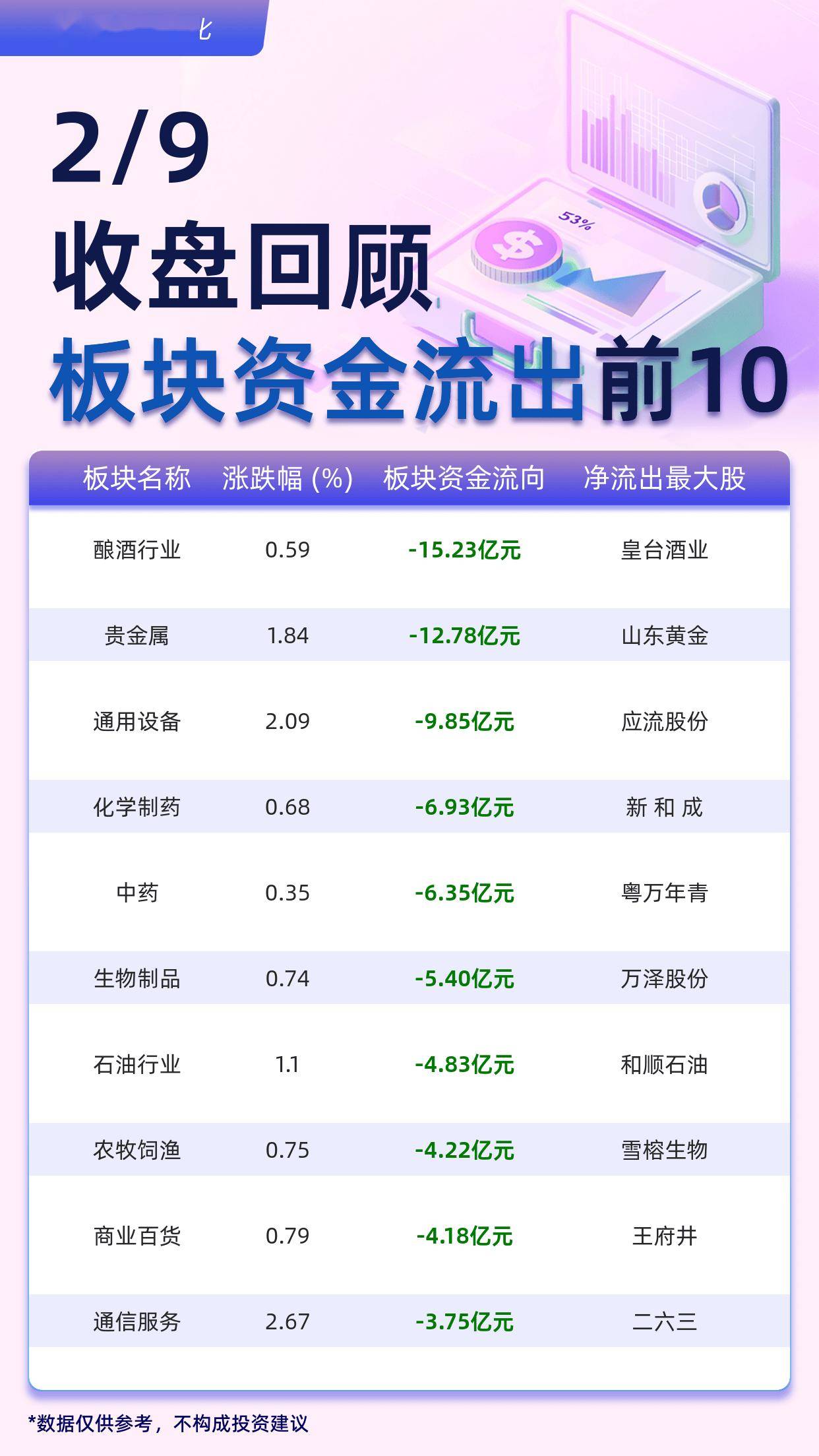
主力板块资金流出前10:酿酒行业流出15.23亿元、贵金属流出12.78亿元
Sou Hu Cai Jing· 2026-02-09 07:16
Core Insights - The main market saw a net inflow of 26.126 billion yuan as of February 9, indicating a positive trend in overall market sentiment [1]. Sector Analysis - The top ten sectors with the largest net outflows of funds were as follows: - **Beverage Industry**: Experienced a net outflow of 1.523 billion yuan, with Huangtai Liquor being the largest contributor to this outflow [2]. - **Precious Metals**: Saw a net outflow of 1.278 billion yuan, primarily driven by Shandong Gold [2]. - **General Equipment**: Had a net outflow of 0.985 billion yuan, with Yingliu Co. being the main affected company [2]. - **Chemical Pharmaceuticals**: Experienced a net outflow of 0.693 billion yuan, with Xinhengcheng as the largest contributor [2]. - **Traditional Chinese Medicine**: Faced a net outflow of 0.635 billion yuan, with Guangdong Wannianqing leading the outflow [2]. - **Biological Products**: Saw a net outflow of 0.540 billion yuan, with Wanze Co. being the most impacted [2]. - **Oil Industry**: Experienced a net outflow of 0.483 billion yuan, with Heshun Oil being the largest contributor [3]. - **Agriculture, Animal Husbandry, and Fishery**: Had a net outflow of 0.422 billion yuan, with Xue Rong Biological being the main affected company [3]. - **Commercial Retail**: Faced a net outflow of 0.418 billion yuan, with Wangfujing leading the outflow [3]. - **Telecommunication Services**: Experienced a net outflow of 0.375 billion yuan, with Erli San being the largest contributor [3].