CHINA MOBILE(00941)

Search documents
中国移动云南公司:科技创新引领数智跃迁
Ren Min Ri Bao· 2025-08-14 21:44
Core Insights - Yunnan Mobile aims to become a leading information service technology innovation company in China, focusing on cultivating new productive forces and enhancing its technological innovation system to drive high-quality economic and social development in Yunnan [1] Mechanism Strengthening - Yunnan Mobile has established a robust organizational framework for technological innovation, including the formation of a Technology Innovation Committee and a Product Management Committee, implementing a dual-committee system to enhance overall planning for innovation [2] - The company emphasizes talent development through a four-tier reward system and an innovation expert points system to stimulate technological innovation among its workforce [2] Beneficial Outcomes - Yunnan Mobile has made significant advancements in various fields such as 5G, intelligent networks, remote medical services, and renewable energy, contributing to the high-quality development of Yunnan's economy and society [3] - The company positions itself as a "provider," integrating capabilities in computing, storage, transportation, intelligence, and security to create an "AI+" digital foundation, including the establishment of the largest digital computing center in Yunnan [3] - Yunnan Mobile has launched a data element circulation service platform and is involved in the operation of the Kunming International Data Exchange, aiming to position Kunming as a key node in the national data market [3] AI Applications - In 2025, Yunnan Mobile will introduce the "An e Elderly Care" sub-brand under its "Mobile Love Home" initiative, focusing on AI-driven health management tools and services for elderly care [4] - The company has developed a nationwide first "61520" intelligent care service platform for children, utilizing AI to support various scenarios for left-behind children and enhancing school safety through advanced AI technologies [4] Ecological Integration - Yunnan Mobile actively engages in diverse activities to stimulate technological innovation, hosting forums and conferences to discuss AI development trends and low-altitude economic growth [5] - The company is committed to transforming hard technology into practical solutions for various industries and enhancing public services, thereby fostering a high-quality development landscape in Yunnan [5]

国资央企加力布局人工智能赛道
Zhong Guo Zheng Quan Bao· 2025-08-14 20:16
Core Insights - The central enterprises in China are significantly increasing their investments in the artificial intelligence (AI) sector, with a focus on high-quality development and capital operations to create new industry advantages and foster new growth drivers [1][2][3] Group 1: AI Revenue and Growth - China Mobile reported AI-related revenue in the "tens of billions" range for the first half of the year, indicating strong growth in the sector [2] - China Telecom's AIDC revenue grew by 7.4% year-on-year, while Tianyi Cloud revenue reached 573 billion [2] - China Unicom's smart network business revenue reached 454 billion, with a 60% year-on-year increase in AIDC contract value [2] Group 2: Development of AI Models - Major state-owned enterprises have launched significant AI models, such as the "Qingyuan" model by the National Energy Group and the "Xiaomiao" model by China National Building Material Group [3] - The industry is witnessing a shift from self-use to output, transforming cloud and energy computing capabilities into tradable public services [3] Group 3: Local Government Initiatives - Local state-owned enterprises are actively creating application scenarios for AI, with Guangzhou showcasing 60 AI application scenarios and over 30 AI professional parks [4] - Shenzhen has introduced a "rolling release" model for selecting high-quality application scenarios, while Zhejiang has published a list of 26 "AI+" open scenarios across various sectors [4] Group 4: Strategic Development and Ecosystem - The State-owned Assets Supervision and Administration Commission (SASAC) emphasizes the need for strategic high-value applications and the integration of AI with the real economy [5] - There is a call for the establishment of a supportive industrial ecosystem that integrates funding, industry, and data resources to foster innovation and competitiveness [6]


三大运营商上半年加码布局AI应用
Zheng Quan Ri Bao Zhi Sheng· 2025-08-14 16:37
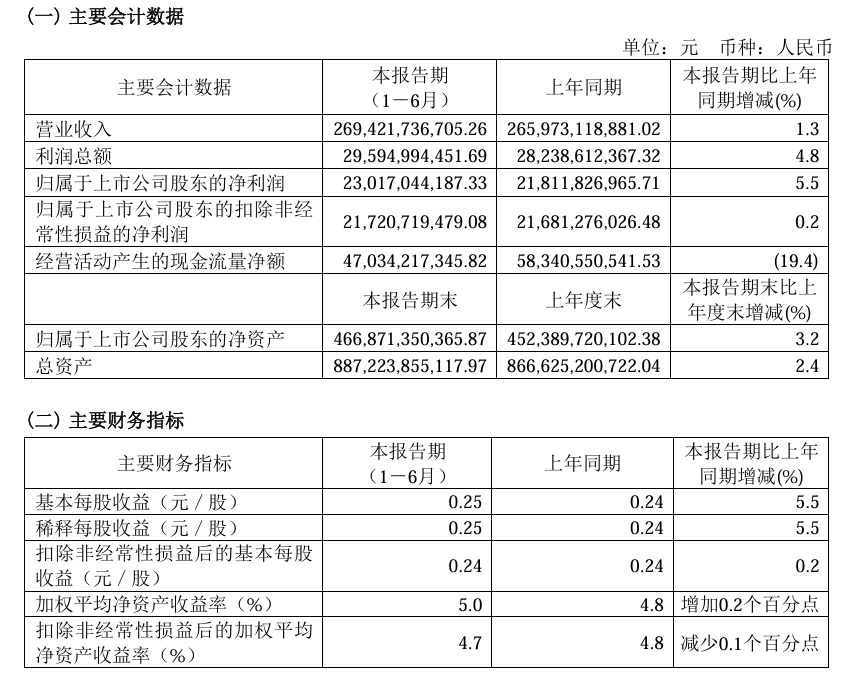
Group 1: Financial Performance - In the first half of 2025, China Mobile reported operating revenue of 543.769 billion yuan, a decrease of 0.5% year-on-year, and a net profit of 84.235 billion yuan, an increase of 5.0% [1] - China Telecom achieved operating revenue of 269.4 billion yuan, a year-on-year increase of 1.3%, and a net profit of 23 billion yuan, up 5.5% [1] - China Unicom's operating revenue was 200.202 billion yuan, reflecting a year-on-year growth of 1.5%, with a net profit of 6.349 billion yuan, an increase of 5.1% [1] Group 2: Dividend Distribution - China Mobile plans to distribute an interim dividend of 59.432 billion Hong Kong dollars, equivalent to approximately 54.199 billion yuan [1] - China Telecom intends to distribute a cash dividend of 0.1812 yuan per share, totaling around 16.581 billion yuan [1] - China Unicom plans to distribute approximately 3.477 billion yuan in dividends to shareholders [1] Group 3: AI Development - China Mobile's AI-related revenue reached several billion yuan, marking a significant growth phase since last year [2] - China Telecom reported intelligent revenue of 6.3 billion yuan, a year-on-year increase of 89.4% [2] - China Unicom is accelerating AI applications to enhance user experience and operational efficiency [2][3] Group 4: Capital Expenditure - China Mobile's capital expenditure for the first half of the year was 58.4 billion yuan, with a focus on computing power investments [4] - China Telecom completed capital expenditure of 34.2 billion yuan, with significant investments in mobile networks and digital industry [4] - China Unicom's capital expenditure was 20.2 billion yuan, a decrease of 15% year-on-year, with future investments expected to stabilize [5]
三大运营商,拟中期分红逾740亿元
Zhong Guo Zheng Quan Bao· 2025-08-14 16:09
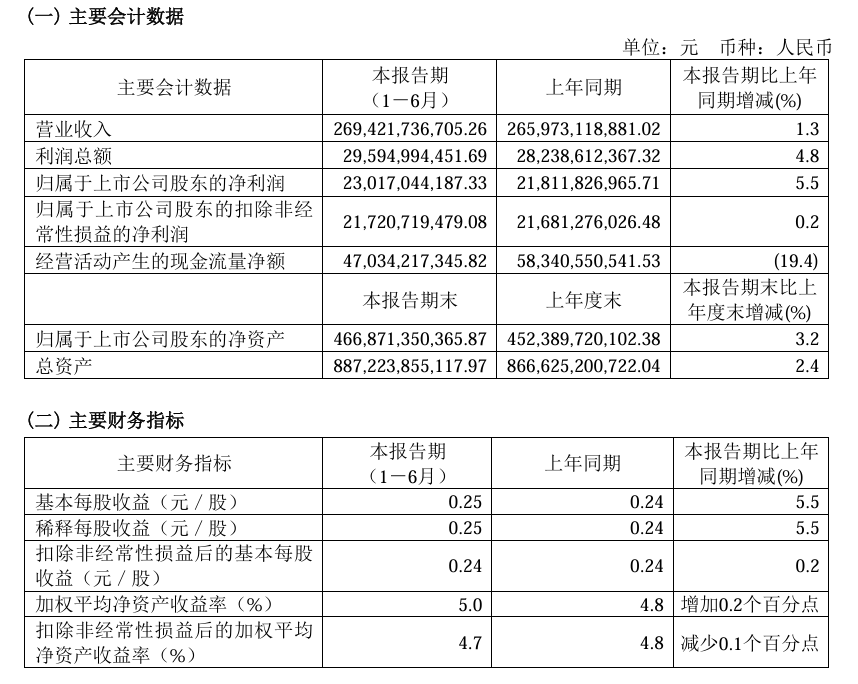
Core Insights - The three major telecom operators in China, China Mobile, China Telecom, and China Unicom, have released their interim reports for 2025, indicating a cautious approach to capital expenditure and a focus on AI and computing investments [1][2][3] Financial Performance - China Telecom reported a revenue of 2694.22 billion yuan for the first half of 2025, a year-on-year increase of 1.3%, with a net profit of 230.17 billion yuan, up 5.5% [3][4] - China Mobile's revenue for the same period was 5437.69 billion yuan, a decrease of 0.5%, marking the first decline in six years, while net profit rose by 5% to 842.35 billion yuan [7] - China Unicom achieved a revenue of 2002 billion yuan, a 1.5% increase, with a net profit of 63.49 billion yuan, up 5.1% [7] Dividend Distribution - The three operators plan a total interim dividend of approximately 742.56 billion yuan, with China Telecom distributing 165.8 billion yuan, China Mobile approximately 541.99 billion yuan, and China Unicom about 34.77 billion yuan [2][6][7] Business Transformation - The telecom operators are accelerating their business transformation, focusing on enterprise markets and new business areas due to saturation in the personal market [3][8] - China Telecom's mobile communication service revenue reached 1066 billion yuan, a 1.3% increase, while its digital industrial revenue grew to 749 billion yuan, with AI-related services showing significant growth [6][9] Capital Expenditure Plans - China Mobile's capital expenditure for the first half of 2025 was 584 billion yuan, down 8.75%, with a full-year plan of 1512 billion yuan, focusing on AI and computing [10][11] - China Telecom's capital expenditure was 342 billion yuan, a 27% decrease, with a full-year plan of 836 billion yuan, emphasizing AI infrastructure [12][13] - China Unicom's capital expenditure for the first half was 202 billion yuan, down 15%, with a full-year estimate of 550 billion yuan, shifting focus towards AI and cloud investments [14] AI and Computing Focus - All three operators highlighted the importance of AI in their business strategies, with China Mobile reporting that 75% of its incremental revenue from cloud services was driven by AI [8] - China Telecom is transitioning its strategy to fully embrace AI, enhancing its service offerings to meet diverse customer needs [9]

三大运营商 拟中期分红逾740亿元
Zhong Guo Zheng Quan Bao· 2025-08-14 15:38
Core Insights - The three major telecom operators in China, China Mobile, China Telecom, and China Unicom, have released their interim reports for 2025, indicating a cautious approach to capital expenditure and a focus on AI and computing investments [1][2][3] Financial Performance - China Telecom reported a revenue of 2694.22 billion yuan for the first half of 2025, a year-on-year increase of 1.3%, with a net profit of 230.17 billion yuan, up 5.5% [3][4] - China Mobile's revenue for the same period was 5437.69 billion yuan, a decline of 0.5%, marking the first revenue drop in six years, while net profit rose by 5% to 842.35 billion yuan [8] - China Unicom achieved a revenue of 2002 billion yuan, a 1.5% increase, with a net profit of 63.49 billion yuan, up 5.1% [8] Dividend Distribution - The three operators plan a total interim dividend of approximately 742.56 billion yuan, with China Telecom distributing 165.8 billion yuan, China Mobile approximately 541.99 billion yuan, and China Unicom about 34.77 billion yuan [2][7][8] Business Transformation - The telecom operators are accelerating their business transformation, focusing on enterprise markets and new business areas due to saturation in the personal market [3][9] - China Telecom's mobile communication service revenue reached 1066 billion yuan, a 1.3% increase, while its digitalization revenue grew to 749 billion yuan, with AI-related services showing significant growth [7][10] Capital Expenditure Plans - China Mobile's capital expenditure for the first half of 2025 was 584 billion yuan, down 8.75%, with a full-year plan of 1512 billion yuan, focusing on AI and computing [11][12] - China Telecom's capital expenditure was 342 billion yuan, a 27% decrease, with a full-year plan of 836 billion yuan, emphasizing AI infrastructure [13][14] - China Unicom's capital expenditure for the first half was 202 billion yuan, down 15%, with a full-year estimate of 550 billion yuan, shifting focus towards AI and cloud investments [15] AI and Computing Focus - All three operators highlighted the importance of AI in their business strategies, with China Mobile reporting that 75% of its cloud revenue growth was driven by AI [9][11] - China Unicom plans to enhance its AI infrastructure and services, while China Telecom is transitioning to a strategy that fully embraces AI [10][14]
全球算力前茅!中国凭啥坐稳世界第二把交椅?
Sou Hu Cai Jing· 2025-08-14 15:26
Core Insights - The article discusses the significance of computing power as a new form of productivity, likening it to "digital electricity" that integrates computing, networking, and storage [2][3] - The "Computing Power Interconnection Action Plan" aims to create a national computing network, enhancing resource integration and standardization, which is a competitive advantage for China compared to the U.S. [5][6] Group 1: Market Overview - The software revenue is projected to increase by 80% from 2020 to 2024, with over 10,000 smart factories covering 80% of major manufacturing categories, indicating that computing power is becoming a new engine for economic growth [5] - The Chinese computing power market is expected to reach 307.5 billion yuan by 2027, with every 1 yuan invested generating 3-4 yuan in economic growth [6] Group 2: Infrastructure Development - China Mobile is a key player with over 1 million computing servers and a computing scale exceeding 43 EFLOPS, accounting for one-sixth of the national resources [9] - The Sichuan computing center is a critical node in the "East Data West Computing" strategy, providing significant resources for large model training and intelligent services [11][12] Group 3: Competitive Landscape - China Unicom operates four smart computing centers with a total computing scale of 30 EFLOPS and has implemented a fully domestic platform supporting various local chips and models [14][15] - China Telecom has developed a cloud-intelligent layout with a computing scale of 21 EFLOPS and has integrated multiple partners into its platform [17][19] Group 4: Strategic Implications - The national computing network led by the three major telecom operators addresses the issue of resource dispersion and reduces computing costs for businesses, enhancing the overall efficiency of resource utilization [21] - The total computing power in China is currently at 280 EFLOPS, narrowing the gap with the U.S., and the competition in computing power is seen as a contest of ecosystems and layouts [21]
中证香港内地股50指数下跌0.26%,前十大权重包含美团-W等
Jin Rong Jie· 2025-08-14 14:01
Group 1 - The core index, the China Securities Hong Kong Mainland Stock 50 Index, experienced a decline of 0.26% to 3002.62 points, with a trading volume of 103.38 billion yuan on August 14 [1] - Over the past month, the index has increased by 5.59%, by 7.99% over the last three months, and has risen by 24.33% year-to-date [1] - The index is designed to reflect the overall performance of Chinese concept securities listed on global exchanges, with a base date of December 31, 2004, and a base point of 1000.0 [1] Group 2 - The top ten weighted stocks in the index include Tencent Holdings (10.93%), Alibaba-W (9.96%), Xiaomi Group-W (7.11%), and others, with a total market share of these stocks contributing significantly to the index [1] - The index's holdings are entirely composed of stocks listed on the Hong Kong Stock Exchange, indicating a focused investment strategy [1] Group 3 - The industry composition of the index shows that consumer discretionary accounts for 31.60%, communication services for 21.93%, and financials for 21.62%, among other sectors [2] - The index undergoes adjustments every six months, with sample adjustments occurring on the second Friday of June and December, allowing for a maximum sample change of 10% [3] - A buffer zone is established for the index adjustments, prioritizing new samples ranked in the top 40 and retaining old samples ranked in the top 60 [3]




中国三大电信运营商公布中期业绩:前沿科技布局蹄疾步稳
Zhong Guo Xin Wen Wang· 2025-08-14 13:59
Group 1: Financial Performance - The three major telecom operators in China reported growth in net profits for the first half of 2025, with China Telecom's operating revenue at 271.5 billion RMB, a 1.3% increase year-on-year, and a net profit of 23 billion RMB, up 5.5% [1] - China Unicom's operating revenue exceeded 200 billion RMB, with a total profit of 17.7 billion RMB, reflecting a 5.2% year-on-year growth, and a net profit of 6.349 billion RMB, up 5.1% [1] - China Mobile achieved operating revenue of 543.8 billion RMB, with communication service revenue at 467 billion RMB, a 0.7% increase, and a net profit of 84.235 billion RMB, up 5.0% [1] Group 2: Technological Advancements - The three telecom operators are accelerating their layout in frontier technology fields, with China Telecom's strategic emerging business revenue growing rapidly, including Tianyi Cloud revenue of 57.3 billion RMB and intelligent revenue of 6.3 billion RMB, up 89.4% year-on-year [2] - China Mobile is enhancing AI innovation and application, with over 60 million monthly active users for its Lingxi intelligent agent and a new upgrade of its MoMA service engine [2] - China Unicom's cloud revenue reached 37.6 billion RMB, with data center revenue growing by 9.4% to 14.4 billion RMB, reflecting strong demand for intelligent services in various sectors [2] Group 3: Future Opportunities - The telecom operators emphasize the importance of seizing opportunities in the digital intelligence era, with China Telecom focusing on optimizing quantum products and promoting AI applications across various industries [3] - China Mobile plans to deepen reforms and enhance its capabilities in technology innovation and integration, aiming to release AI scale effects [3] - China Unicom aims to foster a new ecosystem of AI infrastructure and technology through collaboration with partners, with an expected fixed asset investment of around 55 billion RMB for the year [3]


中华交易服务中国香港内地指数下跌0.33%,前十大权重包含美团-W等
Jin Rong Jie· 2025-08-14 13:56
Group 1 - The core index, the CESHKM, experienced a decline of 0.33%, closing at 6880.32 points with a trading volume of 906.03 billion [1] - Over the past month, the CESHKM index has increased by 4.96%, by 7.28% over the last three months, and has risen by 23.32% year-to-date [1] - The CESHKM index is part of a series of indices that reflect the overall performance of large and mid-cap securities listed in Shanghai, Shenzhen, and Hong Kong, with a base date of December 31, 2004, and a base point of 2000.0 [1] Group 2 - The top ten holdings in the CESHKM index include Tencent Holdings (11.02%), Alibaba-W (10.05%), Xiaomi Group-W (7.86%), and others, indicating a concentration in major tech and financial firms [1] - The index is fully composed of stocks listed on the Hong Kong Stock Exchange, with the largest sector being consumer discretionary at 30.46%, followed by communication services at 23.17% and financials at 21.98% [2] - The industry breakdown of the CESHKM index shows a diverse allocation, with technology at 10.63%, energy at 5.98%, and healthcare at 3.08%, among others [2]
中华港股通优选50指数下跌0.28%,前十大权重包含建设银行等
Jin Rong Jie· 2025-08-14 13:56
Group 1 - The core index, the CESP50, experienced a decline of 0.28%, closing at 3170.29 points with a trading volume of 932.59 billion [1] - Over the past month, the CESP50 index has increased by 5.33%, by 8.84% over the last three months, and has risen by 26.77% year-to-date [1] - The CESP50 index is designed to reflect the overall performance of the top 50 blue-chip securities listed on the Hong Kong Stock Exchange under the "Hong Kong Stock Connect" program [1] Group 2 - The top ten holdings of the CESP50 index include Tencent Holdings (10.86%), HSBC Holdings (10.2%), Alibaba-W (9.9%), Xiaomi Group-W (6.25%), and others [1] - The index's holdings are entirely composed of securities from the Hong Kong Stock Exchange, with financials making up 39.60%, consumer discretionary 23.52%, and communication services 17.16% [2] - Other sectors represented in the index include information technology (8.46%), energy (3.94%), real estate (3.37%), utilities (1.66%), consumer staples (1.00%), industrials (0.83%), and healthcare (0.45%) [2]