CHINA MOBILE(00941)

Search documents
南向资金 | 中芯国际获净买入4.62亿港元
Di Yi Cai Jing· 2026-01-19 09:50
Group 1 - The net inflow of southbound funds today amounted to 2.292 billion HKD [1] - The top three companies with net inflows were SMIC, Hua Hong Semiconductor, and Tencent Holdings, with net purchases of 462 million HKD, 393 million HKD, and 273 million HKD respectively [1] - On the other hand, China Mobile, UBTECH, and Meituan-W experienced net outflows of 600 million HKD, 517 million HKD, and 287 million HKD respectively [1]


中国移动:专题会商推动“两个责任”同题共答
Zhong Yang Ji Wei Guo Jia Jian Wei Wang Zhan· 2026-01-19 03:17
Core Insights - The article discusses the efforts of the disciplinary inspection team stationed at China Mobile to address formalism and reduce burdens on grassroots levels, emphasizing the importance of political responsibility and effective communication within the organization [1][2]. Group 1: Research and Findings - The disciplinary inspection team conducted a special survey from May to August 2025, involving nine provincial subsidiaries to identify issues related to formalism in the evaluation and inspection processes [2]. - A total of over 5,000 feedback materials were collected through various methods, including written questionnaires and interviews, leading to the identification of nine typical manifestations of formalism [2]. Group 2: Problem Reporting and Recommendations - The inspection team reported issues related to overly complex performance indicators, inadequate use of information technology in inspections, and insufficient coordination in award evaluations [3]. - Recommendations were made to shift management philosophies, focus on precise problem rectification, establish long-term control mechanisms, enhance information technology capabilities, and strengthen supervision [3]. Group 3: Continuous Supervision and Follow-up - The inspection team developed a detailed list of six categories of issues and corresponding recommendations, which were distributed to relevant departments to ensure accountability and effective problem resolution [4]. - Ongoing follow-up and evaluation of the rectification efforts will be conducted, with a focus on establishing a more standardized and effective mechanism for future discussions [4].
争做政企标杆,记山东移动威海乳山分公司“政府行业组”
Qi Lu Wan Bao· 2026-01-19 02:54
Core Insights - The "Government Industry Group" at Shandong Mobile's Weihai Rushan branch is a key driver of high-quality development in the government and enterprise market, focusing on customized services and innovative technologies to enhance competitiveness in sectors like government, finance, education, and healthcare [1] Group 1: Customer-Centric Approach - The team aligns closely with the company's strategic goals, centering on customer needs through a model of "industry deepening + checklist management," effectively addressing the digital upgrade demands of government and enterprise clients [2] - Significant performance breakthroughs have been achieved in key projects such as smart cities, cloud computing, and the Internet of Things [2] Group 2: Professional Collaboration - The team emphasizes capability building and knowledge sharing through mechanisms like "industry special teams" and "project review meetings," continuously enhancing members' expertise in areas like 5G private networks and industrial internet [3] - In a project to build a smart government affairs platform, the team completed design, testing, and deployment in just one week, three days ahead of schedule, earning high praise for their swift response and professional service [3] Group 3: Innovation-Driven Solutions - The team actively implements the company's "innovation-driven" philosophy by proposing optimizations to the "platform + ecosystem" service model, transitioning traditional business assessments to a "solution value contribution" evaluation system [4] - This approach effectively enhances customer loyalty and project implementation efficiency [4] Group 4: Service Empowerment and Responsibility - The team is dedicated to providing high-quality service, demonstrating corporate responsibility and commitment, especially during major events by ensuring round-the-clock communication support [5] - During the pandemic, they established a remote teaching platform for educational institutions, facilitating continuous learning despite school closures [5] - The team also conducts regular "digital empowerment salons" to assist small and medium-sized enterprises with digital transformation challenges, receiving widespread acclaim for their efforts [5]
中国移动咪咕“微短剧+运动”新作《浙BA篮球火》热血上线
Huan Qiu Wang· 2026-01-19 02:52
Core Viewpoint - The micro-short drama "Zhe BA Basketball Fire" has been launched, aiming to integrate grassroots basketball culture with workplace challenges and youth passion, thereby promoting public fitness and sports culture in Zhejiang province [1][3]. Group 1: Storyline and Themes - The drama centers on a designer named Lu Ran, who, after facing career setbacks, forms a grassroots basketball team called "Majia Bang" composed of ordinary individuals from various professions [3]. - The narrative highlights the journey of the team as they face internal conflicts, injuries, and rival challenges, ultimately achieving victory in the finals with a last-second shot [3][5]. - Themes of teamwork, mutual support, and the positive values of perseverance and passion for sports are emphasized throughout the series [5]. Group 2: Production Quality and Authenticity - The production team has made extensive preparations to authentically depict the competitive nature of basketball, ensuring that key actions and strategies are accurately represented [6]. - The series pays homage to the Zhe BA event, aiming to capture the spirit of grassroots players and the vibrant atmosphere of community sports [7]. Group 3: Innovation in Sports Culture - "Zhe BA Basketball Fire" represents a significant attempt by Migu Digital Media in the "micro-short drama + sports" genre, continuing the trend of combining local culture with sports narratives [9]. - The show aims to illustrate the positive impact of sports on the lives of ordinary people, marking the beginning of an inspiring journey in grassroots basketball [9].


智通港股通持股解析|1月19日





智通财经网· 2026-01-19 00:33
Group 1 - The top three companies by Hong Kong Stock Connect holding ratios are China Telecom (00728) at 71.06%, Green Power Environmental (01330) at 69.52%, and Kaisa Group Holdings (01108) at 67.54% [1][2] - The largest increases in holding amounts over the last five trading days were seen in Tencent Holdings (00700) with an increase of 46.95 billion, Kuaishou-W (01024) with 27.09 billion, and Alibaba-W (09988) with 24.49 billion [1][2] - The largest decreases in holding amounts over the last five trading days were recorded for China Mobile (00941) with a decrease of 24.84 billion, SMIC (00981) with 11.19 billion, and Meituan-W (03690) with 9.48 billion [1][3] Group 2 - The latest holding ratios for the top 20 companies in Hong Kong Stock Connect show that China Telecom has 9.862 billion shares, Green Power Environmental has 0.281 billion shares, and Kaisa Group Holdings has 0.169 billion shares [2] - The top 10 companies with the largest increases in holdings over the last five trading days include Alibaba Health (00241) with an increase of 17.20 billion and China Life (02628) with 16.38 billion [2] - The top 10 companies with the largest decreases in holdings over the last five trading days include China Aluminum (02600) with a decrease of 7.88 billion and Hang Seng Bank (00011) with 6.50 billion [3]
智通港股通资金流向统计(T+2)|1月19日
智通财经网· 2026-01-18 23:34
Group 1 - Tencent Holdings (00700), Alibaba Health (00241), and Alibaba Group-W (09988) ranked the top three in net inflow of southbound funds, with net inflows of 2.012 billion, 1.440 billion, and 1.128 billion respectively [1][2] - China Mobile (00941), Haidilao (06862), and China Aluminum (02600) ranked the top three in net outflow of southbound funds, with net outflows of -756 million, -460 million, and -434 million respectively [1][2] - Shenzhen Expressway (00548), Jiangsu Nanjing-Hangzhou Expressway (00177), and Anhui Wanan Expressway (00995) had the highest net inflow ratios at 73.29%, 68.10%, and 64.90% respectively [1][3] Group 2 - The top ten stocks by net inflow included Tencent Holdings (20.12 billion), Alibaba Health (14.40 billion), and Alibaba Group-W (11.28 billion), with respective closing prices of 633.000 (+0.88%), 7.780 (+18.96%), and 169.000 (+5.69%) [2] - The top ten stocks by net outflow included China Mobile (-7.56 billion), Haidilao (-4.60 billion), and China Aluminum (-4.34 billion), with respective closing prices of 80.800 (-0.19%), 15.740 (+9.15%), and 13.440 (-1.18%) [2] - The top three stocks by net outflow ratio were Industrial Bank of China Southern (03167) at -100.00%, Yancoal Australia (03668) at -62.10%, and Zhengzhou Bank (06196) at -60.19% [3]


2025年1-11月中国移动通信手持机(手机)产量为13.9亿台 累计下降5.5%
Chan Ye Xin Xi Wang· 2026-01-17 23:58
Core Insights - The production of mobile communication handsets (smartphones) in China for November 2025 is projected to be 140 million units, representing a year-on-year decline of 11.6% [1] - Cumulatively, from January to November 2025, the total production of mobile communication handsets in China is 1.39 billion units, which reflects a decrease of 5.5% compared to the previous year [1] Group 1 - The November 2025 smartphone production forecast indicates a significant decline in output [1] - The cumulative production data for the first eleven months of 2025 shows a downward trend in the mobile handset market [1]

国资委公开80多家央企负责人薪酬
Sou Hu Cai Jing· 2026-01-17 13:14
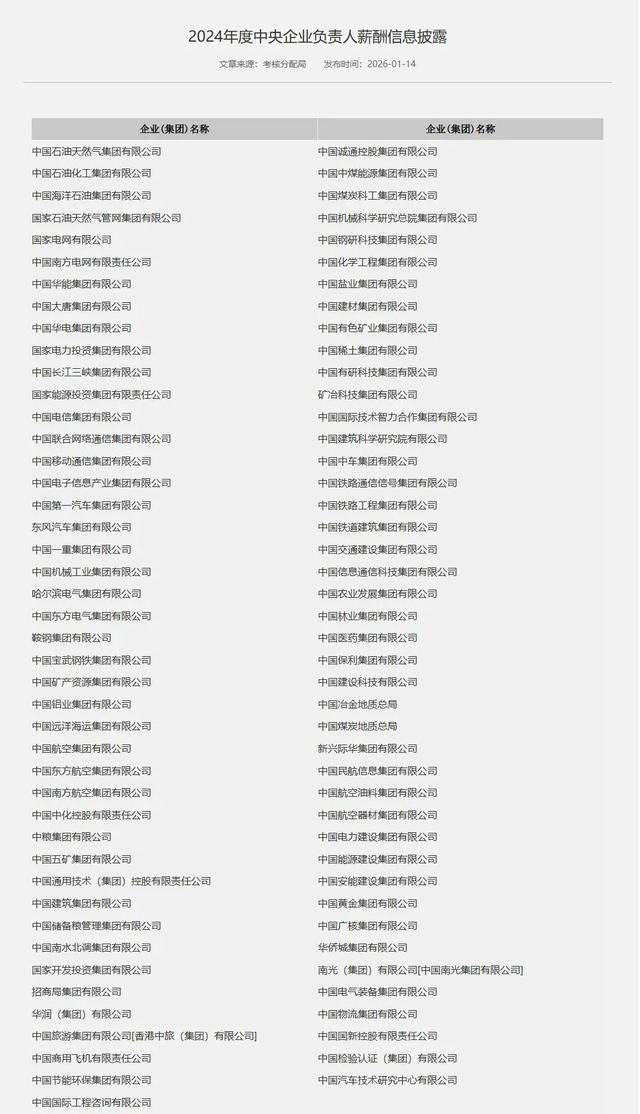
Core Viewpoint - The State-owned Assets Supervision and Administration Commission (SASAC) disclosed the salary information of over 80 central enterprise leaders for the year 2024, indicating a stable salary range without extreme high salaries, showcasing significant industry differentiation [1][5]. Group 1: Salary Disclosure - The disclosure of salary information is part of SASAC's ongoing efforts to enhance transparency in key areas and respond to public concerns [2]. - The overall salary of central enterprise leaders in 2024 remains within a stable range, characterized by "top leaders leading, median concentration, and low compliance," with no extreme high salary phenomena observed [5]. Group 2: Salary Rankings - The top tier of salaries is dominated by leaders from telecommunications and energy central enterprises, with China Mobile's former chairman Yang Jie leading with a pre-tax salary of 1.2582 million yuan, followed by China Telecom and China Unicom chairmen with salaries of 1.2160 million yuan and 1.2101 million yuan respectively [6]. - In the energy sector, PetroChina's chairman Dai Houliang and general manager Hou Qijun both have an annual salary of 978,500 yuan, ranking first among energy central enterprises [7]. - Other notable salaries include China Huaneng Group's chairman Wen Shugang at 961,700 yuan and State Power Investment Corporation's chairman Yu Bing at 953,700 yuan, both of whom are also in the top tier [8]. Group 3: Salary Distribution - The second tier includes core central enterprises in electricity, construction, and automotive industries, with notable figures such as State Grid's chairman Zhang Zhigang earning 735,000 yuan and China National Nuclear Corporation's chairman Yang Changli earning 930,000 yuan [15]. - The third tier consists of central enterprises with strong public welfare attributes, such as China Forestry Group's chairman Shan Zhongli and Overseas Chinese Town Group's chairman Zhang Zhenggao, both earning 438,500 yuan, which is below the average level for central enterprises [16]. Group 4: Salary Variability - Within the same industry, the salary differences among central enterprise executives are manageable, with the highest annual salary for energy central enterprise chairmen (PetroChina at 978,500 yuan) and the lowest (National Pipeline Network at 872,900 yuan) showing a difference of about 100,000 yuan [20].



80多家央企“一把手”2024年年薪披露:最高近百万元, 能源通信行业居前
Hua Xia Shi Bao· 2026-01-17 05:17
Core Viewpoint - The recent disclosure of salary information for over 80 central enterprises by the State-owned Assets Supervision and Administration Commission (SASAC) highlights the structure, level, and distribution of executive compensation, reflecting a commitment to transparency and accountability in state-owned enterprises [2][3]. Salary Structure and Distribution - The highest annual salary for a central enterprise leader in 2024 is 978,500 yuan, held by the chairman of PetroChina, Dai Houliang, followed closely by the former chairman of China Mobile at 972,100 yuan and the former chairman of CNOOC at 966,900 yuan, all from the energy and communication sectors [3]. - Overall, the salary distribution among central enterprise leaders shows a clear stratification, closely related to the industry characteristics and operational challenges, with energy and communication sectors leading in compensation [4]. - Leaders of energy and power central enterprises, such as Huaneng Group and China Southern Power Grid, have salaries exceeding 950,000 yuan, while those in construction, manufacturing, and logistics typically earn between 600,000 and 950,000 yuan, and those in public service sectors earn between 400,000 and 600,000 yuan [3][4]. Industry Differences - There are significant salary disparities among central enterprises based on industry, with energy and communication sectors commanding higher salaries due to their monopolistic nature and substantial impact on the national economy, while sectors like forestry and pharmaceuticals, which focus on social welfare, tend to have lower compensation levels [4]. - Some central enterprises involved in overseas operations, such as China Resources Group, have additional overseas allowances that increase their overall compensation, with the highest total compensation reaching 1,351,200 yuan [4]. Salary Reform and Mechanism - The salary structure for central enterprise leaders consists of a basic salary, performance-based salary, and long-term incentive income, with performance evaluations directly influencing compensation [5][9]. - The 2024 salary determination aligns with the SASAC's performance reform direction, ensuring that compensation is closely tied to performance, with a significant portion of salaries being variable based on performance outcomes [9][10]. - The mechanism for salary determination includes comprehensive assessments of various factors, including safety, social responsibility, and innovation, with penalties for significant operational failures [10]. Transparency and Accountability - The recent salary disclosure is part of ongoing efforts to enhance transparency and accountability in central enterprises, with detailed public reporting of executive names, positions, salaries, and benefits [10]. - To improve public trust, it is suggested that the disclosure should also include the rationale behind salary structures and performance evaluations, not just the figures [10].


陆家嘴财经早餐2026年1月17日星期六
Wind万得· 2026-01-16 23:51
Group 1 - The China Securities Regulatory Commission (CSRC) emphasized maintaining market stability and enhancing monitoring and regulation to prevent excessive speculation and market manipulation [3] - Canada and China reached a consensus on deepening economic and trade cooperation, signing the "China-Canada Economic and Trade Cooperation Roadmap," which includes an annual quota of 49,000 electric vehicles from China with a 6.1% most-favored-nation tariff [3] Group 2 - The State Council of China is focusing on boosting consumption and has outlined measures to clear overdue payments to businesses and ensure wage payments to migrant workers [4] - The Ministry of Commerce announced stronger support for green and smart product consumption through a recycling program for consumer goods [4] Group 3 - The State-owned Assets Supervision and Administration Commission (SASAC) is working on optimizing the layout and structure of state-owned enterprises, focusing on enhancing core business strengths [5] - The Market Supervision Administration has introduced new guidelines for recognizing illegal gains in market regulation, effective from March 20 [5] Group 4 - The A-share market experienced fluctuations, with the Shanghai Composite Index closing at 4,101.91 points, down 0.26%, while the Shenzhen Component Index and the ChiNext Index also saw slight declines [6] - The Hong Kong stock market showed mixed results, with the Hang Seng Index closing down 0.29% but showing a weekly gain of 2.34% [7] Group 5 - The Ministry of Housing and Urban-Rural Development highlighted significant investment opportunities in urban renewal projects during the 14th Five-Year Plan period [11] - The Ministry of Finance extended tax incentives for public rental housing, exempting certain taxes to promote construction [11] Group 6 - The China Automotive Power Battery Industry Innovation Alliance reported a 60.1% year-on-year increase in the cumulative production of power and energy storage batteries in 2025 [12] - The China Securities Association announced new rules allowing certain individual investors to redeem public pension fund shares early under specific conditions [12] Group 7 - The U.S. Federal Reserve officials indicated that current monetary policy remains moderately restrictive, with potential adjustments depending on labor market conditions [15][16] - The U.S. Senate approved funding for federal research institutions, rejecting previous budget cuts proposed by the Trump administration [16] Group 8 - The Chinese bond market showed signs of warming, with yields generally declining and the central bank conducting a net injection of liquidity [20] - Barclays analysts forecast a total issuance of U.S. corporate bonds to reach $2.46 trillion in 2026, marking an 11.8% increase year-on-year [20]